AI Voiceover for Demos: 6 Steps, WCAG Access, U.S. Legal Checks

The best approach is to combine a modern AI voice with a pronunciation editor, a timed script built around your screen actions, and one fine-tuning pass for pacing and emotion before you export. Pair that with synchronized captions, a standalone transcript, and documented consent for any cloned voice, and you get narration that sounds professional and holds up to scrutiny.
TL;DR:
- Write scripts for speech, name interface elements explicitly, and leave two to three second gaps for screen changes or audio description; test pronunciation before generation.
- Export narration separately to adjust individual lines; keep captions within about 0.5 seconds and provide a transcript outside the player.
- The U.S. Copyright Office says entirely AI created work is not copyrightable; human contributions affect protection, and commercial voice cloning requires written consent.
- Choose AI for frequent updates, localized versions, or consistent branding; hire a human when a demo relies on a recognizable spokesperson or authentic emotional performance.
Table of Contents
- Why AI voiceover is the right choice for product and software demos
- Step-by-step workflow: script, mark timing, generate voice, sync, polish, export
- How to pick and tune an AI voice that sounds professional for demos
- Accessibility and legal essentials for demo voiceovers
- Quick fixes for common AI narration quality issues
- TrailerCast’s approach to demo narration and trailers
- When to choose AI voiceover and when to hire a human narrator for demos
- Try TrailerCast to generate branded demo trailers with AI narration
- FAQ
- Sources
Why AI voiceover is the right choice for product and software demos
If you’ve ever re-recorded a demo narration three times because a feature name changed, you already know the pain of human voiceover cycles. AI narration fixes that math.
- Speed: regenerating a line costs minutes, not a studio booking.
- Consistency: every demo variant keeps the same tone, so your brand sounds like one voice across a dozen videos.
- Scale: you can produce stakeholder-specific trims (one for a CFO, one for a security lead) and multilingual versions without re-hiring talent for each language.
- Comprehension: clear, paced narration keeps viewers oriented through UI changes, which matters most in screen recordings where visual context shifts fast.
None of this means quality is automatic. A rushed AI voiceover sounds just as robotic as a cheap text-to-speech demo from a decade ago. The difference between forgettable and polished comes down to the workflow you follow before you hit export, not the model you pick.
Step-by-step workflow: script, mark timing, generate voice, sync, polish, export
A demo voiceover lives or dies on preparation, not on the generation step itself. Here’s the sequence that produces a clean result on the first real attempt.
- Write for speech, not for reading. Use short sentences, name UI elements explicitly (“click the Export button”), and avoid clauses that only make sense on a page.
- Mark pause slots in the script. Build in 2 to 3 second gaps wherever the screen changes or where an audio description needs room, a habit that saves hours later.
- Generate a short test clip first. Run one or two lines through the voice engine to check pronunciation and emotional tone before committing to the full script.
- Generate the full narration as a separate audio stem, never burned directly into the video file.
- Sync and micro-adjust in your editor. Nudge timing on individual lines rather than re-rendering the whole voice track.
- Produce a WebVTT caption file and a standalone transcript, then do one human listen pass before export.
Pro Tip: Keep your script, caption file, and transcript as three separate documents. When you update one line, you update three files, not a buried subtitle track.
This order matters because fixing a mispronounced product name after full generation means regenerating everything. Catching it on a two-line test clip costs you thirty seconds.

How to pick and tune an AI voice that sounds professional for demos
The right voice depends on what the demo is for. A troubleshooting walkthrough needs a calmer, slower persona than a sales pitch trailer meant to build urgency.
- Match persona to purpose: educational demos favor neutral, steady voices; sales-facing trailers tolerate more energy and emphasis.
- Use a pronunciation editor for product names, acronyms, and domain jargon rather than hoping the engine guesses right.
- Insert micro-pauses where the screen cuts or a new panel opens, so narration never talks over a visual change the viewer hasn’t processed yet.
- Apply emotion or emphasis tags sparingly, only on the one or two statements that need to land harder.
Field guidance on accessible audio description production notes that AI text-to-speech systems still struggle with complex jargon and emotional nuance in long-form narration, and that pronunciation editors and emotion tags materially improve the output. Tuning these controls on a short test clip before full generation is still the fastest way to catch problems early.
Accessibility and legal essentials for demo voiceovers
Accessibility isn’t a bonus feature on a demo video. Under WCAG 2.1 Level AA, synchronized captions (Success Criterion 1.2.2) and audio description (Success Criterion 1.2.5) are required whenever visuals convey information the narration doesn’t say out loud, according to UC San Diego’s accessibility guidance.
- Keep captions synchronized within about 0.5 seconds of the spoken audio wherever possible.
- Provide a separate transcript outside the video player, not just an embedded caption track, a practice echoed in accessibility guidance from the University of North Dakota.
- Disclose AI-generated material when it exceeds a de minimis amount. As of July 2025, the U.S. Copyright Office states that content created entirely by AI isn’t copyrightable, and human contributions can affect how much protection applies.
- Before cloning anyone’s voice for commercial use, obtain explicit written consent and archive that license. A platform’s “commercial use” label is not a substitute for permission, a point the FTC’s 2024 statement on AI voice cloning makes directly.
Quick fixes for common AI narration quality issues
Most narration problems trace back to three culprits: pronunciation, pacing, and timing drift. Each has a fast fix.
- Mispronounced names or acronyms: use phonetic respellings or a pronunciation editor rather than regenerating the whole line.
- Rushed or robotic delivery: split long sentences into shorter ones and insert micro-pauses between clauses.
- Narration drifting out of sync with the screen: export the voice as a separate audio stem so you can nudge timing in your editor instead of re-rendering the video.
- Flat or wrong emotional tone: swap long emotional monologues for shorter, individually tagged phrases.
Pro Tip: When a single word keeps breaking, isolate it in its own test clip. Fixing one word in a 90-second render is a search-and-replace problem, not a re-record.
TrailerCast’s approach to demo narration and trailers
We built TrailerCast around the idea that a demo recording shouldn’t require a separate editing pass to become something worth forwarding. Our platform auto-edits demo trailers from real sales calls, picking the 8 to 15 minutes that mattered and stitching them into a branded trailer with optional narration in a cloned voice across 15 or more languages.
- We capture the source recording through built-in conversation intelligence or browser-based recording with no install required.
- Narration timing lines up automatically with the highlights our AI selects, so you’re not manually syncing audio to cuts.
- Decision Rooms let your champion forward stakeholder-specific trailers, each with an embedded transcript and engagement tracking, so you can see who watched what.
- One plan includes every feature, starting at a monthly subscription price per seat, billed annually, with a free trial to test the workflow before committing.
When to choose AI voiceover and when to hire a human narrator for demos
AI voiceover wins when you need speed: many localized variants, frequent script updates, or consistent branding across a library of demos. It also wins when budget realistically rules out a studio session for every version.
Hire a human narrator when the demo depends on authenticity a synthetic voice can’t fake, a recognizable spokesperson, or a performance with real emotional range, like a customer testimonial reenactment; alternatively, explore advanced options in AI Avatars & Voice Cloning for broader voice-cloning services. For most sales demos, though, where personalization per stakeholder and engagement tracking matter more than performance nuance, an AI-edited trailer platform gets you both speed and polish in one pass.
— Daniel
Try TrailerCast to generate branded demo trailers with AI narration
We give you one workspace that turns a raw screen recording or sales call into a branded trailer with optional AI narration, synced captions, and a transcript ready to forward. No separate editing tool, no studio booking, no stitching five apps together to get a demo your champion will actually send up the chain.
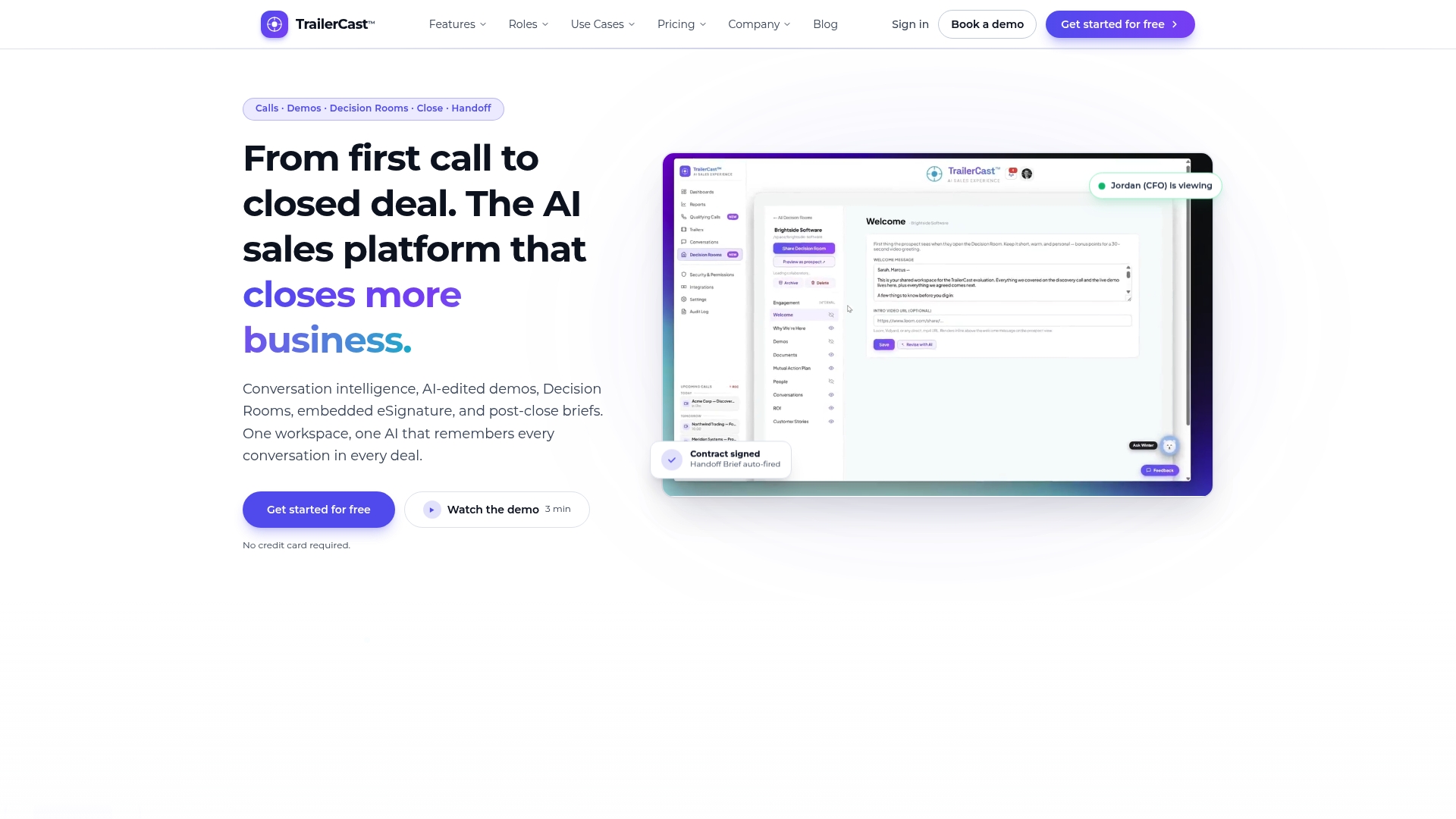
- Upload a recording or capture one through our browser recorder and get an automatic trailer back, highlights already selected.
- Add narration in a cloned voice across 15 or more languages, or keep the original audio.
- Share it through a Decision Room and watch exactly who presses play.
Start a free trial and see your first trailer before your next call.
FAQ
What’s the best AI voiceover tool for demo videos?
The right tool depends on your workflow: look for pronunciation editors, exportable audio stems, and support for emotion or emphasis tags rather than just a flat text-to-speech option. For sales demos specifically, a platform that generates narration as part of an auto-edited trailer saves the extra step of syncing audio to a separately recorded video.
Is it legal to use a cloned voice in a demo video?
It depends on consent and jurisdiction. The FTC’s 2024 statement warns that a platform’s commercial-use license doesn’t replace explicit permission from the person whose voice is cloned, and court cases like Lehrman v. Lovo show state right-of-publicity claims can proceed even when federal copyright claims don’t.
Do AI-narrated demos need captions?
Yes. Under WCAG 2.1 Level AA, synchronized captions are required, and audio description is also required when visuals convey information the narration doesn’t state out loud, per UC San Diego’s accessibility guidance. Keep captions synchronized within about 0.5 seconds and provide a separate transcript outside the video player.
How much does TrailerCast cost for demo trailers with AI narration?
TrailerCast runs one plan with every feature included, starting at a monthly subscription price per seat, billed annually, with a free trial and no credit card required to start.
How do I fix mispronounced product names in AI narration?
Use a pronunciation editor or phonetic respelling for the specific word rather than regenerating the entire script. Testing a short clip before full generation catches most pronunciation issues early, and a final human listen pass catches whatever slips through.