30/60/90 Day Data Privacy Playbook for B2B Sales Calls

Recording a B2B sales call is fine only when you have a documented lawful basis, real notice to the people on the line, and enforced technical safeguards, encryption, role-based access, and a written retention schedule. If any of those three legs are missing, stop and run a quick inventory of what you record, where it lives, and who can open it. The rest of this guide gives you the 30/60/90 day playbook to close the gaps.
TL;DR:
- Recording sales calls requires documented lawful basis, clear notice, and strict data security measures, including encryption and role-based access control.
- Using legitimate interest is more appropriate than consent for most B2B calls, but it demands a documented balancing test and may require a data protection impact assessment for systematic monitoring.
- Vendors handling call data should provide signed data processing agreements, SOC 2 reports, and enforce deletion controls, with regular re-evaluation at least annually.
- Retain recordings only as long as they serve their specific purpose, using predefined buckets like deal duration for raw data and curated clips for longer retention.
- A unified platform for recording, storage, and deal sharing simplifies compliance, enhances security, and streamlines audits compared to multi-tool setups.
Table of Contents
- What Does Data Privacy for Sales Calls Actually Require?
- Consent or Legitimate Interest: Which Legal Basis Fits a B2B Call?
- What Technical Safeguards Do Auditors Expect on a Sales Stack?
- How Long Should You Keep Sales Call Recordings?
- What Should Your Vendor Contracts Require?
- A 30/60/90 Day Plan to Fix Sales Call Privacy Gaps
- How TrailerCast Supports Privacy-Safe Sales Call Workflows
- Privacy as a Deal Accelerant, Not a Blockage
- Get Compliant Recording and Trailer-Ready Deal Rooms in One Workspace
- Where to Verify This Yourself
- Sources
- FAQ
What Does Data Privacy for Sales Calls Actually Require?
Sales leaders ask this after a prospect’s legal team pushes back, or after a CISO on a deal asks a question nobody on the call could answer. The honest response: data privacy for sales calls is not one rule. It’s a stack of decisions, lawful basis, notice, encryption, retention, vendor contracts, that together determine whether your recorded calls hold up under scrutiny.
Here’s the checklist version, the one you can act on before your next call.
- Document lawful basis and purpose for every recording type, and make sure notice appears where participants will actually see it, not buried in a terms page nobody opens.
- Verify encryption in transit and at rest, and confirm someone owns key management. This is not just an IT checkbox.
- Turn on role-based access control and multi-factor authentication, and audit logging. Limit who can export raw transcripts.
- Publish a retention schedule and automate deletion wherever your tooling allows it.
- Update contracts with every transcription and conversation-intelligence vendor, including a data processing agreement and a request for SOC reports.
Pro Tip: Run this checklist against one live deal today, not a hypothetical one. If you can’t answer “who can see this transcript and why” in under thirty seconds, you’ve found your first fix.
Consent or Legitimate Interest: Which Legal Basis Fits a B2B Call?
Most sales leaders reach for “consent” instinctively. It’s the wrong instinct in a lot of B2B contexts. Consent has to be freely given, and when one party controls the deal or the paycheck, that’s a hard standard to meet. A prospect who feels pressure to agree to recording so the deal keeps moving hasn’t given consent that would survive a challenge.
The three bases that actually show up in sales recording:
- Consent works for optional, clearly declinable recording, think an opt-in webinar, not a mandatory discovery call.
- Contractual necessity covers recordings tied directly to delivering or supporting a signed agreement.
- Legitimate interest is the basis most CI tools lean on for standard sales calls, but it requires a documented balancing test weighing your business need against the other party’s expectations. The IAPP’s explainer on audio recording under the GDPR lays out why consent is fragile in exactly this kind of power-imbalanced relationship.
Run a DPIA when monitoring becomes systematic, covers every call by default, or touches sensitive topics like health or financial detail from a stakeholder.
What Technical Safeguards Do Auditors Expect on a Sales Stack?
This is where most RevOps teams get caught flat-footed. A prospect’s security team doesn’t ask about your privacy policy first. They ask about your controls.
- Encryption: TLS for anything moving between systems, AES or an equivalent standard for anything sitting in storage. The FTC treats encryption as a real safeguard, and FTC Safeguards Rule guidance notes that a breach involving properly encrypted data, with the key kept secure, may not trigger the same notification obligations as one involving plaintext.
- Access controls: least privilege by default, separate admin accounts from standard seats, and MFA on anything that touches raw audio or transcripts.
- Auditability: immutable logs on who viewed or exported a transcript, plus redaction options for sensitive fields before a clip gets shared outside the deal team.
- Verification: ask vendors for a SOC 2 report, their encryption configuration, and a short written answer to a basic security checklist before you sign.
FTC enforcement history backs this up directly. Cases like the one against BJ’s Wholesale Club showed that retaining sensitive data longer than needed, combined with weak access controls, is what turns a minor incident into a costly one, according to the FTC’s own guidance on starting with security. Strong authentication and tight internal access show up in nearly every FTC case summary on this topic.
How Long Should You Keep Sales Call Recordings?

Keep only what serves a documented purpose, for only as long as that purpose lasts. That’s the entire principle, and most teams violate it by default because “just in case” feels safer than deleting.
Break retention into buckets instead of one blanket rule:
- Raw audio and full transcripts: shortest window, often tied to deal duration plus a short buffer, unless legal hold applies.
- AI-edited trailers and demo clips: can live longer since they’re curated and stripped of sensitive tangents, but still need an end date.
- Legal hold material: exempted from your standard schedule, but flagged and tracked separately so it doesn’t quietly become permanent.
Write the criteria for each bucket into your privacy documentation, not just an internal wiki. EDPB guidance on video and recording devices recommends storage limitation as a default position, with any extension requiring active justification, not silence. When a data subject request lands, whether that’s a prospect asking what you hold on them or an employee requesting deletion, you need a documented process with a real timeline, not a scramble.
What Should Your Vendor Contracts Require?
Your conversation-intelligence vendor is processing sensitive conversations on your behalf. The contract needs teeth, not boilerplate.
- A signed DPA naming subprocessors, breach notification timelines, and a working deletion API you can actually call.
- Certification requirements, SOC 2 Type II at minimum, requested and reviewed, not assumed.
- Export and archive controls that specify who can pull data out, and whether internal developers have standing access to production transcripts.
- A re-review cadence, annually at minimum, tied to your own security audit schedule, not left to renewal season.
Before you sign anything new, run through the kind of CISO security questions a buyer’s security team would ask you. If your vendor can’t answer them, your prospects will notice.
A 30/60/90 Day Plan to Fix Sales Call Privacy Gaps
You don’t fix this in a week, and trying to will burn goodwill with sales reps who just want to close deals. Sequence it.
- Days 1 to 30: Inventory every place recordings and transcripts live. Tighten default sharing settings. Enforce MFA across the team. Draft real notice language for calls. Sort recordings into retention categories.
- Days 31 to 60: Update DPAs with every vendor touching call data. Turn on deletion automation wherever it exists. Confirm encryption configuration and who owns the keys. Start a DPIA if your monitoring qualifies as systematic.
- Days 61 to 90: Run your first internal audit against the new controls. Train the sales team on notice language and data handling, not just compliance theory. Bake these controls into new-hire onboarding and standard RevOps workflows. Set KPIs, time to fulfill a deletion request, percentage of calls with documented lawful basis, and track them going forward.
Pro Tip: Assign one named owner to each 30-day block. “The team will handle it” is how privacy projects stall at day 45 and never restart.
How TrailerCast Supports Privacy-Safe Sales Call Workflows
A platform built around the full deal lifecycle can carry a lot of this weight structurally, instead of leaving it to a spreadsheet nobody updates.
- Searchable transcripts sit behind role-based access, so a rep can’t pull up a call they weren’t part of by accident.
- Decision Rooms limit sharing to a controlled, no-login space instead of raw recordings flying around over email.
- Enterprise add-ons cover custom DPAs and SSO/SAML for teams that need contract-level guarantees from a vendor.
Full detail on encryption, certifications, and contract terms lives on the TrailerCast security page. Treat any vendor’s security claims, including ours, as a starting point for your own verification, not the final word.
Privacy as a Deal Accelerant, Not a Blockage
Sales leaders tend to treat privacy work as friction added to a deal. The pattern I keep seeing in how deals actually stall is the opposite: a CFO or CISO drops out of a deal cycle not because you recorded a call, but because nobody could answer where that recording went. Get the lawful basis, the notice, and the access controls right up front, and legal review moves faster, not slower. Fewer surprises mean fewer holds.
— Daniel
Get Compliant Recording and Trailer-Ready Deal Rooms in One Workspace
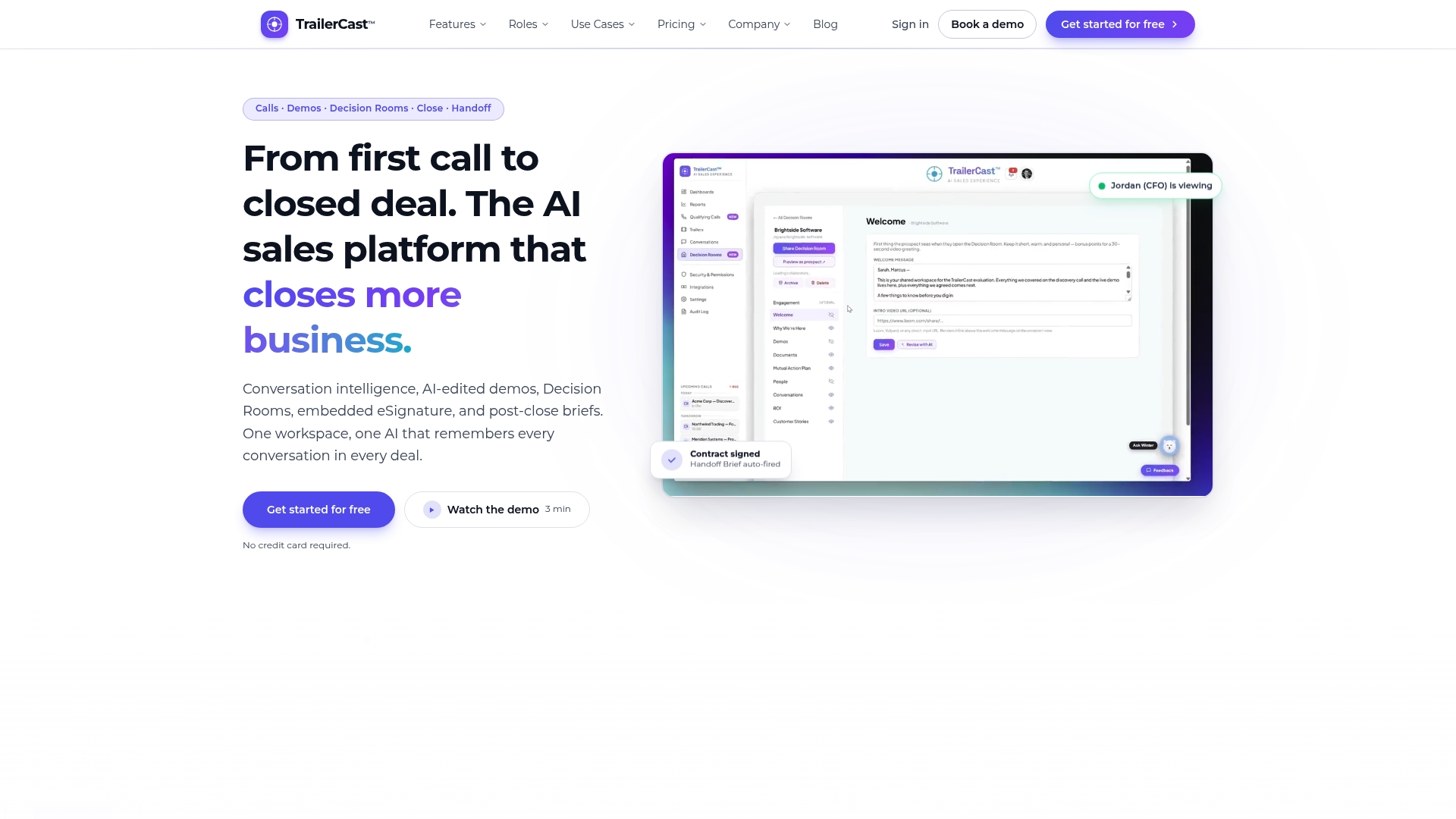
Most teams solve pieces of this checklist with separate tools, one for recording, another for storage, a third for sharing clips with stakeholders, and end up with multiple vendor contracts to audit instead of one. TrailerCast consolidates conversation intelligence, AI-edited trailers, and buyer-facing Decision Rooms into a single workspace, so access controls, retention settings, and audit logs live in one place instead of scattered across multiple systems.
Every plan includes the same feature set, with pricing and details available on the TrailerCast pricing page, along with a free trial and no credit card required. If your team is juggling separate tools for recording, demos, and deal rooms right now, that’s exactly the sprawl this consolidates. Start a trial and run your next multi-stakeholder deal through a single, auditable workspace.
Where to Verify This Yourself
- FTC Safeguards Rule guidance on encryption and access control expectations.
- ICO guidance on monitoring workers, covering proportionality and DPIA triggers.
- IAPP’s explainer on audio recording under the GDPR for the consent versus legitimate interest question.
Sources
- FTC Safeguards Rule: What your business needs to know
- Start with security (FTC guidance / case lessons)
- ICO: Specific data protection considerations for different ways or methods of monitoring workers
FAQ
Should I Use Consent or Legitimate Interest for Sales Calls?
Legitimate interest, backed by a documented balancing test, usually fits standard B2B sales calls better than consent. Consent is fragile in relationships with a power imbalance, since it must be freely given, something IAPP’s GDPR audio recording guidance flags directly.
How Long Should Sales Call Recordings Be Retained?
There’s no universal number. The right approach ties retention to purpose, shorter windows for raw audio and full transcripts, longer for curated trailers, with everything documented in a published schedule rather than left indefinite.
What Should I Ask a Conversation-Intelligence Vendor Before Signing?
Ask for a signed DPA, subprocessor list, SOC 2 report, and a working deletion API. The CISO security questions sellers should expect gives you the buyer-side version of this same list to prepare for.
How Do I Respond to a Data Subject Access or Deletion Request?
Confirm the requester’s identity, locate every system holding their data, including transcripts and trailers, and act within the timeline your own privacy documentation commits to. Document the response so you can show it if challenged later.
Does TrailerCast Offer Enterprise Security Features Like SSO or Custom DPAs?
Yes, SSO/SAML, a custom DPA, and other enterprise add-ons are available as add-ons on top of the standard plan. Full detail sits on the TrailerCast security page.