Deal Risk Signals for Sales Managers: Triage 3 to 5 Deals This Week

Deal risk signals are observable behaviors and data points, like stalled activity, missing stakeholders, and shrinking engagement, that predict whether an opportunity will slip. The immediate move is simple: pull your top 3 to 5 at-risk deals this week and act on them, using three sources you already have: CRM activity, call transcripts, and deal-room engagement.
TL;DR:
- A single warning sign is not conclusive, but two or three on one deal warrant intervention, such as adding stakeholders or resolving procurement gaps.
- Score five to seven signals weekly, prioritize stakeholder mix and recent contact over cosmetic CRM fields, and adjust weights for deal size and segment.
- Run a rule based score for at least two full quarters before piloting predictive scoring; models need hundreds of closed deals, clean historical labels, and human review.
- Rank deals by risk score multiplied by deal value, select 3 to 5 for focused attention, and match each with a specific save play.
- Recheck leading indicators after 7 to 14 days; if a deal has not moved after two weeks, change the save play rather than simply waiting.
Table of Contents
- 1. The Warning Signs Worth Tracking Every Week
- 2. Building a Practical Deal Risk Score, From Simple Rules to Predictive Models
- 3. Predictive Indicators and Where to Find Them
- 4. A 48 to 72 Hour Triage Playbook for Managers
- 5. How an Integrated Platform Captures These Signals in Practice
- 6. What Sales Leaders Should Take Away This Week
- Where TrailerCast Fits Into Your Risk Signal Workflow
- FAQ
- Sources
1. The Warning Signs Worth Tracking Every Week
Most pipelines are full of deals that look healthy on paper and are quietly dying underneath. The signals below are the ones we’d scan first, with a triage action attached to each so you’re not just noticing a problem, you’re fixing it.
- Single-threaded contact: only one buyer contact recorded on the deal. Triage: start multi-threaded outreach to at least two more stakeholders this week.
- Stage stagnation: the deal has sat longer than your typical stage median. Triage: pull it into an executive review and re-qualify it honestly.
- Days since last stakeholder contact: silence from the buying committee. Triage: re-engage with content tailored to what that stakeholder cares about.
- Missing procurement, legal, or finance touches on a large deal. Triage: surface the required documents and get a procurement call on the calendar.
- Low demo engagement or no forwarding to other stakeholders. Triage: send a tailored demo recap aimed at the people who weren’t in the room.
- Price or discount friction, especially repeated discount requests. Triage: reframe around ROI and bring in a procurement-specific play.
- Competitor momentum or RFP mentions surfacing in calls or emails. Triage: build a competitive defense plan immediately.
- Conflicting close dates between your forecast and what the buyer has said. Triage: realign the timeline and document a mutual action plan.
- Weak champion behavior: no ownership, no internal forwarding, no initiative. Triage: hand your champion short, easy-to-share artifacts they can push internally.
- Negative sentiment in transcripts, hedging language, or unresolved objections. Triage: address the objection head-on and log the next step in writing.
None of these signals is damning on its own. A quiet week can just be a quiet week. But when two or three stack up on the same deal, that’s when the deal is telling you something your forecast isn’t.
2. Building a Practical Deal Risk Score, From Simple Rules to Predictive Models
You don’t need a data science team to start scoring risk. You need a spreadsheet, five fields, and the discipline to update it weekly.
- Pick five to seven signals from the list above and assign each a point value based on how strongly it predicts a slip.
- Normalize by deal size so a $200,000 enterprise deal and a $5,000 self-serve deal aren’t scored on the same scale.
- Cap the weight of any single factor on large deals, since one missing procurement touch shouldn’t sink an otherwise healthy six-figure opportunity by itself.
- Weight multi-threading and recent stakeholder contact above cosmetic CRM fields. Gartner’s research on deal risk scoring lists stakeholder mix and activity gaps among the standard inputs practitioners monitor, and both tend to carry more predictive weight than fields like “next steps” that get filled in out of habit.
- Refresh the score weekly, not monthly. A risk score that’s three weeks stale is a lagging indicator pretending to be a leading one.
Adjust your weights by segment and deal size: an enterprise deal missing legal review is a bigger red flag than the same gap on a mid-market renewal.
Pro Tip: Run your rule-based score for at least two full quarters before you even think about a predictive model. You need closed-deal history to validate against, and most teams don’t have enough yet.
If you’re sitting on fewer than a few hundred closed deals with consistent field data, a predictive model will mostly learn noise. Once you clear that volume, with clean historical labels and enough lost deals to compare against wins, you can pilot a model, but keep a human review step in place. Gartner flags governance and data-sufficiency questions as the main reasons predictive scoring efforts stall, and that caution holds here too.
3. Predictive Indicators and Where to Find Them
Leading indicators beat lagging ones because they give you time to act before the deal is already gone. A slipped close date is lagging. A champion who stopped forwarding your emails three weeks ago is leading.
Here’s where each signal actually lives:
| Signal | Primary data source |
|---|---|
| Stakeholder count and roles | CRM contact records |
| Sentiment and objections | Call transcripts |
| Content engagement and forwards | Deal-room analytics |
| Document and email opens | Engagement tracking tools |
| Procurement and legal activity | CRM task and milestone fields |
A significant portion of sales pipelines leak deals due to poor qualification, missed follow-up, and lack of shared visibility into buyer signals, according to Harvard Business Review’s analysis of pipeline leakage. That’s the core argument for leading indicators: the fixes HBR recommends are about catching signals early, not explaining losses after the fact.
Keep a short list of canonical fields (last stakeholder contact, stage entry date, document opens, procurement status) and refresh them daily. A risk score built on weekly-stale data is only slightly more useful than a gut feeling.
4. A 48 to 72 Hour Triage Playbook for Managers
Once you have a ranked list, the next question is what to actually do in the next few days.
- Rank by risk score multiplied by deal value, then pick the top 3 to 5 deals your team can realistically work this week.
- Assign a save play to each: multi-threaded outreach for single-threaded deals, a short tailored demo recap for weak champions, a procurement checklist for deals missing legal or finance touches.
- Set an executive outreach cadence for anything stuck in stage stagnation, since a peer-to-peer call often unsticks what email can’t.
- Check leading indicators again after 7 to 14 days: has a new stakeholder joined the thread, did the champion forward anything, did procurement respond.
- Iterate the play if nothing moved. A deal that doesn’t respond to one save play after two weeks usually needs a different one, not more patience.
Pro Tip: Don’t try to save every at-risk deal at once. A manager coaching five deals well beats a manager spreading thin attention across twenty.
5. How an Integrated Platform Captures These Signals in Practice
Running this playbook by hand works, but it means stitching together a call recorder, a CRM, and a deal-room tool and hoping the data lines up. We built TrailerCast because that stitching is where most of these signals get lost.
A few examples of what shows up automatically when the whole deal lives in one workspace:
- Demo trailer forwards reveal whether a champion is actually selling internally or just sitting on your content.
- Champion attribution trees show exactly who shared what with whom, which turns “weak champion” from a guess into a visible gap.
- Engagement heatmaps in the deal room flag which stakeholders have gone quiet before your CRM would ever notice.
- Transcript-derived sentiment surfaces hedging language and unresolved objections the moment a call ends, not weeks later in a QBR.
These signals feed straight into a save play: a sales rep saw a CFO trailer sit unopened for ten days, flagged it, and the team pivoted to a direct outreach play instead of waiting on the champion, as described in our attribution-in-deal-cycles pilot. Transcript analysis always runs under standard confidentiality and data governance practices, since call content is sensitive regardless of what platform touches it.
6. What Sales Leaders Should Take Away This Week

The deals that slip rarely do it quietly. They send signals for weeks before they die, and the job is to notice them before the forecast does.
Three moves to run now: rank your pipeline by risk score, assign a save play to your top five, and recheck signals in two weeks.
— Daniel
Where TrailerCast Fits Into Your Risk Signal Workflow
If you’re tired of pulling signals from four different tools before you can even build a risk score, that’s the exact gap we built TrailerCast to close. Conversation intelligence, demo trailers, and deal-room engagement data all live in one workspace, so the signals in this article show up without someone manually stitching a CRM export to a call recording.
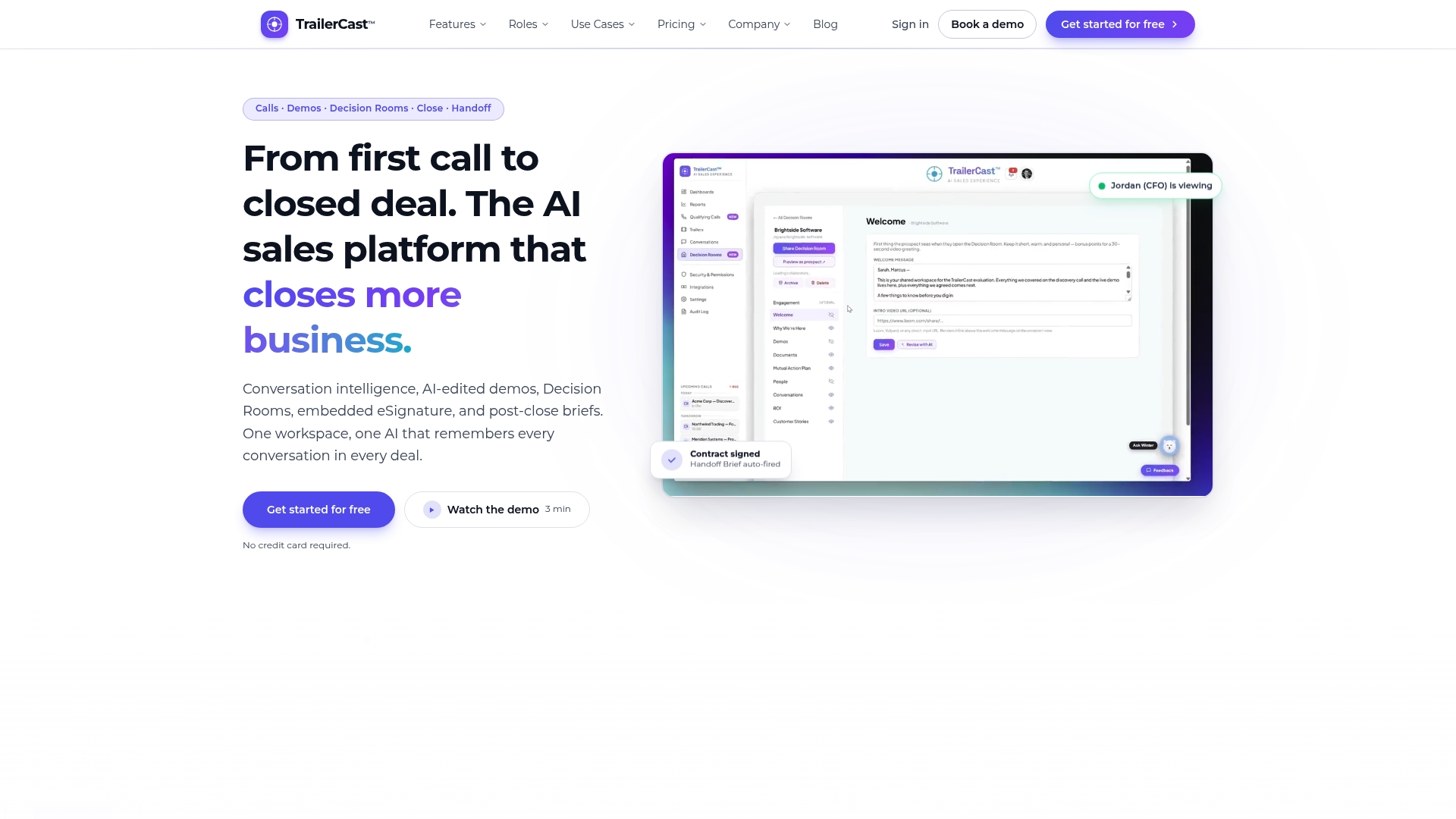
What that looks like in practice:
- Transcripts and sentiment flag weak champion behavior the moment a call ends.
- Deal-room engagement heatmaps show exactly who’s gone quiet, and who’s reading what you send.
- Demo trailers give your champion something forwardable, so multi-threading stops depending on their memory.
Explore the AI sales tool to see how the workspace handles scoring and triage in one place; current pricing details are available on the pricing page.
FAQ
How should I deal with a deal risk once I spot it?
Match the risk to a specific save play instead of a generic follow-up: single-threaded deals need multi-threaded outreach, stalled deals need an executive review, and quiet champions need short, forwardable content. Recheck leading indicators after 7 to 14 days to see if the play worked before trying another one.
What are buying signals, and how do they differ from risk signals?
Buying signals are positive indicators, like a prospect asking about implementation timelines or looping in procurement early, that suggest forward momentum. Risk signals are the inverse: silence, stalled stages, or missing stakeholders that suggest the deal is losing momentum, and tracking both gives a fuller picture than either alone.
What are the main types of risk sales teams should track?
Common categories include stakeholder risk (single-threading, weak champions), activity risk (stalled contact, low engagement), process risk (stage stagnation, missing procurement steps), pricing risk (repeated discount requests), and competitive risk (RFP mentions or competitor momentum). Gartner’s deal risk scoring research lists several of these as standard scoring inputs.
What risks are most commonly associated with sales pipelines?
Pipeline risk most often comes from poor qualification, missed follow-up on buyer signals, and a lack of shared visibility across the sales team, according to Harvard Business Review. These operational gaps are exactly what structured risk signals and weekly scoring are designed to catch early.