Mutual Success Plan: Buyers Own the Roadmap Through Launch

A mutual success plan is a co-created roadmap of shared goals, milestones, owners, and dates that you and your buyer build together. Use it once the buyer shows real intent and more than one stakeholder is involved. Introduced at that moment, it can help clarify the decision process and surface potential friction.
TL;DR:
- Introduce the plan after the buyer shows intent and you have access to multiple stakeholders; wait during early exploration or mirror a fixed procurement RFP.
- Keep the plan under buyer ownership: capture desired outcomes, decision criteria, critical milestones, named owners, agreed dates, completion evidence, and adoption outcomes after signing.
- Meet with the champion and an approver or implementer for 20 to 30 minutes; ask who signs off and what evidence confirms each milestone is complete.
- Treat buyer edits and added stakeholders as qualification signals; if engagement stalls, ask what step is missing and revise dates together during scheduled reviews.
- Work backward from the buyer’s launch or budget deadline, add buffers for legal and security reviews, and label firm commitments separately from target dates.
Table of Contents
- 1. What a mutual success plan is, and how it differs from a close plan
- 2. Why mutual success plans improve B2B deal outcomes
- 3. When to introduce a mutual success plan
- 4. Key elements to include: a practical template
- 5. How to co-create the plan in a 20 to 30 minute working session
- 6. Stakeholder mapping: roles and the questions to ask each
- 7. Setting timelines and milestones: realistic dates and buffers
- 8. Common mistakes sellers make and how to fix them
- 9. Formats and tools for a living mutual success plan
- 10. What I have learned from plans in real deals
- 11. How we help teams run living mutual success plans
- FAQ
- Sources
1. What a mutual success plan is, and how it differs from a close plan
A mutual success plan (MSP) is a shared document that maps the path from today to a decision and then to launch: the outcome the buyer wants, the milestones on the way, who owns each step, the dates, and the evidence that proves each step is done. The Institute of Sales Professionals describes it as a co-created roadmap built around the customer’s desired outcomes, with phases, milestones, and owners, that stays active beyond contract signing.

The word that matters is “mutual,” and there is a simple test for it. A plan is genuinely mutual only when the buyer helps define the milestones, owners, dates, and evidence. If you wrote it alone and emailed it over, it behaves like a seller-owned checklist, whatever you call it.
That is exactly why seller-authored close plans fail. They encourage a linear, seller-centric mindset: send the proposal, get legal review, push for signature by quarter end. Nothing in that sequence tells you what the CFO who missed the demo needs to see, or when the security review actually starts. You end up chasing dates the buyer never agreed to.
What about “MAP” versus “MSP”? Mostly semantics. Mutual action plan and mutual success plan are used interchangeably in many teams. The substantive difference shows up in scope: a MAP often stops at signature, while an MSP deliberately carries on into implementation and measurable outcomes. If you take one thing from the label debate, make it that scope question, not the acronym.
2. Why mutual success plans improve B2B deal outcomes
Complex purchases involve many people and rarely move in a straight line. Gartner’s B2B buying journey analysis points to multiple stakeholders, non-linear decision paths, and a need for buyer enablement at every stage. A plan the whole committee can see is one of the few tools that fits that reality.
Here is what a well-run MSP gives you, and how each benefit traces back to buyer involvement:
- Alignment. When the buyer names the milestones, you stop guessing what happens between calls.
- Less buyer anxiety. A champion who can forward a clear path to a nervous approver feels safer pushing the deal.
- Better forecasts. Dates the buyer set carry far more weight than dates you hoped for.
- Fewer late surprises. Procurement, security, and legal steps appear on the page early, not in the last week.
- Stronger adoption after close. Because the plan names outcomes and owners beyond signature, Customer Success inherits a map instead of a mystery.
Gartner treats buyer enablement as a central sales insight, framing the buyer’s needs and decision process as the core of the modern sales motion. An MSP is one practical way to put that idea into practice.
None of this happens by itself. It takes co-creation, evidence attached to each step, and regular reviews. A plan nobody opens is a document, not a plan.
3. When to introduce a mutual success plan
Timing is the whole game. Practitioners agree on the rule: introduce the plan after the buyer shows intent, not as an early meeting demand. Too early feels like pressure. Too late is administrative cleanup. You also want multi-threading in place, meaning you already talk to more than your one champion.
The buyer’s reaction doubles as a qualification test. Guidance from Rework notes that engagement with the plan is itself a qualification signal. If a buyer leans in, edits it, and adds names, you have a real opportunity. If they go quiet, you learned something cheaply.
Signals that say “now”:
- The buyer asks, “How do we get to a decision?”
- They name other stakeholders, unprompted.
- They mention a procurement step, a budget cycle, or a launch date.
- They ask what implementation would look like.
Signals that say “wait, or mirror their process”:
- A procurement-run RFP with a fixed format. Don’t fight it. Mirror their timeline inside your own notes.
- A very early exploratory conversation where the buyer is still defining the problem.
- A single contact with no access to anyone else. Build more threads first.
If you want a broader view of matching qualification effort to the size of the deal, this B2B lead qualification playbook covers framework choice by deal size.
4. Key elements to include: a practical template
Keep it compact. The Rework guidance is clear that a good plan is buyer-first, concise, and focused on critical-path activities, not an exhaustive project plan. These are the fields worth including:
- Desired outcome (north star): what the buyer wants to be true after launch, in their words.
- Current situation: the problem today and what inaction costs.
- Decision criteria: how the buyer will choose.
- Success criteria: how they will know it worked.
- Critical milestones: only the steps on the path to decision and launch.
- Owners: one named person on the buyer side or ours for every milestone.
- Start and end dates: agreed, not assumed.
- Evidence needed: what proves a milestone is complete.
- Dependencies: what has to happen first.
- Post-signature outcomes: onboarding, adoption, and the first results.
Write every entry in buyer language. If their team says “vendor review,” don’t write “legal redlines.” The plan should read like something their own colleague drafted.
Two sample rows show the shape:
- Buyer milestone: Security review complete. Owner: the buyer’s head of IT. Date: agreed in session. Evidence: signed-off questionnaire.
- Seller deliverable: Tailored pricing summary for finance. Owner: our account executive. Date: two days after the working session. Evidence: finance approver confirms receipt.
Notice what is missing: line items like “send follow-up email.” The moment the plan fills with tasks, it turns into a project plan, and buyers stop reading it.
5. How to co-create the plan in a 20 to 30 minute working session
You can build a real plan in a single short meeting if you prepare first.
- Draft lightly beforehand. Use discovery notes to sketch the outcome and two or three likely milestones. Leave dates blank.
- Invite the right people. Your champion, plus at least one approver or implementer. A plan built with one person is a plan for one person.
- Open buyer-first. Ask: “Working backward from when you need this live, what has to happen internally before then?”
- Elicit buyer milestones. Let them list steps in their own terms. Write them down verbatim.
- Add your commitments in response. For each buyer step, offer what you will deliver to support it, with an owner and a date.
- Capture evidence and owners. For every milestone, ask: “How will your team know that’s done, and who signs off?”
- Set the cadence. Agree on a short recurring check-in and where the plan lives.
- Share and confirm. Send the live version promptly and ask them to edit directly.
Pro Tip: Ask “Who else needs to be comfortable with this?” before you close the session. The name they hesitate over is usually your biggest risk.
After the session, confirm owners individually if someone didn’t speak up, and put the first checkpoint on the calendar before the call ends. A plan without a scheduled review can go stale.
6. Stakeholder mapping: roles and the questions to ask each
Buying committees can include multiple people, each playing a different role. Mapping them is how you assign owners in the plan and spot dependencies early.
Typical roles and the question that exposes the most:
- Technical evaluator or researcher: “What would you need to see to feel confident this works in your environment?”
- Primary decision-maker: “What outcome would make this an easy yes for you?”
- Approver (finance or procurement): “What internal steps happen between verbal yes and signed contract, and how long do they usually take?”
- Implementer or operations lead: “What would make a rollout painful for your team?”
- Security and compliance: “What documentation do you need from us, and when does your review start?”
- End-user sponsor: “What would make your team actually use this daily?”
Across every role, three follow-ups earn their keep: what evidence do you need, who signs off, and who else must be involved?
Use the answers directly. The security lead’s review becomes a milestone with a named owner. The finance approver’s timeline becomes a dependency. If a role has no name next to it, that gap is your next task, and it belongs in the plan as an open item, not in your head.
7. Setting timelines and milestones: realistic dates and buffers
Work backward from the buyer’s latest critical milestone. If they need to be live before a launch or budget cycle, start there and ask what must happen before it. Then add buffers for the steps that always slip: legal review, security questionnaires, and holiday weeks.
Some rules that keep dates honest:
- Anchor on a buyer reason. Never set a date just to land the deal in your quarter. Buyers can tell, and the plan loses credibility.
- Keep only the critical milestones on the path to decision and launch. Too many and you are writing a project plan.
- Put buffers where delays hide, not spread evenly across everything.
- Distinguish firm dates from targets. A board meeting is firm. “Mid-month” is a target.
When a date slips, and it will, update the plan together instead of quietly moving it. Try wording like: “It looks like the security review is running behind. What does that do to the launch date, and is there anything we can do to help?” That keeps the conversation about the shared outcome, not about who failed. If a slip happens twice on the same milestone, ask whether the owner is still the right person.
8. Common mistakes sellers make and how to fix them
Most failed plans fail in one of four ways:
- Introducing it too early. Fix: wait for intent, then offer it as help, not a requirement.
- Making it seller-heavy. If most rows are your tasks, the buyer has nothing to own. Fix: insist on buyer-named milestones.
- Overloading it with low-value line items. Fix: keep only critical-path steps and evidence that matters.
- Treating it as a static document. Fix: schedule reviews and update it live.
Wording makes a difference too. Compare these:
-
Poor: “Here’s our timeline for getting you signed by the 30th.”
-
Buyer-first: “What has to be true on your side before you could sign, and when does each piece happen?”
-
Poor: “Please confirm you’ll review the contract by Friday.”
-
Buyer-first: “Who reviews the contract on your side, and how long does that usually take?”
Pro Tip: If the buyer never edits the plan, treat that silence as data. Ask directly: “Is this the right path, or is there a step I’ve missed?”
9. Formats and tools for a living mutual success plan
A plan only works if people can find it and trust that it’s current. At the category level, you have four options:
- Shared spreadsheet: Fast to start, but it drifts out of date and nobody sees who opened it.
- CRM field or notes: Good for internal visibility, invisible to the buyer.
- Buyer-facing decision room: A shared space where the buyer sees the plan, documents, and conversation in one place. Our decision rooms follow this model.
- Purpose-built living deal surface: A plan that updates itself as the deal moves.
When you evaluate any tool, check for:
- A single source of truth for the whole committee
- Stakeholder activity tracking and engagement analytics
- Automatic reminders
- Evidence attachments on each milestone
- An automatic handoff brief at close
We built our platform around exactly these needs: buyer-facing decision rooms, embedded eSignature, and an AI handoff brief for Customer Success. Our deal room best practices post goes deeper on keeping plans auto-updated. And if you are rolling plans out across a team, a complementary go-to-market roadmap with owners can help RevOps structure the rollout.
10. What I have learned from plans in real deals
Two patterns keep repeating, so I’ll give them as composites rather than named cases. In one scenario, a rep drops a plan into an early call, and the buyer ignores it. In another, a rep waits until the buyer asks, “Who else should see this?”, then offers to sketch the path together. Later, a finance lead and an IT owner can edit it, and the deal can move.
The same tool can work differently depending on the moment. Buyer engagement can offer a signal about an opportunity. My reminder is simple: make the plan visible, make it co-owned, and keep referring to it in every call. If nobody on their side touches it, believe that.
— Daniel
11. How we help teams run living mutual success plans
We built TrailerCast so the plan doesn’t live in a spreadsheet nobody opens. Your buyers get a decision room for the deal. Plan sections stay current from call transcripts and demo trailers, embedded eSignature closes the deal in the same place, and an AI handoff brief gives Customer Success the full context the moment a contract signs.
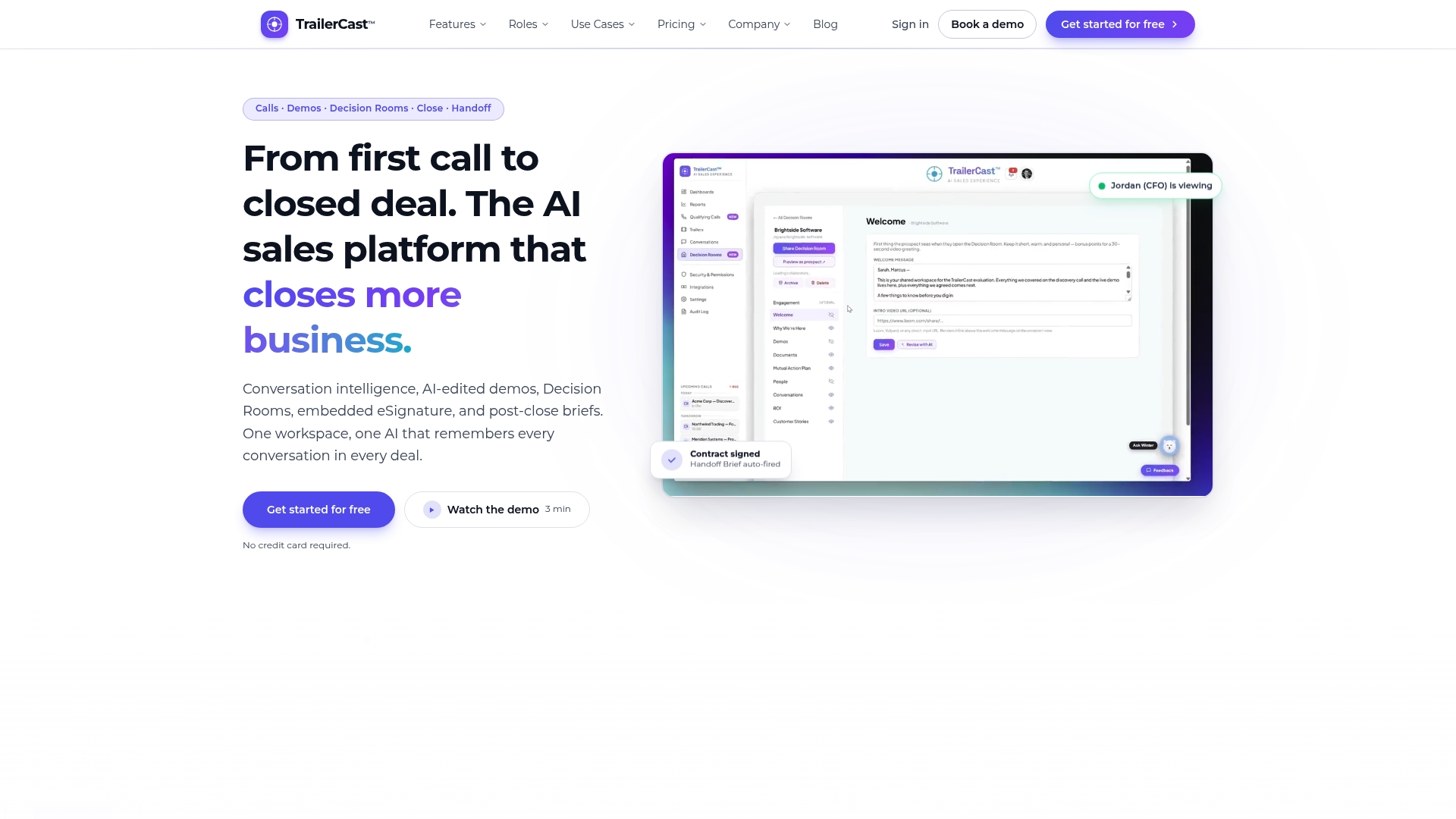
Everything is included in one plan; current prices are on our pricing page, and you can start with a free trial, no credit card needed. See how it fits your deals at Trailercast.
FAQ
What is the point of an action plan?
An action plan turns a goal into specific steps with owners and dates, so everyone knows what happens next. In B2B sales, the most useful version is shared with the buyer, which makes the path to a decision visible and gives both sides something to hold each other to.
What is a success plan?
A success plan is a co-created roadmap that centers on the customer’s desired outcomes, with milestones, owners, and dates. The Institute of Sales Professionals describes mutual success plans as staying active beyond contract signing, which separates them from a plan that ends at the close.
What is a sales action plan and what does it include?
A sales action plan lays out the steps needed to move a deal to decision. A strong one includes the buyer’s desired outcome, critical milestones, named owners, agreed dates, and the evidence that shows each step is complete. Keep it to the critical path rather than every task.
What is a mutual activity plan?
It is another name for a shared plan that lists the activities both buyer and seller will complete on the way to a decision. Most teams call it a mutual action plan or mutual success plan. It counts as mutual only when the buyer helps define the milestones, owners, and dates.
Sources
- Gartner
- From close plans to mutual success plans: Elevating B2B sales outcomes - Institute of Sales Professionals
- “Mutual Action Plans: A 6-Step Sales Process Guide”