Best Navattic Alternatives for B2B SaaS Teams in 2026

The right Navattic alternative depends on one thing before features: your procurement motion. Self-serve HTML-first tools (Arcade, Supademo, Storylane) deploy in hours on a credit card; enterprise sandbox platforms (Reprise, Demostack, Walnut) require annual contracts, SOC 2 reviews, and a sales cycle of their own; and demo-trailer or async video tools (Trailercast, Consensus) solve a different problem entirely, covering what happens after the live demo ends.
Here’s how to self-route:
- Small teams or marketing-led growth small teams: Start with a self-serve HTML tool. Published per-seat pricing, no procurement overhead, live in a day.
- Growth-stage presales with moderate-sized teams and multi-stakeholder deals: Evaluate sandbox/replica platforms alongside Trailercast if you need conversation intelligence and buyer rooms in the same subscription.
- Enterprise presales large enterprise presales in regulated industries: Prioritize SOC 2 Type II, SSO/SAML, and custom MSA availability before comparing features. Procurement alone can take several weeks for mid-market deals.
One benchmark worth anchoring to: self-serve platforms publish per-seat pricing that typically runs in the low hundreds per seat per year, while enterprise flat-priced tiers can reach high annual amounts.
Table of Contents
- How Navattic differs from other demo approaches
- Top Navattic alternatives compared
- How to choose the right Navattic alternative
- How this list was put together
- Key Takeaways
- Why a unified demo and deal platform changes the math
- Trailercast covers demos, deal rooms, and the full sales cycle
- Sources and further reading
How Navattic differs from other demo approaches
Three demo architectures dominate the market, and each maps to a different funnel moment.
HTML/CSS guided tours (Navattic’s core approach) capture your live product’s DOM and let you layer tooltips, hotspots, and branching steps on top. Fast to build, easy to embed on a marketing page, and no engineering required. The tradeoff: they show a frozen snapshot of your UI, so they age quickly and can’t replicate live data flows.
Sandbox and replica environments (Reprise, Demostack, Walnut) clone your actual application, mask or seed demo data, and let a solutions engineer run a live, interactive session that feels like the real product. The authoring lift is higher, procurement is slower, and pricing is enterprise-grade. But for a 5-person buying committee evaluating a $150K deal, a static HTML tour won’t cut it.
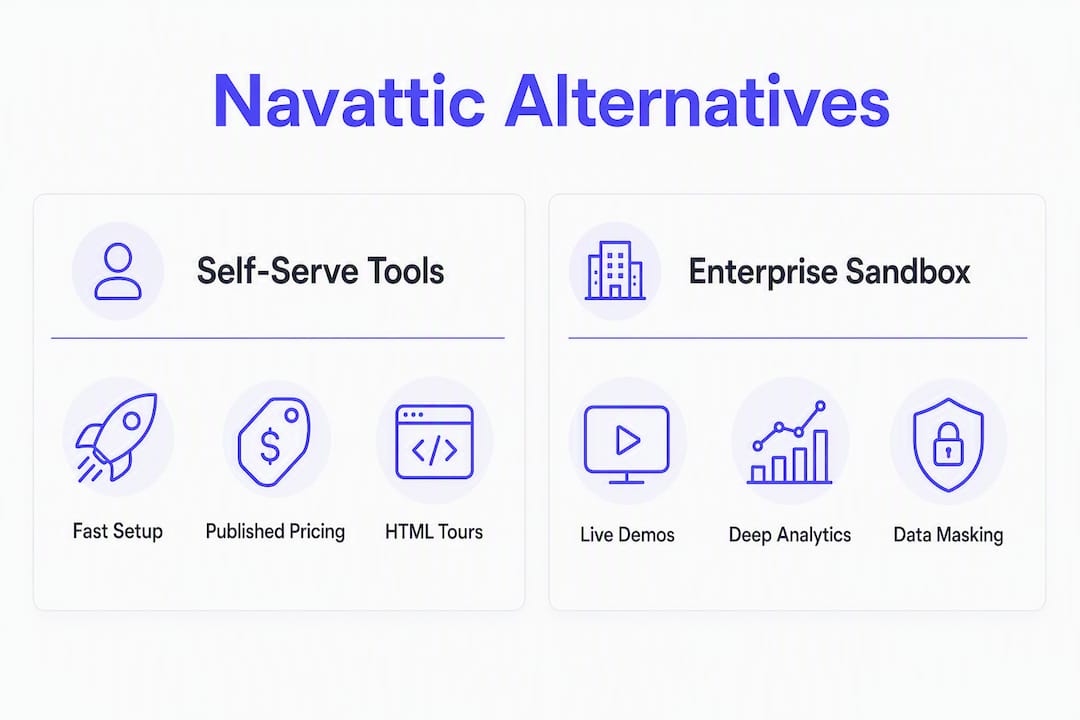
Screenshot/video and demo-trailer workflows (Arcade, Supademo for lightweight use; Trailercast for AI-edited trailers from real calls) are the fastest to produce and the easiest to personalize per stakeholder. A CFO gets a 10-minute trailer focused on ROI; a CISO gets one focused on security. No live session required.
The practical signals to decide quickly:
- Must have SSO or SOC 2 → enterprise sandbox band, budget 6–12 weeks for procurement
- Need published monthly pricing and same-week deployment → self-serve HTML or screenshot tools
- Want to track per-stakeholder engagement after the demo → demo-trailer or deal-room platforms
- Running live SE-led proof-of-concept calls → sandbox/replica environment
| Use case | Demo type | Procurement model |
|---|---|---|
| Marketing CTA / product page | HTML guided tour | Self-serve, monthly |
| Inbound demo center | HTML tour or screenshot walkthrough | Self-serve, monthly |
| SE-led live demo call | Sandbox/replica | Sales-led, annual |
| Async follow-up, multi-stakeholder | Demo trailer + deal room | Self-serve or sales-led |
| Post-demo champion enablement | Demo trailer + buyer room | Self-serve or sales-led |
Top Navattic alternatives compared
Your job-to-be-done should drive which category you evaluate first. Aggregated mid-2026 market data confirms three distinct clusters: HTML-first self-serve tools, enterprise sandbox platforms, and async/demo-trailer tools. The table below maps each product to the dimension that matters most for your buying decision.
| Platform | Best for | Demo type | Authoring speed | Analytics depth | Enterprise readiness | Pricing model |
|---|---|---|---|---|---|---|
| Trailercast | Full deal lifecycle: demos + conversation intelligence + buyer rooms | AI-edited trailers from real calls + deal rooms | Fast (browser recording, no install) | Per-stakeholder engagement, heatmaps, attribution tree | SSO/SAML, custom DPA, enterprise add-ons | $79/seat/month or $59 annual; free trial |
| Navattic | Marketing-led HTML tours, product-led growth | HTML/CSS guided tour | Fast, no-code editor | Page-level and step-level analytics | SOC 2 Type II, SSO on higher tiers | Published per-seat, self-serve |
| Storylane | Growth-stage marketing and presales HTML demos | HTML guided tour + screenshot | Fast, Chrome extension | Demo-level engagement | SOC 2, SSO available | Published per-seat, self-serve |
| Reprise | Enterprise presales, SE-led live demos | Sandbox/replica + HTML overlay | Moderate, requires setup | Account and stakeholder analytics | SOC 2 Type II, SSO, MSA | Sales-led, annual contract |
| Walnut | Sales-led personalized demos, AE-driven | HTML capture + personalization layer | Moderate | Deal and rep-level analytics | SOC 2, SSO | Sales-led, annual contract |
| Arcade | Lightweight marketing tours, fast publishing | Screenshot/GIF/video walkthrough | Very fast | Basic view tracking | Limited enterprise features | Freemium + published tiers |
| Supademo | Small teams, quick async demos | Screenshot + video walkthrough | Very fast | Basic engagement | Limited | Freemium + low-cost tiers |
| Demostack | Enterprise SE teams, live sandbox demos | Full application clone/sandbox | High setup lift | Deep stakeholder analytics | SOC 2, SSO, MSA | Sales-led, enterprise pricing |
| Consensus | Presales video demo automation, buying committee | Video demo tracks + stakeholder routing | Moderate | Buying group analytics | SOC 2, SSO | Sales-led, annual |
Self-serve HTML-first tools: Navattic, Storylane, Arcade, Supademo
These four share the same core motion: capture your UI, add interactive steps, publish a link. Navattic and Storylane are the most feature-complete in this band, with branching logic, CRM integrations, and analytics that go beyond simple view counts. G2 reviewers on Storylane consistently highlight creation speed as a differentiator; teams report going from recording to published demo in under an hour.

Arcade and Supademo sit at the lightweight end: freemium entry points, screenshot-based walkthroughs, and minimal enterprise overhead. Right for a startup that needs a product page demo today, not next quarter.
Pros: Fast time-to-value, published pricing, no sales call required to start. Cons: HTML tours age as your UI changes; limited stakeholder-level analytics; not suited for live SE-led sessions.
Enterprise sandbox platforms: Reprise, Demostack, Walnut
These platforms clone your actual application so SEs can run live, data-masked demos that feel like the real product. G2 reviews for Reprise note strong stakeholder analytics and deep personalization as the primary reasons enterprise teams choose it over HTML tools. Demostack goes furthest on the sandbox fidelity axis, making it the right call for complex, multi-product platforms where a static tour would confuse rather than convert.

Walnut leans toward AE-driven personalization: reps can clone and customize a demo in minutes before a call, without waiting on a solutions engineer. G2 feedback on Walnut points to the self-service customization as the standout feature for sales teams that run high-volume, slightly varied demos.
Pros: Live, interactive demos that mirror the real product; deep analytics; enterprise compliance posture. Cons: High setup lift; sales-led procurement adds weeks; pricing is opaque until you’re in a contract conversation.
Demo-trailer and deal-room tools: Trailercast, Consensus
This category solves a problem the HTML and sandbox tools don’t touch: what happens after the demo. Your champion leaves the call energized, then spends the next two weeks trying to re-sell your product to a CFO and a CISO who weren’t there. A static recording link doesn’t help. A personalized, AI-edited trailer that runs 10 minutes and speaks directly to each stakeholder’s concerns does.
Consensus routes video demo tracks to the right buying committee members and tracks who watched what. It’s built for presales teams that run high-volume, repeatable demo motions and want buying-group analytics at scale.
Trailercast goes further: it combines AI-edited demo trailers from real call recordings with conversation intelligence, buyer-facing decision rooms, embedded eSignature, and post-close handoff in a single subscription. The deal room gives your champion a no-login space to share content, track stakeholder engagement, and keep the buying committee aligned between calls. For teams that currently run Gong or Chorus for calls, a separate demo tool for content, and a deal room like Dock or Aligned, Trailercast consolidates all three into one platform at a per-seat monthly or annual subscription price.
Pros: Solves the post-demo engagement gap; per-stakeholder analytics; no additional tools needed for deal rooms or conversation intelligence. Cons: Not a replacement for a live sandbox demo on a complex SE-led call; best fit for teams with multi-stakeholder buying committees rather than single-contact deals.
How to choose the right Navattic alternative
Prioritize procurement model and demo type fit first, then evaluate integrations and analytics. Here’s a checklist you can bring into a vendor call.
Procurement and commercial:
- Is pricing published, or does it require a sales conversation?
- Is the contract monthly or annual? What are the exit terms?
- Does the vendor offer a free trial or a time-limited pilot without a credit card?
- What’s the per-seat vs. flat-tier model, and how does it scale at your expected seat count?
Security and compliance: 5. Is SOC 2 Type II certified? Can they share the report under NDA? 6. Does SSO/SAML come standard or only on the top tier? 7. Is a custom DPA or MSA available for regulated industries? 8. How is demo data masked or isolated from production?
Authoring and operations: 9. How long does it take to build and publish a first demo? (Ask for a live trial, not a vendor demo.) 10. How quickly can you update a demo when the UI changes? 11. Is there a Chrome extension or browser recorder, or does setup require engineering?
Analytics and integrations: 12. Does the platform track per-stakeholder engagement, or only aggregate view counts? 13. Does it integrate with your CRM (Salesforce, HubSpot) natively, or via Zapier only? 14. Can you export engagement data, or is it locked inside the platform?
Red flags to watch for:
- Pricing only disclosed after a multi-week discovery process
- No documented SOC 2 posture when you’re in a regulated industry
- Mandatory 3-month onboarding before you can run a live demo
- Analytics limited to total views with no stakeholder-level breakdown
- No exportable data or API access
Timeline and cost expectations:
Self-serve tools (Arcade, Supademo, Storylane, Navattic): live in hours to days, published pricing, no contract required. Enterprise platforms (Reprise, Demostack, Walnut, Consensus): expect 4–12 weeks for mid-market procurement, longer for enterprise. Budget accordingly and start the security review early.
Pro Tip: Ask every vendor for a 14-day self-serve pilot before signing anything annual. If they won’t give you one, that’s a signal about how the relationship will go post-contract.
How this list was put together
The evaluation draws on aggregated user reviews from G2, buyer-feedback threads on Reddit and presales communities, vendor documentation and pricing pages, and publicly available roundups from neutral aggregators that compile SE and sales team feedback.
Trust signals collected for each platform:
- G2 review aggregates (rating, review volume, recurring themes in pros/cons)
- Reddit and presales community threads (PreSales Collective, r/sales, r/SaaS)
- Vendor pricing pages and published feature documentation
- Security and compliance disclosures (SOC 2 reports, SSO documentation)
- Pricing band data from verified 2026 roundups
What wasn’t done: no secret benchmark lab, no negotiated pricing data beyond publicly available bands, and no hands-on engineering-level sandbox testing. Feature claims reflect vendor documentation and buyer-reported experience, not internal QA.
To reproduce this check yourself: run a G2 search for each platform, filter reviews by your company size and industry, and cross-reference with a 30-minute self-serve trial. Most self-serve tools let you build a first demo in under an hour, which tells you more about authoring speed than any review will.
Key Takeaways
The single most important decision in this evaluation: match your demo type to your funnel stage before comparing any features, because a tool that’s perfect for marketing CTAs will fail an SE-led enterprise proof-of-concept, and vice versa.
| Point | Details |
|---|---|
| Procurement model first | Self-serve tools deploy rapidly; enterprise sandbox platforms require a longer procurement and security review process. |
| Demo type drives fit | HTML tours suit marketing CTAs; sandboxes suit live SE calls; demo trailers suit async, multi-stakeholder follow-up. |
| Validate SSO and SOC 2 early | Request compliance documentation in week one of any enterprise evaluation to avoid late-stage deal blockers. |
| Stakeholder analytics matter | Per-stakeholder engagement data, not aggregate view counts, is what tells you whether your champion is actually sharing the demo. |
| Trailercast for the full lifecycle | Teams that want demos, conversation intelligence, buyer rooms, and post-close handoff in one subscription should evaluate Trailercast alongside dedicated demo tools. |
Why a unified demo and deal platform changes the math
Most teams evaluating Navattic alternatives are solving a narrow problem: build a better demo. That’s the right starting point. But the deal rarely dies in the demo itself. It dies in the two weeks after, when your champion is trying to re-sell your product to three stakeholders who weren’t on the call, armed with a Loom link and a PDF.
The conventional wisdom says to pick the best tool for each job: a demo platform for demos, a conversation intelligence tool for calls, a deal room for buyer engagement. That logic made sense when the tools were mature and the integrations were reliable. In practice, you end up with three separate dashboards, three data silos, and a champion who gets a different link from each one.
A unified platform doesn’t just reduce your SaaS spend. It means the AI that edited your demo trailer already knows what was said on the discovery call, so the trailer it builds actually reflects the prospect’s stated priorities, not a generic product highlight reel. That’s the part most roundups miss: the value isn’t in any single feature, it’s in the context that flows between them.
That said, if your primary need is a high-fidelity live sandbox for SE-led enterprise demos, a dedicated sandbox platform is still the right call. Trailercast’s demo trailers are built from real call recordings, not live application clones. Know which problem you’re solving before you consolidate.
Trailercast covers demos, deal rooms, and the full sales cycle
If you’re running multi-stakeholder deals and currently stitching together a demo tool, a call recorder, and a deal room, Trailercast replaces all three at $79/seat/month (or $59 billed annually, no credit card for the free trial).
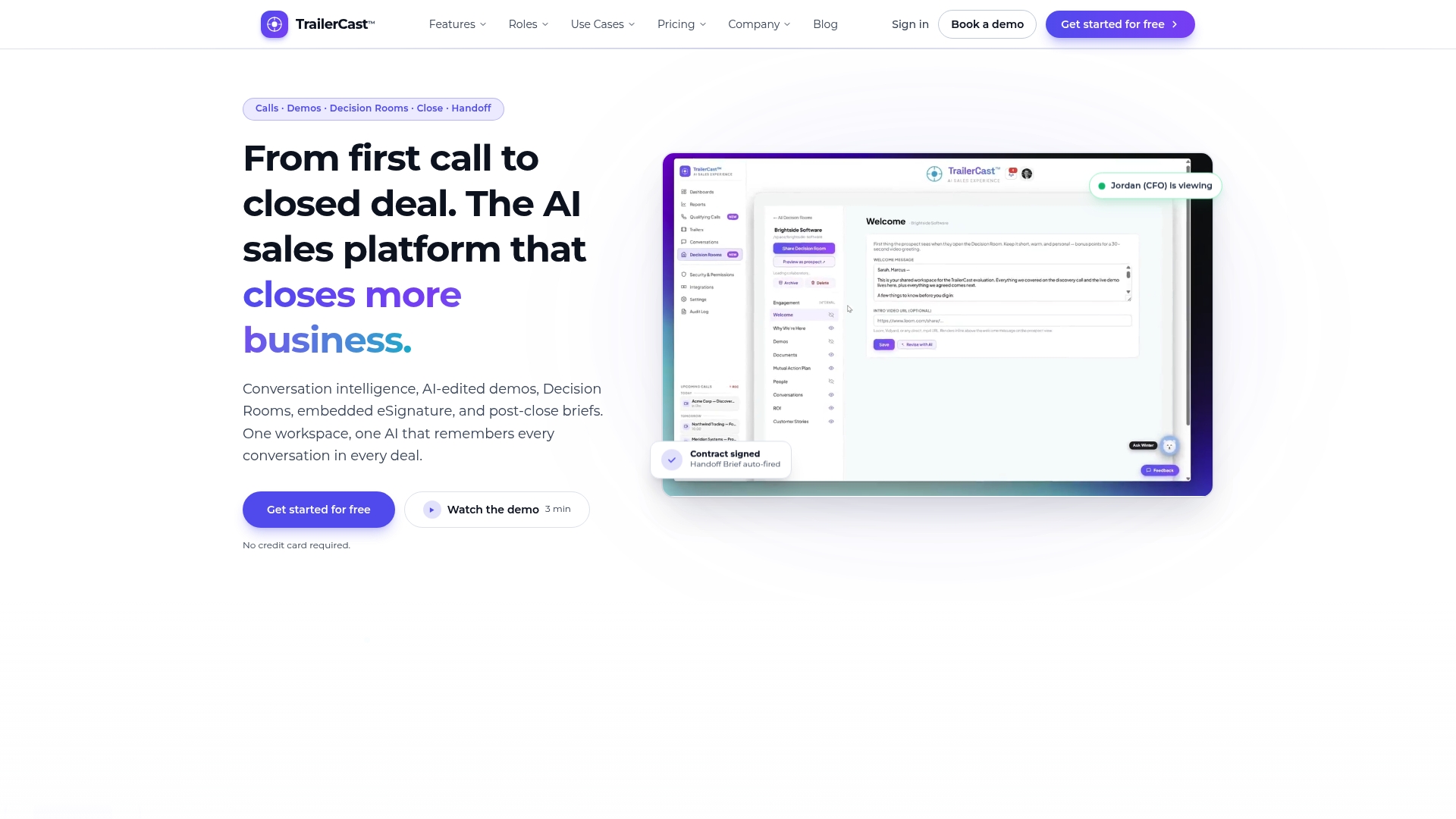
The platform covers every stage of the deal: AI call transcription and summaries from Zoom, Meet, and Teams; AI-edited demo trailers built from your real sales recordings, personalized per stakeholder; buyer-facing decision rooms with per-stakeholder engagement analytics and champion attribution tracking; embedded eSignature; and an AI Handoff Brief that fires to Customer Success the moment a contract signs. Enterprise add-ons (SSO/SAML, custom DPA, white-label) are available on custom contracts.
The first 100 paid teams lock in 20% off for the life of the account. Start a free trial at trailercast.io or review the full feature breakdown to run a side-by-side check against your current stack.
Sources and further reading
Primary sources used to assemble this article:
- Gartner — Navattic alternatives (aggregated reviews)
- G2 — Storylane reviews
- G2 — Walnut reviews
- G2 — Reprise reviews