Stakeholder Mapping Template for CROs and RevOps Teams

A stakeholder mapping template is a per-deal record that tracks every buying-committee member’s role, influence, sentiment, and next action, so your team can multi-thread a complex B2B sale instead of losing it to a meeting you weren’t invited to. Below is a copy-paste block you can drop into a CRM opportunity note or shared spreadsheet right now.
Stakeholder Map Fields (copy this):
- Name / Title / Department
- Influence level (high/medium/low) / Approval power (yes/no/veto)
- Primary concern / Current sentiment (champion, neutral, skeptic, blocker)
- Who influences them / Next step / Last contact date
Pro Tip: Open your first discovery call by asking “who else touches this decision?” and fill in this template live on the call. Waiting until after the call means you’re reconstructing the org chart from memory.
Key Takeaways
A per-deal stakeholder mapping template works because it turns scattered buying-committee knowledge into a single, gated, continuously updated record the whole team can act on.
| Point | Details |
|---|---|
| Capture five essentials | Record role, decision role, priority, sentiment, and influencers for every stakeholder. |
| Use the nine archetypes | Match your message to economic buyers, champions, blockers, and the other archetype types. |
| Layer frameworks | Combine the Power/Interest Grid with a Relationship Network Map for a fuller picture. |
| Gate stages on coverage | Require three engaged threads and an identified economic buyer before advancing. |
| Automate the map | Trailercast centralizes call notes, trailers, and decision rooms so the map updates itself. |
Table of Contents
- What Fields Belong in a Stakeholder Mapping Template?
- Who Are the Nine Stakeholder Archetypes in a B2B Deal?
- Which Framework Should You Use to Prioritize Stakeholders?
- How Do You Build a Stakeholder Map During a Live Deal?
- Worked Example: A $200K SaaS Deal With 13 Stakeholders
- How Should You Multi-Thread and Engage Each Stakeholder?
- Copy-Paste Template and One-Page Executive Summary
- Why an AI Deal Room Makes Stakeholder Mapping Faster
- Sources
What Fields Belong in a Stakeholder Mapping Template?
A usable stakeholder map records five essentials for every person: their formal role in the org, their role in the buying decision, what they personally care about, their current sentiment toward your deal, and who influences them. Miss any one of these and you’re guessing at the moment it matters most, usually right before a contract goes to legal.
RevOps teams that standardize this across every rep typically expand those five essentials into ten trackable fields:
- Name, title, and department
- Influence level and formal approval power
- Primary concern (cost, risk, workflow disruption, career impact)
- Current sentiment and who influences them
- Next step and last contact date
Store the person-level fields on the CRM contact record, keep the deal-specific view (sentiment, next step) at the opportunity level, and mirror the whole map inside a shared decision room so your champion sees the same picture you do. Splitting the data across three disconnected tools is how maps go stale.
Who Are the Nine Stakeholder Archetypes in a B2B Deal?
Most B2B buying committees contain the same predictable cast, even when the org chart looks different every time. Learn to spot these nine and you’ll know what to say before you say it.
- Economic buyer — owns the budget; wants ROI proof, not features.
- Technical evaluator — vets the stack; wants integration and security answers.
- Champion — sells internally for you; wants ammunition and air cover.
- End user — lives in the tool daily; wants proof it won’t slow them down.
- Influencer — no formal power, real sway; wants to be heard early.
- Blocker — resists change; wants risk minimized or the status quo protected.
- Decision maker — makes the final call; wants a short, clear recommendation.
- Signer / gatekeeper — controls access and paperwork; wants process followed.
- Procurement / legal — protects terms; wants standard language and low risk.
A blocker who asks pointed questions is often just under-informed. A blocker who stops responding entirely, or routes you to someone else, is protecting turf. Treat those two very differently.
Which Framework Should You Use to Prioritize Stakeholders?
Different deals call for different lenses, and the smartest RevOps leaders layer more than one.
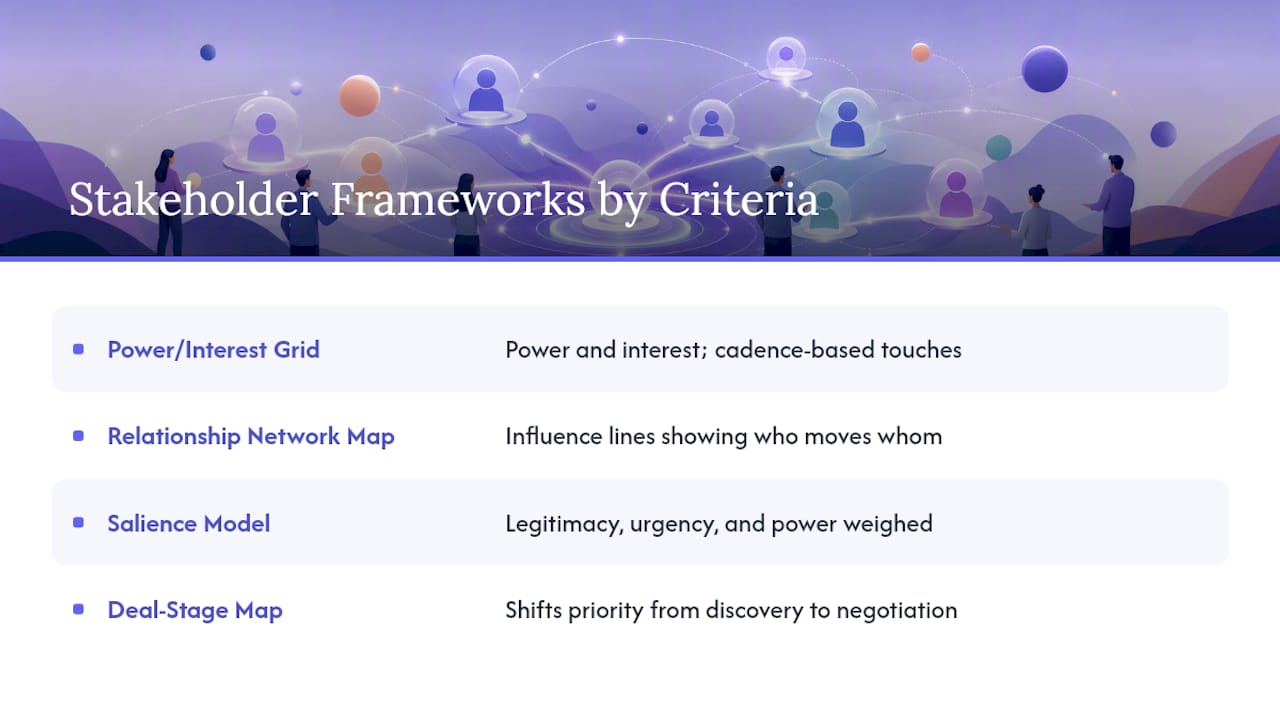
The Power/Interest Grid is the fastest starting point: high power, high interest gets weekly touches; high power, low interest gets concise executive updates; low power, high interest gets nurtured as a future champion. A Relationship Network Map goes further, drawing influence lines between people so you can see who actually moves the CFO, regardless of title. The Salience Model weighs legitimacy, urgency, and power together, useful when a quiet stakeholder suddenly gains urgency near a renewal deadline. A Deal-Stage Map simply shifts your priority list as the deal moves from discovery to negotiation.
How Do You Build a Stakeholder Map During a Live Deal?
Build the map in real time, not after the call ends.
- Identify everyone you know from the first discovery call, even names mentioned in passing.
- Validate with your champion by asking, “Did I miss anyone who’ll weigh in before signature?”
- Assign roles and sentiment to each name using the nine archetypes above.
- Map relationships by asking who reports to whom and who trusts whom informally.
- Identify gaps where a decision-relevant function, like legal, has no named contact yet.
Two questions do most of the work: “Who signed off on the last tool like this?” and “Who would need to say no for this to stall?” Both surface people your champion might not have volunteered.
Close every stakeholder call with a two-line recap sent within an hour: what you heard, what you’re sending next. For late-stage holdouts, propose a 15-to-20-minute “listening session,” framed as their chance to raise concerns directly rather than through your champion.
Worked Example: A $200K SaaS Deal With 13 Stakeholders
Training examples built around a $200K annual SaaS deal commonly surface 10 to 13 named people spanning RevOps, sales, IT, finance, legal, procurement, and the CEO. Here’s a trimmed version of that map:
The gaps tell you more than the names do. An unknown CFO on a $200K deal is a live risk, and a procurement lead who hasn’t engaged means negotiation will stall the moment you get there.
A map with 13 names and only four active threads isn’t a map, it’s a wish list. Coverage matters more than headcount.
The engagement sequence for this deal ran the VP Sales through weekly champion calls, looped in the CFO through a finance-specific ROI call in week three, and looped procurement in during week four, before the deal reached negotiation.
How Should You Multi-Thread and Engage Each Stakeholder?
Multi-threading beats relying on your champion to carry the message alone, because the deal shouldn’t hinge on one person’s memory of your pitch. Arm each archetype with the artifact that speaks their language:
- CFO: a short ROI one-pager, not a slide deck.
- Technical evaluator: a security pack and integration answers.
- End users: a hands-on demo, not a summary.
- Signer: an executive summary they can approve in five minutes.
Coverage rate, the number of stakeholders with a live thread divided by total mapped stakeholders, is a fast leading indicator of forecast reliability.
Track engagement status (active, warm, cold), last contact date, and open risk flags for every stakeholder, and gate stage advancement on those numbers rather than gut feel.

Copy-Paste Template and One-Page Executive Summary
Here’s the full block, ready to paste:
- Per-stakeholder row: Name | Title | Department | Influence | Approval Power | Concern | Sentiment | Influenced By | Next Step | Last Contact
- One-page exec summary sections: Problem statement, proposed solution, ROI summary, timeline, stakeholder sign-off list
Name the file or CRM tab consistently, something like “[DealName]_StakeholderMap,” and update last-contact dates weekly so the map never goes stale between reviews.
Pro Tip: Pin the one-page exec summary inside your shared decision room instead of emailing a PDF. Champions forward links far more reliably than attachments.
Handing the Map to Legal, Procurement, and Customer Success
Before advancing to negotiation, confirm legal and procurement contacts are identified and pass the full map, sentiment history, and open risks to them directly. Use the map to build a mutual action plan with dated milestones. When the deal closes, that same map becomes the handoff brief that keeps Customer Success from starting discovery over from zero.
- Confirm legal/procurement contacts before negotiation opens.
- Attach the mutual action plan with dated next steps.
- Record every stakeholder interaction in the decision room, not in personal notes.
What a CRO Actually Sees When Maps Are Enforced
Teams that require three engaged contacts before a deal advances stages see fewer late-stage surprises and tighter forecasts. One rule that worked consistently: no opportunity moves to negotiation without an identified economic buyer and three live threads. It’s a small gate that catches a lot of bad forecasts early.
Why an AI Deal Room Makes Stakeholder Mapping Faster
Building and maintaining this map by hand across a dozen open deals eats hours every week, and most of that time goes to reconstructing context, not analyzing it. Trailercast centralizes conversation intelligence, AI-edited demo trailers, and buyer-facing decision rooms in one workspace, so your stakeholder map updates itself as calls happen instead of waiting on a rep’s memory.
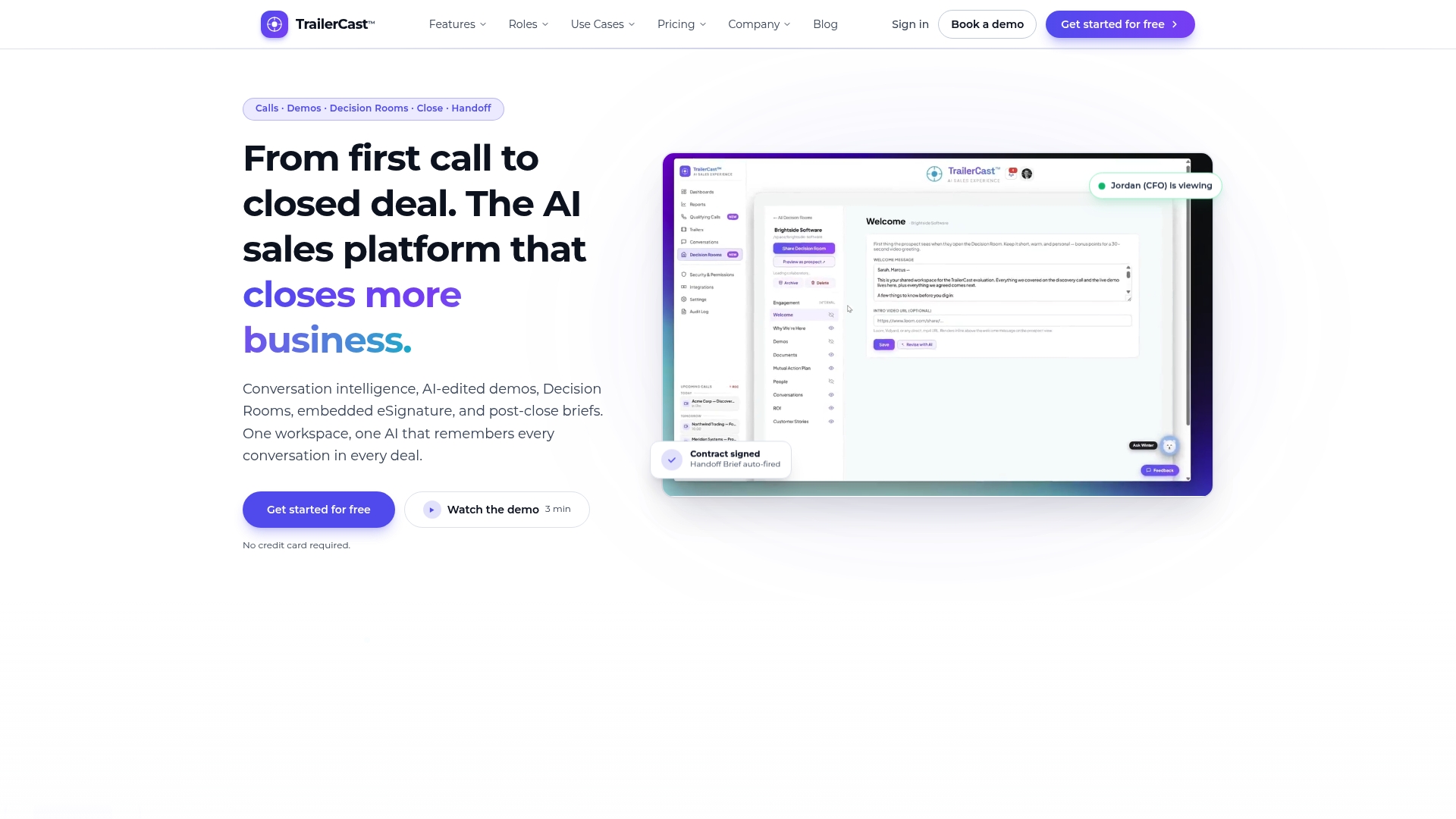
Every call gets transcribed and summarized automatically, tagging who said what and routing it into an evolving Deal Brief that spans the whole opportunity. Instead of one generic demo recap, you can generate a stakeholder-specific trailer, a CFO cut on pricing, a CISO cut on security, that your champion actually forwards, and the engagement panel shows you exactly who opened it and when. That’s coverage data you don’t have to chase down manually.
Start a free trial at Trailercast and see your first stakeholder map build itself from your next discovery call. No credit card required.
Sources
- Stakeholder mapping example
- Buying committee sales
- B2B Buying Committee Mapping: From Identification to Close | Account Map Blog
- B2B Buying Committee Structure: Sales Guide 2026
- Selling to B2B Buying Committees