Buyer Engagement Alerts: A RevOps Playbook That Works

Buyer engagement alerts are routed notifications triggered when a prospect does something that signals purchase interest, like opening a proposal, watching a demo, or hitting the pricing page three times in a week. The right approach isn’t “alert on everything.” It’s tiering signals into real-time, digest, and dashboard buckets, routing each to the channel a rep actually checks, and setting thresholds before you ever flip on a real-time rule.
If you’re starting from zero, here’s your first move:
- Pick one or two named accounts you already care about
- Set a single real-time alert (pricing page view or proposal open works well)
- Pair it with a one-click next step, like a Slack DM template or a pre-built follow-up trailer
- Watch how it performs for two weeks before adding a second rule
Key Takeaways
Buyer engagement alerts work when signals are tiered by urgency, routed to a channel reps actually use, and paired with a defined next step tracked through to conversion.
| Point | Details |
|---|---|
| Tier before you route | Split signals into real-time, digest, and dashboard tiers based on account ownership and stakeholder seniority. |
| Set thresholds before enabling real-time | Require multiple qualifying actions (like 3+ pricing views in 7 days) to avoid pinging reps on noise. |
| Pair every alert with a next step | A DM template, CRM task, or trailer share makes alert-to-action conversion measurable. |
| Review monthly and retune | Track acted-on versus dismissed alerts, then adjust thresholds based on actual reply rates. |
| Trailercast connects alerts to deal context | Call transcripts, demo trailers, and engagement panels live in one workspace, so reps know what an alert means before they respond. |
Table of Contents
- What Signals Actually Trigger Buyer Engagement Alerts?
- Why Buyer Engagement Alerts Move the Revenue Needle
- Where Should Buyer Engagement Alerts Be Routed?
- How Do You Prevent Alert Fatigue From Killing Adoption?
- What’s the Technical Lift to Implement Buyer Engagement Alerts?
- Running Alerts as a Process, Not Just a Notification
- How a Unified AI Sales Workspace Turns Alerts Into Action
- Get Buyer Engagement Alerts With Full Deal Context, Not Just a Ping
- Sources
What Signals Actually Trigger Buyer Engagement Alerts?
Not every website visit deserves a ping. The signals worth tracking fall into a handful of categories, and each one carries a different weight depending on who’s behind it and how they’re engaging.
- Page-level signals — pricing page views, comparison page visits, and repeated return visits to the same URL within a short window.
- Content signals — proposal or document opens, time spent per page, and whether a stakeholder scrolled past the first section.
- Demo and trailer signals — who watched a shared demo trailer, how far they got, and whether they rewatched a specific section (like security or ROI).
- Product usage signals — feature adoption, usage-limit hits, or paywall triggers in product-led motions.
- Third-party intent signals — anonymous research activity picked up by intent platforms, filtered through your ideal customer profile.
Strength isn’t just about the action, it’s about who took it and how often. G2’s Buyer Intent documentation classifies signals by type and buying stage, then recommends action based on activity level: low activity gets nurtured, medium gets engaged, and high activity gets immediate outreach. A CFO opening a pricing page twice outweighs a junior analyst browsing your blog once. Build your rubric around that distinction: T1 (decision-maker, pricing/proposal engagement, repeated visits) triggers real-time. T2 (mid-funnel engagement, unclear seniority) goes to digest. T3 (single low-intent touch) stays on the dashboard.
Why Buyer Engagement Alerts Move the Revenue Needle
Speed matters more than most sales teams admit. A rep who reaches out within hours of a buyer interest notification is working with a warm signal, not a cold guess. The gap between “someone looked at pricing” and “someone talked to a human about pricing” is where deals either accelerate or go quiet.
Buyer engagement alerts earn their place in a few specific scenarios:
- Account-based motions, where a named account suddenly shows multi-stakeholder activity
- Dormant deal revival, when a stalled opportunity shows a proposal reopen or repeat visit
- Expansion signals, when an existing customer’s usage crosses a threshold that suggests upsell readiness
- Churn risk, when engagement on a renewal-adjacent page drops or spikes unexpectedly
Pro Tip: Track alert response rate and post-alert conversion separately. A team that responds fast but converts poorly has a messaging problem, not a speed problem. UnifyGTM reports that teams who tier signals correctly, instead of blasting every touch in real time, see reply rates between 5% and 20% on signal-triggered outreach. That’s the difference tiering makes when the alert reaches the right rep at the right urgency.
Where Should Buyer Engagement Alerts Be Routed?
The channel matters as much as the signal. A real-time alert buried in an email digest is functionally dead. A low-priority signal blasted to Slack trains reps to ignore the channel entirely. Route by urgency, not by convenience.
| Channel | Best for | Why it works |
|---|---|---|
| Slack or direct message | Named accounts showing T1 behavior | Reps see it immediately and can act within minutes |
| Email digest | Execs and cross-functional stakeholders tracking multiple accounts | Batches lower-urgency signals into a scannable summary |
| CRM task | Any signal that needs a documented follow-up | Creates accountability and a timestamp for SLA tracking |
| In-app notification | Product-led signals like usage spikes or paywall hits | Reaches the right team without leaving the product workflow |
6sense’s alert framework shows this in practice, with configurable categories like “New Hot Accounts” and “Recent Contact Engagement” that route to email or Slack depending on urgency and audience. Assign every alert an owner ID, build a fallback queue for unassigned accounts, and give cross-functional stakeholders (CS, marketing) visibility into the same signal without duplicating the notification.
How Do You Prevent Alert Fatigue From Killing Adoption?
Alert fatigue is the fastest way to make reps mute a channel forever, and once that happens, even your highest-value real-time alerts get ignored. Three levers keep the system usable.
- Thresholds: require a minimum activity level before firing, like 3+ pricing page views in 7 days for accounts not already in your pipeline.
- Exclusion lists: suppress alerts for existing customers, accounts with an open opportunity, or known competitors doing research.
- Batching: route anything below your real-time threshold into a daily or weekly digest instead of pinging individually.
A workable configuration might suppress all alerts for accounts with an active deal in a late stage, since the rep already knows to watch that account closely. Meanwhile, an unknown account crossing three pricing views in a week earns a real-time ping precisely because nobody’s watching it yet.
Pro Tip: Require reps to mark alerts as “acted on” or “dismissed.” Review that data monthly. If a rule generates alerts nobody acts on, raise the threshold or kill the rule; if a rule consistently drives replies, consider loosening it slightly to catch more accounts. Customer.io’s guidance on live notifications makes a similar point: these updates work best when scoped tightly to something the recipient is already tracking, not broadcast as general-purpose noise.
What’s the Technical Lift to Implement Buyer Engagement Alerts?
Before you can route anything, you need the data flowing and mapped correctly. Here’s the sequence that avoids rework later.
- Inventory your sources: first-party website analytics, product usage telemetry, document/proposal viewers, demo or trailer play data, and any third-party intent feed filtered through your ICP criteria.
- Build the integration paths: webhook or API endpoints from each source into your alerting layer, CRM field mapping for owner ID and account tier, and defined recipient logic per alert type.
- Lock down permissions: set audit logging so you can trace who received what, and restrict sensitive engagement data (like which stakeholder viewed pricing) to relevant roles.
- Run a sandbox pilot: fire sample alerts against test accounts, confirm routing hits the right recipient, verify CRM tasks generate correctly, and check that attribution ties back to the original signal.
Demandbase’s intent guidance stresses combining intent signals with account intelligence, firmographics and technographics, so alerts don’t fire in a vacuum. A CRM integration partner like GrowthCRM can shorten the mapping work if your stack doesn’t already have clean owner-ID logic wired into account records.
Running Alerts as a Process, Not Just a Notification

An alert without a response protocol is just noise with better timing. Build SLAs by tier: T1 gets a same-day response, ideally within five hours; T2 gets 24 to 48 hours; T3 rolls into your standard nurture cadence instead of a manual response.
Pair every alert with a next step so reps aren’t improvising:
- A DM template plus a shared trailer link for T1 accounts showing demo replay activity
- An auto-generated CRM task with a suggested talk track for T2 follow-up
- A proposal-nudge email template for accounts that reopened a document but didn’t reply
6sense’s research backs this up directly: pairing every alert with a defined next action makes alert-to-action conversion something you can actually measure, instead of a guess based on rep memory. Track that conversion rate in your CRM, tie it back to the originating signal, and schedule a monthly review to retune thresholds based on which rules are driving replies and which are generating dismissals.
How a Unified AI Sales Workspace Turns Alerts Into Action

The gap between an alert and a good response usually isn’t awareness, it’s context. A rep gets a ping that a stakeholder reopened a proposal, but has no idea what that stakeholder actually cares about, what was discussed on the last call, or which trailer section they rewatched. That’s where a consolidated workspace changes the math.
Trailercast keeps call transcripts, AI-edited demo trailers, and buyer-facing decision rooms in one place, so an alert about a CFO viewing a pricing section links directly to what was said about pricing on the last call. A few specifics that matter for alert follow-up:
- Per-stakeholder engagement tracking shows exactly who watched what, not just that “someone” engaged
- Trailer forwarding is tracked as an attribution tree, so you see which stakeholder shared content with whom
- An AI handoff brief auto-generates on close, carrying deal context forward instead of losing it
| Point | Details |
|---|---|
| Alerts need context to be useful | An alert without the underlying call history or content history forces reps to guess at intent. |
| Trailercast fits teams of 11 to 200 employees | Pricing is transparent per-seat, suited to multi-stakeholder B2B deals with 3 to 7 buying committee members. |
What the First 90 Days of Running Alerts Actually Teaches You
Most teams over-alert first, then spend weeks muting rules nobody trusts. The real pitfalls are unclear ownership, no next-step template, and thresholds set from guesswork instead of response data. Start with one tiered rule, measure reply rates before adding volume, and let accuracy earn you the right to go faster.
— Daniel
Get Buyer Engagement Alerts With Full Deal Context, Not Just a Ping
Most alert tools tell you that something happened. Trailercast tells you what to do about it, because the same platform holds the call transcript, the demo trailer, and the buyer’s engagement history that explain why the alert fired. For a RevOps team tired of pinging reps with no context attached, that’s the concrete difference: one workspace instead of five disconnected tools bolted together after the fact.
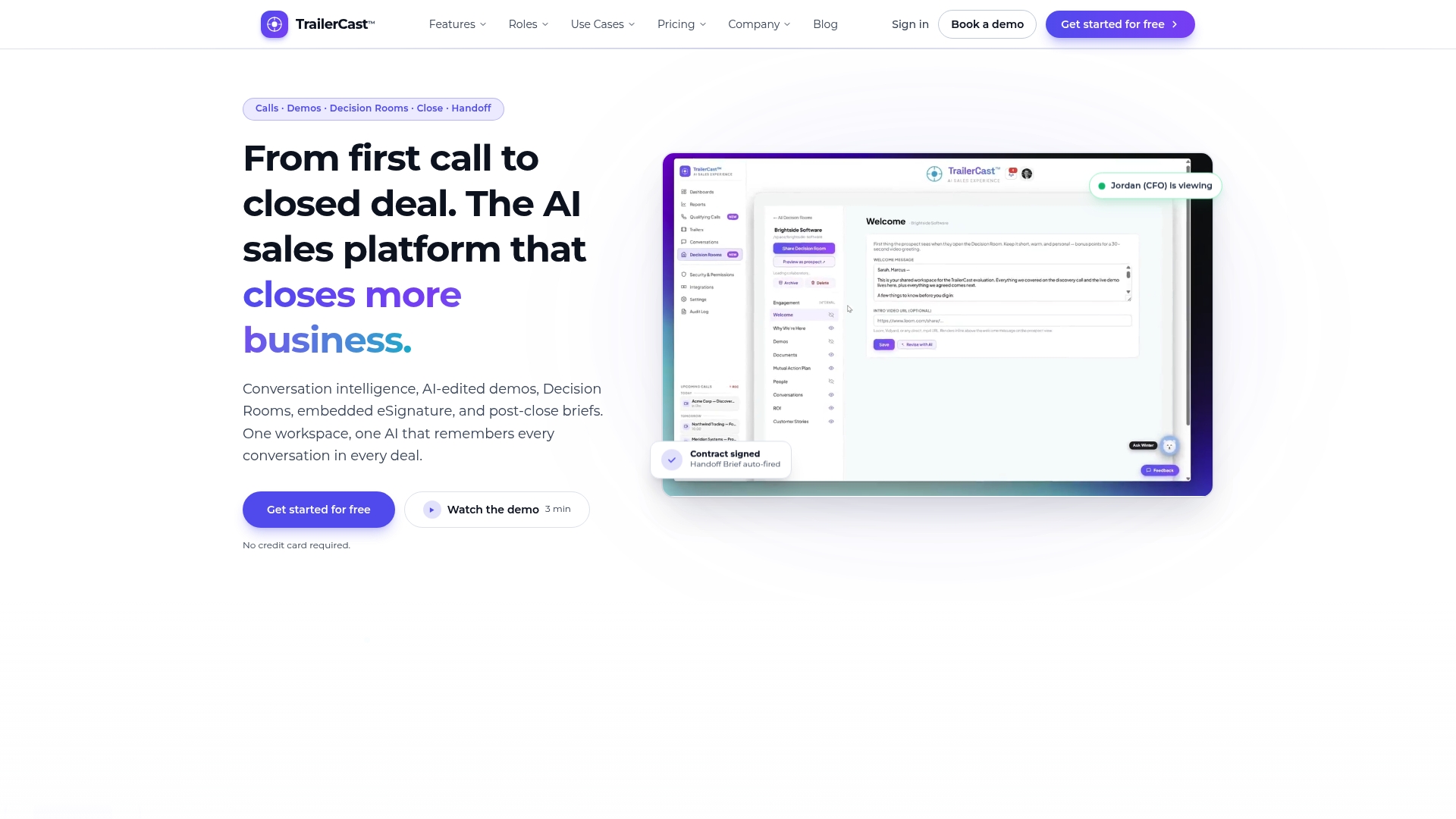
Trailercast fits B2B SaaS sales teams running multi-stakeholder deals, typically between 11 and 200 employees, where a CFO, a CISO, and a champion all need different answers from the same demo. Every plan includes the full feature set, from conversation intelligence to decision rooms with per-stakeholder engagement tracking, at one transparent per-seat price. Start a free trial, no credit card required, and connect your first named account before your next real-time alert fires.
Sources
- Buyer intent — G2 documentation
- Real-time sales alerts — 6sense
- How to set up alerts for buying signals — UnifyGTM
- Live notifications overview — Customer.io
- Buyer intent explained — Demandbase