What CISO Security Questions Sellers Should Expect

A CISO evaluating your SaaS product will accept concise, dated, auditable evidence mapped to core controls, not a sales pitch about “taking security seriously.” Give them a SOC 2 report, a recent pen test, a subprocessor list, and a one-page incident response summary, and most follow-up requests stop there. Everything else in a security review is really just a request for proof, timestamped and specific.
TL;DR:
- The two most critical security documents to prepare are a recent pen test report within the past 12 months and a SOC 2 Type II audit covering continuous monitoring.
- Building and regularly updating a comprehensive evidence packet with clear timestamps and source tagging can significantly reduce procurement delays.
- Responding quickly to common red flags such as expired pen tests, lack of SOC 2 Type II, or missing subprocessor lists can prevent deal stalls and close sales faster.
- Maintaining a shared, accessible evidence library with scheduled refreshes improves readiness for live security discussions and minimizes follow-up requests.
- The ability to produce current, timestamped proof seamlessly is more important than detailed technical security knowledge during vendor security reviews.
Table of Contents
- What Are the Top CISO Security Questions, and What Should You Attach?
- How Do You Package Evidence So CISOs Stop Asking for More?
- How Should Sellers Handle a Live Technical Call With a CISO?
- Which CISO Red Flags Kill Deals, and How Do You Fix Them Fast?
- Why Questionnaire Readiness Belongs on Someone’s Calendar, Not Just Their To-Do List
- How TrailerCast Helps Sales Teams Stay Evidence-Ready
- Frameworks and Templates Worth Bookmarking
- Why the Real Skill Here Isn’t Security Knowledge, It’s Evidence Discipline
- Sources
What Are the Top CISO Security Questions, and What Should You Attach?
CISOs ask a fairly predictable set of questions once you’ve heard a few dozen of them. The trick isn’t guessing what they’ll ask. It’s having the right artifact ready before they ask it. Direct, evidence-request phrasing like “when was your last pen test, and can we see the report” is now the norm, so vague reassurance answers just generate a second round of questions.
Here’s the priority order, ranked by how often each one blocks a deal:
- Penetration test recency. Say: “Our last external pen test was completed within the past 12 months by a named, credentialed firm.” Attach: the full PDF with scope, tester name, and CVSS ratings.
- SOC 2 Type II (not Type I). Say: “We maintain SOC 2 Type II with continuous monitoring across the audit period.” Attach: the report cover page and audit period dates.
- Encryption in transit and at rest. Say: “All data is encrypted with TLS 1.2+ in transit and AES-256 at rest.” Attach: your architecture summary or trust center excerpt.
- Incident response plan. Say: “We maintain a documented IR plan with defined notification timelines.” Attach: a redacted one-page IR summary.
- Vulnerability management cadence. Say: “We run continuous scanning plus quarterly manual testing.” Attach: a live scan dashboard link with a timestamp.
- Access control (SSO, MFA, least privilege). Say: “SSO and MFA are enforced on all privileged accounts.” Attach: your access control policy excerpt.
- Third-party and subprocessor risk. Say: “Here is our current subprocessor list, reviewed quarterly.” Attach: the subprocessor table with data flow notes.
- Data retention and deletion. Say: “Data is retained per contract terms and deleted within a defined window on offboarding.” Attach: your data retention policy.
- Logging and auditability. Say: “All admin actions are logged and retained for audit review.” Attach: a logging policy summary.
- Disaster recovery and business continuity. Say: “We maintain tested DR/BC plans with defined RTO/RPO targets.” Attach: your BC/DR summary with last test date.
The first two items matter more than the rest combined. Enterprise buyers frequently reject vendors over an expired pen test or a Type I report standing in for Type II, and questionnaire delays tied to missing evidence routinely stretch procurement cycles by weeks. If you fix nothing else this quarter, fix those two.
How Do You Package Evidence So CISOs Stop Asking for More?
The questions don’t change much deal to deal. What changes is whether you can produce proof in minutes instead of days. That gap is where deals stall in procurement, not in the questions themselves.
Build a standing evidence packet with these pieces:
- An executive summary PDF (one page, plain language, links to the full reports)
- The full SOC 2 Type II report with the audit period clearly marked
- The pen test report with CVSS severity ratings and a retest confirmation
- A live scan link with a visible timestamp, not a static screenshot
- Your signed DPA template and current subprocessor list
- Your IR plan, including notes from your last tabletop exercise
Host this somewhere durable. A public or NDA-gated trust center works well for static attestations, similar to how Sentrix structures its trust center around SOC 2 documentation. For deal-specific evidence, a shared secure room keeps sensitive files out of email threads and gives you a record of who viewed what. TrailerCast’s decision rooms work this way for the sales side of the file, giving each opportunity a single, evidence-ready home instead of a scattered email chain.
Assign one owner for the whole packet. Refresh it quarterly, and tag every document with its source and last-updated date so nobody’s guessing whether the pen test PDF a rep just sent is six weeks old or sixteen months old.
Pro Tip: Put the last-updated date directly in the file name (e.g., “PenTest_Report_Q1-2026.pdf”), not just in the metadata. CISOs skim file names before they open anything.
How Should Sellers Handle a Live Technical Call With a CISO?
The questionnaire gets you in the room. The live call is where a skeptical CISO tests whether your written answers hold up under follow-up questions. Three scripts cover most of what comes up:
- “Walk me through your last pen test.” Say: “It was completed in [month/year] by [firm], covering [scope]. Here’s the report with CVSS ratings and remediation status.” Have the PDF open and ready to screen-share.
- “What’s your breach notification timeline?” State the exact number in your DPA or IR plan. Don’t estimate. If it’s 72 hours, say 72 hours.
- “What happens if you find a critical vulnerability in production?” Give your remediation SLA by severity (commonly 24 to 72 hours for critical, longer for lower severity) and name who owns the escalation.
Memorize three numbers before every technical call: your latest pen test date and tester credentials, your remediation SLAs by severity, and your breach notification window. If a CISO asks something outside your knowledge, say so and offer a follow-up from your security lead within a defined window. Guessing on a security call is worse than admitting you need to check.
Which CISO Red Flags Kill Deals, and How Do You Fix Them Fast?
Some gaps stall a deal for a week. Others end it. The eight below fall into the second category most often, and the fix isn’t always a full remediation. Sometimes it’s a credible mitigation while the real fix is underway.
- Pen test older than 12 months — schedule a new test now; in the meantime, share continuous scan results with dates.
- No SOC 2 Type II — if you only have Type I, disclose the audit-in-progress timeline and share interim control evidence.
- MFA not enforced on privileged accounts — enforce it immediately; this is usually a same-week fix, not a roadmap item.
- Shared production credentials — move to individual, logged access; offer an access control policy as interim proof of intent.
- No subprocessor list — publish one within days; this is one of the fastest fixes on this list.
- PII appearing in application logs — implement log redaction and show the buyer your remediation ticket and timeline.
- No IR tabletop exercises on record — run one before the next call and bring the notes.
- Missing DPA — have a template ready to sign same week; delay here reads as low prioritization, not complexity.
Dated scan evidence paired with a documented remediation SLA is generally accepted by buyers as a credible interim mitigation for non-critical gaps. That only works, though, if you’re honest about what’s assertion, what’s policy, and what’s third-party-audited. Pro Tip: Never present an assertion as if it were audited. CISOs weight evidence in tiers, and getting caught inflating your tier costs more trust than the original gap did.
Why Questionnaire Readiness Belongs on Someone’s Calendar, Not Just Their To-Do List
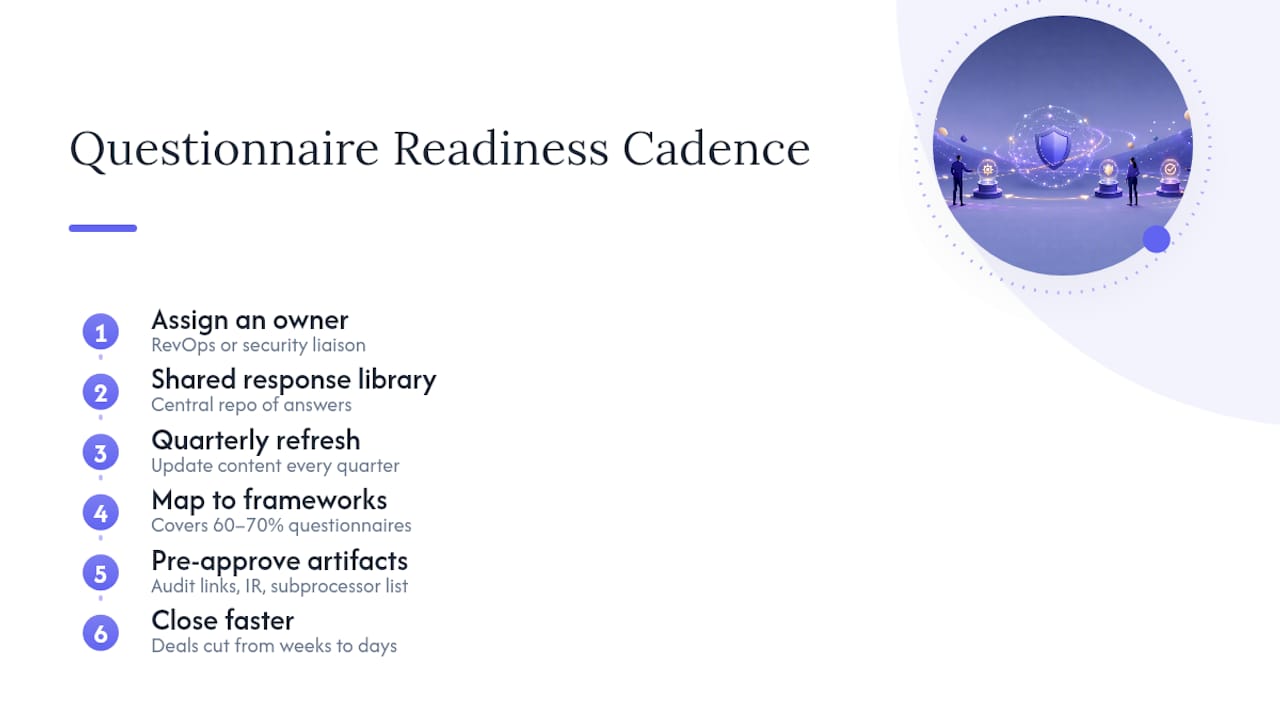
Most sales teams treat security questionnaires as one-off fire drills. That’s the mistake. Assign a RevOps or security liaison to own a shared response library, refresh it quarterly, and map every answer to the frameworks buyers actually use. Completing CAIQ-Lite once and keeping it current can cover 60 to 70% of incoming questionnaires automatically.

The payoff shows up in cycle time, not in the security team’s inbox. Deals that used to sit for three weeks waiting on evidence start closing in days. Pin your audit links, pre-approve an IR summary, and keep the subprocessor list current, and most of the questionnaire writes itself before the CISO even sends it.
How TrailerCast Helps Sales Teams Stay Evidence-Ready
Most of the friction in a security review isn’t the questions. It’s finding who said what, six weeks after the call where your CISO champion actually raised the concern. TrailerCast keeps that conversation searchable instead of buried in a recording nobody rewatches.
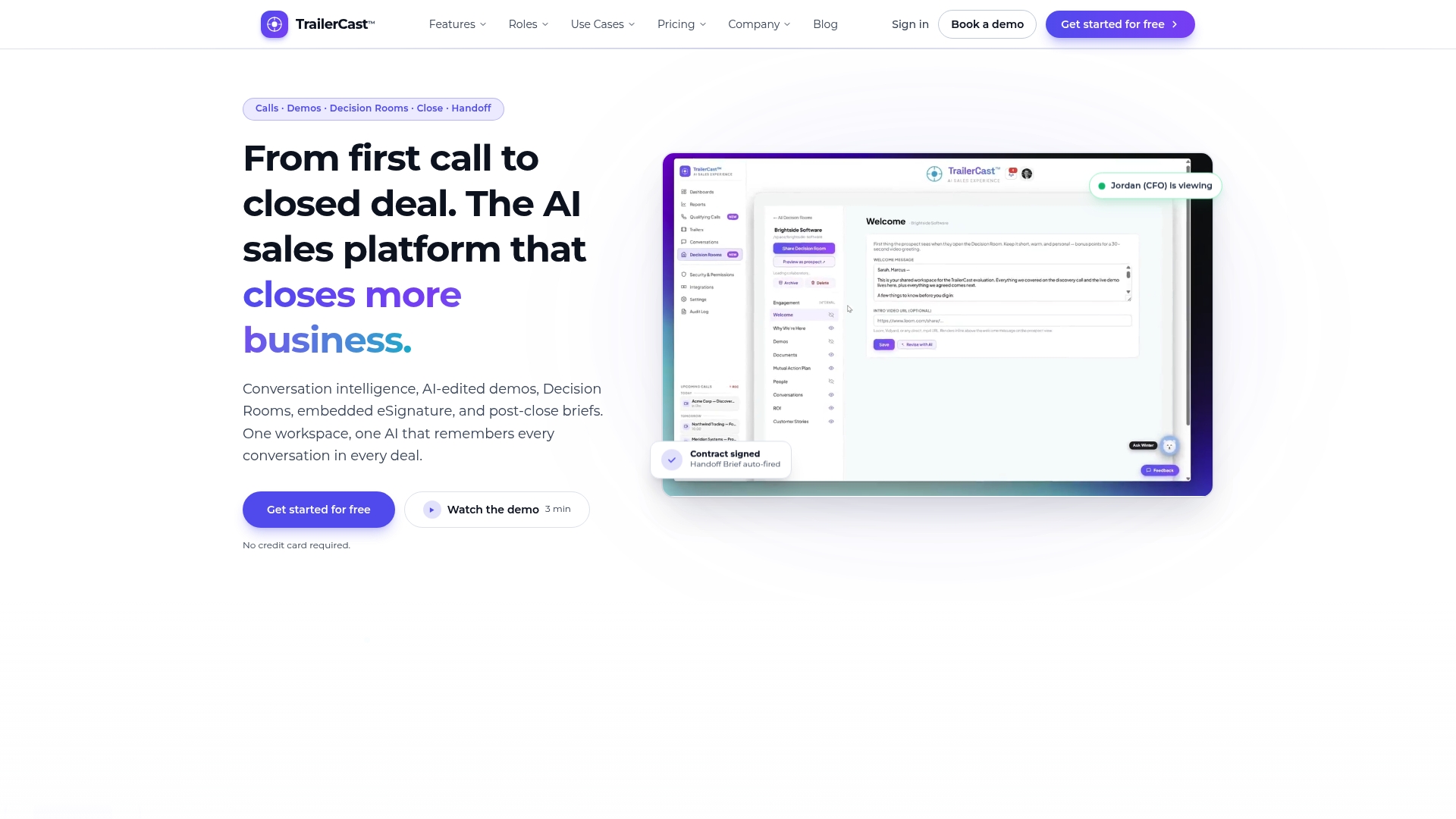
Every discovery call gets transcribed and indexed automatically, so when a champion asks “did we already cover encryption at rest with their CISO,” the answer is a search away instead of a guess. TrailerCast’s AI notetaker captures that detail on every call, and its decision rooms give each deal a single home where you can host your SOC 2 report, pen test PDF, and DPA alongside a stakeholder-specific trailer built for the security reviewer rather than the economic buyer. Embedded eSignature closes the loop without a separate tool once the CISO signs off. Pricing is one tier, all features included, at $79 per seat per month (or $59 billed annually), with a free trial that doesn’t require a credit card, and enterprise add-ons like SSO and custom DPAs available on request. Full documentation on how TrailerCast itself handles data protection lives on its security page, worth sending directly to a buyer’s CISO if they ask. Start a trial at Trailercast and see how much faster the next security review moves when the evidence already lives in one place.
Frameworks and Templates Worth Bookmarking
- CAIQ-Lite / SIG Lite mapping guide for building your master response library
- 50-point vendor security checklist covering the questions that recur across frameworks
- Vendor security assessment vetting checklist for documenting subprocessor and third-party risk
- A one-page incident response plan template, hosted alongside your dated scan reports in your trust center or decision room
Why the Real Skill Here Isn’t Security Knowledge, It’s Evidence Discipline
Most sales teams treat CISO questions as a knowledge problem: get the rep smarter about encryption standards, coach them on SOC 2 terminology, hope they don’t freeze on a technical call. That’s the wrong frame entirely. A CISO doesn’t care whether your AE can define AES-256 from memory. They care whether the proof exists, is current, and matches what the rep just claimed out loud.
The uncomfortable truth is that most deals don’t die because a company has weak security. They die because the evidence is scattered, stale, or inconsistent with what got said on a call three weeks earlier. I’d argue the highest-leverage fix in this entire process isn’t a security investment at all. It’s an ownership and cadence problem that sales leadership keeps punting to whoever answers the questionnaire fastest.
The teams that win these reviews aren’t the ones with flawless infrastructure. They’re the ones who treat their evidence packet like a product with a release cycle: versioned, dated, owned by one person, refreshed on a schedule nobody has to be reminded about. Everyone else is improvising under deadline pressure, which is exactly when inconsistencies slip out and CISOs notice.
— Daniel
Sources
- The 50-Point Vendor Security Assessment Checklist for SaaS
- How to Pass a Vendor Cyber Security Assessment in 2026