Demo for CFOs: Five Questions and Trailer Clips That Win CFO Buy In

A demo for CFO stakeholders should be a live, data-grounded walkthrough that proves three things: how the model handles changed assumptions, where flexibility actually lives, and whether every number traces back to a source you can audit. Anything short of that is a slideshow wearing a demo’s clothes. Before you sit through another vendor pitch, insist on a realistic sample dataset or a read-only connection, ask directly who can edit the underlying logic, and request a short trailer built around cash runway and receivables, not features.
TL;DR:
- Most demos hide assumptions in a data bubble; demand a live, data-grounded walkthrough with a realistic scenario that can be rebuilt mid-call.
- Asking how a tool handles changing assumptions and messy data live reveals whether it truly offers flexibility and transparency beyond scripted presentations.
- Dashboards should allow drill-down to source transactions and show dynamic metrics like cash runway and receivables aging based on live assumptions, not static figures.
- Including the finance team and a technical contact in demos helps ensure the tool fits actual workflows and security requirements before making a decision.
- After the demo, insist on a short proof-of-concept with your own data, and look for transparent documentation, references from similar companies, and clear pricing to validate claims.
Table of Contents
- What to Expect in a CFO-Focused FP&A Demo
- Five Questions Every CFO Should Ask in a Demo. For deeper insight on what to ask about security and ROI during demos, CFOs should stress test cybersecurity ROI with editable assumptions to weigh financial impact in procurement discussions (CFOs: Stress test cybersecurity ROI with editable assumptions).
- Which Dashboards and KPIs Actually Prove Value
- How to Prepare So the Demo Reflects Your Real Priorities
- Validating Claims After the Demo
- Demo Artifacts That Speed CFO Buy-In
- What a Demo Rarely Shows You Until It’s Too Late
- See How TrailerCast Turns Your Demo Into a Deal Your CFO Actually Champions
- Sources
- FAQ
What to Expect in a CFO-Focused FP&A Demo
Vendors run four demo formats, and each tells you something different. Agent-led demos let you type questions in plain language and explore the product without a salesperson steering the narrative, a model Workday has pushed hard for financial management buyers. Live walkthroughs with real-time Q&A are the standard for FP&A tools, often run on a realistic sample dataset with the session capped around 15 minutes, a format CentSight and others lean on. Prerecorded highlight reels work for a first look, but should never be the only artifact you evaluate. Interactive sandboxes, where you click through budgets, imports, and dashboards yourself, offer the most honest read on usability, as platforms like BudgetPilot AI demonstrate.
Keep your own agenda tight:
- 10 to 20 minutes on an executive walkthrough centered on cash and runway.
- 15 or more minutes of Q&A targeted at assumptions, integrations, and edge cases.
- No agenda item devoted purely to feature listing.
On data, ask whether you’re looking at a realistic sample dataset, an anonymized extract of real company data, or a live read-only connection. Insist on seeing which one it is before the call ends.
Five Questions Every CFO Should Ask in a Demo. For deeper insight on what to ask about security and ROI during demos, CFOs should stress test cybersecurity ROI with editable assumptions to weigh financial impact in procurement discussions (CFOs: Stress test cybersecurity ROI with editable assumptions).
Every CFO seat checklist should start with the same five questions, and the order matters because each builds on the last.
- What happens when assumptions change mid-quarter? Watch them actually rebuild a scenario live, not describe it.
- Where does flexibility live after go-live? Some tools bury it in a services contract you’ll pay for later.
- How dependent is the model on rigid templates? Templates that can’t absorb your chart of accounts are a red flag.
- Who can edit the underlying logic once it’s running? If the answer is “only our implementation team,” you’ve just found your bottleneck.
- How does the system behave with incomplete or messy data? Perfect demo data hides this until it’s your problem.
These five, drawn from the CFO seat framework that finance leaders have been circulating, deserve four follow-ups: how the tool reconciles to your general ledger, whether there’s a visible audit trail, how granular permissions get, and what the escalation path looks like when something breaks at 11 p.m. before a board meeting.
Pro Tip: Watch for hedging language like “we’d scope that in onboarding” or “that’s a custom build.” Vague answers to concrete questions are the clearest signal a feature doesn’t exist yet.

Which Dashboards and KPIs Actually Prove Value
A demo earns your attention when the dashboard tells a decision, not just a data story. That’s the core lesson from a recent CFO dashboards masterclass, which argues that templates only matter if they adapt to your own reporting structure rather than forcing you into someone else’s chart of accounts.
Push the vendor to show, live, how these numbers behave:
- Cash runway and monthly burn, recalculated after you change one assumption.
- Accounts receivable aging and working capital, not just static balances.
- Forecast versus actual variance, ideally with a visible explanation for the gap.
- Side-by-side scenario comparisons, not one scenario dressed up two ways.
The real test is traceability. Can you click from a KPI down to the journal entry or source transaction behind it? Can you see the assumption driving a forecast line without asking a sales engineer? A dashboard that can’t drill down is a chart, not a finance tool.
How to Prepare So the Demo Reflects Your Real Priorities
A demo only tells you what you asked it to show. Bring the right people and the right data, or you’ll spend the session admiring features that never touch your actual workflow.
- Include the CFO, the controller, and the FP&A lead in every session, plus a technical contact whenever integrations or security come up.
- Bring a recent close, a cash runway scenario with realistic churn assumptions, and one messy exception, like a customer concentration issue or an unreconciled journal entry.
- Write down success criteria before the call starts: show runway mapped to real GL accounts, export a reconciled schedule, rebuild a scenario in under two minutes.
Teams that skip step three tend to leave impressed and unable to explain why.
Validating Claims After the Demo
The demo is the pitch. What happens next is the proof. Ask for a short proof-of-concept using your own data, or a closely anonymized version of it, with a defined success test and a firm deadline, not an open-ended “let’s see how it goes.”
- Request documentation on SSO, data processing agreements, and whether integrations are read-only by default, points platforms like Finsyte list openly as demo FAQs.
- Ask for references from finance teams your size, not just logos on a slide.
- Compare time-to-value and onboarding support against pricing transparency, and walk away from anyone who won’t quote a straight number.
If a vendor gets defensive about any of this, that’s information too.
Demo Artifacts That Speed CFO Buy-In
The best demos survive the meeting. A short trailer built around your priorities, cash, AR aging, model flexibility, lets your champion forward something worth watching instead of a 45-minute recording nobody will finish. Trailer-style clips built from real calls, rather than generic marketing reels, tend to close more B2B deals faster because the right stakeholder sees exactly the minute that matters to them.
Decision rooms extend that further:
- One page per opportunity with an ROI brief, tracked sharing, and a live thread instead of an email chain.
- Visibility into who on the buying committee actually opened what.
- An automatic handoff brief once a deal closes, so implementation starts with context instead of a cold restart.
What a Demo Rarely Shows You Until It’s Too Late
Most demos run inside a data bubble built to make the tool look effortless. The real test isn’t the polished walkthrough. It’s what happens the first time your assumptions change and nobody from the vendor is on the call. If you take one action from this, make it a two-week sandbox trial or a short trailer covering runway and AR aging before you sign anything.
— Daniel
See How TrailerCast Turns Your Demo Into a Deal Your CFO Actually Champions
Most FP&A vendors leave you holding a recording nobody will rewatch and a PDF you’re expected to re-sell from memory to a CFO who wasn’t in the room. TrailerCast fixes the gap between the call and the decision.
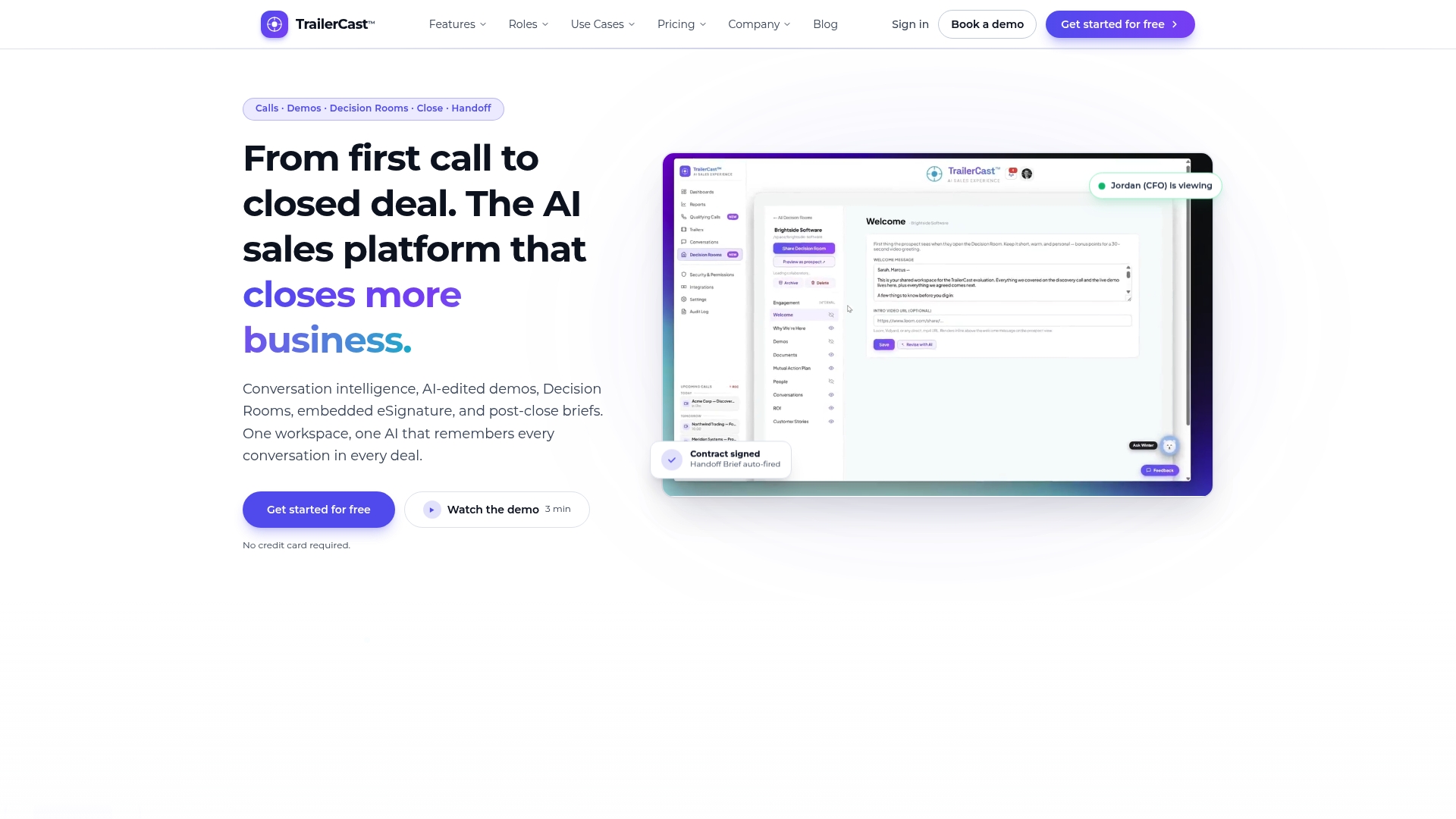
From a real sales call, an AI builds a short, stakeholder-specific trailer, one cut for the CFO on runway and pricing, another for the CISO on security, so your champion has something worth forwarding instead of a full recording. Every deal also gets a decision room where the buying committee can review ROI, track who opened what, and keep the conversation alive between calls, plus an automatic handoff brief when a contract signs. It runs on one plan with every feature included, starting from $59 per seat per month billed annually, with a free trial and no credit card required. Compare pricing and start a trial on the TrailerCast pricing page.
Sources
- From the CFO seat: Five questions to ask in your next FP&A demo
- Book a Demo — See CentSight’s AI CFO in Action | CentSight
FAQ
What Should a New CFO Do First When Evaluating FP&A Tools?
Start by mapping which decisions the tool needs to support, cash runway, board reporting, scenario planning, before booking a single demo. Then request a session that uses your real assumptions or a close analog, not the vendor’s polished sample.
What Is a Good Dashboard for a CFO?
A good CFO dashboard shows cash runway, burn, receivables aging, and forecast-to-actual variance with the ability to drill from any number down to its source transaction. According to a recent CFO dashboards masterclass, the dashboard should tell a decision narrative, not just display static charts.
How Do I Run an Effective Demo for CFO Stakeholders?
Bring the controller, FP&A lead, and a technical contact, and hand the vendor a realistic scenario, like a cash runway model with a customer concentration issue, before the call. Ask the five core questions about assumption changes, flexibility, and logic ownership live, rather than accepting a scripted answer afterward.
How Much Does TrailerCast Cost?
TrailerCast runs on one plan with every feature included, starting from $59 per seat per month billed annually, with a free trial and no credit card needed.
What Is a CFO’s Average Salary?
Average CFO compensation varies widely by company size, industry, and region, and no single figure applies across the board. Rather than rely on a generic number, check a current salary survey specific to your industry and company stage before benchmarking your own comp or a candidate’s offer.