4 Touch Async Demo Follow Up That Escalates On Signals for B2B Sales

The best async demo follow up is a short, personalized video sent within two hours of the call, followed by a tight four-touch cadence over about ten days. The video keeps the demo’s momentum alive and gives your champion something they can actually forward. From there, how fast you escalate to a live conversation should depend on what the prospect does with what you send, not on a fixed script.
TL;DR:
- Sending a personalized, short recap video within two hours of the demo maintains momentum and serves as a shareable resource for stakeholders.
- Async demos are best suited for educating stakeholders, removing scheduling barriers, and supplementing real-time discussions that focus on technical or pricing negotiations.
- Matching async formats to the audience—such as executive trailers, interactive feature demos, or stakeholder-specific clips—enhances engagement and reduces production time.
- A structured follow-up cadence of five touches over ten days, with clear messages and single calls to action, significantly improves deal progression.
- Tracking engagement signals like view count, rewatch frequency, and shares allows prioritization of prospects for timely, personalized outreach.
Table of Contents
- When to use async demos vs live demos
- Async demo formats and which one fits each follow-up goal
- Post-demo cadence, exact messaging templates, and timing
- Engagement tracking, signal-driven prioritization, and trigger rules to go live
- A practical workflow: async follow-up built around TrailerCast
- Why async-first follow-up is the right default, not a shortcut
- TrailerCast: run this entire workflow from one workspace
- FAQ
- Sources
When to use async demos vs live demos
Async and live demos aren’t competing formats. They solve different problems at different moments in the buying process, and mixing them up is where a lot of good demos go to die quietly in someone’s inbox.
Live demos earn their place when you need real-time back-and-forth: discovery calls where you’re still figuring out what the prospect actually needs, technical scoping sessions, or negotiation conversations where objections need to be handled on the spot. Async shines everywhere else, especially in the stretch between calls where most deals actually stall.
- Use async to educate stakeholders who weren’t on the original call, especially the CFO or CISO your champion has to convince without you in the room.
- Use async to remove scheduling friction when a quick recap beats waiting a week for calendars to align.
- Use live demos when the conversation needs real-time problem-solving, like custom technical questions or pricing negotiation.
Here’s the nuance that trips up a lot of sales teams: buyers increasingly want to self-serve, but they still lean on reps to validate what they’re seeing. Gartner’s May 2026 survey found that 70% of B2B buyers prefer a fully self-service buying experience, yet 69% still turn to sales reps to validate AI-generated insights, and buyers used an average of seven information sources during a recent purchase. Async doesn’t replace you. It gives the buyer room to explore on their own terms while keeping you available for the moment they need confirmation.
Async demo formats and which one fits each follow-up goal
Not every async format does the same job, and picking the wrong one for the moment wastes both your production time and the prospect’s attention. Match the format to who’s watching and what they need to walk away knowing.
- Short trailer or clip (60 to 90 seconds): best for executive stakeholders who need the headline, not the full tour, especially a CFO or VP who only cares about ROI and risk.
- Interactive click-through demo: gives technical evaluators a self-paced way to explore specific features without scheduling a second call.
- Self-guided sandbox: lets hands-on users, like a CISO’s security team or a power user, validate claims by actually touching the product.
- Stakeholder-specific clips: a CFO version that leads with pricing and payback, a CISO version that leads with security and compliance, built from the same underlying demo.
Production trade-offs matter here. A full sandbox takes real setup time and permissions work, and most prospects won’t finish a 20-minute tour if you send one unprompted. A tracked async video built from your actual call footage takes minutes to produce and respects the fact that most stakeholders are skimming, not studying. Practitioner guidance on video prospecting backs this up: short trailers win for executive buy-in, while stakeholder-specific clips consistently outperform longer, one-size-fits-all recordings because personalization matters more than runtime.
Post-demo cadence, exact messaging templates, and timing
Most deals don’t die because the demo went badly. They die in the quiet stretch afterward, when no one follows up with enough structure to keep momentum going. A disciplined cadence fixes that, and RAIN Group research cited by Sendspark found that 80% of sales require at least five follow-up touches after a first meeting, which makes a loose “I’ll check in next week” approach a losing strategy.
Here’s the cadence we recommend, adjusted for deal size and urgency:
- Day 0 (within two hours): send a short recap video, 60 to 90 seconds, summarizing what you heard and what you’re sending next.
- Day 2: share a proof point, a relevant case study, or a stakeholder-specific clip addressing a concern raised on the call.
- Day 5: ask directly about the blocker. What’s standing between them and a decision?
- Day 10: a clear breakup message that closes the loop without burning the relationship.
Day 0 template: keep the video to 60 to 90 seconds. Thank them for the time, recap the one or two things that mattered most, and tell them exactly what you’re attaching, whether that’s a pricing breakdown or a security one-pager. The email around it can be two lines: “Here’s a quick recap of what we covered, plus the trailer your team can forward internally.” Practitioner data from Sendspark suggests personalized video follow-ups often convert better than plain text, and sending quickly increases reply rates.
Day 2: lead with proof, not more pitching. “Thought this case study was relevant given what you mentioned about [specific pain point].” One sentence, one link, one clear ask: did this land?
Day 5: stop being polite about it. “What’s the biggest open question on your end right now?” Direct, short, and it gives you real information instead of silence.
Day 10: the breakup email works because it’s honest. “I don’t want to keep filling your inbox if the timing isn’t right. If priorities shift, I’m here.” It often gets more replies than the three touches before it.
Pro Tip: Give each touch exactly one call to action. A message asking for feedback, a meeting, and a document review all at once gets ignored.

Engagement tracking, signal-driven prioritization, and trigger rules to go live
Not every prospect needs the same follow-up speed, and treating them all the same is how reps burn time on cold leads while hot ones go quiet. The fix is watching behavior, not guessing from gut feel.
- View count and time-to-first-play: a prospect who opens your video within an hour is signaling real interest.
- Watch percent: someone who makes it through 90% of a 90-second clip watched the whole thing on purpose.
- Repeat views: watching the same section twice usually means they’re showing it to someone else internally or double-checking a detail.
- Shares and stakeholder-level activity: when your champion forwards a clip to a new name, that’s your clearest signal the deal is multi-threading.
Personalized video follow-ups convert 2 to 3 times better than plain text outreach, which is exactly why tracking who watches, rewatches, and shares your video matters more than tracking email opens ever did.
If the clip gets shared to a name you don’t recognize, that’s your cue to invite the new stakeholder into a shared space and surface the clip built specifically for their role. Pairing these signals with CRM events, like a deal sitting untouched for five days, lets you prioritize who gets a phone call today instead of sending the same generic nudge to everyone in the pipeline.
A practical workflow: async follow-up built around TrailerCast
Here’s what this looks like when the entire sequence runs through one system instead of five disconnected tools. The workflow mirrors the cadence above, but the manual work of clipping, tracking, and chasing signals happens automatically.
- Call capture: an AI notetaker joins the demo call, transcribes it speaker by speaker, and flags qualification details and action items without anyone taking manual notes.
- Moment detection and trailer creation: the system picks the eight to fifteen minutes that actually mattered from the recording and stitches them into a branded trailer with intro and outro slides, ready to send same day.
- Stakeholder-specific trailers: a CFO version leading with pricing sits alongside a CISO version leading with security, built from the same call so nothing gets lost in translation.
- Decision room with tracked engagement: one no-login space per deal shows who viewed the trailer, how much they watched, and who it got forwarded to, turning the attribution guesswork into an actual tree.
- Close and handoff: once the room reaches agreement, embedded eSignature closes the deal, and a handoff brief fires automatically to the team that owns the account next.
The point isn’t the individual features; understanding how AI transforms sales enablement for sales leaders is key to optimizing these workflows. It’s that the signal tracking described above, watch percent, repeat views, stakeholder shares, becomes visible in one place instead of scattered across a video tool, a deal room, and a spreadsheet someone forgets to update.
Why async-first follow-up is the right default, not a shortcut

The sellers who win multi-stakeholder deals aren’t the ones who talk the most. They’re the ones who show up exactly when a buyer needs confirmation and stay out of the way otherwise. An async demo sent within two hours of the call does something a scheduled follow-up call can’t: it reaches the CFO and the CISO before your champion has to reconstruct your pitch from memory, and it frees you to spend your limited synchronous time on the handful of conversations that actually need a human in the room.
That’s the real argument for async-first follow-up. It’s not about doing less work. It’s about putting your attention where a live conversation changes the outcome, and letting a well-made recording do the job of sitting in a chair repeating yourself.
— Daniel
TrailerCast: run this entire workflow from one workspace
We built TrailerCast because the problem was never the calls themselves, it was everything that happened in the space between them: a champion walking into a budget meeting with a PDF, a CISO stuck rewatching a 45-minute recording for a two-minute answer, a deal going quiet because no one tracked who actually opened the follow-up. Instead of stitching together a call recorder, a video editor, a deal room, an e-signature tool, and a handoff doc, everything we described above runs in one place.
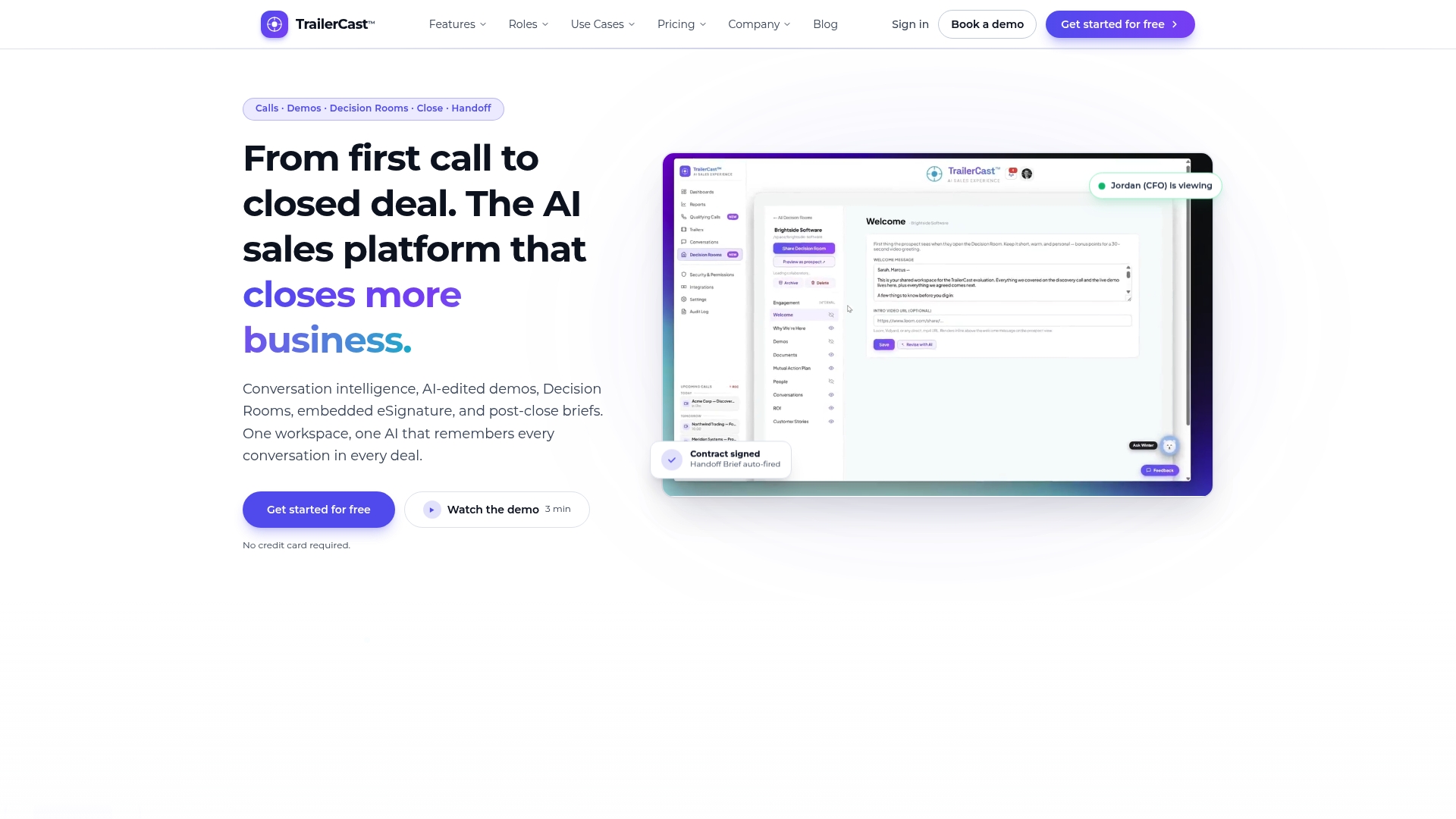
- One AI brain follows the deal from first call to signature, so nothing gets lost in a tool switch.
- Trailers get built automatically from your real call recordings, no separate editing software required.
- Decision rooms track exactly who watched, rewatched, and shared, so you know who to call and when.
We offer one plan with every feature included, with pricing details available on our website, including a free trial and no credit card required. If you want to see how the whole deal lifecycle looks in one workspace, start a trial today at Trailercast.
FAQ
What is an asynchronous meeting?
An asynchronous meeting replaces a live, scheduled call with content participants review on their own time, such as a recorded video update, a written summary, or an interactive demo. It lets people contribute or absorb information without everyone needing to be online simultaneously, which matters most when stakeholders span time zones or busy calendars.
What are some examples of asynchronous work?
Common examples include recorded video updates, shared documents with comment threads, project management tools where tasks and status updates happen on each person’s own schedule, and recorded demo trailers sent for later review. In sales specifically, a short recap video sent after a call is a direct example of async work replacing a status meeting.
What does “async first” mean?
“Async first” means defaulting to non-live communication, like a recorded video or written update, before scheduling a live call, reserving synchronous time for conversations that genuinely need real-time back-and-forth. In sales follow-up, that means sending a short video recap before booking another meeting, and only escalating to a call when engagement signals suggest the prospect needs direct conversation.
Is email asynchronous or synchronous?
Email is asynchronous: the sender and recipient don’t need to be present at the same time, and replies can come minutes, hours, or days later. That’s part of why pairing email with an embedded async video, rather than relying on text alone, tends to perform better for post-demo follow-up, since personalized video follow-ups convert 2 to 3 times better than plain text.
How soon after a demo should I send a follow-up?
The strongest practice is sending a short recap within two hours of the call, while the conversation is still fresh for everyone involved. Practitioner guidance recommends a same-day recap followed by touches on Day 2, Day 5, and Day 10 to keep momentum without overwhelming the prospect’s inbox.
Sources
- Gartner Survey Finds 69% of B2B Buyers Turn to Sales Reps to Validate AI-Generated Insights
- Gartner: AI is reshaping B2B buying but human sellers still close the confidence gap
- Post-Demo Follow-Up Templates That Close Deals | Sendspark