10–20 Deal Pilot: Prove Attribution in Deal Cycles for RevOps

Attribution in deal cycles means tracking which interactions, content, stakeholders, and seller actions inside a single opportunity actually moved it forward or stalled it out. The immediate next step is simple: turn on stakeholder share and engagement tracking inside your active deals today. Do that inside a unified workspace with conversation intelligence and share tracking built in, and this becomes a practice instead of a guessing game.
TL;DR:
- Tracking stakeholder shares and engagement inside deals is essential, especially for hidden influencers who impact decision outcomes without direct contact.
- Recording key events like meeting transcripts, demo views, and contract actions with timestamps and stakeholder metadata provides the necessary signals for attribution.
- Employing combined scoring, sequence verification, and stakeholder influence mapping improves accuracy in determining what moves a deal forward.
- Integrating deal attribution into a unified workspace with automated data syncs ensures adoption and actionable insights without replacing existing CRM systems.
Table of Contents
- Why deal-level attribution matters now
- What to track inside a deal
- How to measure attribution in deals
- Operationalizing attribution in your stack
- Checklist and KPIs for a pilot
- Turning attribution into a repeatable revenue capability
- Run deal-level attribution inside one workspace
- FAQ
- Sources
Why deal-level attribution matters now
Here’s the problem every sales leader already knows in their gut: the deal doesn’t die on the call. It dies in an internal meeting you weren’t part of, where a CFO who never saw your demo asks a question nobody can answer. Buying groups are the reason. Multiple people with different priorities have to reach internal consensus before a contract gets signed, and most of them never talk to your rep directly.
This is where hidden influencers come in, and research backs up why they matter. Edelman and LinkedIn’s research found that hidden decision-influencers are more likely to champion a vendor when that vendor publishes strong thought leadership, and many say it directly helps them convince executives internally. Give your champion something worth forwarding, and they’ll do the selling for you.
Sellers aren’t obsolete in this picture, either. A Gartner survey found that A majority of B2B buyers turn to sales reps to validate AI-generated insights before trusting them. Buyers research on their own, then still want a human to confirm what they found.
What this means for your attribution strategy:
- Hidden stakeholders influence outcomes even when they never join a call.
- Shareable, role-specific content turns a quiet influencer into a visible advocate.
- Rep touchpoints still validate buyer research, so conversation data stays central to any attribution model.
What to track inside a deal
You can’t attribute what you never captured. Most teams lose the signal because it lives in someone’s inbox, a forwarded Slack thread, or a conversation nobody recorded. Prioritize the events that actually correlate with progression, not every click you can technically log.
- Meeting transcripts, tagged by speaker, with specific quotes linked to objections raised or commitments made.
- Demo trailer views, including who watched, how far they got, and who forwarded the clip to someone else.
- Decision Room activity: document opens, comments, and forward events inside the shared deal space.
- Contract and negotiation events: eSignature actions and mutual action plan updates, timestamped.
- Engagement depth signals: play-to-end rate on video, time spent on a document, reply and comment counts.
- Stakeholder metadata: role, influence type (champion, blocker, economic buyer), and a rough sentiment or qualification tag.
A stakeholder mapping template helps you structure this before the data even starts flowing, so you know which roles you’re watching for before the deal is three calls deep.
Pro Tip: Track forward events before you track views. Knowing who shared something with whom tells you more about internal influence than knowing who simply opened it.
How to measure attribution in deals
Once you’re capturing the right events, you need a model that turns them into something your pipeline reviews can actually use. Three approaches work together better than any one alone.
- Event-scoring model: assign weights to actions. A CFO opening your ROI document might score higher than a generic page view; a forward to a new stakeholder might outscore a reply.
- Temporal sequence checks: confirm an event happened before a stage change, not after. A document opened the day after a deal already moved to “negotiation” isn’t the reason it moved.
- Stakeholder-weighted attribution trees: map who shared what with whom, and weight influence by role. The Program on Negotiation at Harvard recommends mapping stakeholders and their interests as a matrix, which is effectively the same exercise applied to deal data instead of a negotiation table.
- Hybrid rules: combine score and sequence so a high-scoring event that happened out of order doesn’t get credit it didn’t earn.
None of this works without clean data underneath it. You need accurate timestamps, identity resolution that merges a meeting participant with their email and their Decision Room login, searchable transcript text, and share metadata that records who forwarded what to whom. Skip any one of these and your attribution tree has gaps you can’t see.
Operationalizing attribution in your stack
Getting this running is a four-step sequence: instrument your calls and shared content, normalize and enrich that data with stakeholder roles, sync the resulting signals to your CRM, and automate the handoff actions that follow a stage change.
Ownership matters as much as the tooling. RevOps typically owns the data model, sales ops enforces how reps log and share content, and someone needs to own data stewardship so stakeholder records don’t rot. Sellers need a short training pass on why this matters, or the instrumentation becomes one more thing they ignore.
Your integration checklist should cover:
- Transcript capture on every call, not just the demos.
- Share and forward tracking on any content a rep sends.
- Decision Room metadata: who accessed what, and when.
- eSignature hooks tied to contract events.
- CRM stage events synced in both directions.
This is exactly the gap a workspace like TrailerCast is built to close. It offers an AI notetaker that captures transcripts and summaries automatically, demo trailers with forward tracking, and Decision Rooms that log engagement trees and document access. Syncing action items from calls into your CRM is covered in more detail in post-meeting action items.
Pro Tip: Before you instrument anything, confirm your call recording and document sharing comply with consent requirements in the jurisdictions you sell into. Attribution data is only useful if it’s legally defensible.
Checklist and KPIs for a pilot
Run this as a pilot before you roll it out company-wide:
- Pick ten to twenty active deals with multiple stakeholders already engaged.
- Instrument every call and Decision Room tied to those deals.
- Define your event scores and sequence rules before the pilot starts, not after.
- Watch for stage moves and check whether a scored event actually preceded each one.
Track these core KPIs: the percentage of deals with tracked shares, the time between a key signal and the next stage move, the champion-forward conversion rate, and your attribution precision, meaning how often a flagged event turns out to be a false move. When precision holds steady across a second batch of deals, you’re ready to scale the instrumentation to the full pipeline.
Turning attribution into a repeatable revenue capability
The instinct is always to instrument everything and build a dashboard nobody opens. I’ve watched teams drown their own pilots in data points nobody could act on in a weekly deal review. Start with the handful of signals that actually precede a stage move, not the ones that are easiest to log.
Adoption is the real constraint, not the data model. If a rep has to open three tools to log a forward, they won’t. Build the workflow into the one place they already work.
— Daniel
Run deal-level attribution inside one workspace
Every capability this guide covers maps to related features: an AI notetaker handles transcripts and summaries, demo trailers have forward tracking, Decision Rooms log engagement trees and document activity, and embedded eSignature closes the loop without a separate tool. 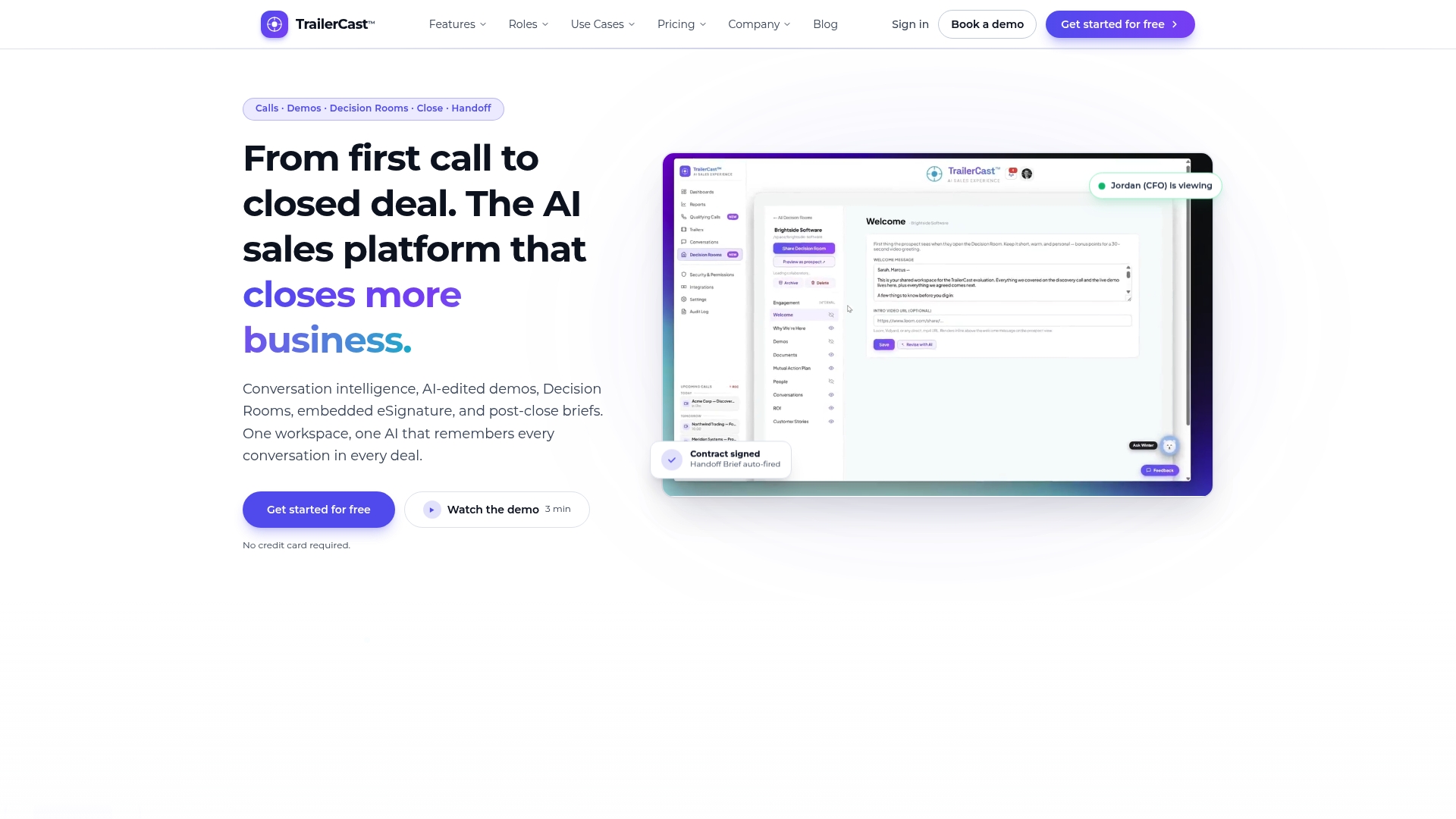
Full feature-by-stage detail lives on the TrailerCast features page. Pricing is one plan with every feature included, from $59 per seat per month billed annually, with a free trial and no credit card required. Start a trial and instrument your next ten deals before you decide whether to scale it.

FAQ
What is deal-level attribution in sales?
Deal-level attribution tracks which interactions, content shares, and stakeholder actions inside one opportunity actually drove it toward close. It’s different from marketing attribution, which credits channels across many prospects over time.
Why do hidden stakeholders matter for deal attribution?
Hidden stakeholders often decide a deal’s fate without ever joining a call, and research from Edelman and LinkedIn found they’re more likely to champion a vendor whose thought leadership helps them make the case internally. Tracking who shares content with whom surfaces these people before the deal stalls.
What’s the minimum data needed to run an attribution model?
You need accurate timestamps, identity resolution across emails and meeting participants, searchable transcript text, and share metadata showing who forwarded what. Without identity resolution in particular, you can’t build a reliable stakeholder-weighted tree, a method the Program on Negotiation at Harvard recommends for mapping stakeholder interests.
Does TrailerCast replace my CRM for attribution tracking?
No, TrailerCast captures the in-deal signals, conversation intelligence, demo trailer forwards, and Decision Room engagement, and syncs them into your CRM rather than replacing it. Details on how each feature maps to the deal lifecycle are on the TrailerCast features page.
How long should a deal-level attribution pilot run?
Most teams can validate a pilot across ten to twenty active deals within one sales cycle, checking whether flagged events actually preceded stage moves. If attribution precision holds up on a second batch of deals, that’s a reasonable signal to expand instrumentation pipeline-wide.
Sources
- 2025 Edelman-LinkedIn B2B Thought Leadership Impact Report
- Gartner press release: 69% of B2B buyers turn to sales reps to validate AI-generated insights
- Simplify complex negotiations with stakeholder alignment — PON (Harvard)