Buyer Enablement: The 2026 Guide for B2B Sales Teams

What is buyer enablement, and why does it flip the script on traditional selling?
Buyer enablement is the practice of giving B2B buyers the information, tools, and expert guidance they need to evaluate a solution and make a confident decision, on their own terms and timeline. Gartner defines it as "the information and tools provided to buyers to help them complete critical buying tasks faster and more easily." That definition matters because it centers the buyer, not the seller.
Three principles anchor the whole discipline:
- Independent exploration: Buyers can research, ask questions, and make progress without waiting for a scheduled sales call.
- Continuous expert access: Accurate, expert-level explanation stays available throughout the entire evaluation, not just during the fraction of time a rep is present.
- Governed accuracy: Every piece of information buyers encounter is sales-approved and consistent, not left to chance or ungoverned internet searches.
The distinction from sales enablement is worth being direct about. Sales enablement equips sellers with training, content, and tools for live conversations. Buyer enablement equips buyers for the much larger portion of the journey that happens without any seller in the room. Both matter. But if you’re only investing in one, you’re leaving the majority of the buying process unaddressed.
The payoff is real: shorter cycles, higher pipeline quality, and far fewer late-stage surprises when a deal stalls because a CFO you never met wasn’t convinced.
Table of Contents
- How leading B2B companies put buyer enablement into practice
- Why buyer enablement has become essential in complex B2B sales
- How to enable buyers at each stage of their journey
- How AI and technology are changing what buyer enablement can do
- What sales teams actually need to execute buyer enablement well
- Common pitfalls in buyer enablement and how to avoid them
- Trailercast covers the space between your sales calls
- Key Takeaways
How leading B2B companies put buyer enablement into practice
The gap between knowing buyer enablement matters and actually doing it is wide. These examples from recognized B2B companies show what it looks like when it works.
- Wistia offers a self-paced product demo directly on its website, letting prospects move through the experience at their own speed without ever talking to a rep.
- Grainger lets site visitors browse digital catalogs, click into product details, and add items to a cart, turning a traditionally rep-heavy industrial purchase into a self-service experience.
- Oyster publishes more than 50 country hiring guides that document labor requirements and calculate employment costs, giving HR buyers the information they need to evaluate independently.
- Notion features a gallery of more than 10,000 community-built templates, letting prospects explore real use cases before committing.
- GE HealthCare allows site visitors to shop for medical equipment and parts at prices starting above $15,000, a remarkable example of high-stakes self-service buying.
What these examples share is governance and visibility. The content isn’t just published and forgotten. It’s designed to answer specific buyer questions, tracked for engagement, and connected to the next step in the purchase process. That combination of self-service access and structured guidance is what separates real buyer enablement from a content library nobody uses.
Why buyer enablement has become essential in complex B2B sales
The math on modern B2B buying is stark. B2B buyers spend only 17% of their total buying time in direct contact with vendors. The other 83% is self-directed research, internal discussion, AI-assisted evaluation, and peer consultation. When a buyer is considering three vendors, each one gets roughly 5–6% of the buyer’s total attention.

That number alone should reshape how you think about your sales motion.
67% of B2B buyers now prefer a rep-free buying experience, according to Gartner’s research. At the same time, buyers are initiating contact earlier: the point of first contact shifted from 69% into the buying journey in 2024 to 61% in 2025, roughly 6–7 weeks earlier. Why? Buyers are seeking vendor validation for AI-generated insights they’ve already gathered on their own.
The risk of doing nothing is concrete. 86% of B2B purchases stall at some point during the process, and 81% of buyers report dissatisfaction with their chosen provider. Ungoverned self-education is a major driver: buyers who piece together information from scattered sources develop confident but inaccurate mental models of your solution. By the time a rep gets back in the room, the damage is done.
Buyer enablement addresses this directly. When buyers have governed, accurate information available throughout their evaluation, they build consensus faster, stall less often, and arrive at final decisions with fewer unresolved objections.
How to enable buyers at each stage of their journey
Gartner’s research makes a compelling case for abandoning the linear funnel. Successful sales organizations focus on cataloging buying jobs, the discrete tasks buyers must complete, rather than mapping a sequential journey. Buyers revisit these jobs repeatedly and in no fixed order.
The core buying jobs and how to support them
- Problem identification: Buyers need to articulate the business problem clearly enough to justify a purchase. Provide diagnostic tools, benchmark reports, and ROI frameworks that help them quantify the gap.
- Solution exploration: Buyers evaluate categories and approaches before comparing vendors. Self-paced demos, interactive product tours, and comparison guides serve this job well.
- Requirements building: Buying committees need to align on what they actually need. Offer configuration tools, technical documentation, and stakeholder-specific content (a security brief for the CISO, a financial summary for the CFO).
- Risk mitigation: Every stakeholder has a different fear. Executive summaries, ROI calculators, and reference case studies help internal champions address those fears without a rep in the room.
- Supplier selection: Buyers need to justify their final choice internally. Provide proposal templates, competitive comparison frameworks, and clear mutual action plans.
A practical roadmap for building your buyer enablement strategy
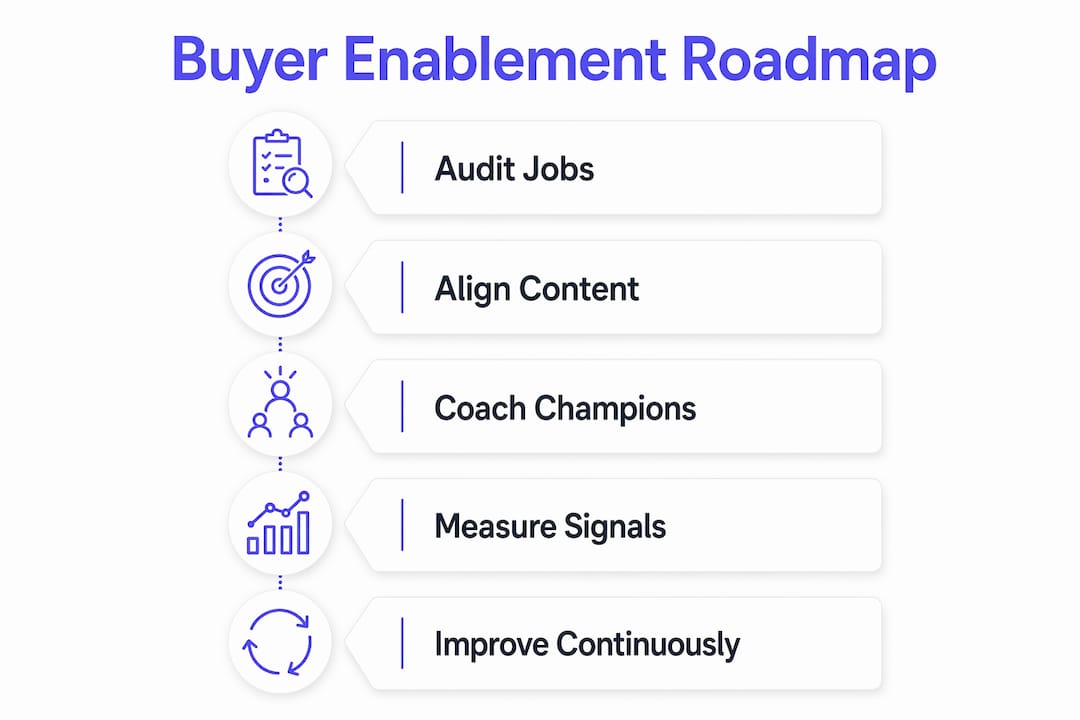
| Step | Action | Key metric |
|---|---|---|
| 1. Audit buying jobs | Interview recent buyers to map the tasks they completed | Jobs identified per deal type |
| 2. Identify content gaps | Match existing assets to each buying job | Gap coverage rate |
| 3. Build governed content | Create or update assets with sales-approved accuracy | Content accuracy score |
| 4. Deploy digital workspaces | Give each deal a persistent, stakeholder-accessible room | Engagement per stakeholder |
| 5. Measure and iterate | Track which content accelerates deals and which stalls them | Time-to-close, stall rate |
The alignment between sales and marketing is where most teams fall short. Marketing tends to produce content for awareness; sales needs content for evaluation. Closing that gap requires shared definitions of the buying jobs and shared ownership of the assets that serve them.
Pro Tip: Build content for the people who weren’t on the call. Your champion will forward your materials to a CFO, a CISO, or a procurement lead who has never heard your pitch. If those assets require a live explanation to make sense, they will fail at the moment they matter most.
How AI and technology are changing what buyer enablement can do
The technology available for buyer enablement in 2026 is genuinely different from what existed two years ago. AI hasn’t just made existing tools faster; it’s enabled entirely new categories of buyer support.
- Conversation intelligence captures every call, extracts key moments, and builds a running deal brief that spans the entire opportunity, not just the last meeting.
- AI-edited demo trailers take a full demo recording and automatically produce a 8–15 minute highlight reel, personalized per stakeholder. A CFO gets the pricing story; a CISO gets the security posture. Your champion has something worth forwarding instead of a recording nobody will rewatch.
- Digital sales rooms give every deal a persistent, branded workspace where the buying committee can explore content, ask questions, and track progress, all without logging in or scheduling a call. Modular, updatable digital content supports stakeholders who missed the original demo.
- Asynchronous expert Q&A lets buyers ask specific questions and get governed, accurate answers without waiting for a rep to be available.
- Engagement analytics show which stakeholders viewed which content, for how long, and what they shared internally, giving sales teams real signal on where a deal actually stands.
The business case for this investment is clear. Industrial B2B firms applying generative AI to customer-facing initiatives report 25% higher revenue over five years compared to those focusing AI only on internal productivity.
Unified platforms matter here. Fragmented toolsets, one tool for calls, another for video, another for deal rooms, create gaps where buyer context gets lost. The most effective approach is a single workspace where the AI follows the entire deal from first call to signed contract. You can explore how integrated AI sales tools handle this across the full deal lifecycle.
Pro Tip: Design every piece of buyer-facing content to be modular and forwardable. A five-minute stakeholder-specific video clip travels further inside a buying committee than a 45-minute recording. Build for the share, not just the view.
What sales teams actually need to execute buyer enablement well
Buyer enablement doesn’t run itself. Sales teams need specific skills, habits, and resources to make it work in practice.

Content fluency is the starting point. Reps need to know what assets exist, which ones serve which buying jobs, and how to deploy them at the right moment. That means a well-organized, searchable content library, not a shared drive with 400 files and no labels. An AI-ranked sales library that surfaces the right asset per deal removes the guesswork.
Champion coaching is underinvested in most sales orgs. Your champion is the one carrying your message into rooms you’ll never enter. Training reps to coach champions, how to brief a CFO, how to handle a procurement objection, how to run an internal demo, is one of the highest-leverage activities in a complex sale. Explore how discovery call intelligence can surface champion coaching moments automatically from recorded conversations.
Cross-functional alignment between sales and marketing requires more than a shared Slack channel. Teams need agreed definitions of the buying jobs, shared ownership of the content that serves them, and a feedback loop so marketing knows which assets actually move deals. Sales team collaboration tools have matured significantly, making this coordination more tractable than it was even two years ago.
Finally, measurement literacy matters. Reps who understand which engagement signals predict deal progression, time spent in a decision room, content forwarded to new stakeholders, questions asked asynchronously, can prioritize their time far more effectively than those flying blind.
Common pitfalls in buyer enablement and how to avoid them
Most buyer enablement programs fail for predictable reasons. Knowing them in advance saves a lot of wasted effort.
Ungoverned content is worse than no content. When buyers encounter conflicting information across your website, your sales deck, and your champion’s forwarded email, they lose confidence in your solution. Governed buyer enablement platforms ensure every explanation is sales-approved and aligned with actual solution capabilities. Build a review process and stick to it.
Treating buyer enablement as a content dump. Publishing 200 assets doesn’t enable buyers; it overwhelms them. The goal is to map the right content to the right buying job at the right moment. If your buyer has to search for what they need, you’ve already lost the plot.
Ignoring the buying committee. B2B buyers are 1.8 times more likely to complete a high-quality deal when they engage with supplier-provided digital tools alongside a sales rep rather than independently. But most sales teams only enable the champion. Every stakeholder in a 3–7 person buying committee has different questions, different fears, and different definitions of value. Enable all of them.
Measuring the wrong things. Content views and email opens tell you very little about deal health. Track stakeholder-level engagement: who in the buying committee viewed which content, what questions they asked, and whether the champion is actively sharing materials internally. That’s where the real signal lives.
Skipping the feedback loop. Buyer enablement is a continuous process, not a one-time build. Win/loss interviews, deal retrospectives, and engagement data should feed back into your content and process on a regular cadence. Without that loop, you’re optimizing for last year’s buyers.
Trailercast covers the space between your sales calls
Most sales teams have the calls covered. What they’re missing is everything that happens after the rep hangs up: the internal meeting the champion runs without you, the CFO who needs a financial summary nobody sent, the CISO who has security questions buried in a recording nobody will rewatch.
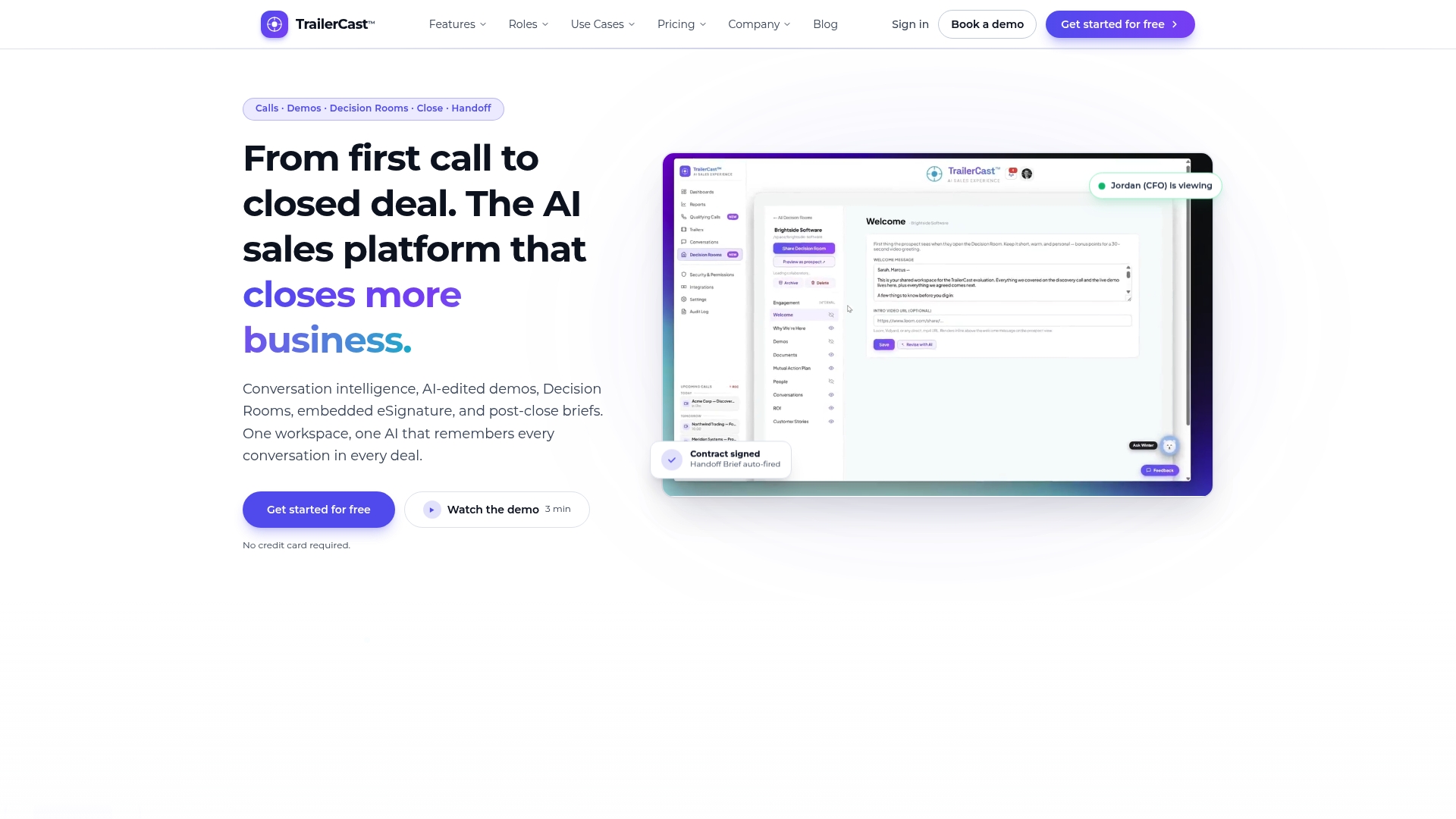
Trailercast is built specifically for that space. It’s a single AI workspace that covers the full deal lifecycle: conversation intelligence on every call, AI-edited demo trailers personalized per stakeholder, branded decision rooms where your buying committee can explore content and ask questions asynchronously, embedded eSignature, and an AI-generated handoff brief the moment the contract signs. One platform instead of five disconnected tools, at $79/seat/month (or $59 billed annually) with no feature gating and no credit card required for the free trial.
If you’re running deals with 3–7 person buying committees and losing ground in the space between conversations, see how Trailercast works and start a free trial today.
Key Takeaways
Buyer enablement works because it governs the 83% of the buying journey that happens without a sales rep present, giving buyers accurate, expert-level information exactly when they need it.
| Point | Details |
|---|---|
| Buyers are mostly self-directed | B2B buyers spend only 17% of their time with vendors; the other 83% is independent research and internal discussion. |
| Rep-free preference is rising | 67% of B2B buyers prefer a rep-free buying experience in 2026, making governed self-service content a competitive requirement. |
| Buying jobs beat linear funnels | Gartner’s framework shows buyers revisit problem identification, solution exploration, risk mitigation, and supplier selection repeatedly and out of order. |
| AI multiplies buyer enablement reach | Generative AI applied to customer-facing initiatives delivers 25% higher revenue over five years compared to productivity-only AI investment. |
| Trailercast owns the space between calls | Trailercast combines conversation intelligence, AI demo trailers, and decision rooms in one platform to keep buyers informed and engaged throughout the full deal cycle. |