2.4 Signals Per Demo: Why RevOps Must Stack Buyer Engagement Signals

The highest-value buyer engagement signals are stacked ones: a buyer who fits your ideal customer profile, keeps returning to decision-stage topics like pricing or security, and shows up alongside a timing trigger like a funding round or leadership change. When you see that combination, multi-thread the account immediately and respond within hours, not days. A single signal, acted on slowly, rarely saves a deal that’s already stalling.
TL;DR:
- High-value signals involve multiple stakeholders engaging with decision-stage content in a short timeframe, especially around key triggers like funding or leadership change.
- Responding within 24 hours to medium- and high-intent signals, such as pricing requests or stakeholder involvement, significantly increases deal closure chances.
- Tracking combined signals across verbal cues, digital behavior, product usage, and external events provides a clearer picture of buying intent than relying on isolated metrics.
- Speed of acknowledgment directly correlates with success, with reps closing 2.1 times more deals when acting within 15 seconds of a signal.
- Using a unified signal store and automating immediate outreach tasks improves responsiveness and prevents deals from stalling due to fragmented data.
Table of Contents
- Key Buyer Engagement Signals to Watch Across Channels
- How to Interpret and Prioritize Signals
- Action Playbook: Roles, SLAs, and Scripts for Signal Response
- Research and Proof: Why These Practices Work
- What Most Teams Get Wrong About Buyer Signals
- Where TrailerCast Fits in Your Signal Stack
- FAQ
- Sources
Key Buyer Engagement Signals to Watch Across Channels
Buyer engagement signals show up in four distinct places, and most teams only watch one or two. That gap is where deals quietly go cold.
On calls and demos, the clearest signals are verbal. A prospect asking about implementation timelines, naming specific integrations, or pushing for pricing detail is telling you they’ve moved past evaluation and into planning. So is the moment they loop in a colleague mid-call, which is early multi-threading in action.
Web and digital behavior tells a parallel story. Repeated pricing page visits, time spent on security or compliance documentation, use of an ROI calculator, and downloads of comparison content all point to a buyer building an internal case, often for people who haven’t talked to you yet.
Inside your product, usage patterns matter just as much. Watch for:
- Activation milestones reached faster than your typical onboarding curve
- New seat invites sent without a prompt from your team
- API calls or integration setup started before a contract is signed
- Usage spikes or limit hits that suggest the trial is being stress-tested for a real rollout
Finally, third-party and trigger events add context that internal data can’t. A funding announcement, a new VP of Sales, an open RFP, a technographic shift away from a competitor, or a cluster of review-site activity all signal that something is changing inside the account, often right when buying urgency rises.
How to Interpret and Prioritize Signals
Not every signal deserves the same response. We’ve found it useful to score signals against five dimensions: depth, frequency, seniority, ICP fit, and timing.
- Depth asks how far into the decision the behavior reaches. Reading a blog post is shallow. Opening a security questionnaire is deep.
- Frequency tracks repetition. One pricing page visit is curiosity. Three visits in a week is intent.
- Seniority weighs who is acting. A director reaching out carries more weight than an individual contributor browsing alone.
- ICP fit checks whether the account matches your best-fit customer profile, since intent from a poor-fit account rarely converts.
- Timing looks for a trigger event, like new funding or a leadership change, that explains why now.
The difference between weak and strong signals is almost always stacking. A single visitor viewing your pricing page once is noise. A champion, a security lead, and a finance stakeholder all engaging with pricing and integration content in the same week, inside an account that just hired a new CTO, is a different conversation entirely.
Most teams benefit from defining a simple threshold: two or more stakeholders, engaging with decision-stage content, within a short window, counts as high intent and triggers immediate outreach. Below that, it’s a nurture signal, not an alert.
Call-analysis research found closed-won calls averaged 2.4 buying signals per demo, compared to 0.7 on closed-lost calls. That gap is the clearest evidence we have that stacking, not any single cue, separates deals that close from deals that stall.

Action Playbook: Roles, SLAs, and Scripts for Signal Response
Speed is the variable most teams underweight. Here’s a workable response structure:
- SDRs act on medium-intent signals within 24 hours, confirming interest and identifying additional stakeholders.
- AEs handle high-intent signals, like pricing or demo requests, same day or within 24 hours at the outside.
- Multi-thread outreach to named stakeholders within 48 hours of a buying-committee signal, rather than waiting for the champion to make introductions.
- Follow up on ambiguous dismissal language with a direct, open question like “Help me understand what specifically you want to think through,” which surfaces the real objection instead of letting it go unaddressed.
Coordination should be automatic where possible: auto-create CRM tasks when a signal fires, assign an owner immediately, and notify the team through Slack or email rather than relying on someone to check a report.
Pro Tip: Add signal recognition and response latency to your call-review rubric, not just talk-track adherence, so coaching reinforces the behavior that actually predicts wins.

Research and Proof: Why These Practices Work
Gartner’s research on the B2B buying journey found that buyers who use supplier-provided digital tools alongside a sales rep are 1.8 times more likely to complete a high-quality deal, which supports pairing instrumentation with fast human response rather than choosing one over the other.
Call-analysis data backs the speed argument directly:
Reps who acknowledged a buying signal within 15 seconds closed 2.1 times more often than reps who took over 30 seconds.
That’s from the same closed-won versus closed-lost call study, and it’s consistent with what we see in deal rooms: conversation intelligence catches the verbal signal, a demo trailer gets it in front of the stakeholder who wasn’t on the call, and a decision room shows you the moment they engage. Capturing the signal and acting on it fast are two separate disciplines, and most tooling only solves one.
What Most Teams Get Wrong About Buyer Signals
The most common mistake is chasing single passive metrics, like one pricing page visit, instead of waiting for a stacked pattern across people and channels. The second is treating signal detection as the finish line: teams build alerts, then let them sit in a queue for two days. Coach for acknowledgement speed, not just follow-up quality, and design your assets so that a champion can hand off a clear answer without reconstructing it from memory.
— Daniel
Where TrailerCast Fits in Your Signal Stack
We built TrailerCast because the signals were never the hard part. Catching them fast, and getting the right stakeholder the right context, was.
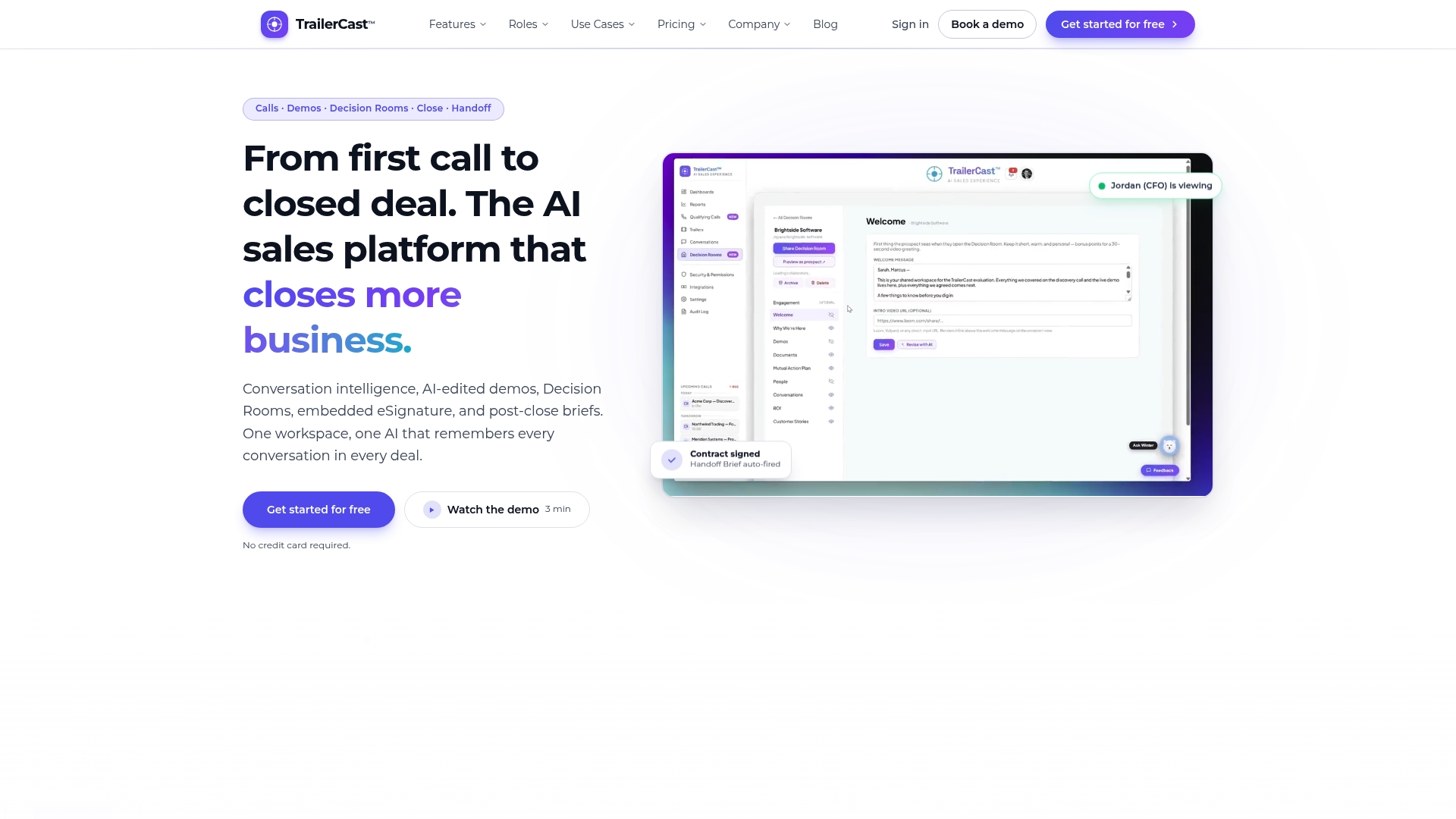
Our conversation intelligence picks up verbal signals the moment they happen on a call. Decision rooms surface who’s engaging and track interactions, making forwarding activity a visible signal instead of a guess. Demo trailers turn a single call into something a non-attendee can engage with, which is often where the next signal fires. Embedded eSignature closes the loop and feeds a handoff brief straight to the next team.
If you’re testing this, track signal density per deal, first-signal-to-acknowledge latency, and demo-to-win rate before and after. Start a free trial on our AI sales platform and see what changes when every signal lives in one workspace.
FAQ
What are some common buying signals?
Common buying signals include repeated pricing page visits, questions about implementation timelines, requests to add stakeholders to a call, and spikes in product usage during a trial. They matter most when several appear together rather than in isolation.
What are buyer intent signals?
Buyer intent signals are behaviors that suggest a prospect is actively evaluating a purchase, such as visiting decision-stage content, engaging multiple stakeholders, or responding to leading indicators that predict outcomes before lagging metrics move. They’re most reliable when weighted by depth, frequency, seniority, and fit.
What are some effective tactics for engaging customers?
Responding quickly to high-intent signals, personalizing follow-up content for specific stakeholders, and proactively multi-threading into the buying committee all tend to move deals forward. Gartner’s research notes that combining supplier digital tools with active seller outreach improves deal quality.
What are some examples of signals?
Examples span verbal cues like pricing questions on a call, digital behavior like security documentation views, product usage like seat invites during a trial, and external events like a funding announcement or new executive hire. 6sense’s 2025 Buyer Experience Report found buyers are forming preliminary preferences earlier, which makes catching these signals early more valuable than ever.
Sources
Buyer engagement signals live in at least five places: your CRM, conversation-intelligence transcripts, website analytics, product usage data, and third-party intent feeds. Each holds a piece of the picture, and none of them alone is reliable.
A few metrics are worth surfacing on every deal:
- The B2B Buying Journey: Key Stages and How to Optimize Them
- The Timeline for Influencing B2B Buyers Is Shrinking: Insights From 6sense’s 2025 Buyer Experience Report
The practical fix for fragmented dashboards is a canonical signal store: one place, usually the CRM or an engagement layer on top of it, where every signal lands regardless of source. From there, push lightweight tasks to reps rather than another dashboard to check. Adoption fails fastest when a rep has to log into a third tool to see what’s happening.
Guardrails matter too. Dedupe signals from the same source so one email thread doesn’t look like three separate events, and enrich firmographic data before scoring, so a poor-fit account with high web activity doesn’t get flagged as high intent.