Deal Review Framework: A Practical Guide for SaaS Sales Teams

A good deal review framework does one thing: it separates what you have verified about a deal from what you are assuming. Pick one deal, walk through a fixed set of evidence questions (buyer, problem, process, paper, risk), and leave with dated next steps. This guide gives you the framework, a checklist you can copy, a meeting cadence, and a way to turn the findings into coaching and a more honest forecast.
TL;DR
- A deal review inspects one deal in depth. A pipeline review scans the whole portfolio, and a forecast call defends a number. Mixing them hurts all three.
- Score every deal on five blocks: buyer, problem, process, paper, and risk. For each, record the claim, the evidence, the owner, and the next dated action.
- Run a weekly 1:1 on three to five deals, a short team triage for stuck deals, and a forecast check that downgrades anything without proof.
- Specifics beat adjectives. Names, dates, and quotes are evidence. “The committee isn’t aligned” is not.
- Capture calls and buyer activity automatically so the review argues from the record, not from the rep’s memory.
Table of Contents
- What a deal review is (and what it is not)
- The five-block deal review framework
- The deal review checklist
- How to run the meeting
- Using the findings: coaching and forecast accuracy
- Our perspective
- Make the evidence automatic
- A one-page starter plan
- FAQ
- Sources
What a deal review is (and what it is not)
A deal review is a focused conversation, usually between a rep and a manager, about one active opportunity. The goal is to surface real risk, find what the rep might be missing, and agree on the next moves. B2BLead frames it as a coaching conversation between the account executive and the manager, aimed at advancing the deal to close.
The cleanest way to understand it is to compare it with the meetings it gets confused with:
| Meeting | Question it answers | Scope | Output |
|---|---|---|---|
| Deal review | What is verified versus assumed on this deal? | One deal | Risks and dated actions |
| Pipeline review | What is the shape of the pipeline? | Whole portfolio | Coverage, stage mix, velocity |
| Forecast call | Will it close, and when? | Roll-up of commits | A number |
| QBR | How did the quarter go strategically? | Quarter | Performance and plans |
Leadline Partners draws the same line: a forecast call asks whether a deal will close and when, while a deal review asks what is actually verified. Their point about behavior is the one I would underline. Forecast conversations reward confidence. Deal reviews only work when reps are rewarded for disclosing gaps.
The number of deals matters too. One coaching guide says that six deals in 30 minutes is a pipeline status meeting, and a less useful one. And Frontline to Forecast argues that many leaders run pipeline review and believe they have inspected deals, when they have only inspected patterns. Their suggestion is to spend most of the meeting on individual deals.
If you have ever watched a deal die in an internal meeting you weren’t part of, you already know why. The pipeline report looked fine. Nobody had checked who was in that meeting.
The five-block deal review framework
Several published frameworks exist, and they overlap heavily. SalesGrowth’s version uses nine evaluation points, from qualification and buyer input data through the buying process, decision criteria, the next required action, and why the buyer hasn’t purchased yet. MEDDPICC gives you eight or so fields. Both are good. The risk is that a nine-point or eight-letter template turns into a form reps fill in to get through the meeting.
So here is a simpler structure that maps onto whatever methodology you already use. Five blocks, each answered with evidence.
1. Buyer: who is actually in this deal?
Name the economic buyer, the champion, and anyone who can block. Then ask for the date of the last direct contact with each and what they said. Revcentric Partners’ MEDDPICC template makes the standard useful: for the economic buyer, direct interaction or buyer action should show that access is real. For the champion, ask what this person has actually done, not how friendly they are.
The question I find most revealing is the one Frontline to Forecast recommends: who is the second stakeholder? Single-threaded deals tend to look healthy right up until they aren’t. If you want a refresher on mapping roles, our MEDDPICC checklist covers each field.
2. Problem: what is it costing them?
Write the problem in the buyer’s words and quantify it. PulseRevOps’ SaaS question set asks for the cost of inaction in dollars and for the quantified outcome and where it is written down. If the number only lives in the rep’s head, it is an assumption. Good discovery questions are what make this block easy to fill.
3. Process: how will they decide and buy?
List the remaining steps, the people involved, and the gates: legal, procurement, security. Ask which of these steps the buyer told you about and which you inferred. Then check the timeline: is it driven by a buyer event (a renewal, a board meeting, a launch) or by your quarter end? B2BLead’s manager questions include exactly that, along with whether the economic buyer has been engaged personally.
Decision criteria belong here too. If you can’t say how the buyer will compare you with the alternatives, including doing nothing, use a decision criteria checklist to draw them out.
4. Paper: what stands between a yes and a signature?
MSA status, procurement contact, redlines, security questionnaire, SSO requirements, order form. Late-stage deals stall here more than reps admit. A security review process that starts early takes a whole class of surprises off the table, and so does a clean electronic signature workflow.
5. Risk: what would have to be true for this to miss its date?
This is the closing question Frontline to Forecast suggests, and it works because it invites the rep to think like the buyer. Add competition (who else is in, and how you differ) and the reason for any slowdown. If a deal has slipped, make the rep say why in one sentence, with a name attached.
The deal review checklist
For each block above, the template should make four things visible, following the pattern in Revcentric’s guidance: the current assertion, the evidence behind it, the person responsible for closing the gap, and the next dated action. Here is a version you can paste into your CRM or a shared doc.
Buyer
- Who is the economic buyer? Date and content of the last direct contact.
- Who is the champion, and what have they done in the last two weeks to advance the deal?
- Who else influences or can block? Have we met them?
- Who was not on the last call but will be in the decision?
Problem
- What is the problem in the buyer’s own words?
- What is the quantified impact, and where is it written down?
- What happens if they do nothing this quarter?
Process
- What are the remaining steps, in order, with owners and dates?
- Which steps did the buyer confirm and which are our assumption?
- Is the timeline set by a buyer event?
- What are the decision criteria, and where do we stand on each?
Paper
- What is the status of the MSA, security review, and procurement?
- Who owns each document on the buyer’s side?
- Are there technical requirements (SSO, data residency) we haven’t confirmed?
Risk
- What would have to be true for this deal to miss its date?
- Who is the competition, including the status quo?
- When did the deal last move, and what moved it?
Next steps
- What is the one action that most reduces risk, with a name and a date?
Be strict about that last item. B2BLead’s guidance asks for specific, time-boxed actions tied to de-risking within the next seven days. Its example is scheduling a technical validation call with a VP of Engineering by Friday. “Follow up with the champion” is not a next step.
The evidence rule
The whole framework rests on one rule: no evidence, no credit. A good test for each field is whether a colleague could verify it without asking the rep. A call recording, an email from the buyer, a mutual action plan the buyer has edited, a redline from procurement: these count. “I think they’re on board” does not.
This is also why vague language is a warning sign. The PulseRevOps coaching guidance notes that abstract statements like “committee not aligned” can work as shields against evidence-based assessment. Ask for names, dates, and quotes, and the shield drops.
How to run the meeting
Who and how often

Most guidance converges on a weekly rhythm. Insight Partners recommends weekly deal reviews in a 1:1 between the first-line manager and the rep, at 20 to 30 minutes per deal, longer for strategic enterprise deals. The manager picks the deals, focusing on strategic and at-risk ones. They also stress rules of engagement that make it safe for a rep to say “I don’t know, but I’ll find out by next week.”
A three-layer cadence is a reasonable way to scale that. PulseRevOps lays out one:
- Weekly AE and manager 1:1: next dated buyer-side commitments on deals above a materiality threshold.
- Weekly manager and VP call: commit and best case only.
- Bi-weekly stuck-deal triage: deals that meet a written definition of stalled.
The same source offers an agenda for the 1:1: five minutes on what changed since last week, 25 walking deals by close date against your qualification framework, 10 coaching the deal most likely to slip, and five writing next steps into the CRM before anyone leaves. Treat the minutes as a starting point and adjust to your deal size.
The flow of a single deal
- Rep narrates from memory. Two minutes, no slides. You learn what the rep believes.
- Manager probes with evidence questions. Walk the five blocks. Note every place the answer is “I think.”
- Compare with the record. Open the transcripts, the buyer’s activity, the last emails. Mark where belief and record differ.
- Agree on the one or two actions. Name, date, and the buyer-side outcome expected.
- Write it down. Update the CRM during the meeting, not afterward.
Step 3 is where most teams fall down. Without the record, the manager is reviewing the rep’s memory of a conversation, which is a lossy copy of the original.
Using the findings: coaching and forecast accuracy
Coach the pattern, not the person
Treat what you find as coaching material. Sales Xceleration’s pipeline quality audit guidance says findings should be used for coaching, not punishment, and offers a useful split: early-stage deals that stall point to qualification and pain discovery, while a strong win rate with thin coverage points to prospecting. The same logic applies to your reviews. If three reps keep missing the CFO, that is a team training topic.
Early-stage stalls often start before the deal review would even catch them. Consistent evaluation of opportunity quality and buyer process pairs well with solid lead nurturing strategies, because a lead that was never properly engaged tends to turn into a deal that stalls without a clear reason.
Make the forecast earn its categories
Deal review evidence is what keeps commit honest. PulseRevOps suggests that on the manager-to-VP call you demand specific proof for commit deals: redlines returned from procurement, the economic buyer on a call within the last two weeks, a countersigned mutual action plan, a completed security review. Anything without proof drops to best case immediately.
You can also measure whether the habit is spreading. GitLab’s handbook describes Opportunity Consult Coverage, the share of later-stage opportunities above set ARR thresholds that had a documented consult in the last 30 days. It states that higher coverage gives sales leadership more confidence in the forecast. It also sets the expectation that managers run at least one consult every 30 days on opportunities that warrant a full command plan.

Put guardrails on slippage
Sales Xceleration also recommends flagging deals that exceed the average time in their current stage, reviewing deals that linger in negotiation beyond recent closed-won comparisons, and triggering a management review when a close date slips more than twice in a rolling 90-day period. Pair those triggers with your stuck-deal triage. PulseRevOps suggests every deal leaving triage with one of four outcomes: an exec-to-exec intervention with a named exec and date, an authorized pricing or terms concession, a reset plan with new milestones, or disqualification with a logged loss reason. Our guide to sales pipeline metrics shows which numbers to watch alongside this.
Our perspective
I built TrailerCast on a simple observation: the calls were never the problem. The space between them was.
A deal review exposes that space. The champion loved the demo, then walked back to a CFO who wasn’t there. The CISO’s answers are buried in a recording nobody will rewatch. The manager asks “who’s the economic buyer?” and the rep answers from memory, because memory is all there is.
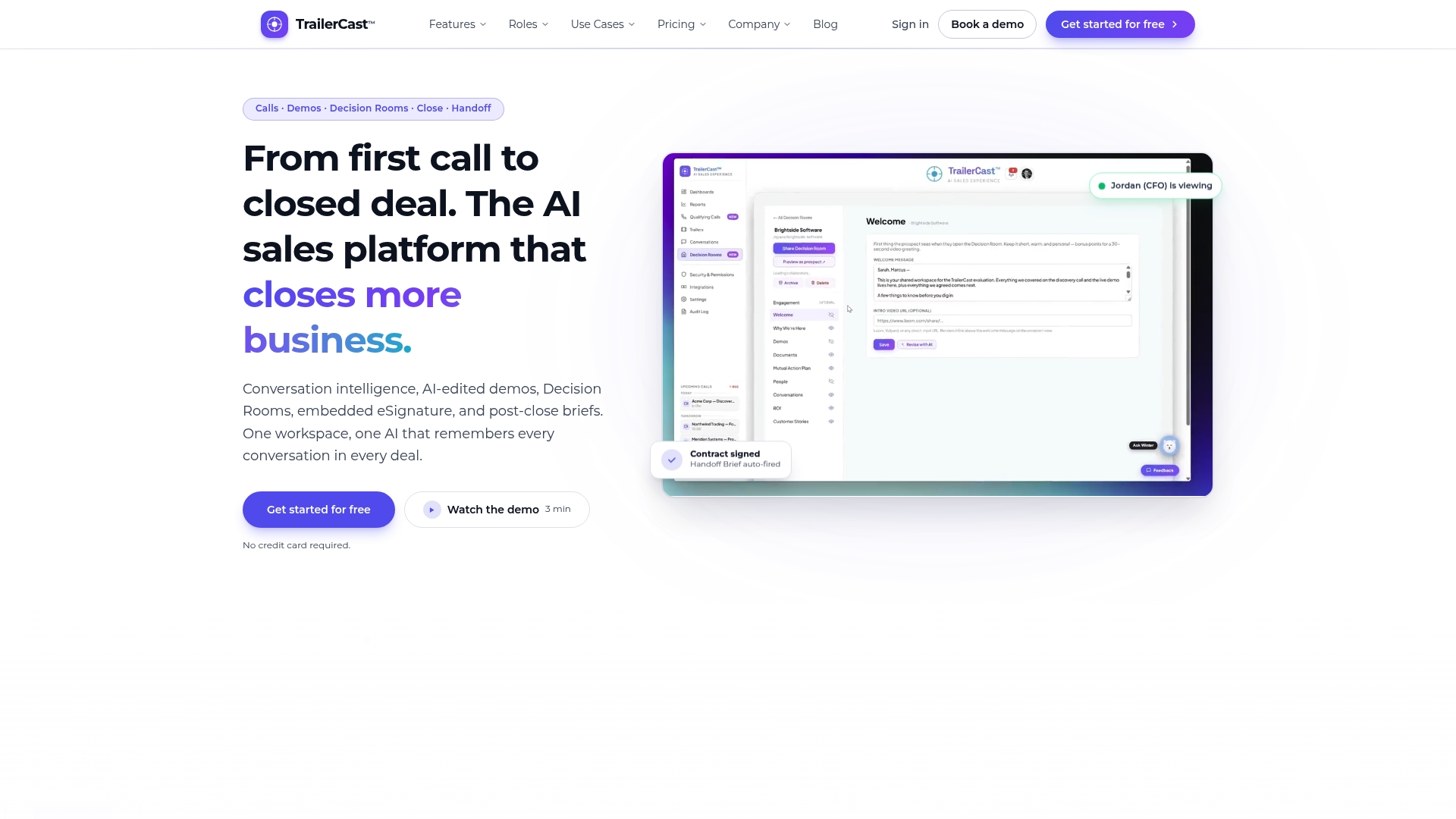
That is why we think the review should start from the record, not from a narration. When every call is transcribed and summarized, when a Deal Brief builds across the whole opportunity, and when the buyer’s engagement with the demo trailer and the deal room is visible, the manager can ask better questions. “Your summary says the CFO is aligned. Where did she say that?” becomes a thirty-second check instead of a debate.
We also think the five tools most teams stitch together (call recording, demo video, deal room, eSignature, handoff) create gaps that reviews then have to patch. We built one workspace where one AI follows the deal from first call to closed deal, so the evidence your framework asks for is already in one place.
The best review I ever sat in ended with a rep saying “I don’t know, and I’ll find out by Thursday.” That is a healthy deal team.
Daniel
Make the evidence automatic
A framework is only as good as the evidence you can pull into the room. If you want transcripts, stakeholder-specific demo trailers, buyer activity in a decision room, and embedded signature in one place, TrailerCast is one plan with every feature, from $59 per month per seat. Our meeting recording feature captures the calls your reviews depend on, and the handoff brief carries what you learned into the customer team after close.
For a deeper look at how recorded calls help multi-stakeholder deals, read our AI sales calls playbook.
A one-page starter plan
If you are starting from nothing, do this over the next month:
- Week 1: Copy the checklist above into your CRM or a shared doc. Cut it down to what your sales cycle needs.
- Week 2: Run weekly 1:1 reviews on three deals per rep. Spend most of the meeting on the deals, not the pattern.
- Week 3: Add the proof requirement for commit. Downgrade what lacks it, and tell the team why.
- Week 4: Start a stuck-deal triage with a written stall definition and the four outcomes.
After a month, look at what your reviews kept finding. The recurring gap, whether single-threading, missing paper process, or unquantified pain, is your next training topic.
FAQ
How long should a deal review take?
Plan on 20 to 30 minutes per deal for a standard review, according to Insight Partners, with more time for strategic enterprise deals. If you are covering six deals in half an hour, you are running a pipeline status meeting. Cap the weekly 1:1 at three to five deals.
Which deals should we review?
Pick strategic deals, at-risk deals, and deals about to move into commit. Managers usually choose, not reps, so that the hard deals are not skipped. Rotate so each rep’s key opportunities get inspected over a few weeks.
Do we need MEDDPICC to run a deal review?
No. MEDDPICC is one structure for the questions, and other qualification methods cover similar ground. What matters is a fixed set of questions, an evidence requirement for each answer, and a dated next action. Use the methodology your team already knows.
How is a deal review different from a forecast call?
A forecast call defends a number and asks whether a deal will close. A deal review asks what is verified about one deal and what to do next. Keep them separate, and use review evidence to decide which deals deserve a commit label.
Sources
- B2BLead: B2B deal review
- Leadline Partners: how to run a deal review
- PulseRevOps: open-ended questions in coaching
- Frontline to Forecast: pipeline review vs. deal inspection
- SalesGrowth: deal review framework
- Revcentric Partners: MEDDPICC template for deal reviews
- PulseRevOps: pipeline review cadence for SaaS
- PulseRevOps: deal-review cadence
- Insight Partners: running effective deal reviews
- Sales Xceleration: pipeline quality audit
- GitLab Handbook: opportunity consults