Decision Criteria Checklist for Evaluating SaaS Software

A good decision criteria checklist does four things: it separates must-haves from nice-to-haves, assigns weights before anyone sees a demo, defines what a good score looks like, and requires evidence for every number. Below is the full checklist, worked examples of criteria, a scoring method, and what to do when your stakeholders disagree. If you sell software, read it from the other side too: it shows you what your buyer’s committee is trying to do while you aren’t in the room.
TL;DR
- Decision criteria are the standards a buying group uses to compare options. Requirements are what a product must do. Preferences are what people would like.
- Set pass/fail gates first, then weight the remaining criteria so they total 100 and score vendors from 1 to 5.
- Agree on criteria and weights before the first demo, and score independently before discussing.
- Every score needs evidence: a demo timestamp, a doc link, a reference call or a trial result. No evidence means “unknown”.
- Sellers who help shape criteria early have more influence over the outcome than those who respond after they are locked.
Table of Contents
- What decision criteria are (and what they are not)
- The decision criteria checklist
- Decision criteria examples for SaaS
- How to score without fooling yourself
- Resolving stakeholder disagreement
- How sellers uncover and shape decision criteria
- Perspective
- Make your criteria visible to every buyer
- FAQ
- Sources
What decision criteria are (and what they are not)
Decision criteria are the requirements and standards a buying group uses to compare options and choose a solution: what it must do, why that matters, and how options will be scored. They can be formal, like a written RFP scorecard, or informal, like a VP who simply wants “something my team will actually use.” Both count. The informal ones often decide the deal.
Three terms get blurred, so keep them apart:
- Requirement: a capability or condition the software must have to meet business needs.
- Preference: something a person would like. Buyers can capture preferences, translate them into needs, and then sort must-haves from nice-to-haves.
- Decision criterion: the yardstick applied to requirements and preferences, with a weight and a scoring rule attached.
A requirement says “must integrate with Salesforce.” A criterion says “Salesforce integration: 15% weight, scored 0 to 4, evidence required from a live demo of two-way sync.”
The decision criteria checklist
This is the structure a thorough buying team ends up with. Use it as a template and delete what doesn’t apply. Research on SaaS comparison workbooks lists a similar set of parts, and the ordering below is ours.
1. Frame the decision
- The business problem in one sentence
- Expected outcomes and how you will measure success
- Scope, users, constraints, budget boundaries and deadline
- Decision owner, approver and a review date
Defining the problem, outcomes, constraints, required capabilities and success criteria before you look at products keeps the vendor with the best demo from writing your requirements for you.
2. Write requirements with owners
- Give each requirement an ID and a named owner
- Tag each as must-have, nice-to-have or do-not-need, the simple scale Arena recommends
- Cover the areas people forget: administration, audit history, configuration, reporting, availability, vendor support and the vendor’s financial health
3. Set hard gates
Gates are pass/fail. If a vendor fails one, it never reaches the weighted scoring. Apply gates before weighted scoring so a flashy tool can’t average its way past a dealbreaker. Typical gates: a required security attestation, a mandatory integration, data residency, or a price ceiling.

4. Weight the criteria
Give percentage weights that total 100. Weight them by your organization’s needs and apply the same weights to every candidate to reduce bias.
5. Define scoring anchors
Say in advance what poor, acceptable and strong mean. One published scorecard uses an anchored 0 to 4 scale from “does not meet” to “materially exceeds”. Without anchors, a “4” from one person is a “2” from another.
6. Collect evidence
- Vendor evidence links
- Acceptance tests run on your own data
- Pricing and total cost of ownership
- Trial results, risks and unresolved questions
Keep evidence and unknowns separate from scores.
7. Record the decision
Write the recommendation, the conditions attached to it, the approver and a review date. If a weight or score changes later, correct it openly in the record.
Decision criteria examples for SaaS
Common categories, as Rework’s vendor scorecard lists them: functional fit, integrations and APIs, security and compliance, total cost of ownership, vendor viability and support, implementation effort, usability and adoption, and scalability. Here is how each turns into something you can score.
| Criterion | What to ask | Evidence that counts |
|---|---|---|
| Functional fit | Can it run our top three workflows end to end? | Live demo of your scenario |
| Integrations | Does it sync with our CRM and calendar without workarounds? | Sandbox test, API docs |
| Security and compliance | Which attestations and controls exist? | Security page, completed questionnaire |
| Total cost of ownership | What is the all-in cost over 3 years? | Quote, implementation estimate |
| Vendor viability | Will they be here and supporting us in 3 years? | References, financial signals |
| Implementation effort | How long to first value? | Pilot timeline |
| Usability | Will reps use it without being nagged? | Trial usage by actual end users |
| Scalability | What happens at 2x the users or data? | Architecture docs, customer references |
If you buy for a larger or public organization, the U.S. CIO Council’s playbook gives a second lens. It treats effectiveness, mission criticality, utilization, complexity and usability as business-value factors, and technical requirements, interoperability, scalability and security standards as technical-fit factors. It also says total cost of ownership analysis belongs in application evaluation.
Buying AI tools? APQC’s checklist covers business alignment, technical capabilities, security and ethics, partnership support, commercial viability and adoption readiness. Add data handling questions, such as whether your content trains the vendor’s models.
A worked example: sales call software
Say a 40-person sales team is choosing a conversation intelligence tool. Gates: works with Zoom and Teams, and passes the security questionnaire. Then weights:
| Criterion | Weight | Vendor A (1-5) | Weighted | Vendor B (1-5) | Weighted |
|---|---|---|---|---|---|
| Transcript and summary accuracy | 25 | 4 | 100 | 3 | 75 |
| CRM integration | 20 | 5 | 100 | 4 | 80 |
| Rep adoption and usability | 20 | 3 | 60 | 5 | 100 |
| Total cost of ownership | 15 | 3 | 45 | 4 | 60 |
| Security and admin controls | 10 | 4 | 40 | 4 | 40 |
| Support and onboarding | 10 | 4 | 40 | 3 | 30 |
| Total | 100 | 385 | 385 |
A tie. That is exactly when you test sensitivity: Luck My Sales recommends checking whether reasonable weight changes reverse the ranking. Here, moving 5 points of weight from accuracy to adoption would hand Vendor B the win. Now you know the real debate is accuracy versus adoption, not a spreadsheet detail.
How to score without fooling yourself
The mechanics are simple. Set the gates, assign weights totaling 100, score each vendor from 1 to 5, multiply by the weights and sum the results. The discipline is what makes it work:
- Lock criteria and weights before the first demo. Sales Ops Club’s scorecard guidance says the same.
- Require evidence for every score. If you can’t point to a demo timestamp, documentation link, reference-call quote or trial result, mark it unknown and turn it into a vendor question.
- Don’t score what doesn’t apply. Keep unknowns visible rather than averaging them away.
- Give every vendor the same scenarios. Identical priority scenarios, realistic workflows and validated commercial terms keep the comparison fair, as SaaSRow’s template advises.
- Run a pilot when the stakes justify it. Our guide to pilots versus proofs of concept explains how long each should run and what each proves.
If the tool you are evaluating will be used to coach or score people, consider how consistent scoring works in practice. A walkthrough on piloting automated call scoring shows the same principle of consistent, weighted criteria applied to calls.
Resolving stakeholder disagreement
The CFO weights cost. The CISO weights security. The end users weight whether it makes their Tuesday easier. All three are right.
- Score independently first. Sales Ops Club recommends independent scoring, then focused discussion where scores differ by two or more points, so seniority doesn’t set the number in the room.
- Bring frontline users in early. Forrester advises prioritizing functions that affect daily work and having vendors demonstrate realistic workflows by role, because executive satisfaction may not predict frontline usability.
- Change weights in the open. If someone wants to adjust a weight after seeing results, write it in the decision record with the reason.
How sellers uncover and shape decision criteria
If you are on the selling side, the checklist above is your discovery agenda. Ask which three to five factors the buyers will weigh, how they trade off cost, features and implementation time, and who is involved. Then confirm business-level criteria and weighting with the economic buyer, ideally tied to a proof of value.
Bob Apollo’s MEDDPICC perspective adds two points: understand both formal and informal criteria and whether they favor you, and engage before criteria are formalized, because that is when you can still influence them.
The problem is the handoff. Your champion sat in the demo. The CFO and CISO didn’t. Two things help:
- Give each stakeholder what their criteria need. See our guides to the demo for CFOs and the CISO security demo, and how to handle the security review process.
- Prepare a sales demo checklist so each criterion gets shown, not just claimed.
Perspective
I built TrailerCast because I kept watching the same thing happen. The calls were never the problem. The space between them was. A champion leaves a great demo and walks back to a CFO who wasn’t there, a CISO who needs answers buried in a recording nobody will rewatch, and a PDF they are expected to re-sell from memory.
That space is where decision criteria get applied, and you are usually absent. We think the answer is to own it: keep every call, demo and message in one workspace so one AI follows the whole deal, then give each stakeholder something built for their criteria. A CFO trailer that talks pricing. A CISO trailer that talks security. A deal room where the evidence sits next to the scorecard.
Our claim is that a buying team scoring you on evidence should find that evidence in one place. That is what we designed TrailerCast to do.
Daniel
Make your criteria visible to every buyer
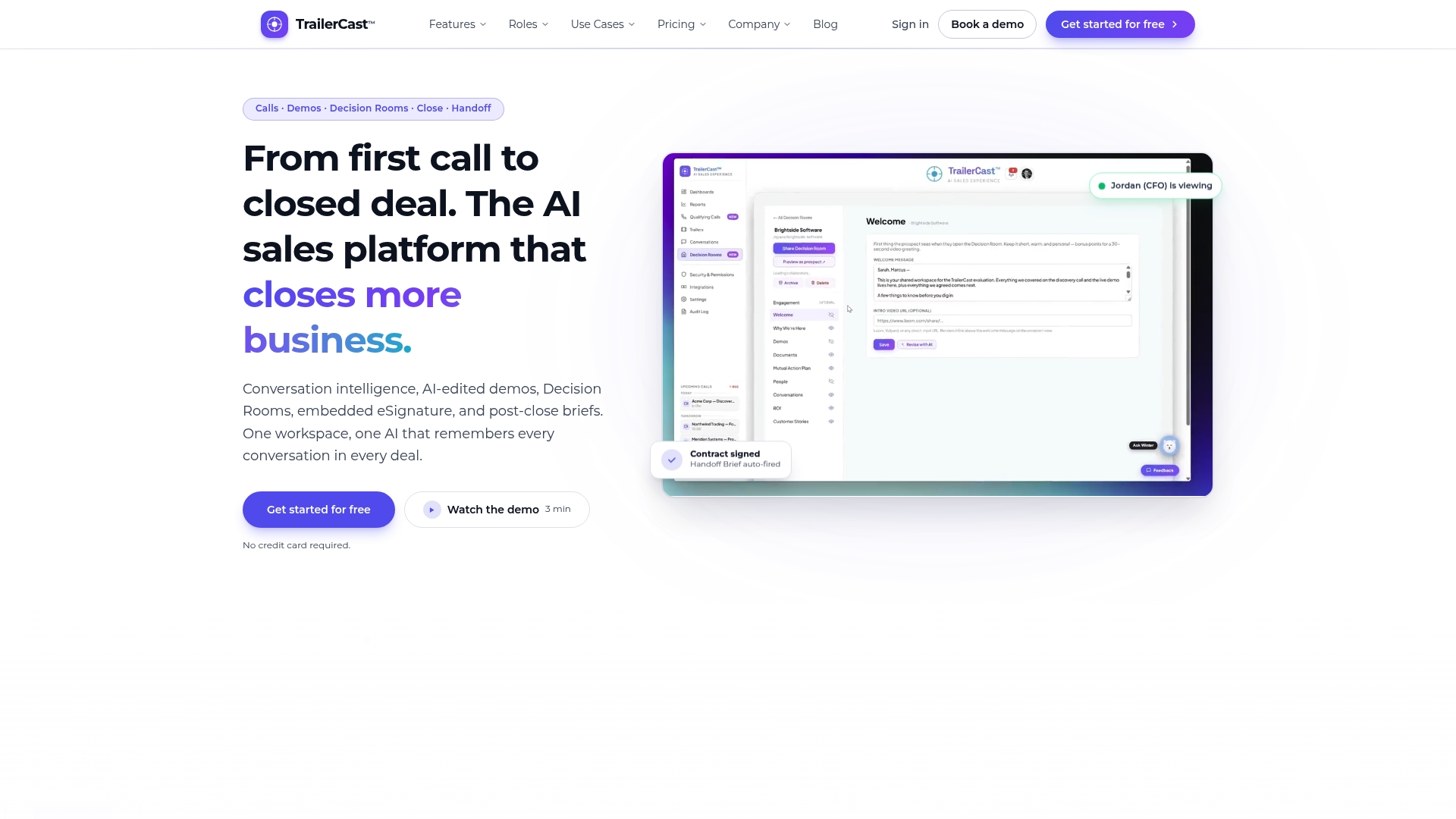
TrailerCast is an AI sales platform that puts conversation intelligence, AI-edited demo trailers, buyer-facing Decision Rooms, eSignature and post-close handoff in one workspace. It starts at $59 per month per seat, with one plan and every feature included, on the plan page. Use discovery call notes to capture the criteria your buyers state, and let every stakeholder see the evidence.
If you want to see the whole flow, start at trailercast.io.
FAQ
What is the difference between decision criteria and evaluation criteria?
In practice, people use them interchangeably. Both describe the standards used to compare options. Decision criteria is the term sales methodologies like MEDDPICC use for the buyer’s standards, while evaluation criteria is more common in procurement and scorecards.
How many criteria should a checklist have?
Enough to cover the real risks, few enough that weights stay meaningful. Most teams do well with 6 to 10 weighted criteria after the hard gates. If a criterion carries less than 5% weight, it probably belongs in a nice-to-have list instead.
Should price be the biggest weight?
Not by default. Compare total cost of ownership, not the sticker price, and weight it according to your constraints. Government guidance on application evaluation says to include total cost of ownership analysis alongside business value and technical fit.
When should we set the criteria?
Before the first vendor demo. Once a demo has shaped what people want, weights drift toward whichever product impressed them. Lock them, then correct any later change openly in the decision record.
Sources
- Decision Criteria in MEDDPICC
- Arena: Capturing Requirements
- SaaS Comparison Template
- Noloii: B2B Software Evaluation Lifecycle
- Luck My Sales: Sales AI Vendor Scorecard
- U.S. CIO Council: Application Rationalization Playbook
- Rework: SaaS Vendor Evaluation Scorecard
- APQC: AI Vendor Selection Criteria
- Sales Ops Club: Sales Software Evaluation Scorecard
- Forrester: Bring Your Business Users to the Vendor Selection Party
- Revenue Playbook: Sales Methodologies
- MEDDPICC+RR Opportunity Qualification