How to Follow Up Leads and Close More Deals

Following up with leads is the single skill that separates reps who hit quota from those who don’t. 80% of B2B sales close between the 5th and 12th contact, yet 44% of reps stop after two touches. That gap is where deals die. Effective lead follow-up, the industry term for systematic post-contact outreach, requires four things working together: speed, persistence, multi-channel reach, and a message worth reading. Get all four right and your pipeline stops leaking. Miss any one of them and you’re leaving closed revenue on the table.
How to follow up leads with a structured multi-touch cadence
A cadence is a planned sequence of touchpoints spread across a defined window. The goal is to stay visible without becoming noise. Most high-performing reps run 5–8 touches over two to three weeks, front-loading the first three contacts in the opening 72 hours when prospect interest is highest.
Companies that respond within one hour of a lead inquiry are nearly 7 times more likely to qualify that lead than those who wait 24 hours. Speed is not a nice-to-have. It is the first competitive advantage in any follow-up sequence.

Channel rotation matters as much as timing. Phone calls produce response rates of 15–25%, email lands at 5–15%, and LinkedIn sits at 10–20%. No single channel wins every time. Rotating across all three roughly triples your effective reach compared to email alone.
Here is a sample 8-touch cadence that works for most B2B SaaS deals:
| Day | Channel | Content purpose |
|---|---|---|
| Day 1 | Personalized intro, one clear value statement | |
| Day 2 | Phone | Live call or voicemail referencing the email |
| Day 3 | Connection request with a brief context note | |
| Day 5 | Share a relevant case study or insight | |
| Day 7 | Phone | Second call, reference their specific business context |
| Day 10 | Ask one low-friction question tied to their priorities | |
| Day 14 | Comment on their recent post or share relevant content | |
| Day 18 | Break-up email, close the file unless they respond |
Pro Tip: Leave voicemails on days 2 and 7 only. More than two voicemails in a sequence reads as desperation. Keep each voicemail under 20 seconds and reference the email you already sent so the prospect has a clear next step.
Video messages sent via async video follow-up are particularly effective on days 5 and 10. A 60-second personalized video outperforms a text email in reply rate because it is harder to ignore and easier to forward inside a buying committee.
How should you segment leads before following up?
Not every lead deserves the same cadence depth. Treating a cold inbound form fill the same as a prospect who attended your demo and asked about pricing is a waste of time and a fast path to unsubscribes.
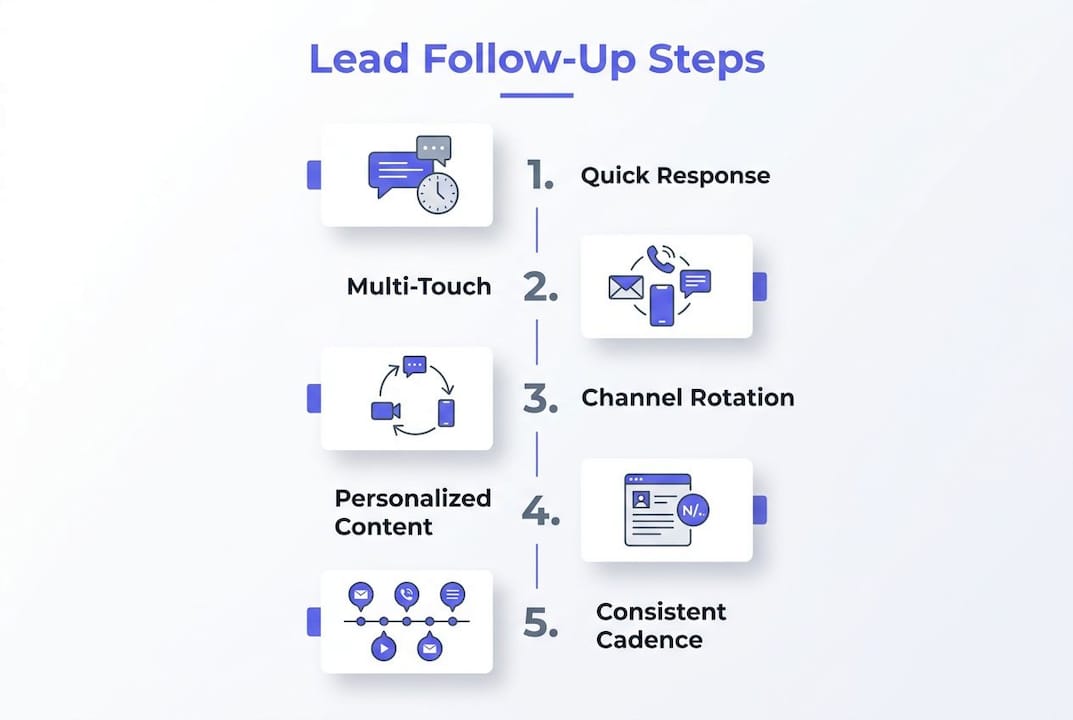
Segmenting leads by source, engagement level, and buying intent is the foundation of efficient follow-up. High-intent leads get an aggressive, front-loaded cadence. Low-intent leads get a longer, lighter nurture track. The difference in approach is not just about effort. It is about relevance.
Four practical segments to build your follow-up system around:
- Hot leads (demo attended, pricing page visited, replied to an email): Contact within 15 minutes. Run a 5-touch cadence over 7 days. Every message references a specific action they took.
- Warm leads (downloaded content, opened multiple emails, attended a webinar): Contact within 4 hours. Run a 6-touch cadence over 14 days. Lead with value, not a pitch.
- Cold leads (inbound form fill, no prior engagement): Contact within 24 hours. Run a lighter 4-touch cadence over 21 days. Focus on education and problem framing.
- Re-engagement leads (went dark after initial interest): Start with a pattern-interrupt message. Reference what changed in their industry or your product since they last engaged.
Multi-channel nurture strategies achieve 3–8% cold-to-qualified-meeting conversion over 90 days, compared to 0.5–2% for email-only sequences. That difference compounds across a full pipeline.
Pro Tip: For hot leads, automate the first acknowledgment email within minutes of their action, then have a human rep make the first live call. Automation handles speed. Humans handle nuance. Use both.
What makes a follow-up message actually work?
The most common follow-up mistake is the “just checking in” email. It signals nothing, adds no value, and gives the prospect no reason to respond. Top performers plan 12 or more unique touchpoints with distinct value-add content at each phase of the lead lifecycle. That discipline is what separates persistent from annoying.
Every message needs a reason to exist. Rotate across these content types to keep each touch fresh:
- A relevant case study from their industry
- A short insight tied to a problem they mentioned
- A question anchored to their specific context (“Is reducing onboarding time still a priority this quarter?”)
- A new product capability that addresses a concern they raised
- A third-party article or data point that reframes their problem
“Persistence in follow-up is respected when every message adds genuine value. Empty check-ins lead to unsubscribes and lost deals. The rep who shows up with something useful every time is the one who gets the meeting.”
The break-up email is one of the most underused tools in a rep’s kit. Sent as the final touch in a cadence, it tells the prospect you are closing their file unless they respond. Break-up emails generate 10–20% response rates from otherwise unresponsive leads. The psychology is loss aversion. People respond when they feel something is about to disappear.
Common mistakes that kill conversion rates:
- Quitting after one or two touches when most deals need five or more
- Relying on email alone when phone and LinkedIn dramatically improve reach
- Spacing touches too far apart and losing momentum
- Sending the same message twice with different subject lines
- Skipping the break-up email entirely
The most effective follow-up questions are low-friction and specific. “Is X still a priority this quarter?” outperforms “Are you still interested?” every time. The first question respects the prospect’s context. The second puts them on the spot.
What tools support scalable lead follow-up?
Technology does not replace good follow-up judgment. It removes the friction that causes reps to skip touches, forget timing, or send generic messages at scale.
CRM platforms and sales engagement tools enable automated sequences that fire the right message at the right time across the right channel. The best setups combine automated routine touches with human-triggered messages at high-signal moments. AI and automation tools can send instant lead acknowledgments around the clock, but human engagement at high-intent moments consistently produces better outcomes than automation alone.
Here is how different tool categories support the follow-up process:
| Tool category | Primary function | Best use in cadence |
|---|---|---|
| CRM platform | Contact management, pipeline tracking | Logging touches, triggering sequences |
| Sales engagement platform | Multi-channel sequence automation | Scheduling email, call, and LinkedIn steps |
| AI call notetaker | Call transcription and summary | Capturing context for personalized follow-ups |
| Async video tool | Personalized video messages | High-value touches on days 5 and 10 |
| Deal room platform | Buyer-facing shared workspace | Centralizing content between calls |
Trailercast sits across several of these categories at once. Its AI call notetaker captures every discovery call and demo, then auto-drafts a personalized follow-up email from the transcript. That means the rep sends a message referencing exactly what the prospect said, within minutes of the call ending, without writing it from scratch.
The Trailercast Decision Room gives each deal a shared space where the buying committee can review content, ask questions, and track next steps between calls. Engagement analytics show which stakeholders opened what, so the rep knows exactly who to follow up with and what to address. That is not a guess. It is a signal.
Key Takeaways
Effective lead follow-up requires speed, persistence across 5 or more touches, multi-channel outreach, and a distinct value-add message at every contact point.
| Point | Details |
|---|---|
| Speed wins early | Responding within one hour makes you nearly 7 times more likely to qualify the lead. |
| Persistence pays off | 80% of B2B sales close after the 5th touch; most reps quit at two. |
| Segment before you sequence | Hot, warm, cold, and re-engagement leads each need a different cadence depth. |
| Every message needs a reason | Rotate case studies, questions, and insights to avoid empty check-ins. |
| Break-up emails work | A final “closing the file” email recovers 10–20% of unresponsive leads through loss aversion. |
The part of follow-up nobody talks about enough
I have watched reps with great products lose deals not because they were outpitched, but because they went quiet after a strong demo. The champion walked back to their CFO with nothing but a PDF and good intentions. The deal died in an internal meeting the rep was never part of.
The real follow-up problem is not laziness. It is the absence of a system. When you do not have a cadence written down, you rely on memory and motivation. Both fail under quota pressure. The reps who consistently close are not more talented. They are more disciplined. They have a sequence, they work it, and they add something real to every touch.
The other thing I have learned: timing matters more than frequency. A message sent the morning after a prospect’s earnings call, referencing something specific from their results, will outperform five generic emails sent over two weeks. Context is the multiplier. Automation gives you scale. Context gives you conversion.
Build the cadence once. Personalize the context every time. That combination is what turns a follow-up process into a closing machine.
— Daniel
Trailercast turns every follow-up into a tracked, personalized touchpoint
Most reps lose deals in the space between calls. Trailercast is built specifically for that gap. The platform captures every call, auto-drafts the follow-up email, and gives your buyer a shared Decision Room where the deal lives between conversations.
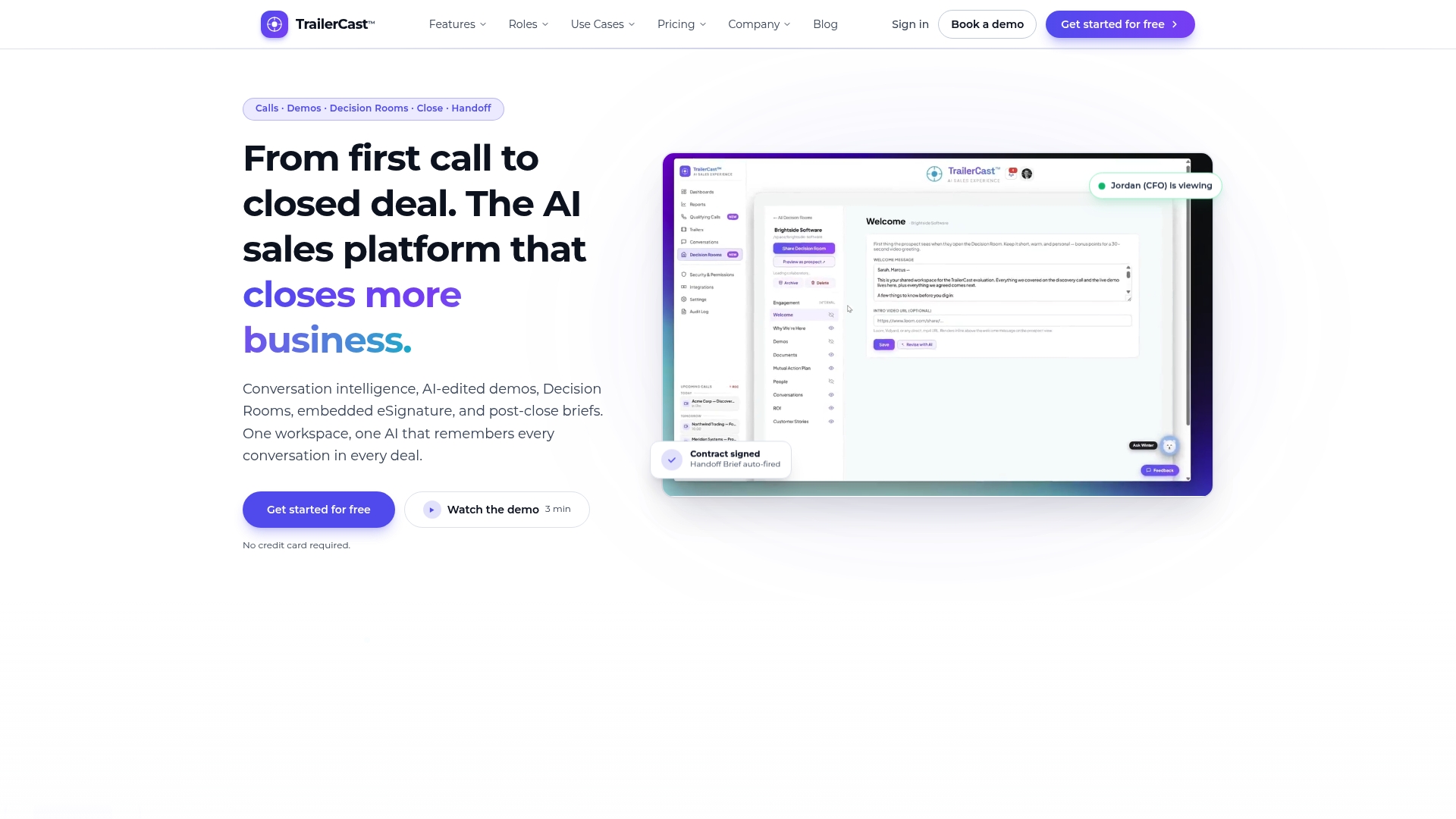
Every stakeholder interaction is tracked. Every content view is logged. You always know who engaged, what they read, and when to reach back out. Trailercast replaces five disconnected tools with one workspace that runs the full deal from first call to signed contract. See how it works at trailercast.io or explore the full platform features to see what fits your team.
FAQ
How many follow-up touches does it take to close a deal?
80% of B2B sales close between the 5th and 12th contact. Plan a minimum of 5–8 touches per lead before moving on.
What is the best time to follow up after a lead inquiry?
Responding within one hour of a lead inquiry makes you nearly 7 times more likely to qualify that lead compared to waiting 24 hours.
What should I say in a follow-up email?
Reference something specific from your last interaction or the prospect’s business context. Ask one low-friction question like “Is this still a priority this quarter?” rather than a vague ask.
What is a break-up email and does it work?
A break-up email tells the prospect you are closing their file unless they respond. It generates a 10–20% response rate from otherwise unresponsive leads by triggering loss aversion.
Is multi-channel follow-up really better than email alone?
Multi-channel nurture strategies produce 3–8% cold-to-meeting conversion over 90 days, versus 0.5–2% for email-only sequences. Phone and LinkedIn add meaningful reach that email cannot match alone.