30–60 Minute Kickoff Call Agenda for Multi Stakeholder B2B SaaS
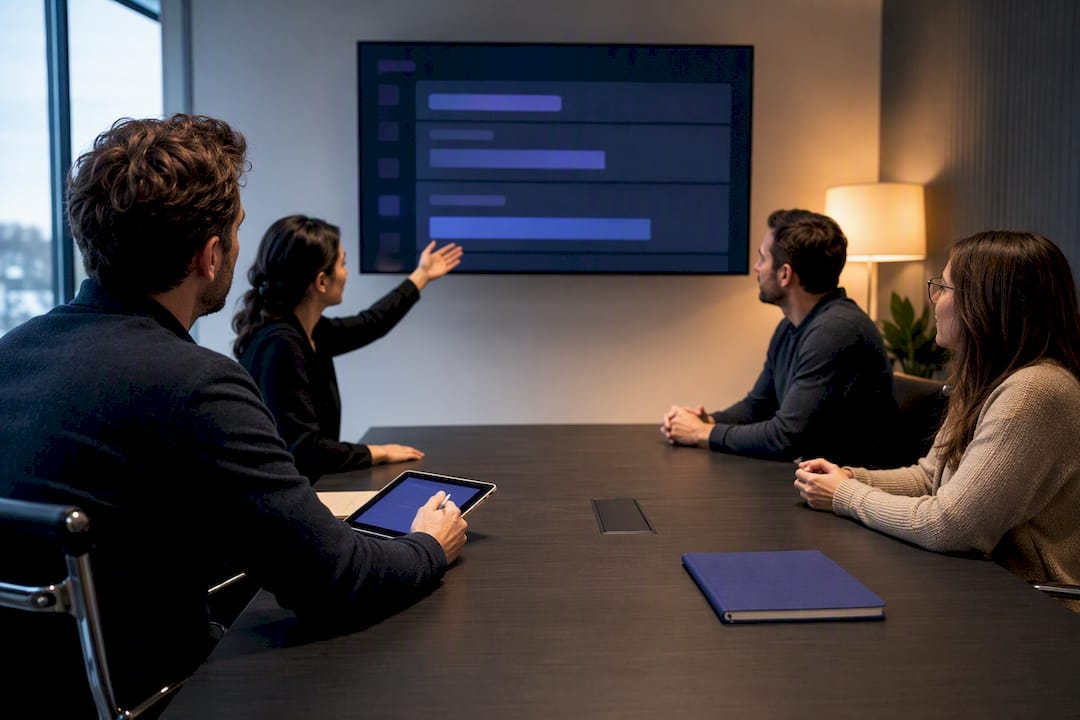
Run your kickoff in five phases: Opening, Context, Problem & Impact, Decision Process, and Next Steps, with appropriate time allocated to each. The AE owns qualification and runs the call; if a customer-success manager is joining, introduce them by name as the ongoing owner once the deal moves forward. Before anyone hangs up, the next meeting gets scheduled live, on the call, with a date attached.
TL;DR:
- Calls should be tailored to deal complexity, with 30, 45, or 60 minutes allocated based on the number of stakeholders and layers of approval involved.
- A clear, shared agenda visible during the call enhances transparency and encourages buyers to answer more openly, reducing defensive behavior.
- Active exercises like role-playing objections and micro account planning improve skills and foster tangible behaviors such as asking quantifiable questions or mapping stakeholders.
- Post-call handoffs must be completed within 24 to 48 hours using structured documents and shared workspaces to ensure continuity and prevent misunderstandings.
- Using a unified workspace for the entire kickoff process streamlines tool management and creates a consistent, accessible source of truth for everyone involved.
Table of Contents
- Kickoff Call Agenda Templates for 30, 45, and 60 Minutes
- How Do You Run Each Phase of a Kickoff Call?
- Which Parts of a Kickoff Should Be Active, Not Just Conversational?
- What Happens After the Call: The AE-to-CS Handoff
- The Kickoff Mistakes Nobody Warns You About
- How TrailerCast Runs This Entire Agenda for You
- Sources
Kickoff Call Agenda Templates for 30, 45, and 60 Minutes
Deal complexity should decide your call length, not habit. A single-stakeholder renewal doesn’t need the same runway as a five-person buying committee evaluating a six-figure contract, and forcing every deal into the same 30-minute box is how important context gets skipped.
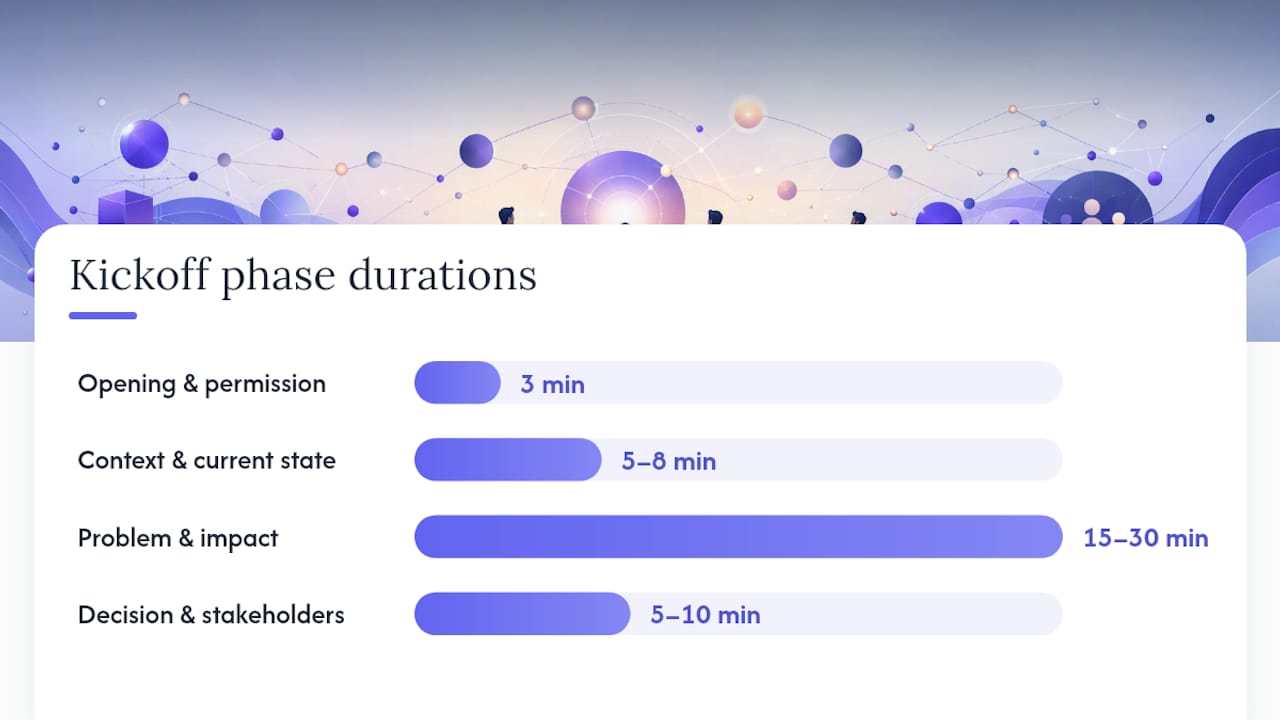
The 30-minute template works for early-stage qualification calls or deals with one or two stakeholders. Open with 3 minutes of framing, spend 5 to 8 minutes on context, dedicate 15 minutes to problem and impact questions, and close with 5 minutes locking the next step. This mirrors the practical default most B2B sales teams use for standard discovery.
The 45-minute template fits mid-market deals with two to four stakeholders. Here’s how the time typically breaks down:
- Opening and permission: 3 minutes
- Context and current-state mapping: 8 minutes
- Problem and impact questioning: 20 minutes
- Decision process and stakeholder mapping: 9 minutes
- Brief positioning and next steps: 5 minutes
This length gives you room to ask follow-up questions instead of rushing through a checklist, and it’s usually enough time to surface at least one stakeholder you hadn’t accounted for.
The 60-minute template is built for enterprise deals with multiple stakeholders and layered approval chains. Add 10 extra minutes to problem and impact discovery, and consider a short breakout: if a CFO or CISO joins partway through, spend 5 to 10 minutes speaking directly to their priorities before rejoining the full group. This keeps the broader agenda intact while still giving specialized stakeholders a reason to stay engaged.
For the calendar invite itself, keep the opener simple: “30 minutes to understand your current process, map who’s involved in a decision, and figure out if there’s a fit worth exploring further.” That one line does double duty. It sets expectations and signals you’re not walking in with a canned pitch.
How Do You Run Each Phase of a Kickoff Call?
Every phase has a job to do, and skipping the order costs you information you’ll need later. Here’s how to run each one, with sample questions you can adapt on the spot.
-
Opening and permission (3 minutes). State the agenda out loud, then ask: “What would make this a good use of your time?” This single question does more work than any rapport-building small talk. It hands the buyer partial control of the call, and sharing a simplified agenda upfront measurably reduces the defensiveness that comes from feeling sold to.
-
Context and current state (5 to 8 minutes). Map the tools, people, and workflows already in play. Ask “Walk me through how this gets handled today” and “Who else touches this process?” You’re building a picture of the system you’d be replacing or supplementing, not just collecting trivia.
-
Problem and impact (15 to 30 minutes, depending on call length). This is where deals get won or lost. Anchor every question to cost and urgency: “What does this cost you in hours, dollars, or missed opportunities each month?” and “What happens if this doesn’t get solved this quarter?” Vague pain doesn’t survive a budget conversation. Quantified pain does.
-
Decision process and stakeholders (5 to 10 minutes). Ask directly: “Besides you, who else needs to sign off on something like this?” and “Is there budget allocated, or does this need to get built into a future cycle?” Mapping the buying committee early prevents the classic failure mode where a deal dies in a meeting you weren’t invited to.
-
Brief positioning and next steps (5 minutes). Resist the urge to demo. A short, one-paragraph positioning statement tied to what you just heard is enough. Then lock the next meeting on the calendar before the call ends, not in a follow-up email.
Preparing 10 to 15 strong open-ended questions across these phases keeps you ready without turning the call into an interrogation — treat the list as a guide, not a script.
Pro Tip: Keep your agenda visible on screen or in a shared workspace during the call. When buyers can see the structure and the logic behind your questions in real time, they answer more openly because the process feels transparent instead of extractive.
Which Parts of a Kickoff Should Be Active, Not Just Conversational?
Talking through an agenda for 45 straight minutes produces information. It rarely produces behavior change.
Two exercises repeat well across teams:
- Role play the CFO objection. Pair reps and have one play a skeptical economic buyer. Run it for 5 minutes, then debrief: what landed, what didn’t, what would you say differently.
- Micro account planning. Give the team 10 minutes to fill out a one-page plan: known stakeholders, open questions, and the single biggest risk to the deal closing.
Mixing tactical training with interactive sessions like panels and live-call reviews builds skills that a slide deck never will.
For remote teams, assign a notetaker for each breakout and capture outcomes in a shared doc immediately after. That record becomes your coaching material for the next one-on-one.
Pro Tip: Score two or three specific behaviors after each active exercise, not a vague “did well” rating. Something like “asked a quantified follow-up question” is coachable. “Good energy” is not.
What Happens After the Call: The AE-to-CS Handoff
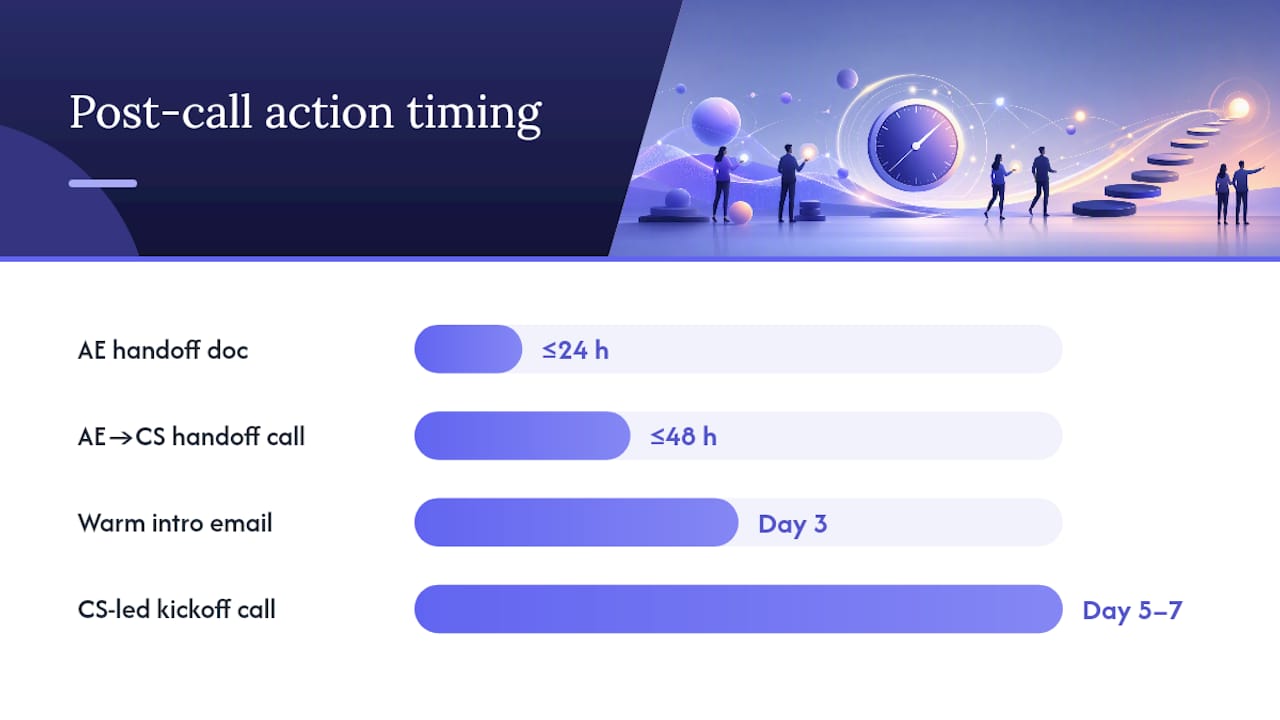
The 24 to 48 hours after a kickoff call decide whether the next team inherits clarity or has to reconstruct it from memory; following a detailed client onboarding checklist for service professionals can help map the post-call handoff and kickoff planning effectively. A recommended cadence, drawn from post-sales handoff practices, looks like this:
- Within 24 hours: AE completes a structured handoff document covering why the prospect is buying, promised features, a stakeholder ledger, and any flagged risks.
- Within 48 hours: Internal AE-to-CS handoff call walks the incoming owner through the deal context live.
- Day 3: Warm introduction email connects the buyer to their new point of contact.
- Day 5 to 7: CSM-led kickoff call begins onboarding with full context already in hand.
This structured handoff timeline exists because the alternative, a CSM starting cold on a discovery call the buyer already sat through once, tells the customer nobody was listening.
Publish a persistent workspace or shared link the buyer can return to between calls. Include the agreed next steps, key documents, and a running thread for questions. A call template built as an operating framework rather than a one-off note makes that workspace the source of truth instead of a scattered email chain, and it gives every future call a starting point instead of a blank page.
The Kickoff Mistakes Nobody Warns You About
Three failure modes repeat across almost every stalled deal I’ve studied. First, reps treat the agenda as private instead of shared, which makes buyers guess at the logic behind each question. Fix: state the agenda out loud and keep it visible. Second, nobody names a next-step owner, so the follow-up email becomes the first place anyone commits to a date. Fix: lock the calendar invite before the call ends. Third, CS inherits a deal with no risk flags, so problems the AE already knew about resurface as surprises. Fix: make risk disclosure a mandatory handoff field, not an optional one.
For coaching, score whether reps quantified impact, mapped the buying committee, and secured a dated next step, not just whether the call “felt good.”
— Daniel
How TrailerCast Runs This Entire Agenda for You
There are alternatives to juggling multiple disconnected tools for one kickoff call: instead of a notetaker app, a separate demo editor, a static deal room, and a manual handoff email, one workspace can carry the whole process from first question to CSM kickoff.
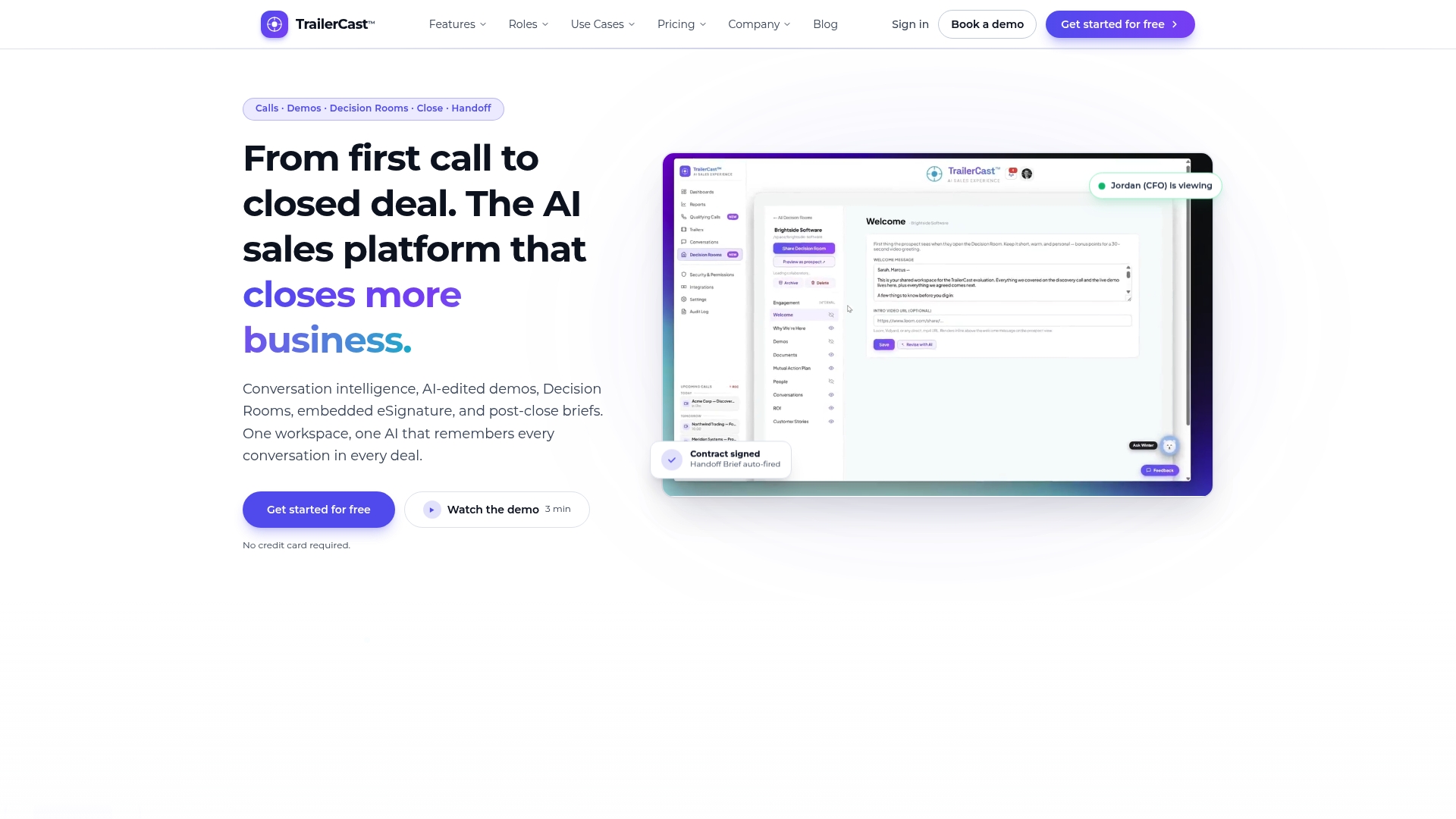
Here’s an example workflow. An AI notetaker joins the call and produces a structured summary with qualification notes and action items, tagged to the deal automatically. If the call includes a walkthrough, the system can edit the key 8 to 15 minutes into a branded trailer the champion can forward to stakeholders who weren’t there. That trailer can live inside a shared Decision Room, a persistent workspace where the buying committee can review documents, track the mutual action plan, and see next steps without a follow-up email chain. Once the deal closes, an AI Handoff Brief can be sent to the CSM within hours, carrying the stakeholder map, promised features, and risk flags this article described.
If your team is running kickoff calls on a patchwork of tools right now, start a free trial and see how one workspace holds the whole deal together.
Sources
- Discovery Call Agenda: Structure That Uncovers Pain — QUOTA Training
- Discovery Call Agenda Template for B2B Sales Teams | Prolifiq
- Post-Sales Handoff Process for CS Teams | Lyniro
- How to run a sales kickoff — HubSpot