Product Demonstration Examples That Actually Close B2B Deals

Three product demonstration examples you can run today: a live walkthrough trailer of moderate length, a short async demo trailer for outbound and follow-up, and an interactive sandbox snippet for product-led evaluation. The distribution pattern that moves deals fastest is a personalized AI-edited trailer sent the same day, dropped into a buyer-facing decision room, followed by a mutual action plan within a couple of days.
TL;DR:
- Live walkthrough trailer: 20–25 minutes total, core product time under 5–7 minutes per capability, closed with a KOI (Key Operational Impact) line and a mutual action plan.
- Async demo trailer: 60–90 seconds, hook in the first 10 seconds, one workflow highlight, tracked share link.
- Interactive sandbox snippet: 5–8 guided steps, success checkpoint, handoff to a recorded trailer for execs who weren’t in the room.
Three-line verdict for outreach: “Saw you’re evaluating [category]. Recorded a 90-second walkthrough of the one workflow your team would use every day. Here’s a link — takes less time than a calendar invite.”
Table of Contents
- Why a demo is a structured conversation, not a feature tour
- What do the three core product demonstration examples look like?
- How do you tailor demo content for CFOs, CISOs, end users, and champions?
- How do you share demo trailers so they actually drive the deal forward?
- Which demo format and length should you choose?
- Ready-to-use templates: agenda, script, KOI bank, and pre-demo checklist
- How does Trailercast implement these demo examples at scale?
- Key Takeaways
- What actually separates demos that close from demos that stall
- Run these demo examples at scale with Trailercast
- Sources and further reading
Why a demo is a structured conversation, not a feature tour
The demos that convert don’t show everything. They confirm one thing: that the buyer can see your product inside their own workflow.
“Nobody watching your product demo actually cares about your product, your company, or you. Give away your big finale right up front — ‘Here’s what our product is going to do for you.’” ProductPlan
That’s the counterintuitive truth most reps miss. They open with a company history slide or a feature checklist, and the buyer’s brain checks out before the first screen share loads.
The fix is two things used together. First, the Tell-Show-Tell framework: open each topic with context (30–90 seconds), show the capability (1–4 minutes), close with impact (30–60 seconds). Second, a KOI at the end of every topic.

KOI (Key Operational Impact): A three-words-or-fewer phrase that names the business result of what you just showed. “Fewer missed renewals.” “One less handoff.” “Instant audit trail.” Buyers reconstruct the demo’s value from these phrases long after the call ends.
Pro Tip: Open every demo with the outcome, not the agenda. Say the KOI for the whole meeting in your first sentence: “By the end of this, you’ll see how your team closes the approval loop in under two minutes.” Then prove it.
What do the three core product demonstration examples look like?
Example A: Live walkthrough trailer (20–25 minutes)
Live SaaS walkthroughs work best when core product time stays under 5 minutes per capability inside a 15–25 minute meeting. Here’s the structure:
- Opening Tell (30–60s): State the business headline. “Today I’ll show you how [Company] can cut your demo-to-close cycle by removing the follow-up gap.”
- Topic 1 — Show (up to 7 min): Walk one end-to-end workflow. Pause for a confirmation gate: “Does this match how your team handles it today?”
- Topic 2 — Show (up to 7 min): Second workflow, same gate.
- Topic 3 — Show (up to 7 min): Third workflow, same gate.
- Closing Tell (2–3 min): Recap with KOIs. “Three things you just saw: faster handoffs, zero re-keying, one audit trail. What’s the next step on your side?”
Sample KOI lines to say aloud: “Zero re-keying.” “Instant stakeholder visibility.” “One source of truth.”
Example B: 60–90 second async demo trailer
Recorded demos are the scale lever for outbound and follow-up. Keep them short and outcome-first.
- Hook (10s): Name the pain. “Most teams lose deals in the 48 hours after a great demo.”
- Workflow highlight (40–60s): Show one realistic workflow, not a feature list. Workflow storytelling consistently outperforms feature tours in engagement.
- CTA (10–15s): “Reply with a time, or grab a slot here.”
Sample subject line: “90-second look at [specific workflow] for [Company]” Sample email snippet: “Recorded this specifically for your team — it’s the one workflow your ops lead asked about. Link below, no login needed.”
Example C: Interactive sandbox snippet (5–8 steps)
- Steps 1–3: Guide the buyer through a realistic setup scenario using their own data or a close analog.
- Steps 4–6: Let them trigger the key outcome themselves (the “aha” moment lands harder when they do it).
- Step 7–8: Success checkpoint, then hand off to a recorded trailer for the CFO or CISO who wasn’t in the session.
| Format | Best use | Core product time |
|---|---|---|
| Live walkthrough | Qualified mid-funnel meeting | Under 5 min per capability |
| Async trailer | Outbound, follow-up, top-of-funnel | 60–90 seconds |
| Interactive sandbox | Product-led evaluation, technical buyers | 5–8 guided steps |
How do you tailor demo content for CFOs, CISOs, end users, and champions?
Every stakeholder in a 3–7 person buying committee needs a different version of the same story. Discovery notes tell you which version to send.
| Role | What to show | Proof point | KOI line | Question to ask |
|---|---|---|---|---|
| CFO | ROI summary, approval workflow | Time-to-close reduction, cost per deal | “Fewer tools, one invoice” | “What’s the cost of your current stack per seat?” |
| CISO | Security settings, access controls, data handling | Compliance posture, audit trail | “Full audit trail” | “What’s your current data-residency requirement?” |
| End user | Daily workflow, time saved per task | Steps removed from current process | “Two clicks, not ten” | “Where does your team lose the most time today?” |
| Champion | Full deal room, stakeholder map, sharing tools | Engagement analytics, attribution tree | “You stay in control” | “Who else needs to see this before a decision?” |
For CFOs, lean on approval workflow efficiency and cost consolidation. For CISOs, lead with compliance and access controls before touching any feature. End users respond to time saved on a specific daily task, not to platform vision. Champions need to feel equipped to re-sell internally, which means giving them something worth forwarding.
How do you share demo trailers so they actually drive the deal forward?
The demo itself rarely closes the deal. What closes it is what happens in the 48 hours after. Combine a personalized AI-edited trailer with a buyer-facing decision room, and you own that space.
- Same day (within 2 hours): Send the personalized trailer with a one-paragraph recap. Subject: “Your [Company] demo recap + next step.” Use a tracked async video link so you know exactly when each stakeholder watches.
- Day 1: Invite the champion to the decision room. Include the mutual action plan, ROI section, and any documents they requested.
- Day 2: Multi-thread. Send stakeholder-specific trailer clips to the CFO and CISO directly. Reference what their champion shared.
- Day 2–3: Send the mutual action plan with named milestones and owner fields filled in. The 48-hour follow-up window is where most deals stall or die.
Metrics to track after distribution:
- Play rate (did they watch at all?)
- Time-to-first-watch (urgency signal)
- Watch-to-end rate (engagement depth)
- Decision room interactions (who opened what, when)
- Demo-to-opportunity conversion rate
Async video scales reach without adding headcount. One well-built trailer can do the work of three follow-up calls.
Which demo format and length should you choose?
Match format to intent. Live for qualified mid-funnel. Short async for outreach and follow-up. Sandbox for technical evaluation.
| Format | Best use case | Recommended length/steps |
|---|---|---|
| Live walkthrough | Mid-funnel qualified meeting | 15–25 minutes; under 5 minutes per capability |
| Async trailer | Outbound, post-demo follow-up, top-of-funnel | short duration |
| Interactive sandbox | Technical evaluation, product-led growth | several guided steps, under a moderate total number |
| Recorded overview | Website conversion, inbound nurture | 2–3 minutes |
Short recorded demos of a few minutes are the sweet spot for top-of-funnel, where attention is the real constraint. For async follow-up, keep it brief.
Ready-to-use templates: agenda, script, KOI bank, and pre-demo checklist
Three-line agenda (send 24 hours ahead)
Sending a short agenda 24 hours before the meeting lowers no-show rates and sets expectations. Use this:
30–60 second opening tell (paste verbatim)
“Before I share my screen, here’s the headline: by the end of this call, you’ll see exactly how [Company] can [specific outcome]. I’ll show you one workflow, ask a few questions, and we’ll figure out together if it fits. Sound good?”
Pre-demo tech checklist
- Browser tab with demo environment open and pre-loaded with realistic data
- Browser recording active (no install required with Trailercast)
- Sandbox populated with prospect-relevant data (not generic placeholder names)
- Meeting link tested from a second device
- Screen share permissions confirmed
- Backup slide deck ready if live environment fails
- Decision room pre-built with prospect’s name and logo
KOI bank (10 ready-to-use lines)
- “Zero re-keying.”
- “One source of truth.”
- “Instant audit trail.”
- “Fewer missed renewals.”
- “One less handoff.”
- “Deals don’t stall.”
- “CS starts informed.”
- “Two clicks, not ten.”
- “Full stakeholder visibility.”
- “Closed in-app.”
Same-day recap email template
Subject: [Company] demo recap + next step
“Great call today. Three things we covered: [KOI 1], [KOI 2], [KOI 3]. I’ve dropped everything into your decision room here: [link]. The mutual action plan is inside with suggested milestones. Let me know if anything needs adjusting before we loop in [CFO/CISO name].”
How does Trailercast implement these demo examples at scale?
Trailercast automates trailer creation from call recordings and centralizes decision rooms, tracked sharing, and eSignature in one workspace, so teams can run all three demo patterns without stitching together five tools.
| Demo example | Trailercast capability |
|---|---|
| Live walkthrough trailer | AI notetaker transcribes call; auto-edit trailer picks the 8–15 minutes that mattered |
| Async demo trailer | AI edits and brands the clip; tracked share link fires same day |
| Interactive sandbox snippet | Browser recording captures the session; trailer generated for exec stakeholders |
| Stakeholder-specific versions | CFO and CISO trailers personalized per role from one recording |
| Decision room + mutual action plan | One branded room per deal; MAP, ROI, and documents in one place |
| eSignature | Embedded close in-app via embedded eSignature workflow |
Implementation in five steps:
- Connect your calendar (Google or Microsoft) so the AI notetaker joins every demo automatically.
- After the call, review the AI-generated trailer and approve or trim it in one click.
- Personalize one clip per key stakeholder (CFO, CISO, end user) using the role-based trailer feature.
- Drop the trailer and mutual action plan into the decision room; share the no-login link with your champion.
- Track play rate and decision room engagement from the dashboard; follow up on the stakeholders who haven’t watched yet.
Key Takeaways
The most effective product demonstration examples combine a KOI-anchored Tell-Show-Tell structure with a personalized async trailer and a buyer-facing decision room sent within 48 hours of the live call.
| Point | Details |
|---|---|
| Lead with the outcome | Open every demo with the KOI headline before touching the product. |
| Match format to stage | Live for mid-funnel, 60–90 second async for outreach, sandbox for technical evaluation. |
| Follow up within 48 hours | Send a tracked trailer and decision room link the same day; the mutual action plan by day two. |
| Personalize per stakeholder | CFO, CISO, and end-user trailers each need a different KOI and workflow highlight. |
| Trailercast scales all three | Auto-edited trailers, decision rooms, and tracked sharing run from one workspace at $59/seat/month billed annually. |
What actually separates demos that close from demos that stall
Most reps treat the demo as the finish line. It isn’t. The demo is the evidence. What closes the deal is whether your champion can re-sell that evidence to the people who weren’t in the room.
That’s the gap most sales teams underestimate. A champion leaves a great call, walks back to a CFO who wasn’t there, and has nothing but memory and a PDF. The deal dies in an internal meeting you weren’t part of. The fix isn’t a better demo. It’s a better artifact from the demo: a short, personalized trailer the champion can actually forward, with a decision room that keeps the conversation alive.
The other thing worth saying plainly: the Prep-Show-Prove loop matters more than the demo itself. Skipping the pre-call discovery brief means you’re guessing at KOIs. Skipping the same-day recap means the momentum you built evaporates overnight. The reps who consistently advance deals aren’t necessarily the best presenters. They’re the ones who treat the 48 hours before and after the demo as seriously as the demo itself.
Run these demo examples at scale with Trailercast
Every rep on your team can run a live walkthrough, ship a personalized async trailer the same day, and host a decision room where the deal lives between calls. Trailercast handles the editing, the tracking, and the follow-up automatically, so you spend time selling, not assembling clips.
The fastest starter flow: let the AI notetaker join your next discovery call, approve the auto-generated trailer in one click, and drop it into a decision room with a mutual action plan before you close your laptop. That’s the whole pattern, running in under 10 minutes.
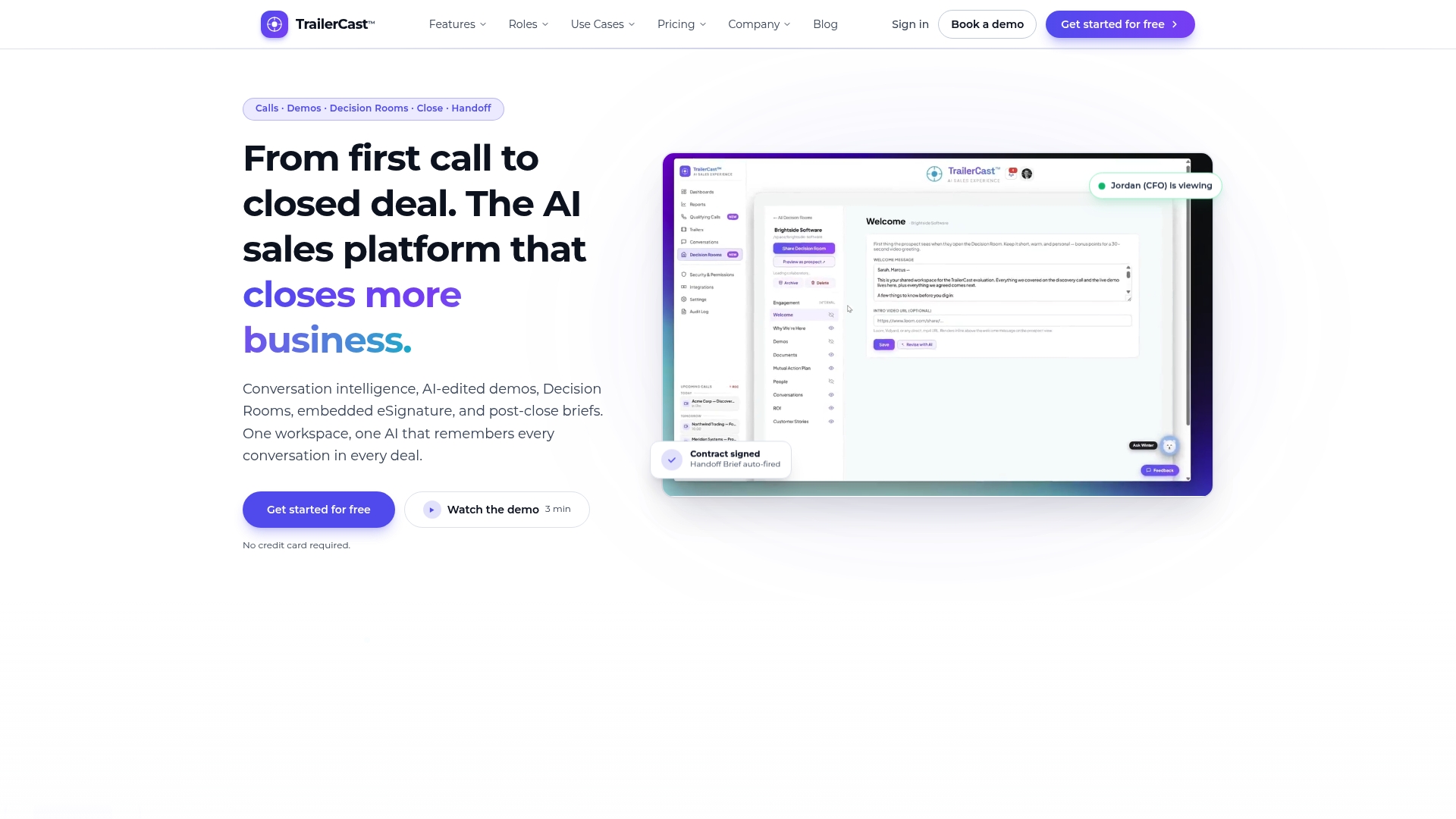
At $59/seat/month billed annually, Trailercast replaces conversation intelligence, demo video editing, deal rooms, eSignature, and post-close handoff in one workspace. No credit card needed to start. See how it works or explore all features to map your current stack against what one platform can replace.
Sources and further reading
- How to Give a Product Demo That Actually Converts — timing guidance for live SaaS walkthroughs and agenda best practices
- Master Tell-Show-Tell: The Proven 3-Part Framework — structure for each demo topic
- Product Demos: How to Create Demos That Convert — async trailer length and top-of-funnel format guidance
- Product Demo Guide — async video as a scale lever
- The Counterintuitive Truth About Your Product Demos — outcome-first framing
- SaaS Demo Best Practices — Prep-Show-Prove loop and mutual action plan
- Trailercast AI Demo Trailers — auto-edited trailers from real sales calls
- Trailercast Decision Rooms — buyer-facing deal rooms and engagement analytics
- The 48 Hours After Your Demo — why same-day follow-up determines deal velocity