Qualification Scorecard: How to Build One That Scores Evidence

A sales qualification scorecard is a short grid that rates a deal on a fixed set of criteria, such as pain, budget, champion and buying process, so you can decide whether to advance it, work the gaps or let it go. The version that works scores evidence, not rep optimism. A line only earns points when a named buyer said it and you can point to where.
If you sell SaaS into multi-stakeholder deals, this is the difference between a forecast built on gut feel and one you can defend in a deal review. Below you’ll find the criteria to include, a 0-3 scoring scale, sample weights and thresholds, what to do when information is missing, and how to turn the score into one next action.
TL;DR
- A qualification scorecard rates each deal on fixed criteria (MEDDIC, MEDDPICC or a custom list) so every opportunity gets judged the same way.
- Score the evidence behind each criterion, not your belief. A 0-3 scale (unknown, assumed, buyer-stated, confirmed and acted on) keeps reps honest.
- Thresholds help you triage, but the weakest element should decide your next conversation, and a missing critical item can outweigh a strong total.
- Record what is known, who confirmed it, how, and what happens next. That turns a score into a plan.
- Calls, transcripts and a running deal brief make the evidence easy to capture, so the scorecard stays current.
Table of Contents
- What a qualification scorecard actually does
- MEDDIC and MEDDPICC scorecards, explained
- Score the evidence, not the opinion
- Weights, thresholds and when to ignore them
- What to do when information is missing
- Turn the score into one next action
- Build your scorecard in five steps
- Where scorecards break down
- Our perspective
- Keep the evidence behind your scorecard in one place
- FAQ
- Sources
What a qualification scorecard actually does
Most reps already qualify. They just do it in their heads, then summarize it in a CRM field that says “Champion: yes.” A scorecard forces the question behind that field: how do you know?
It does three jobs:
- Triage. You have more open deals than hours. A consistent score tells you which ones deserve a second call this week.
- Gap spotting. The grid shows which criteria are blank. A deal with a strong champion and no identified economic buyer looks very different from one with the reverse.
- Coaching and forecasting. Managers and sales engineers can inspect the same facts instead of listening to a story.
The common point-based approach is a 100-point grid. One published example uses ten categories scored 0 to 10 each, including relationship, compelling event, urgency, consequences of inaction, ROI, budget, risk and solution fit. In that example, a score below 40 means disqualify or send back to nurture, 40 to 60 means more discovery, and above 60 means advance to proposal.
That structure is a fine starting point. The weak spot is that a 7 out of 10 on “urgency” is usually somebody’s feeling. The rest of this guide fixes that.
MEDDIC and MEDDPICC scorecards, explained
When readers search for a MEDDIC scorecard, they want the criteria mapped to a score. MEDDIC is the six-letter framework built at Parametric Technology Corporation in the 1990s. MEDDPICC adds a Paper process and a second C for Competition.
The eight MEDDPICC checks are:
| Letter | Criterion | The question it answers |
|---|---|---|
| M | Metrics | What measurable outcome does the buyer expect? |
| E | Economic Buyer | Who owns the budget, and have we met them? |
| D | Decision Criteria | How will they judge solutions? |
| D | Decision Process | What steps and people sit between now and a yes? |
| P | Paper Process | What legal, security and procurement steps come before signature? |
| I | Identify Pain | What problem is costly enough to act on? |
| C | Champion | Who inside sells for us when we’re not in the room? |
| C | Competition | Who or what else are they considering, including doing nothing? |
A MEDDIC scorecard is the same grid with the first six rows. If your deals are small, transactional and rarely touch procurement, six rows are enough. If you sell to mid-market or enterprise buyers, keep Paper Process, because that is where deals that looked done tend to stall. We cover the full framework in our 24-point MEDDPICC checklist.
Score the evidence, not the opinion
Here is the change that makes a scorecard worth keeping. Instead of asking “how strong is the champion, 1 to 10?”, ask “what is the best evidence we have?”
A simple 0 to 3 evidence scale looks like this:
- 0: no information.
- 1: an assumption. You believe it, but no buyer said it.
- 2: stated by a named buyer.
- 3: confirmed and acted on.
One practitioner guide defines strong evidence as specific, buyer-originated, time-bound, and consequential for value, access, risk, sequencing or the next commitment. That last part matters. “They said budget isn’t an issue” is a 1 or 2. “Finance approved $48,000 for Q1 and the PO request is in procurement” is a 3.
What this looks like on a real deal
Say you’re selling a platform to a 120-person software company. After the first two calls, your scorecard might read:
| Criterion | Score | Evidence |
|---|---|---|
| Identify Pain | 3 | VP Sales named the cost of missed follow-ups on two lost deals, confirmed in the second call |
| Champion | 2 | Director of RevOps volunteered to run the pilot, but hasn’t yet brought us to her boss |
| Metrics | 1 | We think they care about cycle length. Nobody has given a target |
| Economic Buyer | 0 | Not mentioned by name |
| Decision Process | 1 | Champion said “it goes through a few people” |
| Paper Process | 0 | Security review never raised |
That deal totals 7 of 18. The total is not the insight. The insight is that you have a real pain and a friendly contact, and almost nothing on money, people and paper. Your next call has an obvious job.
Weights, thresholds and when to ignore them
Not every criterion carries equal weight. One published example for an enterprise SaaS team suggests MEDDIC weights of 25% for Champion, 20% for Economic Buyer, 20% for quantified pain, 15% for Decision Process, 10% for Metrics and 10% for Decision Criteria. Its common thresholds are 70 or higher for committed pipeline, 50 to 69 for qualified pipeline, and below 50 for early stage or nurture.
A lead-level model works differently. A five-dimension system for SaaS companies in the $3M to $30M ARR range scores ICP fit, timing, authority, need clarity and budget signal from 0 to 3 each, for a maximum of 15. It suggests 10 or above as a reasonable starting threshold for sales-qualified leads, and advises calibrating against your own closed-won data within the first 60 days.
That calibration advice is the one to copy. Published weights are a template, not a law. To adapt them:
- Pull your last 20 closed-won and 20 closed-lost deals.
- Mark which criteria were actually strong in each.
- Raise the weight of the criteria that separated the two groups.
- Re-check every quarter. Your market and deal size drift.
For a look at how teams compare point-based approaches and use thresholds to decide whether a deal progresses, this piece on building a trusted sales pipeline is a useful companion.
Don’t average your way into a false forecast
One MEDDPICC scorecard template argues against averaging the scores into a probability. Its reasoning: a missing paper process can matter more than several strong categories. A deal with six 3s and a 0 on Paper Process is not an 85% deal. It’s a deal with a known landmine.
A practical fix is to add gates. Whatever the total, a deal cannot move to “commit” unless the Economic Buyer and Paper Process are at 2 or higher. Totals triage. Gates protect the forecast.
What to do when information is missing
Missing information is normal. The mistake is treating it as a low score and moving on, or worse, filling it in with hope.
One guide recommends four evidence states: unknown, asserted, confirmed and inspectable. Each state points to a different kind of work. Unknown means discovery. Asserted means you need the buyer to say it, or a second source. Confirmed means you can build strategy on it. Inspectable means you can show it, such as a recording, an email or a document.
The same source says a useful field should record four things:
- what is known,
- who confirmed it,
- how it was confirmed,
- what must happen next.
Put those four into every scorecard cell, even if the cell just says “Unknown. Ask in call 3.” It converts a blank into an assignment.
Where evidence goes stale
Evidence has a shelf life. A budget confirmed in March may not survive a reorg in June. Mark each confirmed item with a date, and treat anything older than your typical sales cycle as a 1 until someone reconfirms it. Reps who skip this are the ones surprised when a champion changes jobs.

Turn the score into one next action
A scorecard that doesn’t change what you do next week is paperwork. One MEDDPICC coaching approach describes a repeatable loop: plan what’s known, inspect each element against evidence, then take the single next action that closes the most important gap. The same source says the weakest element should decide the next conversation. Early in a deal the gaps are typically Identify Pain and Metrics. Later they tend to be the Economic Buyer and the decision or paper process.
In a weekly deal review, run these questions in order:
- What changed since last week?
- Which evidence contradicts something we believed?
- Which scores rest on old evidence?
- What is the one action most likely to reduce uncertainty?
The fourth question is the hard one. “Send the proposal” is rarely it. More often it’s “get the champion to introduce us to the CFO” or “ask the CISO for the security questionnaire now, not after pricing.” If that second one rings a bell, our guides to CISO security questions and the security review process show how to get ahead of the paper stage.
Teams automating follow-up after the score is set can also look at how AI lead qualification works to keep next steps moving between calls.
Build your scorecard in five steps
- Choose your criteria. Use MEDDIC for simpler cycles, MEDDPICC when security, legal or procurement is involved. Add one or two of your own if your deals fail in a predictable place, such as integration risk.
- Adopt the 0-3 evidence scale. Write the definition of each number at the top of the sheet so reps and managers score the same way.
- Set weights and gates. Start with a published split, then calibrate to your closed deals. Add gates for the criteria that kill deals late.
- Add the four-field note. Known, confirmed by, how, next step. No note, no score above 1.
- Review weekly, calibrate quarterly. Compare scores to outcomes and adjust.
The discovery stage is where most of the 0s become 2s. If your calls feel like interrogations or free-form chats, our discovery call framework and discovery questions for SaaS sales give you the questions that fill the grid naturally.
Where scorecards break down
Three failure patterns show up again and again:
- Reps score once and never update. The scorecard becomes a snapshot of call one.
- Scores get inflated before reviews. If a low score invites blame, reps will round up. Make a low honest score the safe answer.
- The evidence lives in somebody’s memory. The call happened, the champion said the right thing, and nobody wrote it down in a way a manager or sales engineer can check.
The third one is a tooling problem more than a discipline problem, and it is the one we built TrailerCast to solve.
Our perspective
We built TrailerCast on a simple observation: the calls were never the problem. The space between them was. Your champion leaves a great demo, then walks back to a CFO who wasn’t there, or a CISO whose answers are buried in a recording nobody will rewatch.
A qualification scorecard is only as good as the evidence feeding it. If that evidence lives in your head, a scattered notes app and three different tools, the scorecard turns into guesswork with a nicer layout. That’s why we designed one workspace where the AI notetaker transcribes each call, flags qualification signals and builds an evolving Deal Brief across every conversation in the opportunity. When you review a deal, the question “who confirmed that?” has a place to look.
We also think the next action matters more than the number. When the weakest element is the economic buyer or the buying committee, a personalized demo trailer for the CFO or a buyer-facing decision room gives your champion something to forward and gives you a way to see what stakeholders actually engage with. That is how a gap on the scorecard becomes a move in the deal.
Our aim is simple: you walk into every review knowing what’s confirmed, what’s assumed, and what to do next.
Daniel
Keep the evidence behind your scorecard in one place
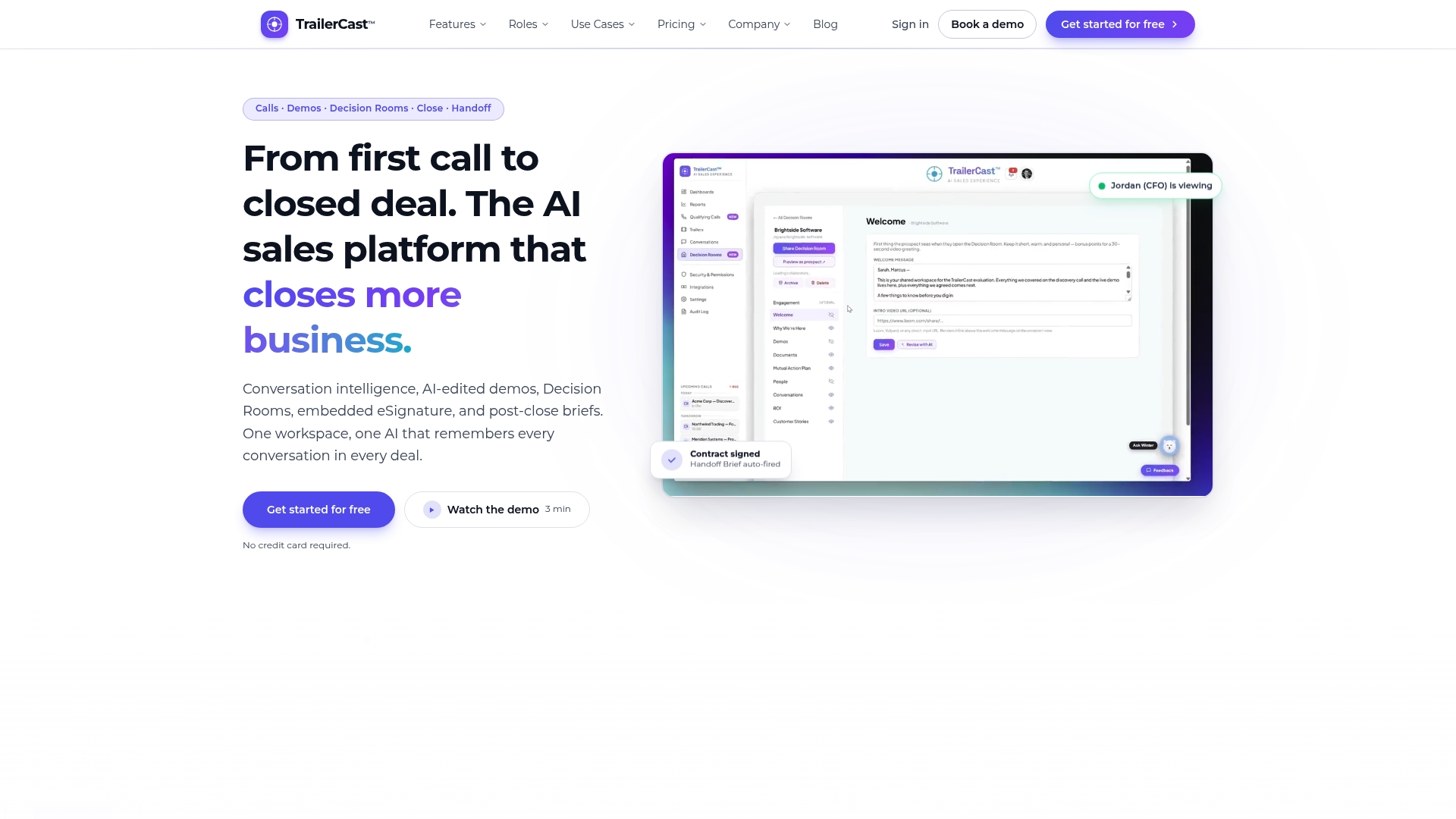
If you want the scorecard to stay current without extra admin, TrailerCast records and summarizes your calls, tracks qualification signals in a running Deal Brief, and turns demo recordings into short trailers you can tailor for each stakeholder. It also covers buyer-facing decision rooms, embedded eSignature and the post-close handoff in the same workspace.
Pricing is one plan with every feature, from $59 per month per seat. See the details on the TrailerCast plan page, or start with the AI call notetaker for discovery calls. To see how deal health connects to forecasting, read our guide to sales pipeline metrics.
FAQ
What is a sales qualification scorecard?
It is a structured grid that scores an opportunity on set criteria, such as pain, budget, champion and decision process. Each criterion gets a score and a note on the evidence behind it. The result helps you decide whether to advance, keep discovering or disqualify.
What is a MEDDIC scorecard?
A MEDDIC scorecard maps the six MEDDIC elements (Metrics, Economic Buyer, Decision Criteria, Decision Process, Identify Pain and Champion) to a score for each deal. MEDDPICC adds Paper Process and Competition. Most teams score each element from 0 to 3 based on the strength of buyer-confirmed evidence.
What score means a deal is qualified?
There is no universal number. Published examples range from a 100-point grid where 60 or more advances to proposal to weighted models using 70 or more for committed pipeline. Set your threshold by comparing scores with your own won and lost deals, and add gates for critical criteria.
How do I score a criterion when I don’t have the information?
Score it 0 and write what you need, who can provide it and when you’ll ask. If the rep believes something but no buyer said it, that’s a 1. Move it up only when a named buyer states it, and again when it’s confirmed and acted on.
How often should I update a qualification scorecard?
After every meaningful buyer interaction, and formally in your weekly deal review. Date your confirmed evidence, and re-check anything older than your normal sales cycle.
Sources
- Opportunity Qualification: Frameworks, Scorecard & Process
- MEDDPICC Explained: All 8 Letters + Free Scorecard
- The Deal Qualification Score
- MEDDPICC Sales Qualification Criteria Guide
- B2B Sales Qualification Playbook
- Inbound Lead Qualification Framework for SDR Teams
- MEDDPICC Scorecard Template for Opportunity Reviews
- How to Coach Deals with MEDDPICC