SaaS Contract Negotiation: A Seller’s Playbook That Sticks

The single most effective way to negotiate a SaaS contract as a seller is to refuse to move on price without getting something back, and then enforce that trade through a written quote, an approval matrix, and billing systems that actually execute what you promised. Hold list price. Trade terms, not dollars, for concessions. Record every exchange in a concession ledger so nothing gets negotiated twice.
Three things separate reps who protect margin from reps who bleed it every quarter:
- Start renewals 180 days before the contract ends, and time new deals to a vendor’s fiscal-year-end or end-of-quarter window when possible.
- Never give a discount without a documented trade (multi-year term, prepay, case study rights, expansion commitment).
- Enforce every agreed trade operationally with an immediate written quote, an expiration date on that quote, and a billing system that can actually run the ramps and caps you negotiated.
Key Takeaways
Disciplined SaaS contract negotiation means trading terms instead of price, documenting every concession, and enforcing those trades through operational systems that actually execute them.
| Point | Details |
|---|---|
| Trade, don’t discount | Log every concession in a ledger against a reciprocal commitment like term length or prepay. |
| Start renewals at day 180 | Buyers who negotiate six months out get better terms; sellers should mirror that timeline for outreach. |
| Route discounts through an approval matrix | Bands like 0 to 10% (rep) up to over 35% (CRO/CFO) add friction to deep discounts. |
| Enforce with quotes and billing systems | Written, expiring quotes and CPQ compatibility stop silent under-billing after signature. |
| Close the info gap between calls | TrailerCast documents negotiated terms and hands off the full history to CS at signature. |
Table of Contents
- The SaaS Contract Negotiation Framework Sellers Actually Need
- Timing And Scripts: When To Push And What To Say
- What To Trade Instead Of Cutting The Price
- Making Negotiated Terms Stick Operationally
- How TrailerCast Supports Disciplined SaaS Contract Negotiation And Enforcement
- Which Legal Clauses Actually Get Negotiated
- Common Contract Pitfalls That Cost Sellers Later
- Negotiating Service Level Agreements Without Giving Away Margin
- How To Handle Termination And Exit Clauses
- IP And Data Ownership: Who Owns What
- Where Compliance And Regulatory Requirements Enter The Negotiation
- What The Textbook Playbook Gets Wrong
- Negotiate Smarter With A Platform Built For The Full Deal
- Sources
The SaaS Contract Negotiation Framework Sellers Actually Need
Most SaaS reps negotiate by instinct: a buyer pushes back on price, the rep caves a little to keep the deal moving. That habit is how discounting becomes the default instead of the exception. The fix is a documented “give-get” principle: every concession the seller makes gets logged against something the buyer gives in return.
A concession ledger is the tool that makes this real. It’s not a spreadsheet gimmick. It’s a record, tied to dates and deliverables, of what you gave (a 12% discount) and what you got (a three-year term, prepay, a signed case study). PulseRevOps found that deals closed under a 10% discount showed roughly 30% better net retention than deals with deeper cuts, which is the entire argument for holding the line in one data point.
Approval routing keeps this disciplined instead of aspirational. A typical structure looks like this:
- 0 to 10% discount — the AE approves it, no escalation needed.
- 10 to 25% — a sales manager signs off, and the ledger must show a matching trade.
- 25 to 35% — a VP of Sales approves, usually reserved for multi-year or strategic logo deals.
- Above 35% — only a CRO or CFO signs, and it should be rare enough that reps notice when it happens.
Before any of that, know your walk-away point. Calculate it from cost-to-serve, the renewal baseline you’re protecting, and the opportunity cost of the rep’s time on a deal that isn’t closing. If a prospect’s ask falls below that number, walk. Your BATNA (best alternative to a negotiated agreement) is what keeps you from negotiating against yourself.
Pro Tip: Send a written quote or recap email within an hour of any call where terms get discussed. Verbal agreements evaporate; the buyer’s memory of “you said 20% off” rarely matches yours, and a same-day recap ends the argument before it starts.
Timing And Scripts: When To Push And What To Say
Timing decides more of a SaaS deal’s final price than any single negotiating tactic. In a dataset of 47 deals, buyers who started negotiations six months out averaged roughly 39% off list, compared to 14% for buyers who started 30 days before their contract expired. That’s not because six-month buyers negotiate harder. It’s because they have leverage: time to walk, time to run an RFP, time to make the seller sweat a quarter-end number. Sellers need the mirror image of that leverage, which means starting your own renewal outreach at day 180, not day 30.
The renewal script breaks into three windows:
- Day 180: Send a proactive check-in reviewing usage and outcomes, not price. This is where you build the ROI narrative before any number gets discussed.
- Day 90: Present the renewal quote with any proposed terms, tied explicitly to adoption data.
- Day 30: Lock the signed-by deadline. If the buyer hasn’t signed, the “temporary” pricing protections you offered earlier expire.
For new deals, timing your close to the vendor’s own fiscal calendar matters just as much, except now you’re the vendor with the calendar. Most SaaS companies close books at the end of a fiscal quarter, and reps who understand their own company’s quota pressure can use that same rhythm on buyers hunting for a deal in the final week. It cuts both ways, which is exactly why you should know your own EOQ pressure and never let a buyer smell it.
Before price ever comes up, get a clean commitment on the decision itself. A script that works: “If we can align on terms today, is TrailerCast the platform you’re moving forward with?” That single question separates real buyers from people fishing for a number to shop elsewhere. If the answer is a hedge, the conversation isn’t ready for pricing yet.
Once you’re negotiating, protect the renewal baseline with structure: signed-by deadlines convert time pressure into a limited concession window, and capped escalators keep next year’s price increase from becoming a fight. A discount without an expiration date isn’t a negotiating tool. It’s a permanent price cut you gave away for free.
What To Trade Instead Of Cutting The Price
Price is the least creative lever in a SaaS deal, and it’s the one that does the most long-term damage, because whatever you concede becomes the renewal floor. The stronger move is trading terms the buyer values without touching the number that follows them into next year’s negotiation.
Tradeable inventory in a typical SaaS deal is wider than most reps use: seat counts, module access, implementation credits, SLA tiers, payment terms, and case study rights all carry real value to a buyer without permanently discounting your list price. Here’s where to start:
- Contractual ramps, not informal ones. A true ramp is written into the order form with specific step-up dates and amounts. An informal “we’ll bill you less for a few months” promise, with nothing in the contract, is how deals quietly under-bill for a year.
- Non-recurring discounts (a one-time implementation credit) instead of a recurring price cut, so the reduction doesn’t survive into renewal math.
- Payment term flexibility — prepay for a discount, or net-60 terms for a buyer who needs cash flexibility but won’t move on price.
- Waived or capped escalators for the first renewal cycle only, with a hard expiration written into the clause.
- Case study or reference rights traded for a modest discount, which pays for itself the first time your marketing team uses the logo.
SLA upgrades and premium support deserve their own line item rather than a freebie. If a buyer wants a faster response-time tier, sell it as a paid add-on tied to a multi-year commitment. That converts a “gimme” into revenue instead of margin loss.
Making Negotiated Terms Stick Operationally
A brilliant negotiation that never makes it into your billing system isn’t a win. It’s a liability waiting to surface at renewal, when finance discovers the customer has been billed at the wrong tier for eleven months.
The fix starts with the paperwork. A written quote with an expiration date isn’t just admin, it’s an enforcement mechanism: it forces the buyer to act inside a defined window and gives your own team a single source of truth for what was actually agreed.
- Generate the quote immediately. Every negotiated term, cap, and ramp gets written down the same day, not reconstructed from memory two weeks later.
- Route it through the approval matrix. A deal desk enforces discount floors automatically, which stops desk-level margin leakage before it happens.
- Confirm your CPQ, CLM, and billing systems can actually execute the deal. Ramps, caps, and non-recurring discounts that a billing platform can’t schedule create silent under-billing and renewal disputes months later.
- Hand the signed contract to finance and ops with the full trade history attached, not just the final number.
- Set a 180-day renewal alert the moment the ink dries, so the next negotiation starts on your terms, not the buyer’s.
Pro Tip: Build a habit of reviewing every negotiated multi-year deal at the 12-month mark against its original ramp schedule. This catches under-billing while it’s still a rounding error, not a five-figure back-charge fight.
How TrailerCast Supports Disciplined SaaS Contract Negotiation And Enforcement
The gap between a great negotiation and a great outcome is usually the space between calls, where terms get misremembered and stakeholders who weren’t in the room make decisions off secondhand notes. TrailerCast is built to close that gap.
- Call transcription and structured summaries capture exactly what was promised, searchable later when a buyer disputes a term.
- Decision Rooms hold the agreed trades, ROI numbers, and documents in one place the buying committee can revisit without a memory relay.
- Branded demo trailers give a champion something to forward to the CFO or CISO who wasn’t on the call, built for SaaS security or pricing conversations specifically.
- Embedded eSignature closes the deal in-app the moment terms are locked, without a hop to a separate signing tool.
- Automated handoff briefs send the full negotiation history, including every concession and its trade, straight to customer success at signature.
The deal doesn’t die because the seller made a bad argument. It dies in an internal meeting nobody from your side attended, where the champion has to re-sell your pricing logic from memory. Owning that space between conversations is the actual negotiation battleground.
Sellers building a formal sales motion around this discipline often start with a documented sales process before adding tooling on top of it.
Which Legal Clauses Actually Get Negotiated
Legal review is where good commercial deals get quietly reshaped, usually around three clauses: indemnity, liability caps, and data privacy.
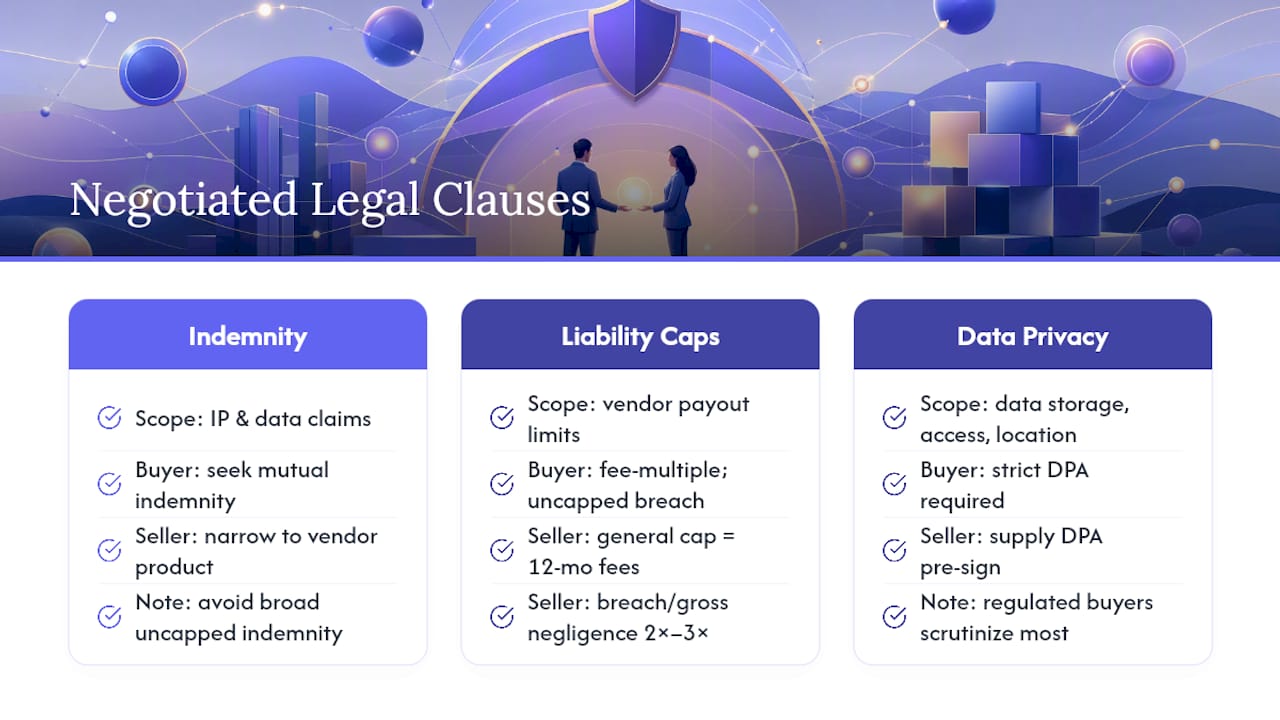
Indemnity clauses assign responsibility if a third party sues over IP infringement or data misuse. Buyers will push for mutual indemnification; sellers should hold a narrower scope tied specifically to claims arising from the vendor’s own product, not the buyer’s misuse of it. Giving broad, uncapped indemnity to close a deal is one of the most common ways a SaaS vendor inherits risk it never priced in.
Liability caps limit how much a vendor pays out if something goes wrong. The standard opening position is a cap tied to fees paid in the prior 12 months. Enterprise buyers will ask for a multiple of that, or an uncapped exception for data breaches. A reasonable middle ground is a higher cap (often 2x to 3x annual fees) carved out specifically for breach or gross negligence, while keeping general liability capped at 12 months of fees.
Data privacy and processing terms get scrutinized hardest by regulated buyers. A Data Processing Addendum covering how customer data is stored, who can access it, and where it’s processed usually needs to exist before legal will sign off, regardless of commercial terms. A practical guide to SaaS security fundamentals helps reps anticipate these asks before they stall a deal in redline.
None of these clauses should be traded away casually. A rep who concedes uncapped liability to save two weeks of legal back-and-forth is trading a real, quantifiable risk for a scheduling convenience.
Common Contract Pitfalls That Cost Sellers Later
Most SaaS contract problems aren’t discovered at signature. They surface eleven months later, at renewal, when someone in finance notices the numbers don’t match what was promised.
The most common pitfall is the informal ramp: a verbal agreement to bill less for the first few months that never gets written into the order form. When nobody remembers the exact terms, billing defaults to full price, the customer disputes the invoice, and the relationship starts its second year in a fight instead of a renewal conversation.
Auto-renewal clauses without adequate notice windows create a different problem. If a customer must cancel 90 days before renewal and doesn’t realize it, they renew angry, which is a worse outcome for retention than a clean, well-communicated renewal.
Uncapped price escalators are a slow-burn pitfall.
Vague scope definitions around “users” or “seats” cause disputes when a customer’s headcount changes. Define exactly what triggers a true-up, and when.
Silent scope creep happens when a customer adds users or modules informally, without a contract amendment. It feels generous in the moment and becomes an audit problem later.
The fix for all five is the same: nothing agreed verbally is real until it’s written into a quote and executed in a billing system that can actually track it.
Negotiating Service Level Agreements Without Giving Away Margin
SLA negotiations tend to follow a predictable pattern: the buyer’s procurement team asks for aggressive uptime guarantees and fast response times, often lifted wholesale from an enterprise vendor’s contract, without regard for what your product or team can realistically support.
Start by defining uptime in a way you can actually measure and defend, typically 99.9% for standard tiers, with clear exclusions for scheduled maintenance. Resist open-ended uptime commitments without a defined measurement window and remedy structure. Service credits, not cash refunds, should be the default remedy for missed SLA targets, capped at a percentage of monthly fees rather than the full contract value.
Response and resolution times deserve tiering rather than a single blanket promise. A P1 outage affecting the whole platform warrants a faster response than a cosmetic bug report. Buyers pushing for uniform “one-hour response on everything” haven’t thought through what that commitment actually costs to staff.
The strongest move available to sellers is treating premium SLA tiers as a paid upgrade rather than a negotiating giveaway. If a buyer wants faster support or a higher uptime guarantee than your standard tier, price it separately and tie it to a longer-term commitment. That turns an SLA ask, usually a cost center for you, into incremental revenue instead of a margin concession buried inside the base price.
Document the SLA terms with the same rigor as pricing: measurement methodology, exclusions, remedy caps, and review cadence, all written into the contract, not left to a side conversation nobody wrote down.
How To Handle Termination And Exit Clauses
Termination clauses get the least attention during negotiation and cause the most pain during a dispute, precisely because both sides assume they’ll never need them.

Termination for convenience lets either party exit with notice, typically 30 to 90 days, without cause. Buyers want this flexibility; sellers should tie it to a minimum commitment period so a customer can’t sign a multi-year deal and exit in month two without consequence.
Termination for cause covers material breach, usually with a cure period (commonly 30 days) before the terminating party can actually walk. Define “material breach” specifically rather than leaving it open to interpretation, since a vague standard invites disputes exactly when tensions are already high.
Data return and deletion obligations need clear timelines. Most enterprise buyers expect data export within 30 days of termination and deletion confirmation shortly after. Sellers should specify the format data will be returned in, since an unstructured data dump satisfies the letter of the clause while creating a real headache for the departing customer.
Post-termination fees for early exit protect the revenue you priced the deal around. If a customer signed a three-year term at a steep discount and exits in year one, an early termination fee recoups some of that lost economics; without one, the discount you gave for commitment becomes free.
Exit clauses are also where the concession ledger earns its keep: if a discount was traded for a multi-year commitment, the termination clause should reflect that trade, not undercut it.
IP And Data Ownership: Who Owns What
Intellectual property and data ownership questions surface in almost every enterprise SaaS negotiation, and the standard answer is simpler than most buyers expect: the vendor retains ownership of the platform, code, and any general improvements made during the engagement, while the customer retains ownership of its own data.
The friction usually shows up around derivative work and feedback. If a customer’s feature request or configuration influences the product roadmap, some buyers will ask for IP rights or exclusivity over that improvement. Sellers should hold firm here: feedback and feature requests improve the product for everyone, and granting exclusivity or ownership over roadmap decisions to a single customer creates a precedent that becomes unmanageable across a customer base.
Customer data ownership should be unambiguous in the contract: the customer owns its data, the vendor processes it solely to deliver the service, and access rights terminate on contract end except for legally required retention periods. This is rarely a point worth negotiating away from, since giving it up creates real legal exposure with no upside.
Aggregated or anonymized data usage, often used for benchmarking or product analytics, is a middle ground worth defining explicitly. Many buyers will accept anonymized, aggregated use of their data for product improvement, but object to anything that could re-identify their organization. Spell out exactly what “anonymized” means in the contract rather than leaving it to interpretation later, since that ambiguity is where trust breaks down fastest.
Where Compliance And Regulatory Requirements Enter The Negotiation
Compliance requirements don’t usually kill deals outright, but they do stall them, and they reshape the terms that make it into the final contract more than almost any other factor.
Buyers in regulated industries, healthcare, financial services, and public sector, will bring their own requirements into the negotiation before price is even discussed: SOC 2 Type II reports, HIPAA business associate agreements, GDPR-compliant data processing addenda, or industry-specific frameworks depending on the buyer’s jurisdiction and sector. A seller who can produce these documents on request moves faster through legal review than one scrambling to generate them mid-negotiation.
The negotiation angle here is preparation, not concession. Reps who show up with a current SOC 2 report and a standard DPA already drafted eliminate an entire category of back-and-forth that otherwise burns weeks. Reps who don’t have these ready end up making commercial concessions to compensate for the delay their own compliance gaps caused, which is a bad trade nobody planned for.
Regional data residency requirements are increasingly common asks, especially from buyers with EU operations or public-sector contracts. If your infrastructure can’t currently support data residency in a specific region, say so early rather than after a signed letter of intent, since backing out of that promise later costs far more trust than never making it.
What The Textbook Playbook Gets Wrong
Most negotiation advice treats a SaaS deal like a single event: one call, one number, one signature. That framing misses where deals actually get won or lost, which is in the twelve weeks of scattered calls, forwarded emails, and internal buyer-side meetings between “interested” and “signed.”
The conventional wisdom on discounting is directionally right (hold the line, trade instead of cutting) but underestimates how much of that discipline collapses simply from information loss. A rep can run a flawless give-get negotiation on a call, and still lose the deal three weeks later because the champion mangled the terms explaining them to a CFO who wasn’t there. The concession ledger and approval matrix are necessary. They’re not sufficient without a way to make sure what was actually agreed survives contact with the buying committee.
That’s the part most negotiation frameworks skip entirely. They optimize the moment of the ask and ignore the moment after, when a promise made on a call has to travel through people who never heard it firsthand. The reps who protect margin best aren’t necessarily the sharpest negotiators in the room. They’re the ones whose terms survive the trip back to the buyer’s leadership team intact.
Prioritize documentation before cleverness. A mediocre negotiator with a written ledger beats a brilliant one relying on memory.
— Daniel
Negotiate Smarter With A Platform Built For The Full Deal
TrailerCast gives sales teams a documented negotiation trail instead of scattered notes and half-remembered promises, so every trade you make survives the trip from the call to the contract. The features built for this playbook include:
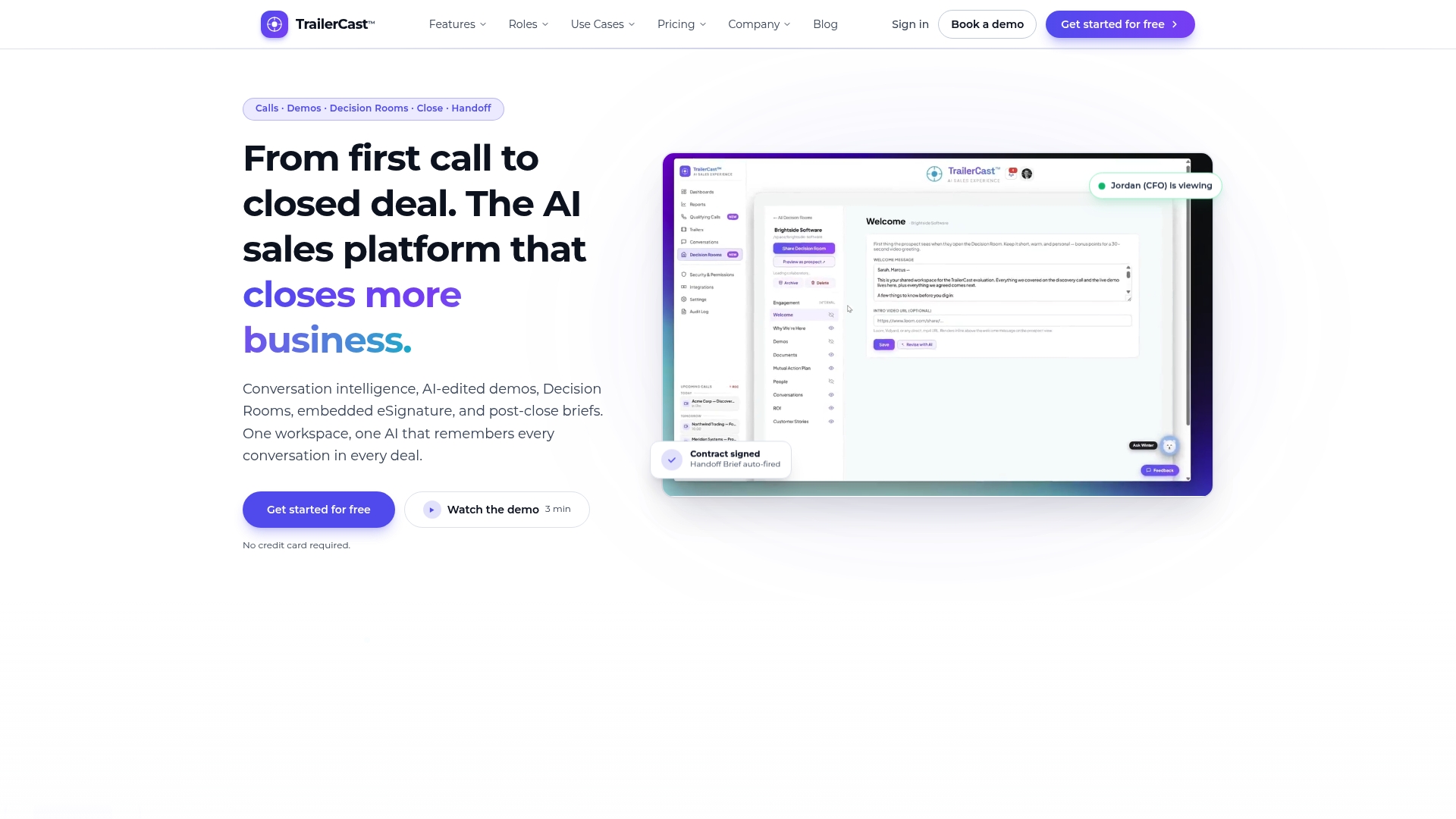
- Searchable call transcripts that pin down exactly what discount was traded for what commitment, no more disputes over memory.
- Decision Rooms that hold agreed terms, ROI math, and documents in one place your buying committee can actually revisit.
- Branded demo trailers your champion can forward to a CFO or CISO who wasn’t on the call, without re-explaining pricing logic from scratch.
- Embedded eSignature that closes the loop the moment terms are locked, no separate tool, no delay.
- Automated handoff briefs that send your full negotiation history to customer success at signature, so nothing gets renegotiated by accident in month two.
If your team is negotiating multi-stakeholder SaaS deals and losing terms in the gap between calls, look at TrailerCast’s full feature set or start with a free trial to see how a single workspace holds a negotiation together from first call to signed contract.
Sources
- How do you negotiate enterprise SaaS contracts in 2027 without…?
- SaaS Contract Negotiation 2026: 47 Deals Analyzed | Softabase
- 7 Contract Negotiation Strategies for B2B Founders