How to Write Security Questionnaire Responses That Win

The fastest way to produce accurate security questionnaire responses is a scoped, evidence-backed answer library paired with a named response owner who controls scope and attachments. Without those two things, you’re starting from scratch every time, chasing the same SMEs, and sending inconsistent answers to buyers who will notice.
Here’s what to do right now:
- Assign a single response owner who coordinates intake, routes questions to SMEs, and owns the deadline.
- Confirm scope before answering anything: which systems, environments, and data types does this questionnaire cover?
- Pull approved answers from your existing library or prior responses rather than drafting from scratch.
- Attach dated evidence for every claim that requires it: SOC 2 report, pen test executive summary, policy excerpts.
- Flag every question as yes / no / needs-review before writing a single word of prose.
- Loop in legal before submitting any answer that implies a contractual SLA, guarantee, or uptime commitment.
A security questionnaire response checklist with an intake owner, reviewer list, answer library, and mapped evidence reduces cycle time and prevents inconsistent or unsupported answers across stakeholders.
Key Takeaways
Accurate, fast security questionnaire responses require a named owner, a scoped answer library, and dated evidence attached to every material claim.
| Point | Details |
|---|---|
| Assign one response owner | A single GRC analyst or security program manager coordinates intake, routes questions, and owns the deadline. |
| Build a 40–60 answer library | Canonical answers covering common domains let you reuse 80% of responses across recurring DDQs. |
| Date and scope every answer | Scope answers to specific systems and attach evidence with observation periods; avoid absolute language. |
| Involve legal on commitments | Any answer implying an SLA, uptime guarantee, or breach notification timeline needs legal review before submission. |
| Treat DDQs as an operational control | Version answers, run quarterly reviews, and keep attachable evidence sets ready to avoid the heroic scramble. |
Table of Contents
- What is a security questionnaire and why do organizations send them?
- What control domains will you see in most DDQs?
- How do you prepare and deliver responses faster?
- Best practices and common pitfalls when answering security questionnaires
- How should you reference certifications and third-party evidence?
- What tools and templates can speed up your responses?
- What are realistic timelines and costs for U.S. teams?
- A 30/60/90 day sprint to get control of questionnaire velocity
- The case for treating DDQs as an operational control
- Sources
What is a security questionnaire and why do organizations send them?
A security questionnaire is a structured set of questions a requesting organization sends to evaluate a vendor’s cybersecurity controls, data-handling practices, and compliance posture before entering or continuing a business relationship. The purpose is risk transfer: the buyer needs documented evidence that your environment won’t become their liability.
Who sends them varies, and that context shapes the right level of detail:
- Procurement teams at enterprise buyers use them during vendor onboarding, often as a gate before contract execution.
- Vendor risk management (VRM) teams send them on a recurring basis, typically annually, to monitor existing suppliers.
- Customers in regulated industries (financial services, healthcare, government contractors) send them as a contractual requirement, not a courtesy.
- Prospects’ CISOs or security engineers send them mid-sales cycle to unblock a deal before legal review.
The questionnaire format varies by requester. Common instruments include the Shared Assessments SIG (a long-form, comprehensive third-party risk instrument), the Cloud Security Alliance CAIQ (cloud-focused, mapped to the CSA Cloud Controls Matrix), the Vendor Security Alliance VSAQ (a shorter, startup-friendly format), and custom due-diligence questionnaires (DDQs) built by the requester’s own team. Knowing which format you’re working with tells you immediately how much evidence you’ll need and how granular the answers should be.
What control domains will you see in most DDQs?
Most security assessment questions cluster into ten domains regardless of the framework behind them. Access control, encryption, incident response, vulnerability management, logging and monitoring, backup and recovery, business continuity and disaster recovery (BC/DR), vendor and subprocessor management, privacy and data handling, and compliance and certifications together cover the majority of questions in any SIG, CAIQ, or custom DDQ.
Here’s what each domain typically asks:
- Access control: Do you enforce MFA? How is privileged access managed and reviewed? What is your offboarding process?
- Encryption: What encryption standards apply to data at rest and in transit? Who manages keys?
- Incident response: Do you have a documented IR plan? What are your notification timelines for a breach affecting customer data?
- Vulnerability management: How often do you run scans? What is your patching SLA for critical CVEs?
- Logging and monitoring: What events are logged? How long are logs retained? Do you use a SIEM?
- Backup and recovery: What is your RTO/RPO? How often are backups tested?
- BC/DR: Do you have a tested business continuity plan? When was it last exercised?
- Vendor/subprocessor management: Do you assess your own vendors? Do you maintain a subprocessor register?
- Privacy/data handling: Where is data stored? Do you support GDPR/CCPA deletion requests? Who has access to customer data?
- Compliance: Do you hold SOC 2, ISO 27001, or FedRAMP? What is the scope?
These domains map directly to standard frameworks. The CIS Controls provide a prioritized baseline you can align to questionnaire items and cite as implementation evidence. The CSA Cloud Controls Matrix v4 maps cloud-specific controls to CAIQ questions. NIST SP 800-53 and ISO/IEC 27001 Annex A both organize controls into domains that mirror these categories closely, so an ISO 27001 certification or a NIST-aligned policy set gives you pre-built answers for most of the list.
Evidence weight differs by domain. Access control, encryption, and incident response tend to be evidence-heavy: buyers want your SOC 2 report, a pen test executive summary, or an access-review attestation, not just a “yes.” Architecture and role descriptions are more explanation-heavy, where a clear written answer with a diagram reference is sufficient.
How do you prepare and deliver responses faster?
The workflow is: intake and scope, triage, owner assignment, answer lookup, evidence mapping, internal review, legal sign-off, and submission. Running those steps in order, with the right people at each gate, is what separates a two-day turnaround from a two-week one.
Step 1: Intake and scope. The response owner receives the questionnaire, confirms the format (SIG, CAIQ, custom), identifies the requesting team and their deadline, and documents which systems and data types are in scope. Never start answering before scope is confirmed.
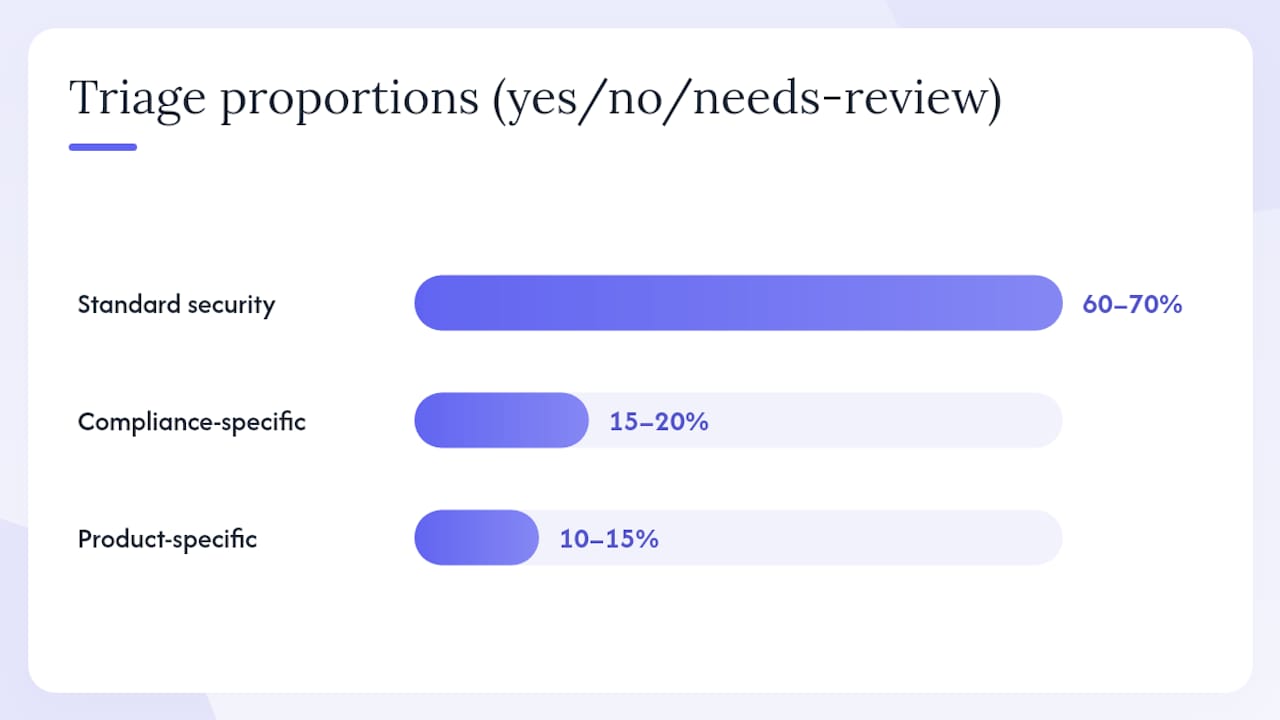
Step 2: Triage. A triage approach typically splits questionnaire items into standard security questions (roughly 60–70%), compliance-specific questions (15–20%), and product-specific questions (10–15%). Flag each question: yes (answer exists in library), no (control not in place, needs honest framing), or needs-review (partial control, in-progress, or requires SME input).
Step 3: Owner assignment. Route each question category to the right SME. A practical ownership template:
| Role | Responsibility |
|---|---|
| Response owner (GRC analyst) | Intake, coordination, final review, submission |
| Security SME | Access control, encryption, IR, vulnerability management |
| Engineering/product reviewer | Architecture, data flows, subprocessor list, backups |
| Legal reviewer | Liability language, breach notification commitments, SLA claims |
| Deadline owner | Tracks SLA, escalates blockers |
Step 4: Answer lookup. Pull from your canonical answer library first. A library of 40–60 approved answers covers most DDQs and lets teams reuse 80% of answers across recurring questionnaires. If no approved answer exists, draft one and route it through security review before using it.
Step 5: Evidence mapping. For every claim requiring evidence, attach the specific artifact: SOC 2 Type II report (or executive summary under NDA), pen test executive summary, ISO 27001 certificate and scope statement, access-review attestation, encryption configuration snippet, or subprocessor register. Date every attachment.

Step 6: Internal review. The security SME reviews for accuracy. The response owner checks for scope consistency. Legal reviews any answer that implies a commitment.
Step 7: Submit. Package the response per the requester’s format. Include a cover note that identifies the response owner and their contact information for follow-up questions.
Pro Tip: Avoid absolute language in your answers. Phrases like “we always,” “we guarantee,” or “we never” create contractual exposure and are almost never literally true. Replace them with scoped, accurate language: “As of [date], [control] is implemented for [in-scope systems] and verified in our SOC 2 Type II report covering [observation period].”
Best practices and common pitfalls when answering security questionnaires
The central rule is simple: be concise, evidence-backed, and scoped. Every answer should state what the control is, confirm it applies to the in-scope environment, and point to the evidence that verifies it.
Do:
- Reuse approved answers from your library verbatim; ad-hoc rewrites introduce inconsistency.
- Date every piece of evidence and note its observation window or certification period.
- Scope your answers explicitly: “for our production environment hosted on AWS us-east-1.”
- Use “N/A” with a one-line explanation when a control genuinely doesn’t apply to your environment.
- Offer full reports under NDA rather than attaching them directly when they contain sensitive architecture details.
Don’t:
- Use absolute words: “always,” “never,” “100%,” “guarantee,” “zero incidents.”
- Send internal-only artifacts (raw audit findings, unredacted pen test reports, internal policy drafts with open action items).
- Answer questions outside your confirmed scope to appear more capable than you are.
- Let engineering or product teams submit answers without security review.
- Ignore breach history questions. Buyers know you’ve had incidents; a transparent, well-framed answer builds more trust than a deflection.
Sensitive questions deserve careful phrasing. For breach history, a strong framing is:
That answer is honest, scoped, and forward-looking. It shows process maturity, not just an absence of problems.
When a control is in progress, say so: “This control is currently in implementation, targeted for completion by [quarter]. Interim compensating controls include [X].” Overstating a control’s maturity is the fastest way to lose a deal after a follow-up audit.
How should you reference certifications and third-party evidence?
Certifications are signals, not answers. A SOC 2 Type II report is the AICPA attestation framework that verifies your service organization’s controls over a defined observation period. An ISO 27001 certificate confirms your ISMS scope and certification body. Neither one answers a specific question on its own. You need to attach or offer the specific evidence the buyer expects and reference it precisely.
What to attach vs. what to offer under NDA:
- Attach: ISO 27001 certificate, SOC 2 executive summary (bridge letter if the report is aging), pen test executive summary, subprocessor register.
- Offer under NDA: Full SOC 2 Type II report, full pen test report with findings, internal audit reports, architecture diagrams with IP ranges.
Evidence reference table:
| Evidence type | What it supports | Key metadata to include |
|---|---|---|
| SOC 2 Type II report | Access control, availability, confidentiality, change management | Observation period (start/end dates), auditor name, Trust Service Criteria covered |
| ISO 27001 certificate | ISMS scope, risk management, policy framework | Certification body, scope statement, expiry date |
| Pen test executive summary | Vulnerability management, remediation posture | Test date, scope (in/out of scope systems), methodology, critical/high finding count and status |
| Access review attestation | Privileged access, least privilege, offboarding | Review date, reviewer name/role, systems covered |
| Subprocessor register | Vendor/third-party risk, data residency | Last updated date, data categories processed per subprocessor |
A sample short answer for an encryption question: “Data at rest is encrypted using AES-256. Data in transit is protected using TLS 1.2 or higher. These controls are verified in our SOC 2 Type II report (observation period: [start date] to [end date], available under NDA) and our most recent penetration test (conducted [month, year]).”
Version-control your evidence attachments with a filename convention that includes the document type, scope, and date: SOC2_TypeII_2025-09-30_ExecSummary.pdf. That one habit prevents reviewers from opening a two-year-old report by mistake.
What tools and templates can speed up your responses?
Two practical paths exist: a managed answer library with lightweight automation, or an integrated DDQ automation platform that pulls evidence directly from your stack. The right choice depends on your questionnaire volume and team size.
Answer library approach (best for teams receiving fewer than 20 DDQs per year):
- Build a spreadsheet or wiki-based library with canonical answers, evidence links, last-reviewed date, and owner.
- Store 40–60 answers organized by control domain.
- Use the CIS Controls Self-Assessment Tool (CIS-CSAT) to generate a baseline self-assessment you can reference in answers.
- Integrate with your document management system so evidence links stay current.
Integrated DDQ automation (best for teams receiving 20+ DDQs per year or managing enterprise accounts):
- Platforms in this category ingest incoming questionnaires, match questions to your answer library using semantic search, and surface the closest approved answer for human review.
- They typically integrate with GRC tools, cloud storage, and ticketing systems to pull evidence automatically.
- Initial setup requires 40–80 hours to build and validate the answer library; the ROI compounds quickly on repeat buyers.
Template resources to bootstrap your library:
- The Vendor Security Alliance publishes questionnaire templates that give you a ready-made taxonomy to organize answers against.
- The CAIQ v3.1 answer format (yes/no + narrative) is a useful structural model even for non-cloud questionnaires.
- Maturity-tiered answers (startup posture vs. enterprise posture) let you match your actual control maturity without overclaiming.
Pro Tip: Name every answer and evidence file with a consistent convention: [Domain]_[ControlShortName]_[LastReviewedYYYY-MM]. For example: AccessControl_MFA_2025-11. This makes it immediately clear whether an answer is current and prevents two team members from maintaining conflicting versions of the same answer.
What are realistic timelines and costs for U.S. teams?
A small, scoped DDQ (20–40 questions, familiar format) takes 2–8 hours of total effort without automation. A complex enterprise SIG or CAIQ with 200+ questions and evidence requirements runs 3–10 person-days. Those numbers drop dramatically after you’ve built a working answer library.
Timeline bands by questionnaire type:
- Quick triage (any questionnaire): 1–2 hours. Response owner reviews format, flags yes/no/needs-review, assigns owners.
- Standard DDQ (20–60 questions): 1–2 days total. GRC analyst pulls answers, security SME reviews, legal spot-checks.
- Full SIG or CAIQ (100–300+ questions): 5–10 business days. Requires GRC analyst, security SME, engineering reviewer, and legal sign-off.
- Evidence gathering: Add 1–3 days if reports need to be requested from auditors or if the pen test is aging and a bridge letter is needed.
Role-based effort estimates:
- GRC analyst: 60–70% of total effort (intake, answer lookup, coordination, submission).
- Security SME: 20–25% (technical accuracy review, evidence identification).
- Legal reviewer: 5–10% (liability language, breach notification commitments).
- Engineering/product: 5–10% (architecture questions, subprocessor list, data flows).
At a blended U.S. rate of $75–$150/hour for GRC and security staff, a manual SIG response can cost $3,000–$8,000 in labor. An automation platform with a $10,000–$30,000 annual license typically breaks even after 4–8 enterprise DDQs per year. If you’re responding to more than that, the math favors automation.
Invest in automation when: questionnaire volume exceeds 15–20 per year, you have recurring buyers who send the same format annually, or the contract values at stake justify the setup cost.
A 30/60/90 day sprint to get control of questionnaire velocity
Start with scope and ownership, then build your answer library, then automate the repeatable parts. That sequence matters: automation built on top of unreviewed answers just scales your errors.
Days 1–30: Foundation
- Appoint a named response owner (GRC analyst or security program manager).
- Document your intake process: how questionnaires arrive, who receives them, and what the SLA is by tier.
- Audit your existing responses from the past 12 months and extract the 40–60 most common answers.
- Build a simple answer library (spreadsheet or wiki) with canonical answers, evidence links, last-reviewed date, and owner.
- Create an evidence map: list every certification, report, and attestation you hold, with expiry dates and scope.
Days 31–60: Accuracy and coverage
- Run every existing answer through a security SME review. Flag anything that uses absolute language or references outdated evidence.
- Map your answer library to the SIG, CAIQ, and CIS Controls taxonomies so you know which approved answer covers which framework question.
- Establish a quarterly review cadence: one owner per domain, 30-minute review per quarter.
- Pilot the process on one live questionnaire end-to-end and measure cycle time.
Days 61–90: Automation and metrics
- Evaluate automation tooling based on your volume and stack integrations.
- Set up evidence auto-retrieval for your most frequently attached documents.
- Track four metrics going forward: cycle time per questionnaire tier, number of follow-up questions from buyers, percentage of answers pulled from the library (reuse rate), and evidence attach rate.
The case for treating DDQs as an operational control
The teams that handle questionnaires well share one trait: they treat the process as an ongoing operational control, not a one-off sales artifact. Ownership plus a versioned answer library beats ad-hoc effort every time, not because it’s more organized, but because it’s auditable.
The most common failure mode is the “heroic scramble”: one person chases five SMEs over two weeks, assembles answers in a shared doc, and submits something that’s never reviewed again. The next questionnaire starts from scratch. The answers drift. A buyer’s follow-up audit surfaces a discrepancy between what you said six months ago and what you say today.
Teams that scale do three things differently. They version their answers with dates and owners, so there’s a clear record of what was true when. They run quarterly reviews tied to their audit calendar, so answers stay current without a crisis triggering the update. And they build attachable evidence sets, meaning the SOC 2 exec summary, the pen test summary, and the ISO certificate are always ready to attach, not something you have to request from your auditor under deadline pressure.
The questionnaire is a window into your security program. Treat it like one.
Sources
Use these canonical resources as the basis for standard answers and evidence mapping when building your library.