Solution Engineer: Role, Skills, and Career Path in 2026

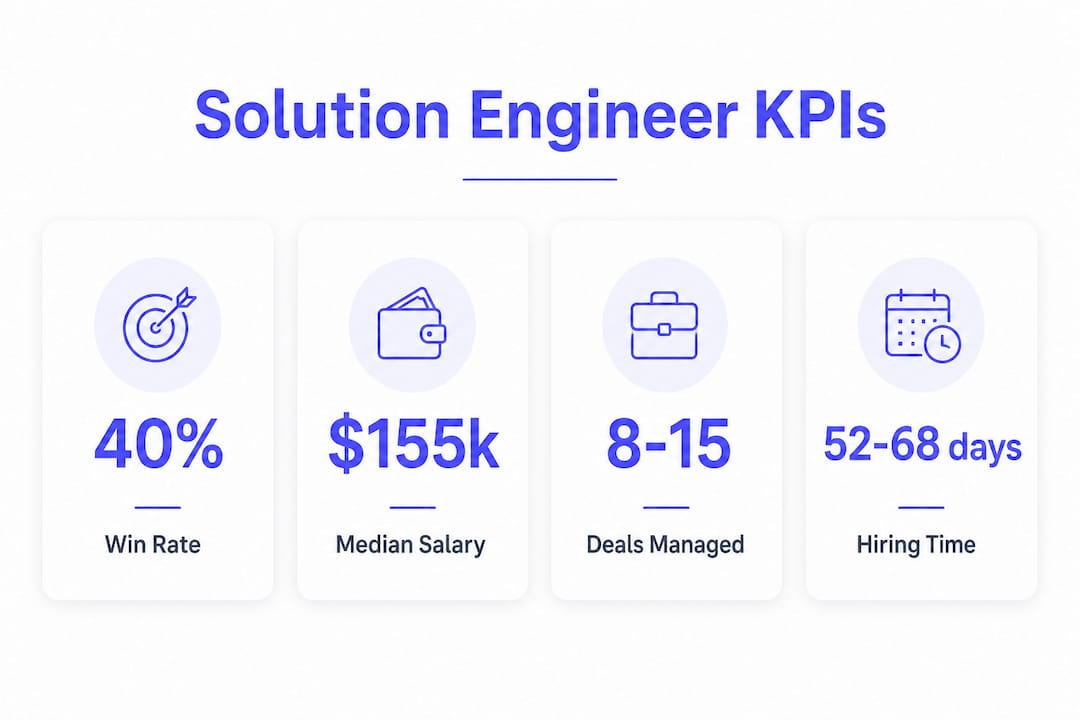
A solution engineer is defined as a technical sales professional who translates customer requirements into tailored technical solutions, driving deal success in complex B2B environments. Known in many organizations as a sales engineer or solutions consultant, this role sits at the intersection of product knowledge and customer need. The SE role covers technical discovery, proof-of-concept delivery, demo design, and RFP responses, all in close partnership with account executives. With a national median base salary of $155,000 in 2026 for AI-focused roles, this is one of the most valued positions in B2B tech sales.
What does a solution engineer do day to day?
The core job is deceptively simple: help the sales team win deals by proving the product works for the customer’s specific situation. The execution, though, is anything but simple.
A typical week for a solutions engineer looks like this:
- Technical discovery calls. The SE joins early sales calls to understand the customer’s existing infrastructure, pain points, and technical constraints. This is not passive listening. The SE asks pointed questions about data flows, security requirements, and integration dependencies.
- Custom demo design and delivery. Generic demos lose deals. The SE builds and delivers product demonstrations tailored to the buyer’s exact use case, often adjusting the environment the night before a call.
- Proof-of-concept management. POCs are where deals are won or lost. The SE scopes success criteria upfront, runs the evaluation, and documents results in a format the buying committee can act on.
- RFP and security questionnaire responses. Enterprise deals require written technical validation. The SE owns this, translating product capabilities into precise answers for procurement and security teams.
- Account executive collaboration. The SE and AE operate as a two-person team. The AE manages the relationship and commercial terms; the SE manages technical credibility and feasibility.
- Deal prioritization. Managing 8–15 active deals simultaneously is standard. The SE must decide which opportunities deserve intensive POC investment and which get a lighter-touch demo.
Pro Tip: Ruthless prioritization is the skill that separates good SEs from great ones. Allocate your deepest effort to deals with clear technical fit and strong executive sponsorship. Low-probability deals with vague requirements will consume your calendar and drain your team.
The daily reality also includes internal coordination. SEs brief product managers on customer feedback, support customer success during handoffs, and sometimes train new AEs on technical positioning. The role is never purely pre-sales in practice.

How do solution engineers impact sales metrics?
The business case for hiring a solutions engineer is measurable. Win rates on SE-supported deals run between 25% and 45%, deal velocity improves by 10%–20%, and POC conversion rates land in the 50%–70% range. Each of those numbers represents real revenue.
“The most successful SEs act as a bridge between sales and product engineering, translating customer constraints into actionable product feedback and making technical judgments on deal fit. This role shapes product development by communicating customer technical requirements effectively.”
The table below maps the key performance indicators used to evaluate solutions engineers in most B2B sales organizations.
| Metric | Benchmark Range | What It Measures |
|---|---|---|
| Win rate on supported deals | 25%–45% | Technical validation effectiveness |
| Deal velocity improvement | 10%–20% | Speed of moving deals through pipeline |
| POC conversion rate | 50%–70% | Quality of proof-of-concept execution |
| Active deals managed | 8–15 simultaneously | Workload and coverage capacity |
Coverage ratios matter here. When one SE supports too many AEs, quality drops and burnout follows. When the ratio is too low, the SE function becomes a cost center. Most high-performing teams calibrate this carefully, treating SE capacity as a strategic resource, not a support function.
How does a solution engineer differ from related roles?
Title confusion is real in this field. Solutions Engineer, Sales Engineer, and Solutions Consultant typically describe the same pre-sales lifecycle, but the label varies by industry and company culture. SaaS and cloud vendors favor “Solutions Engineer.” Infrastructure and hardware vendors lean toward “Sales Engineer.” Neither title signals a fundamentally different job.
The distinctions that actually matter are scope and timing:
- Solutions Consultant often implies a post-sales or professional services component, especially in consulting-heavy industries.
- Technical Solutions Architect or system solution consultant carries a broader design mandate, typically involving enterprise architecture decisions rather than deal-specific demos.
- Cloud solution engineer is a specialization within the SE title, focused on cloud infrastructure platforms and migration workloads.
- Customer solution specialist tends to appear in organizations where the SE function blends pre-sales and customer success responsibilities.
- Forward Deployed Engineer (FDE) is a distinct role. SEs focus on pre-sales validation; FDEs focus on post-sales deployment and writing production code inside customer environments. The skill sets overlap but are not interchangeable.
| Role Title | Primary Focus | Typical Industry |
|---|---|---|
| Solutions Engineer | Pre-sales technical validation | SaaS, cloud |
| Sales Engineer | Pre-sales technical validation | Infrastructure, hardware |
| Solutions Consultant | Pre-sales plus advisory or post-sales | Enterprise software, consulting |
| Technical Solutions Architect | Enterprise design and architecture | Large enterprise, cloud |
| Forward Deployed Engineer | Post-sales implementation | AI, developer tools |
The career implication is practical. If you are interviewing for an SE role at a SaaS company and the title says “Sales Engineer,” do not assume the job is different. Read the responsibilities, not the title. The reverse is also true: a “Solutions Consultant” role at a legacy software firm may involve far more post-sales work than a typical SE position.
What skills and career paths define a successful solution engineer?
The SE role demands a rare combination: enough technical depth to earn credibility with engineers, and enough commercial awareness to support a sales motion. Neither alone is sufficient.
Core technical skills include:
- Technical discovery. Asking the right questions to map customer infrastructure and identify integration requirements.
- Demo design. Building environments that reflect the customer’s actual data and workflows, not generic sample data.
- POC scoping. Defining success criteria before the evaluation starts, so the outcome is objective and defensible.
- Written technical communication. RFP responses, security questionnaires, and architecture diagrams all require clarity under deadline pressure.
Soft skills matter just as much. Stakeholder management across a buying committee of 3–7 people requires reading the room, adjusting technical depth by audience, and knowing when to escalate to product or engineering. Judgment on customer fit is equally critical.
Pro Tip: Technical disqualification is one of the most valuable skills an SE can develop. Recommending against a deal when the product is a poor fit protects your company’s reputation and prevents the kind of toxic customer relationships that drain support resources for years.
Career progression from an SE role is genuinely broad. Common paths include:
- Senior SE or Principal SE, with ownership of strategic accounts and mentorship of junior team members.
- Product Manager, using customer feedback gathered in discovery and POCs to shape the roadmap.
- Customer Success Manager, applying technical knowledge to drive adoption and retention post-sale.
- Account Executive, transitioning commercial skills into a quota-carrying role.
- Sales Engineering Manager, leading a team of SEs and owning the function’s coverage model.
SE roles take 52–68 days to fill on average, longer than most sales positions. That hiring difficulty reflects the dual skill set required and signals strong long-term demand for people who can do this job well.
Key Takeaways
The solution engineer role is the most measurable technical function in B2B sales, with win rates, deal velocity, and POC conversion all directly tied to SE performance.
| Point | Details |
|---|---|
| Core function | SEs own technical discovery, demos, POCs, and RFP responses in partnership with AEs. |
| Performance benchmarks | Win rates of 25%–45% and POC conversion of 50%–70% are standard SE success metrics. |
| Title variations | Solutions Engineer, Sales Engineer, and Solutions Consultant usually describe the same pre-sales role. |
| Critical skill | Technical disqualification protects company reputation and prevents costly customer mismatches. |
| Career mobility | SEs commonly move into product management, customer success, AE roles, or SE leadership. |
The underrated power of the SE role
I have watched a lot of B2B sales organizations treat their SEs as demo jockeys. The AE books the meeting, the SE shows up to run the product, and everyone moves on. That model wastes the most strategically valuable person in the room.
The best SEs I have seen operate as technical advisors, not presenters. They walk into discovery calls with a hypothesis about what the customer’s real problem is, and they use the conversation to test it. When the product does not fit, they say so. That honesty builds more trust than any polished demo ever could.
What gets underappreciated is the feedback loop. Every discovery call an SE runs is a product research session. Every POC failure is a signal about where the product falls short. Organizations that route that information back to product teams build better products faster. The ones that treat SEs as a support function miss all of it.
The shift toward AI-native sales environments is changing the SE role in ways that are not fully visible yet. AI tools handle more of the repetitive documentation, which frees SEs to spend more time on the judgment-intensive work: qualifying deals, scoping POCs, and advising buying committees. That is where the real value has always been. The tools just make it easier to get there.
— Daniel
How Trailercast supports solution engineers throughout the deal cycle
Solution engineers run complex, multi-stakeholder deals where the space between calls is where momentum dies. Trailercast is built to own that space.
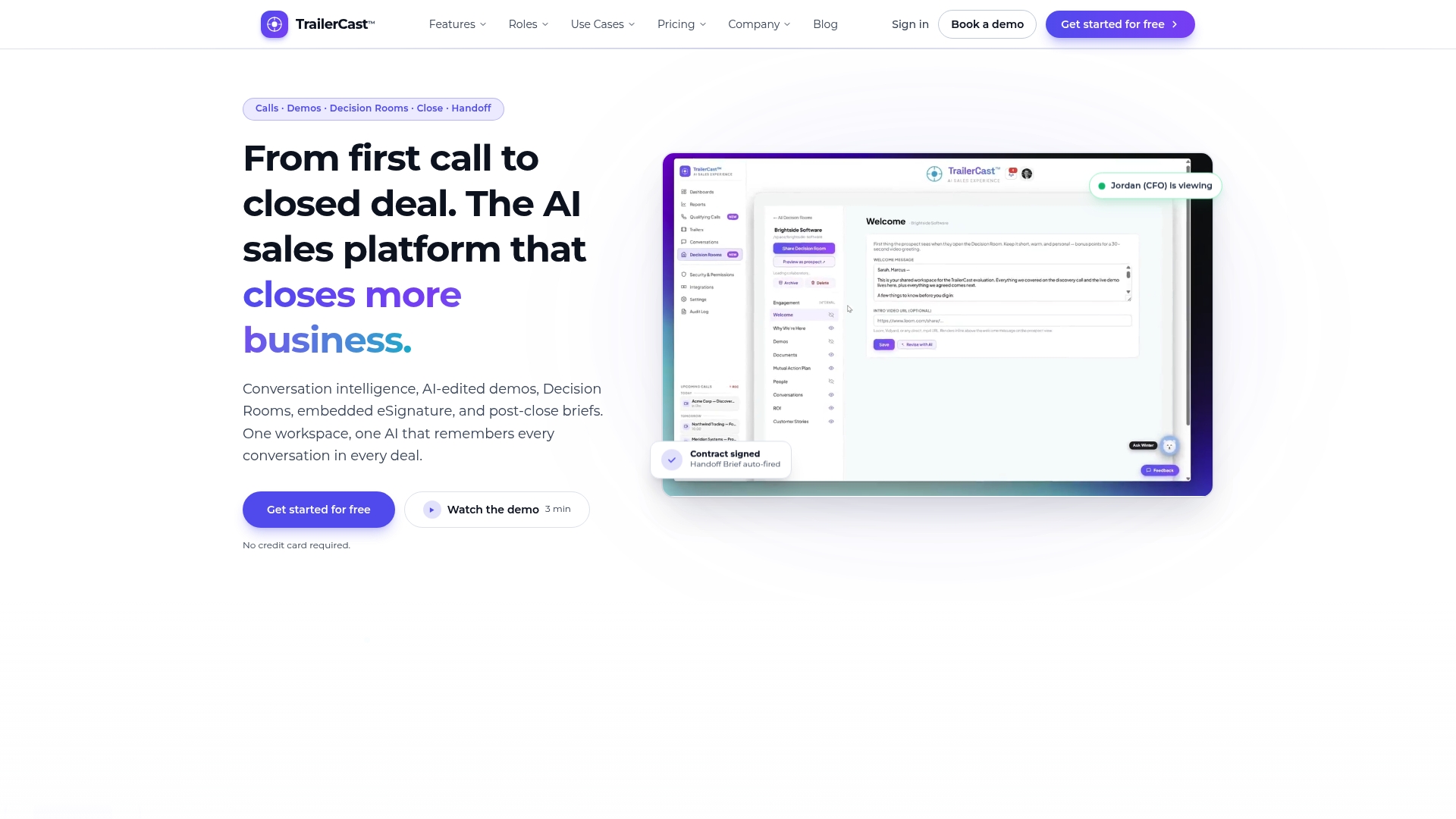
Trailercast’s AI sales platform captures every discovery call, structures the key findings, and builds an evolving Deal Brief that spans the full opportunity. The AI demo trailer feature automatically edits your demo recording into a branded highlight reel, personalized per stakeholder, so your champion has something worth forwarding to the CFO or CISO who missed the live session. Decision Rooms give the buying committee a single place to review materials, ask questions, and track the mutual action plan. When the deal closes, an AI Handoff Brief fires automatically to customer success with full deal context. One platform. Every stage. No dropped context.
FAQ
What is a solution engineer?
A solution engineer is a technical sales professional who handles discovery, demos, proof-of-concept evaluations, and RFP responses to help close B2B deals. The role works in close partnership with account executives throughout the sales cycle.
How much do solution engineers earn in 2026?
The national median base salary for Solutions Engineers in AI-focused roles is $155,000 in 2026, with total compensation often significantly higher when bonuses and equity are included.
What is the difference between a solution engineer and a sales engineer?
The titles are largely interchangeable. SaaS and cloud companies tend to use “Solutions Engineer,” while infrastructure and hardware vendors prefer “Sales Engineer,” but both roles cover the same pre-sales technical lifecycle.
How many deals does a solution engineer manage at once?
Most SEs manage 8–15 active deals simultaneously. Effective workload management and deal prioritization are critical to maintaining quality and avoiding burnout.
What career paths are available to solution engineers?
SEs commonly advance to senior SE, product manager, customer success manager, account executive, or sales engineering manager roles, reflecting the broad commercial and technical skills the position develops.