Vendor DPA Requirements: The B2B Compliance Playbook

A Data Processing Agreement (DPA) is the written contract your organization must have with any vendor that processes personal data on your behalf. Before you sign with a new SaaS provider, cloud vendor, or analytics platform, that agreement needs to cover eight non-negotiable elements: processing scope and duration, purpose limitation, security measures, subprocessor controls, breach notification timelines, data subject rights (DSAR) assistance, audit rights, and end-of-contract deletion or return. Miss any one of them and you’re exposed, whether the regulator knocking is the California Privacy Protection Agency or a GDPR supervisory authority.
The legal anchors are GDPR Article 28, California’s CCPA/CPRA, Virginia’s VCDPA, and a growing stack of state laws that now mirror the same obligations model. As a risk-management tool, a DPA documents that your vendor acts only on your instructions and can prove it.
Non-negotiable DPA elements to require before signing:
- Written contract confirming controller/processor roles
- Processing scope: categories of data, data subjects, purpose, and duration
- Purpose limitation and data minimization obligations
- Confidentiality requirements for vendor personnel
- Technical and organizational security measures with evidence
- Subprocessor disclosure, consent, and flow-down obligations
- Breach notification within a defined window recommended
- DSAR assistance with timelines
- Audit and assessment rights
- Data return or secure deletion at termination
- Liability carve-out for security incidents
Practical guidance, not legal advice. This guide is a compliance reference for procurement, privacy, and security teams. Run every clause past qualified counsel before executing. Primary regulatory anchors: GDPR Article 28, CCPA/CPRA (Cal. Civ. Code § 1798.100 et seq.), Virginia VCDPA, Colorado CPA, Connecticut CTDPA, Texas TDPSA, and Maryland MODPA.
Key Takeaways
A vendor DPA is only as strong as the evidence behind it: require scope, security proof, subprocessor disclosure, a defined breach clock, DSAR assistance, audit rights, deletion certification, and a liability carve-out before any vendor processes personal data on your behalf.
| Point | Details |
|---|---|
| Four highest-leverage clauses | Prioritize subprocessor approval, breach-notification hours, audit rights, and liability carve-out in every negotiation. |
| Multi-state drafting strategy | Use a base DPA for the strictest per-topic requirement, then add state-specific exhibits for California, VCDPA-style states, and others. |
| Evidence over assertions | Request SOC 2 Type II, ISO 27001, and pen test reports by name; store them in a vendor-risk register with renewal dates. |
| Breach notification clock | Push for 48 hours from vendor awareness to preserve your own statutory reporting windows. |
| Ongoing monitoring | Review subprocessors lists quarterly, calendar annual attestation renewals, and integrate vendor breach contacts into your incident playbook. |
Table of Contents
- Which U.S. laws actually require a vendor DPA?
- Clause-by-clause checklist: what your vendor DPA must include
- How to verify a vendor actually meets DPA requirements
- Drafting one DPA that covers multiple U.S. states
- How to negotiate and operationalize DPA commitments
- Sample clauses you can adapt for your DPA
- Why DPAs are a trust signal, not just a legal checkbox
- Sources
Which U.S. laws actually require a vendor DPA?
Every major U.S. state privacy law requires a written contract governing third-party processing. The trigger varies slightly by statute, but the practical answer is: if a vendor touches personal data on your behalf, you need a DPA.
Key legal triggers:
- GDPR applies when you process data of EU or UK residents, regardless of where your company is based.
- California CCPA/CPRA requires a written contract with “service providers” and “contractors” that restricts their use of personal information.
- Virginia VCDPA, Colorado CPA, Connecticut CTDPA follow a GDPR-inspired obligations model requiring processor contracts with defined duties.
- Texas TDPSA and Maryland MODPA add to the pile with similar written-contract requirements.
The critical distinction for drafting: California uses a restrictions-based model (the contract tells vendors what they cannot do with data), while VCDPA-style states use an obligations-based model (the contract specifies what vendors must do). Both approaches need to live in your base DPA.
| Dimension | California CCPA/CPRA | VCDPA-style states (VA, CO, CT) |
|---|---|---|
| Model | Restrictions-based | Obligations-based |
| Subprocessor consent | Written authorization required | Prior consent or right to object |
| Audit rights | Reasonable audit rights | Assessment rights; some allow third-party audits |
| Breach notice anchoring | Tied to California breach law | Tied to state breach statute |
| Sensitive data rules | Explicit limits on sensitive PI | Heightened obligations for sensitive categories |
| DSAR assistance | Vendor must cooperate with requests | Defined timelines for processor assistance |
Pro Tip: When your vendor relationships span multiple states, draft for the strictest applicable requirement on each topic. Use a base DPA for the common floor, then attach a short state-specific exhibit that maps the divergent language. One redline process, multi-state coverage.
Clause-by-clause checklist: what your vendor DPA must include
This is where most DPAs fall short. The structure is right; the substance is thin. Here’s what each clause needs to actually say.
1. Scope and roles. Confirm controller versus processor status, the subject matter, duration, categories of personal data (e.g., contact data, usage logs, payment data), and categories of data subjects. GDPR Article 28 specifies these as mandatory elements. Without them, the agreement is legally incomplete.
2. Purpose limitation and data minimization. The vendor may process data only for the specific business purpose stated in the agreement. No secondary use, no model training on your data, no cross-customer analytics. Redline any clause that allows “improving services” without a defined scope.
3. Security measures. Require appropriate technical and organizational measures under Article 32, taking into account the state of the art and the risk to data subjects. Name concrete controls: AES-256 encryption at rest, TLS 1.3 in transit, multi-factor authentication, role-based access controls, and regular vulnerability scans. Then require proof. Acceptable evidence includes a SOC 2 Type II report, ISO 27001 certificate, or a recent penetration test summary. A vendor that can’t produce any of these is a red flag, not a negotiation point.
The security clause is only as strong as the evidence behind it. A vendor can write “appropriate measures” into a contract and still run unencrypted backups. Require SOC 2, ISO 27001, or pen test reports by name and attach them as exhibits.
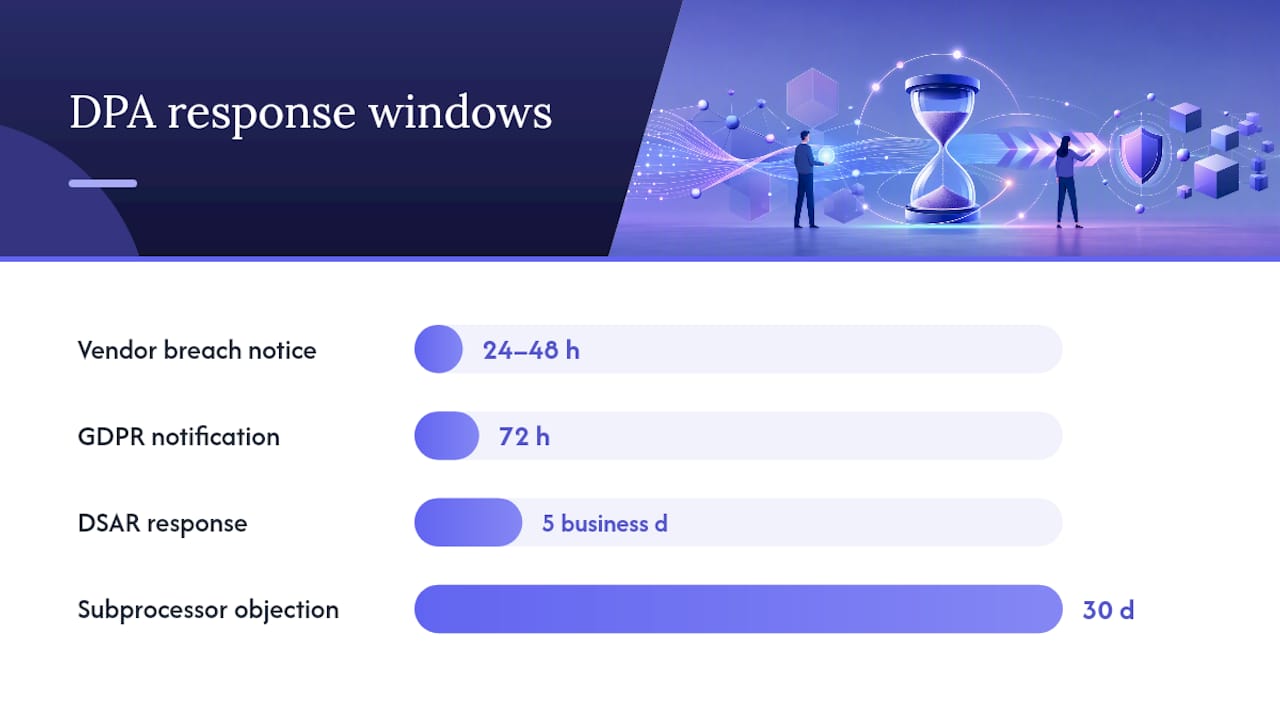
4. Subprocessors. Require a public, dated list of all subprocessors. The vendor must obtain your prior written consent before adding a new subprocessor, or give you a defined objection window (30 days is common). The vendor’s contract with each subprocessor must flow down equivalent protections.
5. Breach notification. Push for vendor notice within 24–48 hours of becoming aware of an incident. That clock matters because your own statutory notification windows (72 hours under GDPR, varying timelines under state laws) start running from when you knew or should have known. The notice must include: nature of the incident, categories and approximate number of data subjects affected, likely consequences, and measures taken or proposed.
6. DSAR assistance. The vendor must help you respond to data subject access, deletion, correction, and portability requests. Specify the response timeline (typically within 5 business days of your request) and a named contact or process for joint responses.
7. Audit and assessment rights. A three-tier model works well:
- Annual SOC 2 Type II or ISO 27001 report (standard)
- Independent third-party assessment on reasonable notice (elevated risk)
- On-site audit for cause, with cost allocation to the vendor if a material breach is found
8. Data return and deletion. At termination, the controller elects return or deletion. A reasonable timeline: data returned within 30 days, backup copies deleted within 90 days, and a written certification of deletion provided.
9. Cross-border transfers. If data flows outside the U.S. or to EU/UK processors, name the transfer mechanism: Data Privacy Framework (DPF) certification or the appropriate Standard Contractual Clauses (SCC) module. Require a Transfer Impact Assessment for sensitive data flows.
10. Liability and indemnification. Negotiate a carve-out from the general liability cap for data breaches. A meaningful floor (often a multiple of annual fees paid) or a separate sublimit signals the vendor takes breach risk seriously. Require evidence of cyber liability insurance.
11. Record-keeping. The vendor must maintain records of processing activities, access logs, and security assessments for a defined retention period (typically the contract term plus three years).
Pro Tip: The four highest-leverage items to prioritize in any DPA negotiation are: subprocessor approval rights, defined breach-notification hours, audit rights beyond SOC reports, and a liability carve-out for security incidents. Win those four and you’ve covered most of your exposure.
How to verify a vendor actually meets DPA requirements
A signed DPA is a starting point, not a finish line. Verification is the job.
Documents to request before signing:
- Signed DPA (or your redlined version)
- SOC 2 Type II report (current, within 12 months)
- ISO 27001 certificate (if applicable)
- Recent penetration test executive summary
- Dated subprocessors list
- Data flow diagrams showing where personal data is stored and processed
- Cyber liability insurance certificate
Due diligence questions for your RFP or security questionnaire:
- What encryption standards do you apply at rest and in transit?
- Where is personal data stored (data residency)?
- How long do you retain access and audit logs?
- Have you experienced a data breach in the past 24 months? If so, describe your response.
- How do you notify customers of subprocessor changes?
- What is your mean time to notify in the event of a security incident?
When evaluating attestations, a SOC 2 Type II report covers a defined period and scope. It’s sufficient for most SaaS vendors. For high-risk processing (health data, financial data, large-scale consumer data), insist on the right to commission an independent assessment or on-site audit. Automating supplier document collection and maintaining a vendor-risk register keeps this evidence current without manual chasing.
Pro Tip: Require the subprocessors list to be publicly accessible via a URL and include a contractual SLA for notification of changes (e.g., 30 days’ advance notice). Log the URL in your vendor-risk register so any team member can check it without asking legal.
Drafting one DPA that covers multiple U.S. states
The goal is a single base agreement that travels, not a separate DPA per state.
- Identify all applicable jurisdictions. Map where your data subjects live, not just where your company operates. If you have customers in California, Virginia, Colorado, and Connecticut, all four frameworks apply.
- Map the strictest per-topic requirement. For each clause topic (subprocessor consent, audit rights, DSAR timelines, sensitive data handling), identify which state imposes the most demanding standard.
- Draft the base DPA to that floor. The base agreement satisfies the strictest requirement on each topic, which means it automatically satisfies the less demanding ones.
- Add state-specific exhibits for divergent language. Some states use different defined terms or require specific statutory references. An exhibit keeps the base clean while preserving compliance.
- Include a compliance matrix. A one-page exhibit mapping each state’s key requirements to the relevant base clause helps internal reviewers confirm coverage without re-reading the full agreement.
State-specific exhibit outline:
- Exhibit A (California): Service provider restrictions, opt-out obligations, sensitive PI handling
- Exhibit B (Virginia/Colorado/Connecticut): Processor obligations, data protection assessment triggers, DSAR timelines
- Exhibit C (Texas/Maryland): Applicable definitions, breach notification cross-references
Pro Tip: Adopt a “strictest-first” clause for purpose limitation and sensitive data handling. It’s cleaner than trying to layer state-specific carve-outs, and it holds up better when new state laws pass.
How to negotiate and operationalize DPA commitments
Negotiation without operationalization is just paperwork. Both matter.
Negotiation priority order:
- Subprocessor approval rights (prior written consent or 30-day objection window)
- Breach notification defined hours (push for 48 hours from awareness)
- Audit rights beyond SOC reports (independent assessment for high-risk processing)
- Liability carve-out for security incidents (meaningful sublimit or multiple)
For lower-leverage items (record-keeping format, log retention periods), accept attestation requirements rather than burning negotiation capital. A SOC 2 report plus the right to audit for cause covers most scenarios without requiring an on-site audit clause that vendors routinely resist.
Post-signing operational checklist:
- Store the signed DPA, evidence exhibits, and insurance certificates in a vendor-risk register
- Calendar annual SOC 2 or ISO 27001 renewal reviews
- Set a reminder for subprocessors list checks (quarterly or on vendor notification)
- Integrate the vendor’s breach notification contact into your incident response playbook
- Assign a DPA owner (privacy or legal) for each high-risk vendor relationship
- Schedule a 12-month DPA review for any vendor processing sensitive data categories
Sample clauses you can adapt for your DPA
These snippets are adapted from established DPA frameworks. Run them past counsel before use.
Scope clause: “Processor shall process Personal Data only on documented instructions from Controller. The subject matter of processing is [describe service]. The duration of processing is the term of the Agreement. Categories of Personal Data include [list]. Categories of Data Subjects include [list].”
Security measures clause: “Processor shall implement appropriate technical and organizational measures, including at minimum: AES-256 encryption at rest, TLS 1.3 in transit, multi-factor authentication for privileged access, and annual penetration testing. Processor shall provide Controller with a current SOC 2 Type II report or ISO 27001 certificate upon request.”
Subprocessor clause: “Processor maintains a public, dated list of Subprocessors at [URL]. Processor shall provide Controller with 30 days’ advance written notice before engaging a new Subprocessor. Controller may object in writing within that period. Processor shall impose equivalent data protection obligations on each Subprocessor.”
Breach notification clause: “Processor shall notify Controller without undue delay, and no later than 48 hours after becoming aware of a Personal Data Breach, providing: the nature of the breach, categories and approximate number of data subjects affected, likely consequences, and measures taken or proposed.”
Deletion clause: “Upon termination, Processor shall, at Controller’s election, return or securely delete all Personal Data within 30 days. Backup copies shall be deleted within 90 days. Processor shall provide written certification of deletion upon request.”
These snippets are starting points, not final language. Adapt them to your risk profile, the vendor’s processing scope, and applicable state law. Clauses that look complete on paper can still leave gaps if the defined terms in your master agreement don’t align.
Why DPAs are a trust signal, not just a legal checkbox
Here’s an honest take: most organizations treat DPA negotiation as a legal obstacle to clear before onboarding a vendor. That framing gets it backwards.
A well-drafted DPA tells you something real about a vendor. A vendor that resists a defined breach-notification clock, won’t share a SOC 2 report, or pushes back on subprocessor disclosure is showing you their operational maturity before you’re locked in. That’s valuable information. The DPA negotiation is the due diligence.
At Trailercast, we’ve built this thinking into the product itself. Trailercast’s security architecture documents tenant isolation, encryption standards, and access controls because those are the exact questions a privacy or procurement team will ask when reviewing a DPA. Decision Rooms operate with per-deal isolation so data from one buying committee never bleeds into another. When a CISO asks about data residency or subprocessors during a deal, the answer is documented, not improvised.

The vendors that make DPA negotiation easy are the ones who’ve already operationalized the commitments. That’s the signal worth looking for.
Sources
These are the primary regulatory and practice resources used to prepare this guide:
- Gdpr
- Data Processing Agreements Under US State Privacy Laws: What Your Vendor Contracts Need in 2026 | PrivacyLawMap
- Vaquill
This article is general information, not a substitute for advice from a qualified lawyer. Consult a qualified legal professional about your own circumstances before acting on anything here.