What an AI Deal Brief Actually Gets Right (and Wrong)

An AI deal brief is a one-page, evidence-backed summary of a deal that pulls from call transcripts, CRM fields, and contract documents, so a seller, sales leader, or buyer can get up to speed in under a minute. It exists because the alternative, a rep summarizing a deal from memory before a forecast call, is how good deals die quietly. The point of a real deal brief isn’t just speed. It’s the paper trail. When every claim links back to a timestamp or a CRM snapshot, the whole team stops arguing about what was said and starts deciding what to do next.
If you’re evaluating tools or building this into your own process, here’s the pragmatic path: use an integrated platform like Trailercast that generates these briefs automatically from the calls and documents you already have, with sources you can click into.
- Defines the deal in one page: value, stage, next step, owner
- Backs every claim with a timestamp, document link, or CRM record
- Updates on its own schedule, not whenever someone remembers to
Key Takeaways
An effective AI deal brief pairs a one-page overview with a linked evidence block, and it only earns trust when every claim traces back to a timestamp, document, or CRM record a reader can check.
| Point | Details |
|---|---|
| Two formats, one deal | Use an overview for current state and a recap for history across a chosen timeframe. |
| Evidence is non-negotiable | Every fact should link to a transcript, document clause, or CRM snapshot. |
| Label confidence explicitly | Mark statements as confirmed, observed, or interpretation to stop guesses from becoming record. |
| Keep it to one page | Push supporting detail behind links instead of stretching the main view. |
| Trailercast builds it automatically | One AI brain tracks every call and demo to generate a continuously evolving, evidence-backed deal brief. |
Table of Contents
- What Goes Into an AI Deal Summary
- How Do You Generate an AI Deal Brief?
- How Do You Verify an AI-Generated Deal Brief?
- Building a One-Page Deal Brief Template
- Connecting Briefs to Your CRM, Calls, and Documents
- How Trailercast Builds Verified AI Deal Briefs
- Why Most Deal Brief Advice Misses the Point
- Get Verified Deal Briefs Without Stitching Five Tools Together
- Frequently Asked Questions
- Sources
What Goes Into an AI Deal Summary
A good AI deal summary has two modes, and mixing them up is where most homegrown templates fall apart. The overview is a snapshot, the state of the deal right now. The recap is a history, what changed and when. Productive’s AI Deal Summary feature draws exactly this line, letting users pull a recap across a chosen window, last 7, 14, 30, 60, or 90 days, or the entire deal lifetime.
Here’s what belongs in each:
- Overview snapshot — deal title, dollar value, close probability, current stage, the single next step, and the owner’s name.
- Recap timeline — a chronological list of the calls, emails, and milestones that moved the deal, tagged by date.
- Evidence block — inline citations pointing to transcript timestamps, document clauses, or CRM change history.
- Stakeholder map — who’s involved, their role in the buying decision, and how engaged each one has been.
- Decision criteria and risks — what the buyer said they’re weighing, plus any red flags a rep flagged manually.
- Next actions — concrete, owned tasks, not vague reminders like “follow up soon.”
Skip any of these six and the brief becomes either too thin to trust or too long to read in a meeting.
How Do You Generate an AI Deal Brief?
The mechanics matter less than the inputs you feed the system and where you put a human in the loop. A brief is only as good as what it’s built from, and most disappointing outputs trace back to missing or messy source data, not a bad model.
Here’s the workflow, start to finish:
- Gather your inputs: call recordings or transcripts, the CRM record, proposal or contract drafts, and the activity log (emails, tasks, notes).
- Entity extraction: the system pulls names, dollar amounts, dates, and product mentions out of unstructured text.
- Timeline assembly: those extracted entities get sequenced into a chronological record of the deal.
- Evidence tagging: each fact in the brief gets linked back to its source, whether that’s a call transcript or a CRM field.
- Draft generation: the AI writes the actual overview and recap text using the tagged evidence.
- Human approval: a rep or manager reviews the draft, corrects anything off, and locks a version.
Most tools split the interface into a quick catch-up view, a single click that surfaces the latest snapshot, and a full recap view where you configure the timeframe yourself. That distinction matters when you’re prepping for a five-minute standup versus a full quarterly business review.
Pro Tip: Never let a brief auto-publish to a buyer without a human approval step. The AI is fast at drafting, not at knowing which internal note should never leave the building.
Version history matters here too. If a brief changes between Tuesday and Friday, you want to see exactly what changed and who approved it, not just the latest state.
How Do You Verify an AI-Generated Deal Brief?
Verification is the difference between a brief people trust and one they quietly double-check anyway. The market has noticed this gap. Duxre’s AI Brief product was built specifically around the idea of a cited, broker-approved document rather than an unverified AI draft, which tells you buyers are actively rejecting summaries they can’t trace back to a source.
Three practices make a brief auditable instead of just plausible:
- Inline citations that link, not just mention. A transcript timestamp, a document clause reference, or a CRM snapshot ID, each claim should click through to its origin.
- Confidence labeling. Every line should read as confirmed (sourced fact), observed (timestamped event), or interpretation (a rep’s judgment call that needs an owner’s sign-off).
- Immutable evidence blocks with change logs. Once evidence is tagged, it shouldn’t silently disappear when someone edits the summary text around it.
On the security side, access levels and redaction rules matter more than most teams realize before their first buyer-facing brief leaks a competitor mention. Set who can see internal-only fields versus what gets shared externally before you generate your first brief, not after.
Contract-level detail adds another layer of trust. Stigg’s acquisition of Received.ai folded contract management and invoicing into a single runtime layer, a sign that linking contract terms directly into deal tooling reduces the gap between what sales promised and what finance actually bills.
Building a One-Page Deal Brief Template
The single biggest failure mode in DIY deal briefs isn’t missing data. It’s length creep. A brief that runs three pages doesn’t get read before the forecast call; it gets skimmed for the number and ignored otherwise. A useful opportunity brief template keeps the main view to one page and pushes supporting detail behind a link.
Here’s the minimum viable structure:
- Header row: deal name, value, stage, owner, last updated date
- Summary: two to three sentences on where things stand and what’s next
- Evidence block: the facts, each labeled by confidence level
- Stakeholder list: names, roles, engagement level
- Risks and open questions: what could stall the deal
- Next action: one task, one owner, one date
That confidence labeling deserves its own habit. Every statement should fall into one of four buckets:
Confirmed buyer fact (sourced), observable event (timestamped), internal interpretation (requires an owner), or unknown. Labeling this way keeps assumptions from quietly becoming company memory, which is exactly what happens when a rep’s guess about budget gets repeated so often it starts sounding like something the buyer actually said.
One more decision point: buyer-facing versus internal. A brief you’d hand a prospect strips out competitor mentions, internal margin notes, and any speculative risk language. An internal version keeps all of it. Build both from the same evidence base rather than maintaining two separate documents that drift apart over time.
Connecting Briefs to Your CRM, Calls, and Documents
A deal brief that lives in isolation from your actual sales stack becomes stale within a week. The integrations matter as much as the brief format itself.
The standard connections look like this: meeting recorders (Zoom, Google Meet, Microsoft Teams) feed transcripts in automatically, your CRM syncs stage changes and custom fields, and cloud document storage anchors contract versions so the brief always points to the current draft, not last month’s redline.
- Route call recordings straight into transcript ingestion the moment a meeting ends.
- Sync CRM stage and amount fields so the overview snapshot never goes stale.
- Anchor proposal and contract links so evidence points to the live document, not a static copy.
- Decide between event-driven generation (a brief refreshes right after a key call) and nightly batch updates, depending on how fast your deals move.
Decision rooms and short async video recaps do the distribution work once the brief exists, giving a champion something concrete to forward internally instead of a summary they have to explain from memory. For RevOps, the rollout order is simple: map your data sources first, configure routing rules second, and assign a named approval owner before anything goes live.
How Trailercast Builds Verified AI Deal Briefs
Trailercast was built around a single observation: the calls were never the real problem. The gap between them was, the space where a champion walks into a budget meeting alone and has to re-sell your pitch from memory. One AI brain follows every call, demo, and message across the whole deal, and it keeps building an evolving deal brief the entire time, not just when someone remembers to ask for one.
That brief stays verifiable because the underlying features are built for evidence, not just narrative:
- Transcript timestamps tie every claim back to the exact moment it was said on a call.
- AI-edited demo trailers extract the 8 to 15 minutes that actually mattered, so a highlight becomes evidence, not just a clip.
- Branded decision rooms carry their own evidence blocks and an engagement panel showing who’s actually reviewed what.
- Embedded eSignature and an automatic post-close handoff brief mean the deal record doesn’t reset to zero the moment a contract signs.
Pricing sits at one tier with every feature included, a monthly or annual subscription pricing model, including a free trial option. It fits best for B2B SaaS teams running multi-stakeholder deals, typically three to seven people in the buying committee, at companies between 11 and 200 employees. Full details live on the pricing page.
| Point | Details |
|---|---|
| Follows the whole deal | One AI brain tracks every call, demo, and message instead of resetting per interaction. |
| Evidence beats narrative | Timestamps, trailer highlights, and decision room activity back every claim in the brief. |
| Built for committee deals | Best fit is 3 to 7 stakeholder buying groups at 11 to 200 employee companies. |
Why Most Deal Brief Advice Misses the Point
The conventional wisdom treats AI deal briefs as a summarization problem: feed a transcript into a model, get a paragraph back, done. That framing misses what actually makes a brief useful, which is trust, not brevity. A three-sentence summary nobody believes is worse than no summary at all, because it creates false confidence in a forecast call.
The evidence block is the part everyone underrates. Vendors are racing toward “verified” and “cited” language for a reason, buyers got burned by confident-sounding AI text with no way to check it. If your brief can’t tell you which specific moment in a call supports a claim, you don’t have a brief. You have a guess with good formatting.

What I’d prioritize first, before format or design, is the confidence labeling system: confirmed, observed, interpretation, unknown. That single habit does more to prevent bad forecast calls than any amount of AI polish. Get that right, and the one-page template basically writes itself.
Get Verified Deal Briefs Without Stitching Five Tools Together
Most teams trying to build this today are duct-taping a call recorder, a CRM export, and a shared doc into something that resembles a deal brief, and it falls apart the moment someone forgets to update the doc. Trailercast skips the stitching entirely: one AI brain already tracks every call, demo, and message in the deal, so the brief exists continuously instead of getting rebuilt from memory before each forecast meeting.
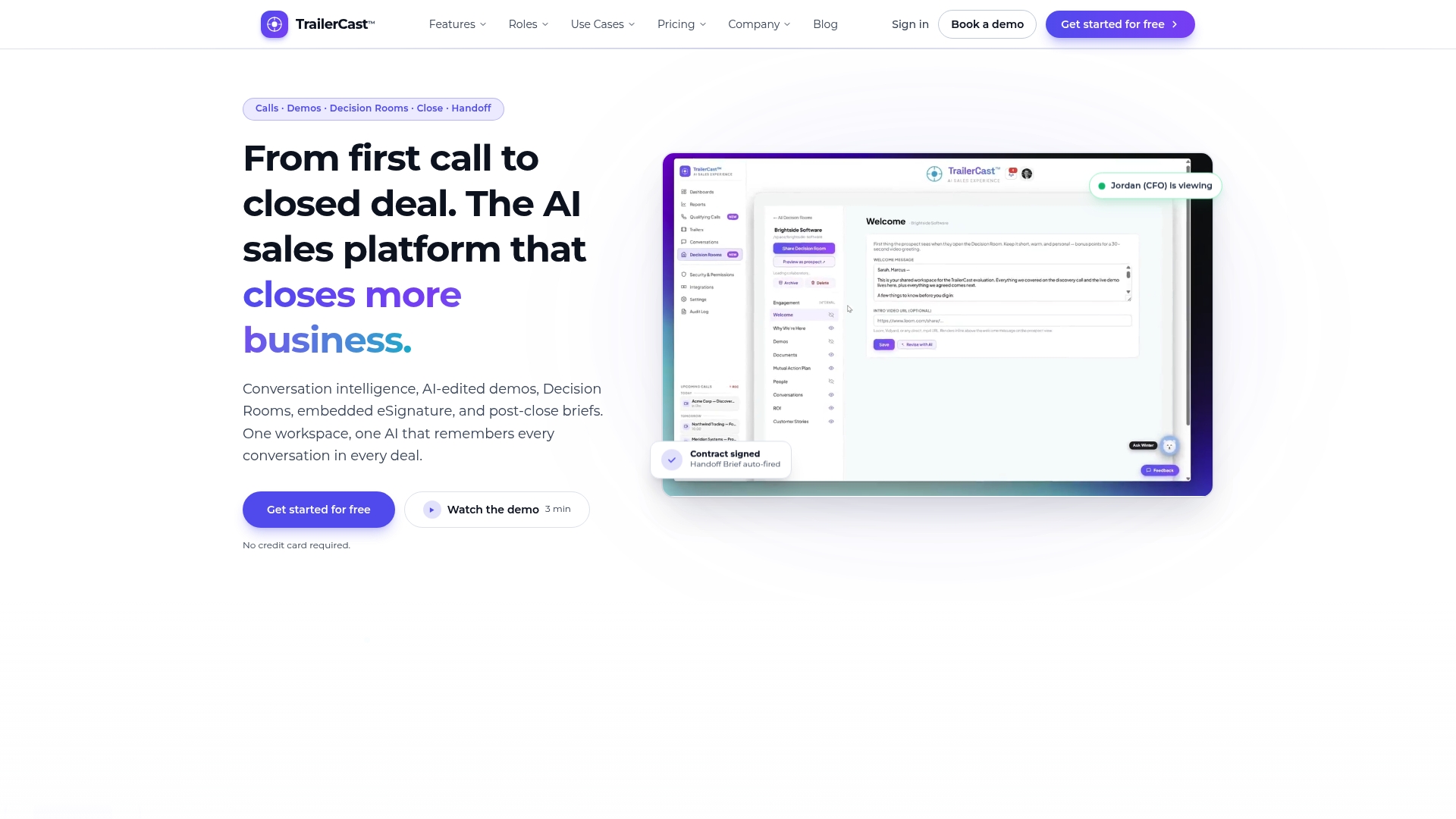
That matters most for teams selling into buying committees of three to seven people, where a champion needs something evidence-backed to forward to a CFO or CISO who wasn’t on the call. Because the same platform handles the calls, the demo trailers, and the decision room where a buyer reviews everything, the evidence in your brief is never more than a click from its source.
Start a free trial at Trailercast, no credit card required, and see your first evidence-backed deal brief generate from your next scheduled call.
Frequently Asked Questions
Is an AI deal brief the same as a deal recap? No. An overview is a snapshot of where the deal stands right now; a recap is the history of how it got there, usually shown across a selectable timeframe like 7, 30, or 90 days.
How do I stop an AI deal brief from hallucinating facts? Require inline citations on every claim, tag statements by confidence level (confirmed, observed, interpretation), and route every brief through human approval before it’s shared externally.
Can an AI deal brief be shared with buyers? Yes, but strip internal-only notes and competitor mentions first. Build buyer-facing and internal versions from the same evidence base so they don’t drift apart over time.
What data does an AI deal brief need to generate accurately? At minimum: the call recording or transcript, the CRM record, any proposal or contract drafts, and the account’s activity log of emails and tasks.
Does Trailercast integrate with my existing CRM and calendar? Trailercast auto-schedules through Google and Microsoft calendars and joins Zoom, Meet, and Teams calls directly, building the deal brief from those transcripts alongside your CRM data.
Sources
- Stigg acquires Received.ai to bring contract management and invoicing into its runtime AI usage platform