AI Sales Calls for Multi-Stakeholder B2B Deals: Playbook

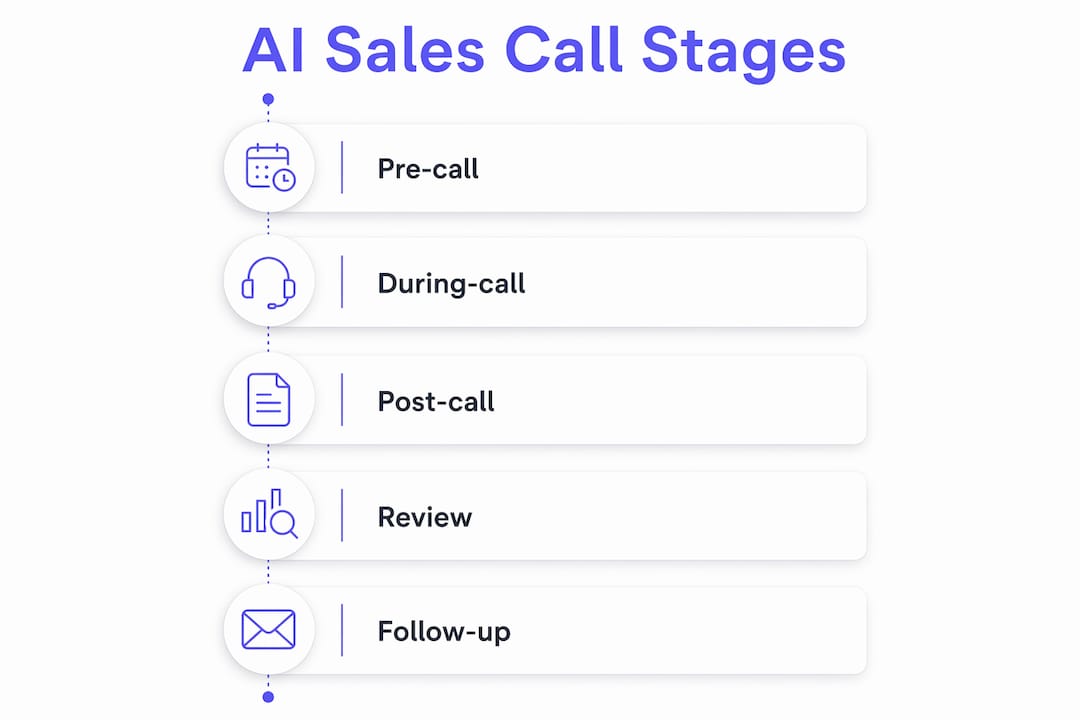
Adopt a three-stage AI call workflow — Pre-call, During-call, After-call — and mandate a 10-minute post-call review immediately after every high-value conversation. That single discipline, more than any tool, is what separates reps who lose deals in the silence between calls from reps who control the buying committee. Enable live assist and auto-transcription on your top-priority accounts today, and require every rep to finalize action items and tag stakeholders before they close their laptop. Trailercast is one platform built to run that entire workflow, from first dial to signed contract.
Table of Contents
- What are AI sales calls, and how does the three-stage model work?
- The stage-by-stage playbook your reps can use today
- How to orchestrate outreach across a small buying committee
- What should you require from any AI sales call vendor?
- How to pilot AI sales calls and prove ROI in 4–6 weeks
- Should you consolidate into one platform or build a best-of-breed stack?
- Key Takeaways
- What actually moves the needle in AI-assisted selling
- Trailercast covers the full deal lifecycle in one workspace
- Useful sources for deeper reading and procurement
What are AI sales calls, and how does the three-stage model work?
“AI sales calls” describes any sales conversation where AI touches at least one stage of the call lifecycle: who you dial, what happens live on the call, or what gets done after it ends. The three stages map cleanly to the work reps actually do.
| Stage | Core Purpose | Minimum Technical Requirement |
|---|---|---|
| Pre-call | Research, enrichment, intent prioritization | Data enrichment, CRM pull, contact validation |
| During-call | Live transcription, coaching prompts, sentiment flags | Speaker-separated transcription, low-latency live assist |
| After-call | Review, CRM writeback, follow-up sequencing | Automated summary, CRM sync, follow-up draft |
Contact data quality is the foundation. Validate phone numbers and enrich records before you ever enable an AI dialer, because bad data kills connect rates before AI gets a chance to help. During the call, speaker-separated transcription with CRM writeback is the minimum viable feature set. After the call, the 10-minute review window is when action items harden into pipeline.
The stage-by-stage playbook your reps can use today
Pre-call
- Pull the account brief from your CRM: last touch, open items, stakeholder map.
- Verify contact data — direct dial, not a switchboard number.
- Identify one intent signal (recent funding, job change, product page visit) to personalize the opener.
- Prepare a one-page question set: three diagnostic questions, one hypothesis to test.
Pro Tip: Set a CRM rule that blocks a call from moving to “active” stage unless a direct dial is logged. Reps who skip this step waste AI dialer capacity on numbers that never connect.
During-call
Keep live assist prompts glanceable. High-performing reps treat AI like a silent heads-up display: a one-line cue they absorb in a half-second, not a script they read aloud. When a pricing objection surfaces, the prompt tells you the response angle; you deliver it in your own words. Never read a prompt verbatim. The buyer hears the pause and the shift in register.
Post-call: the 10-minute review
The 10-minute post-call review is non-negotiable. Use it to:
- Confirm AI-generated action items against what you actually committed to.
- Tag each stakeholder mentioned by role (economic buyer, champion, blocker).
- Log the three CRM fields that matter most: next step, next step date, and primary objection.
- Flag any coaching moment for your manager before the call fades from memory.
Pro Tip: Draft your follow-up email inside the review window using the transcript. Automated follow-up responses drafted from what was actually said convert better than templated check-ins written hours later.
How to orchestrate outreach across a small buying committee
Multi-stakeholder deals don’t die on the call. They die in the internal meeting you weren’t part of, when your champion tries to re-sell a demo from memory to a CFO who wasn’t there. Orchestration is how you fix that.

The pattern that works is a Director-agent model: one AI layer that reads engagement signals across channels (email opens, Decision Room visits, video plays) and decides in real time whether the next touch should be a LinkedIn message, an email, an SMS, or a voice call. Behavior-driven orchestration outperforms message-blast sequences because it responds to what buyers actually do, not what you hope they’ll do.
For a 5-person buying committee, the artifact strategy looks like this:
- Champion: full demo recording plus a personalized trailer they can forward.
- CFO: a 90-second pricing-focused trailer, ROI summary, and a link to the Decision Room.
- CISO: a security-focused trailer clipped from the same demo, with compliance docs attached.
- End users: a short product walkthrough clip tied to their specific workflow pain.
The Director agent feeds on three data streams: CRM deal fields, interaction history (who opened what and when), and engagement signals from the Decision Room. When the CFO opens the ROI doc at 9 PM, that’s a signal. The next morning’s touch should acknowledge momentum, not restart the conversation.
Trailercast’s demo trailer and Decision Room features are built for exactly this pattern: AI-edited clips personalized per stakeholder, a no-login room where the buying committee can engage asynchronously, and an attribution tree that shows who shared what with whom.
What should you require from any AI sales call vendor?
Procurement gets messy fast when every vendor claims “full lifecycle AI.” Here’s what to actually verify.
Must-haves:
- Zoom, Teams, and Google Meet recording support with speaker separation
- CRM writeback to custom fields (not just activity logs)
- Calendar integration for auto-join and scheduling
- Exportable transcripts and deal data you own
- Low-latency live assist (prompts that arrive during the conversation, not after)
- AI-generated follow-up drafts and demo trailer creation
- Buyer-facing Decision Rooms with per-stakeholder engagement tracking
- AI handoff briefs for post-close Customer Success transfer
Red flags to reject a vendor:
- No native CRM sync (manual export only)
- Summaries you can’t edit or correct
- Autonomous outbound calling without explicit opt-in controls
- No contact data validation before dialing
- Black-box AI with no explanation of how summaries are generated
Pricing shapes vary: per-seat for conversation intelligence, usage-based for autonomous voice agents and high-volume dialers. Budget for both models if your stack includes outbound automation alongside live coaching. For AI communication coaching features specifically, look for tools that surface coaching cards with latency under two seconds.
How to pilot AI sales calls and prove ROI in 4–6 weeks
A tight pilot beats a sprawling rollout every time. Scope it to 10–15 accounts, two to three reps, and a clean 4–6 week window.
| KPI | What It Measures | Target Signal |
|---|---|---|
| Connect rate | Data quality and dialing efficiency | Baseline + trend |
| Meetings booked per call | Conversion from conversation to pipeline | Week-over-week lift |
| Next-step rate | Post-call discipline and AI summary quality | Most calls logged |
| Admin time saved (min/day) | Rep productivity gain | Reduction vs. pre-pilot |
| Win rate on AI-coached calls | Coaching impact on close velocity | Compare to control group |
Governance matters as much as the metrics. Assign one RevOps owner to review AI summaries weekly, flag hallucinated action items, and calibrate the model’s coaching prompts. Run a biweekly pipeline health check against the KPI table above. At week six, present a leadership scorecard that includes total cost of ownership: seat cost, integration hours, and admin time recovered.
Should you consolidate into one platform or build a best-of-breed stack?
| Factor | Consolidated Platform | Best-of-Breed Stack |
|---|---|---|
| Time to value | Faster (one setup, one login) | Slower (multiple integrations) |
| Integration complexity | Low | High |
| Deal context continuity | Single record across all stages | Fragmented across tools |
| Cost | Predictable per-seat | Variable; adds up quickly |
| Governance overhead | One vendor, one DPA | Multiple contracts and audits |
| Best for | Teams needing full lifecycle coverage | Large enterprises with bespoke telephony |
Consolidation wins when your primary pain is the space between calls: reps losing context, champions re-selling from memory, CS starting blind. A single deal record that spans every call, demo, Decision Room thread, and handoff brief removes that friction without a custom integration project. Best-of-breed wins when you have a specialist requirement — a telephony stack with deep carrier integrations, for example — that no consolidated platform matches.
When demo trailers, Decision Rooms, and AI handoff briefs are all on your must-have list, a consolidated platform is almost always the faster and cheaper path.
Key Takeaways
The most effective AI sales call strategy combines a three-stage workflow with a 10-minute post-call review discipline and a consolidated platform that carries deal context from first call to closed contract.
| Point | Details |
|---|---|
| Three-stage workflow | Run Pre-call, During-call, and After-call stages with distinct AI tasks at each step. |
| 10-minute review rule | Finalize action items, tag stakeholders, and log CRM fields within 10 minutes of every call. |
| Data quality first | Validate contact data before enabling AI dialers; bad data kills connect rates upstream. |
| Pilot scope | Run a 4–6 week pilot on 10–15 accounts and measure connect rate, next-step rate, and admin time saved. |
| Trailercast | Covers all five deal stages in one workspace: calls, demo trailers, Decision Rooms, eSignature, and handoff briefs. |
What actually moves the needle in AI-assisted selling
The honest truth about AI sales calls is that most teams implement them backwards. They buy the transcription tool, get excited about summaries, and then wonder why win rates haven’t moved. The tool isn’t the problem. The workflow is.
AI provides the most leverage in two places: removing the friction between conversations (the research, the CRM hygiene, the follow-up drafting) and giving reps a real-time signal layer during the call itself. Neither of those matters if the underlying contact data is garbage or if reps aren’t reviewing summaries before the next touch.
The practical caution I’d add: treat AI as a heads-up display, not a co-pilot who talks. The moment a rep starts reading prompts aloud or letting the AI drive the diagnostic conversation, you’ve lost the thing that actually closes deals — a human who listens well and asks the right follow-up question. Data quality, human review loops, and a clear governance owner are what separate teams that see ROI from teams that churn through tools.
Trailercast covers the full deal lifecycle in one workspace
Five tools stitched together with Zapier is not a sales stack. It’s a liability. Trailercast replaces conversation intelligence, AI-edited demo trailers, buyer-facing Decision Rooms, eSignature, and post-close handoff briefs with one workspace where every deal lives, and one AI that remembers every call, demo, and message across the opportunity.
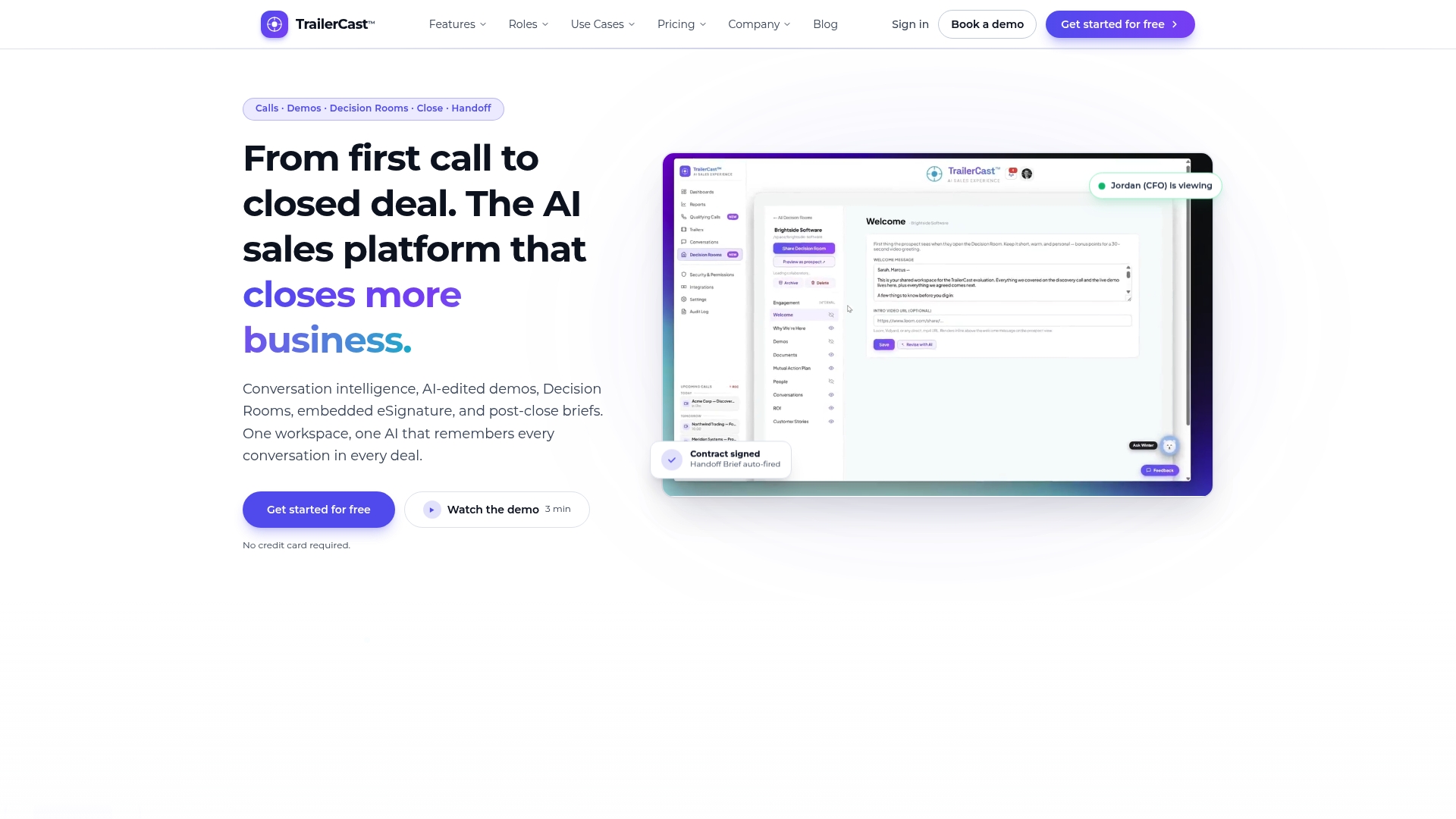
For B2B SaaS teams with 3–7 stakeholders per deal, the consolidation math is straightforward: one platform at a monthly per-seat subscription with flexible billing options, no feature gating, no credit card required to start. The AI notetaker joins Zoom, Meet, and Teams automatically, produces speaker-separated transcripts and structured summaries, and builds an evolving Deal Brief across every call in the opportunity. When the demo ends, the AI clips key minutes that mattered into a stakeholder-personalized trailer your champion can actually forward. The full platform runs from first call to signed contract and CS handoff.
Start a free trial at trailercast.io. No credit card, no setup call required.
Useful sources for deeper reading and procurement
- Pipedrive: AI sales calls — three-stage workflow definition and the 10-minute post-call review best practice
- Tomba: AI Sales Call Guide — contact data quality, transcription features, and pricing model overview
- Darwin AI: AI Discovery Calls — discovery call conversion benchmarks and diagnostic question frameworks
- Wizia AI Agents — Director-agent orchestration pattern and channel-decision architecture
- ElevenLabs: AI Sales Chatbot — 24/7 qualification, meeting booking, and CRM calendar integration
- Trailercast: discovery calls use case — live AI notetaker, Deal Brief generation, and transcription features
- Trailercast: full platform overview — deal lifecycle coverage, pricing, and trial policy
- Trailercast: demo trailers and Decision Rooms — stakeholder-personalized trailer creation and buyer-facing deal rooms
- Trailercast: features by stage — full feature matrix for procurement and technical evaluation
- Trailercast: AI handoff brief — post-close CS handoff automation and stakeholder map transfer