Sales Leaders: In 30 Days Prove an AI Sales Library Ranks Per Deal

An AI sales library is a centralized, searchable hub for pitch decks, case studies, demo videos, and proposals that use AI to rank and recommend the right asset for a specific deal. The fastest evaluation step: check whether the tool ranks content per opportunity (not just by tag) and whether it plugs directly into your CRM and conferencing tools.
TL;DR:
- A deal-aware AI sales library ranks content based on signals like deal stage, industry, and stakeholder role, not just tags or folders.
- Effective implementation requires embedding the library within existing workflows, such as CRM, conferencing, and messaging tools, to boost adoption.
- Measuring success involves tracking asset engagement, reuse rates, and correlations with deal cycle times or deal sizes to validate ROI.
- Starting with a small pilot using demo assets or proposals helps optimize taxonomy and workflow integration before full deployment.
- TrailerCast offers a single, comprehensive solution for ranking, sharing, and tracking sales content, priced at $59 per seat per month with a free trial.
Table of Contents
- Core features to expect from an AI sales library
- How deal-aware AI works: signals, search, and integrations
- Implementation and adoption checklist for a sales library rollout
- What to measure: engagement metrics and ROI from a sales library
- Practical use cases: how teams use an AI sales library during deals
- Why TrailerCast is a practical, direct solution for the same job
- Author’s recommendation: how to pick a pilot and what to prioritize
- TrailerCast next steps: trial, pilot, and product links
- Sources
- FAQ
Core features to expect from an AI sales library
Most sales libraries promise the same thing: a single place for your content. The good ones actually deliver on it. A few capabilities separate a real AI sales library from a glorified shared drive.
- Centralized storage with role-based access: reps, managers, and partners see only what’s relevant to their role, and every common asset type (decks, one-pagers, videos, case studies) lives in one pool.
- Version control: shared links always point to the latest file, so a prospect never opens a pricing sheet from two quarters ago.
- Deal-ranking AI: instead of a static folder tree, the system surfaces content based on deal stage, industry, and stakeholder role.
- Per-asset engagement tracking: you see who opened what, for how long, and whether they forwarded it.
- One-click sharing: the right asset drops straight into a buyer-facing room or a prospect thread without a separate export step.
Top enablement platforms are built around exactly this combination: centralized content, personalization at scale, and tight CRM integration that keeps sellers moving instead of hunting for files.
How deal-aware AI works: signals, search, and integrations
Deal-aware ranking isn’t one clever algorithm. It’s a stack of signals working together, and understanding that stack helps you push back on vague vendor claims.
- Deal signals feed the model: CRM fields, deal stage, discovery notes, transcript highlights, and the stakeholder ledger all shape which content ranks highest for a given opportunity.
- Semantic search replaces keyword match: instead of searching for “security,” the system understands a query like “what do we tell a CISO worried about SOC 2” and returns the matching packet.
- Retrieval-augmented indexing keeps the library current: content gets chunked, indexed, and retrieved based on meaning, not just filenames or folder placement.
- Integration surfaces determine adoption: CRM, conferencing tools like Zoom, Meet, and Teams, file stores, and messaging apps like Slack all need to talk to the library for it to matter in daily work.
Combining multiple short signals, rather than leaning on a single CRM field, is what keeps recommendations from getting noisy, according to G2’s playbook on review intelligence. The same principle applies to any deal-aware system: more context, weighted correctly, beats a single input every time. A conversation intelligence layer that captures call transcripts adds another strong signal to that mix.
Implementation and adoption checklist for a sales library rollout
A library with no governance turns into clutter within a quarter. A library with no adoption plan turns into a ghost town. Both are avoidable with a short checklist before launch.
- Assign content owners who approve new uploads and retire outdated ones on a set schedule.
- Build a shallow tagging taxonomy mapped to buyer personas and deal stages, not an exhaustive folder tree nobody remembers.
- Embed the library inside existing workflows: CRM records, sequence tools, and buyer-facing rooms, not a separate tab reps have to remember to open.
- Run a pilot with one team, set clear usage KPIs, and nudge adoption from inside the tools reps already use.
- Revisit the taxonomy after 30 to 60 days based on what reps actually search for.
Keeping taxonomy simple and letting usage data guide governance tends to matter more early on than chasing advanced ranking features, a point G2’s enablement category analysis also makes.
Pro Tip: Launch with one play, like a single proposal template or one demo asset, before rolling out the full library. It’s easier to fix a small taxonomy than an overgrown one.
What to measure: engagement metrics and ROI from a sales library
The business case for an AI sales library rests on a handful of measurable outcomes, not a feeling that “reps like it now.”
Track per-asset metrics: views, viewer identity, time spent, and replay patterns on video content. Track attribution: who shared an asset internally within the buying committee, and what happened after. Then connect usage to outcomes: does heavier use of a specific case study correlate with faster cycle times or larger deal sizes?

Reps who use AI search capabilities are 50% more likely to reuse the function and report finding content faster, according to MindTickle’s State of Revenue Enablement report. That reuse rate is one of the clearest early signals that a library is actually working, long before win-rate data catches up.
Practical use cases: how teams use an AI sales library during deals
The theory matters less than what happens inside a live deal. Here’s where a deal-aware library earns its keep.
- A rep opens a branded Decision Room for a new opportunity, and the library auto-populates the sections most relevant to that buyer’s industry and stage.
- A champion needs something to forward to a CFO who missed the call, so the rep shares an AI-edited demo trailer built specifically around pricing and ROI.
- Mid-negotiation, a security question comes up, and the rep attaches the right security packet in one click instead of digging through a shared drive.
- After close, an auto-generated handoff brief pulls the exact case study and promised features the rep used during the deal, so Customer Success starts with context instead of a blank slate.
Reps rarely stick with tools that feel disconnected from their daily workflow. Surfacing content where they already work, inside the CRM or a shared room, is consistently the biggest lever for adoption, according to MindTickle’s report.
Why TrailerCast is a practical, direct solution for the same job
I built TrailerCast because the calls were never the real problem. The space between them, where a champion tries to re-sell your pitch from memory, is where deals quietly stall.
- TrailerCast’s AI sales library ranks content per deal and surfaces it directly inside branded Decision Rooms, so reps aren’t hunting for the right asset mid-negotiation.
- The platform combines conversation intelligence, AI-edited demo trailers, buyer-facing rooms, embedded eSignature, and post-close handoff briefs in one workspace instead of five disconnected tools.
- Every asset shared inside a room gets tracked with an engagement panel, so a rep can see the moment a CFO opens the pricing trailer.
Sellers spend less time assembling a pitch from scratch and more time responding to what the buying committee is actually asking for.
Author’s recommendation: how to pick a pilot and what to prioritize

Prioritize CRM embedding and deal-context ranking over broad content ingestion. A library that indexes everything but ranks nothing just becomes a bigger haystack.
Start with one play, demos or proposals work well, and measure reuse and any correlation with win rate before expanding. Keep your taxonomy shallow at launch. You’ll learn more from three months of rep feedback than from any taxonomy workshop.
— Daniel
TrailerCast next steps: trial, pilot, and product links
If you’re evaluating an AI sales library, the fastest path to an honest answer is a small pilot, not a six-month vendor bake-off. TrailerCast puts the deal-aware library, AI-edited trailers, and Decision Rooms in one workspace, so you’re testing one system instead of stitching five together and hoping the handoffs hold.
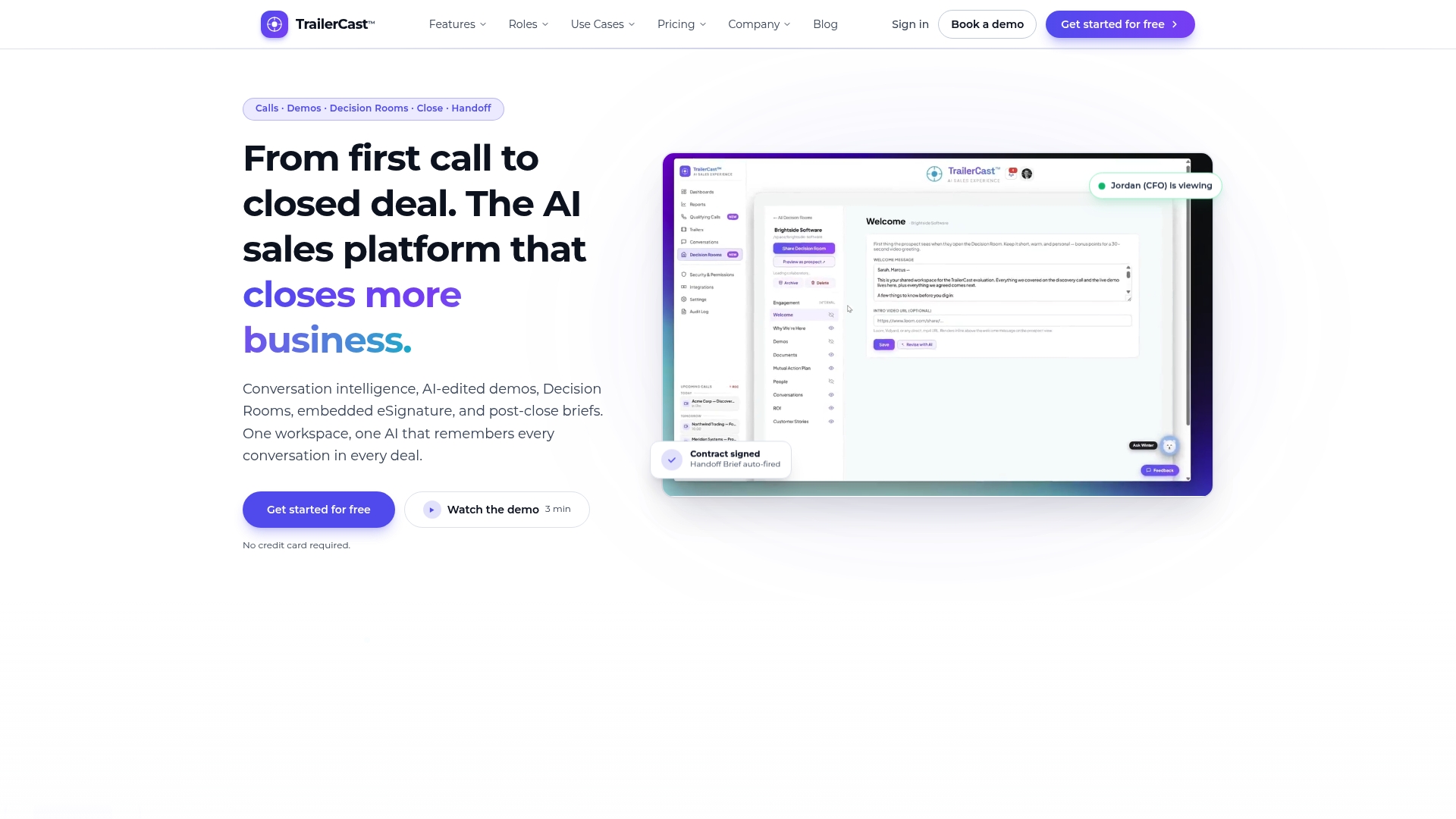
A practical pilot: run a single revenue pod through TrailerCast for 30 days, then measure time-to-find and asset reuse against your current setup. Every feature is included at $59 per seat per month billed annually, with a free trial and no credit card required. Explore the full feature set or check pricing before you commit a team to the pilot.
Sources
For readers who want to go deeper: MindTickle’s State of Revenue Enablement report covers AI adoption outcomes in enablement, G2’s review intelligence playbook explains relevance signals, and G2’s enablement category page summarizes vendor capabilities. For hands-on adoption tactics, see this buyer mapping and content activation guide.
FAQ
What is an AI sales library used for?
An AI sales library centralizes sales content and uses AI to recommend the right asset for a specific deal based on stage, industry, and stakeholder role. It replaces manual searching through shared drives with ranked, context-aware suggestions.
How is an AI sales library different from a shared drive?
A shared drive stores files with no sense of relevance, while an AI sales library ranks content per deal using signals like deal stage and CRM data. It also tracks engagement per asset, showing who viewed what and for how long.
What integrations should an AI sales library have?
Look for CRM integration, conferencing tools like Zoom, Meet, and Teams, and messaging platforms like Slack, since surfacing content inside existing workflows drives adoption far more than a standalone portal. Version control and role-based access are also standard expectations.
How much does TrailerCast cost?
TrailerCast offers one plan with every feature included, priced at $59 per seat per month billed annually, with a free trial and no credit card required. There’s no tiered pricing or feature gating.
How do you measure ROI from a sales library?
Track time-to-find, asset reuse rate, and per-asset engagement, then look for correlation with cycle time and deal size. Reps using AI-powered search tools report being 50% more likely to reuse the function, which is often the first measurable sign of adoption.