Sellers: 4 to 10 Minute CISO Security Demo That Gets Reviewed

The right move is simple: deliver a 4 to 10 minute CISO trailer built from your real demo call, paired with a decision room of labeled verification artifacts. That combination lets a CISO check your architecture, encryption, and access control claims without digging through a 45-minute recording. A CISO security demo, done this way, becomes something a security reviewer can actually finish in one sitting.
TL;DR:
- Creating a security trailer should focus on key categories like architecture, data flow, encryption, and access control to address CISOs’ primary concerns.
- Clips should be ordered by importance, starting with the most critical risk areas, and kept under 10 minutes to ensure quick review.
- The decision room must organize all artifacts logically, with a focus on easy, under-90-second verification checks like SSO login and audit logs.
- Building the security verification room before the demo call ends allows rapid response to questions, reducing review time and deal delays.
- Using a no-login, branded decision room enables tracking stakeholder engagement and prevents the need for follow-up emails for content verification.
Table of Contents
- What CISOs evaluate: the checklist sellers should map to trailer clips
- How to build a 4 to 10 minute CISO trailer from a recorded demo
- What belongs in a CISO decision room, and how to organize it
- Quick technical checks a CISO can run, and the red flags that stall deals
- Share and track: formats, forwarding, and the signals that matter
- How TrailerCast puts this playbook into practice
- Tailoring a security demo to different CISO personas and industries
- Common mistakes sellers make preparing a CISO security demo
- Author perspective: the one habit that saves a week
- Speed up your CISO trailers with TrailerCast
- FAQ
What CISOs evaluate: the checklist sellers should map to trailer clips
CISOs are not evaluating your UI. They are checking whether your product introduces risk into their environment, and they run through the same categories every time. Knowing those categories lets you cut a long demo into the exact clips that answer each one.
- Architecture and hosting: where the product runs, whether it is multi-tenant, and what isolates one customer’s data from another.
- Data flow: what data enters the system, where it is stored, and what leaves it (especially anything touching customer PII or call recordings).
- Encryption: whether data is encrypted in transit and at rest, and who holds the keys.
- Identity and access management: SSO/SAML support, role-based access, and whether permissions map to their existing identity provider.
- Logging and auditability: whether admin actions and data access produce an exportable audit trail.
- Incident response: what happens, and who gets notified, if something goes wrong.
- Vendor risk: subprocessors, certifications, and how the vendor itself is secured.
Each axis decides a go/no-go, not a nice-to-have. A single short clip showing an SSO login flow or an audit log export does more to move a deal than ten minutes of feature walkthrough ever will.
How to build a 4 to 10 minute CISO trailer from a recorded demo
Treat this as a thirty-minute production task, not a video editing project. Here is the sequence that works:
- Search the transcript for security keywords. Look for “SSO,” “encryption,” “audit,” “access control,” “SOC,” “role,” and “data residency.” Most calls already contain two or three moments where someone asked a security question and your team answered it on camera.
- Flag the timestamps. Mark the start and end of each relevant answer, not just the question. A clip should open on the question and close on the resolution.
- Order clips by weight, not by call chronology. Lead with whatever answers the CISO’s biggest likely objection: usually access control or data isolation.
- Cap the runtime. Keep the cumulative length under 10 minutes. If you have more than 8 to 10 strong clips, cut the weakest ones rather than stretching the runtime.
- Add structure frames. An intro slide naming the prospect and stakeholder, a one-line agenda slide, and an outro pointing to the decision room turn a clip reel into something that reads as deliberate.
- Layer in captions or narration that reference artifacts. A caption like “see SOC 2 Type II report in Decision Room” does more work than narration alone.
A realistic sample: a 40-minute discovery-plus-demo call usually yields 4 to 6 usable security clips, totaling 6 to 8 minutes once trimmed to just the relevant answer.
Pro Tip: Build the trailer the same day as the call, while the context is still fresh and the clip boundaries are obvious.

What belongs in a CISO decision room, and how to organize it
A CISO should be able to find what they need in under 90 seconds. That means no loose attachments in an email thread, and no folder named “misc.”
- One-page security summary: architecture, encryption standard, IAM support, and certification status on a single page.
- SOC 2 or ISO attestation: the actual report or a current summary, not a logo on a website.
- Architecture diagram: data flow from ingestion to storage to deletion.
- SSO/SAML integration guide: how it connects to their identity provider.
- Pen test summary: scope, date, and remediation status.
- Named security contact: an actual person and email, not a support inbox.
Name folders by function, not by file type: “01 Security Summary,” “02 Compliance Attestations,” “03 Architecture,” “04 Trailer Clips.” Inside the trailer clip folder, label each clip with the artifact it supports, so the clip showing SSO login sits next to the SSO integration guide it proves.
Quick technical checks a CISO can run, and the red flags that stall deals
CISOs trust what they can verify themselves faster than they trust what you tell them. Build your demo around a handful of lightweight, watchable checks:
- SAML SSO login: show the actual redirect to their identity provider, not a slide describing it.
- Audit log export: show a real export, even a sample one, with timestamps and user actions.
- Role-based access control: show two different roles seeing two different views of the same account.
Each of these should run in under 60 seconds on camera. The goal is proof, not a tutorial.
Vendors that pair a labeled decision room with a short trailer reduce CISO review time and speed up procurement, because the reviewer spends time verifying instead of hunting.
Watch for these red flags before a CISO finds them first: no named security owner, no SOC 2 or ISO attestation available on request, encryption claims with no stated standard, and SSO described as “on the roadmap.” Fix each one before the trailer goes out, not after the CISO asks.
Share and track: formats, forwarding, and the signals that matter
A branded, no-login decision room beats an MP4 attachment or a PDF one-pager because it keeps everything (trailer, documents, people) in one place your champion can forward without explaining it themselves.
- No-login decision room: best for multi-stakeholder review, since it holds documents and the trailer side by side.
- Standalone MP4: fine for a single clip shared in Slack, weak for anything requiring follow-up documents.
- PDF one-pager: useful as a leave-behind, but it cannot carry video.
When your champion forwards the room, give them one sentence of context to pass along, naming exactly which artifact answers which concern. Watch for a CISO opening the room, playing the trailer, and then downloading the compliance folder. That sequence is the clearest signal a review is actually underway.
Pro Tip: Ask your champion to forward the room directly rather than exporting a PDF, so you keep visibility into what the CISO actually opens.
How TrailerCast puts this playbook into practice
We built TrailerCast around this exact workflow, because we kept watching sellers lose days to manual clip-hunting and scattered attachments.
- Our AI notetaker joins the call and produces a searchable transcript, so finding the security moment takes seconds instead of a rewatch.
- Our AI-edited trailers pick the 8 to 15 minutes that matter and stitch them into a branded clip reel, with a version that can lead with security content for a CISO stakeholder.
- Our Decision Rooms hold the trailer next to documents, a people map, and a live thread, so nothing lives in a separate inbox.
- Our engagement panel shows exactly when a stakeholder opens the room and plays the trailer, turning a guess into a visible signal.
- Our embedded eSignature and AI Handoff Brief carry the deal straight through close without a tool switch.
Each feature maps to one step in the playbook above: search the transcript, extract the clip, share the room, watch the signal.
Tailoring a security demo to different CISO personas and industries
Not every security reviewer weighs the same risks. A fintech CISO cares most about data residency and regulatory certifications; a healthcare CISO leads with HIPAA-adjacent data handling and encryption scope; a CISO at an 11 to 200 person SaaS company often cares more about SSO and role-based access than formal attestations, simply because their own stack is leaner.
Adjust the trailer order, not the content. If you know the vertical in advance, open with the clip that answers that industry’s first question: residency for fintech, data minimization for healthcare, SSO for lean SaaS teams. The same six clips can serve three different CISOs if you reorder them around what each one asks first.

Titles matter too. A CISO at a regulated company often shares the room with a compliance officer or legal counsel, so a decision room built for that persona should surface the attestation documents before the architecture diagram. A CISO at a smaller company is more likely to be the sole technical reviewer, so a tighter, faster trailer with fewer artifacts tends to move faster than an exhaustive one.
When you do not know the persona ahead of time, default to the general checklist from earlier in this piece. Over time, keep a small library of clip orderings by vertical, since the underlying clips rarely change, only the sequence does.
Common mistakes sellers make preparing a CISO security demo
The most common failure is sending the full demo recording and hoping the CISO finds the relevant part. They will not watch 45 minutes to find 90 seconds of useful content, and the deal stalls while nobody follows up.
A close second: no named security contact. A CISO who hits a question with no clear owner to ask will often just stop the review rather than chase an answer through your champion.
Other recurring mistakes:
Sending documents without context, so a CISO opens a SOC 2 report with no explanation of scope or date. Treating the trailer as a marketing reel instead of a verification tool, with music and branding but no substantive security content. Waiting for the CISO to ask for artifacts instead of preloading the decision room before the request comes in. Forgetting to update the trailer or documents when your security posture changes, leaving a stale pen test summary in the room months after a new one exists.
Each of these adds a follow-up email and a week of delay. The fix in every case is the same: build the room before the CISO asks for it, not after.
Author perspective: the one habit that saves a week
If there’s one change I’d push every seller to make, it’s this: open the decision room before the demo call even ends, and drop the first security clip in while the conversation is still warm. Waiting until after the call to assemble everything adds a full review cycle, because the CISO’s first question arrives before your trailer exists. A room that is already live when the question lands turn a week of chasing into a same-day answer.
— Daniel
Speed up your CISO trailers with TrailerCast
We built TrailerCast because stitching together a call recorder, a video editor, a deal room, and a signature tool to produce one CISO-ready trailer takes far longer than the review itself should. With one workspace, the transcript search, the auto-edited trailer, and the decision room sit together from the start, so a seller can go from a finished demo call to a shared security trailer the same afternoon.
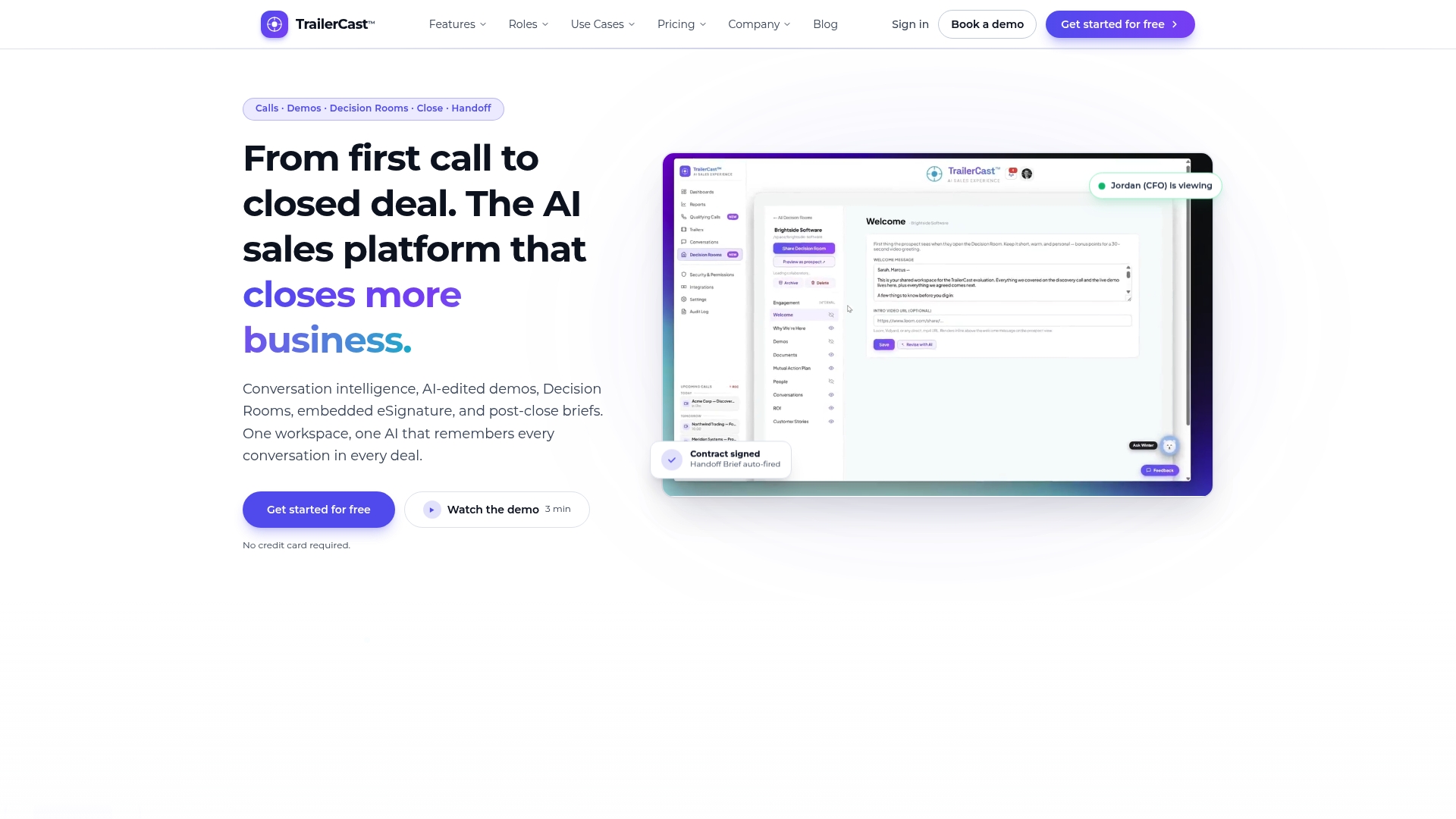
Our AI-edited trailers can be personalized per stakeholder, including a CISO-focused cut that leads with architecture and access control instead of pricing. Pricing runs from $59 per seat per month on annual billing, with every feature included and no gated tiers. Start a free trial and build your first CISO trailer from a real call this week at Trailercast.
FAQ
What should a CISO security demo actually include?
A CISO security demo should include a short trailer, ideally 4 to 10 minutes, built from clips that show your architecture, encryption, access control, and logging, paired with a decision room holding your compliance attestations and a named security contact. The goal is letting a CISO verify claims quickly rather than rewatching a full call.
How long should a security trailer for a CISO be?
Most effective CISO trailers run between 4 and 10 minutes, built from 4 to 8 clips pulled from a longer demo recording. Anything longer starts to resemble the original call it was meant to replace.
What documents do CISOs expect to see before approving a vendor?
CISOs typically expect a SOC 2 or ISO attestation, an architecture diagram, an SSO or SAML integration guide, and a recent pen test summary, organized so each document can be found in under 90 seconds. A checklist of common CISO questions can help you confirm nothing is missing before you share the room.
How do I share a security trailer so I can track if the CISO watched it?
A branded, no-login decision room lets you track whether a stakeholder opened the room and played the trailer, which a plain MP4 attachment cannot do. Watching for that engagement signal, rather than waiting on an email reply, tells you when a review is actually underway.
What is the biggest mistake sellers make when preparing for CISO review?
The most common mistake is sending the entire demo recording and expecting the CISO to find the relevant minute themselves, which usually just stalls the deal. Pairing a short, security-focused trailer with pre-loaded verification documents, as described through NEXTmsp’s practical review guidance, avoids that delay entirely.