Conversation Intelligence in Sales: A Coaching Playbook

Conversation intelligence in sales automatically turns every sales call into structured coaching data and deal signals, so managers stop guessing why deals stall and reps stop losing what they learned the moment they hang up. Start small: pilot it with one team for 60 days, then connect it to your CRM so notes and action items write themselves back to the deal record. In the first 60 to 90 days, expect:
- Faster ramp for new reps who can study top-performer calls instead of shadowing them live
- Clearer coaching moments, pulled straight from real objections instead of secondhand recaps
- Far fewer manual notes cluttering your CRM after every call
Key Takeaways
Conversation intelligence works because it turns raw sales calls into structured coaching data and CRM-ready deal signals that scale beyond what any manager can review live.
| Point | Details |
|---|---|
| Start with a pilot | Run one team for 30 to 90 days with defined objectives before a full rollout. |
| Prioritize CRM writeback | Insights that never reach the CRM rarely change rep behavior or get reused. |
| Coach reps first, managers second | Self-coaching with personal call data drives faster habit change than manager-only reviews. |
| Track a short metric list | Talk-to-listen ratio, discovery questions, and action-item capture tie directly to win rate. |
| Consider an integrated platform | Trailercast pairs conversation intelligence with demo trailers and deal rooms so call insight follows the whole deal. |
Table of Contents
- What Is Conversation Intelligence in Sales?
- How Does Conversation Intelligence Work?
- What Features Should You Expect From a CI Tool?
- Where Does Conversation Intelligence Deliver the Most Value?
- Which Metrics Actually Matter?
- How Do You Roll Out Conversation Intelligence Without Stalling?
- What Does an Integrated CI Platform Look Like in Practice?
- How Do Conversation Intelligence Tools Compare?
- Where Is Conversation Intelligence Headed?
- Give Every Deal a Home, Not Just Every Call a Transcript
- Frequently Asked Questions
- Sources
What Is Conversation Intelligence in Sales?
Conversation intelligence combines automatic speech recognition (ASR), natural language processing (NLP), and machine learning to transcribe sales calls and pull structured insight out of them: who talked, what got asked, which objections surfaced, and what happens next. It works on real human-to-human interactions, live or recorded, according to AssemblyAI’s guide to conversation intelligence.
That is a different job from conversational AI. Conversational AI, like chatbots or voice agents, conducts or simulates conversations. Conversation intelligence analyzes the ones your reps already had.
Conversation intelligence uses AI, machine learning, and NLP to extract actionable data from voice conversations. It is the analysis layer, not the conversation itself.
The distinction matters for budgeting and expectations:
- Conversational AI tools automate outreach or handle simple buyer questions
- Conversation intelligence tools study what was said and turn it into coaching material and pipeline signals
How Does Conversation Intelligence Work?
Most platforms run the same three-stage pipeline under the hood, according to Verint’s conversation intelligence guide:
- Recognition. Speech-to-text converts audio into a transcript and separates speakers.
- Understanding. NLP tags entities, topics, and intent, flagging things like pricing mentions or competitor names.
- Insights. Machine learning scores sentiment, detects moments (objections, buying signals), and drafts action items.
A typical data flow looks like this: call recording feeds a transcript with speaker labels, keyword and entity detection scans it for relevant moments, highlight extraction pulls the clips that matter, and the summary writes back to your CRM.
What you get and when:
- Real time: talk-time ratios, live battlecards, competitor-mention alerts
- Near real time: call summary, sentiment score, flagged risks
- Post-call: full transcript, action items, coaching notes, CRM-ready deal update
What Features Should You Expect From a CI Tool?
Not every tool billed as “conversation intelligence” does the same job. Before you buy, check for:
- Transcription with speaker separation and timecodes, so you can jump straight to the moment that matters
- Moment detection for pricing discussions, competitor mentions, and objections
- Action-item extraction and sentiment or tonality scoring
- Real-time assist and battlecards during live calls
- Clip generation, so a single strong answer from a call becomes something a champion can forward
- Automated call summaries and CRM integration with writeback, not just a dashboard you have to remember to check
That last point is easy to underrate. Insights that never make it back into the CRM rarely change rep behavior, according to Verint’s guide. A brilliant transcript sitting in a separate tool is just a transcript.
Where Does Conversation Intelligence Deliver the Most Value?
Four use cases tend to pay for the tool by themselves:
- Coaching and ramping. New reps study real objection handling from top performers instead of relying on a shadowing schedule.
- Demo clipping and async follow-up. The best 10 minutes of a demo become a clip a champion can share with the CFO who wasn’t on the call.
- Pipeline risk detection. Sentiment shifts and stalled next steps surface before a deal quietly dies.
- Automated CRM notes and follow-up tasks. No more rebuilding a call recap from memory an hour later.
Sales teams that study repeatable behavior from top performers tend to close more deals and spend less time on manual documentation, according to IBM’s overview of conversation intelligence.
AEs, SDRs, managers, and RevOps all benefit, but managers gain the most leverage. One manager can now review coaching signals across an entire team’s calls instead of sitting in on a fraction of them live.
Which Metrics Actually Matter?
Track a short list well instead of a long list badly:
- Talk-to-listen ratio
- Discovery questions asked per call
- Objection frequency and how each was handled
- Competitor mentions
- Action-item capture rate
- Coaching pass rate (calls reviewed vs. calls that needed review)
Tie these to outcomes that matter to leadership: win rate and sales cycle length by rep cohort, not just activity counts. A rep who asks more discovery questions but still loses deals at the same rate isn’t improving, they’re just talking more.
Measurement tip: baseline every metric before rollout. Without a “before” number, you can’t tell whether a metric moved because of coaching or because your pipeline mix changed.
How Do You Roll Out Conversation Intelligence Without Stalling?
Treat this as a pilot first, not a company-wide mandate:
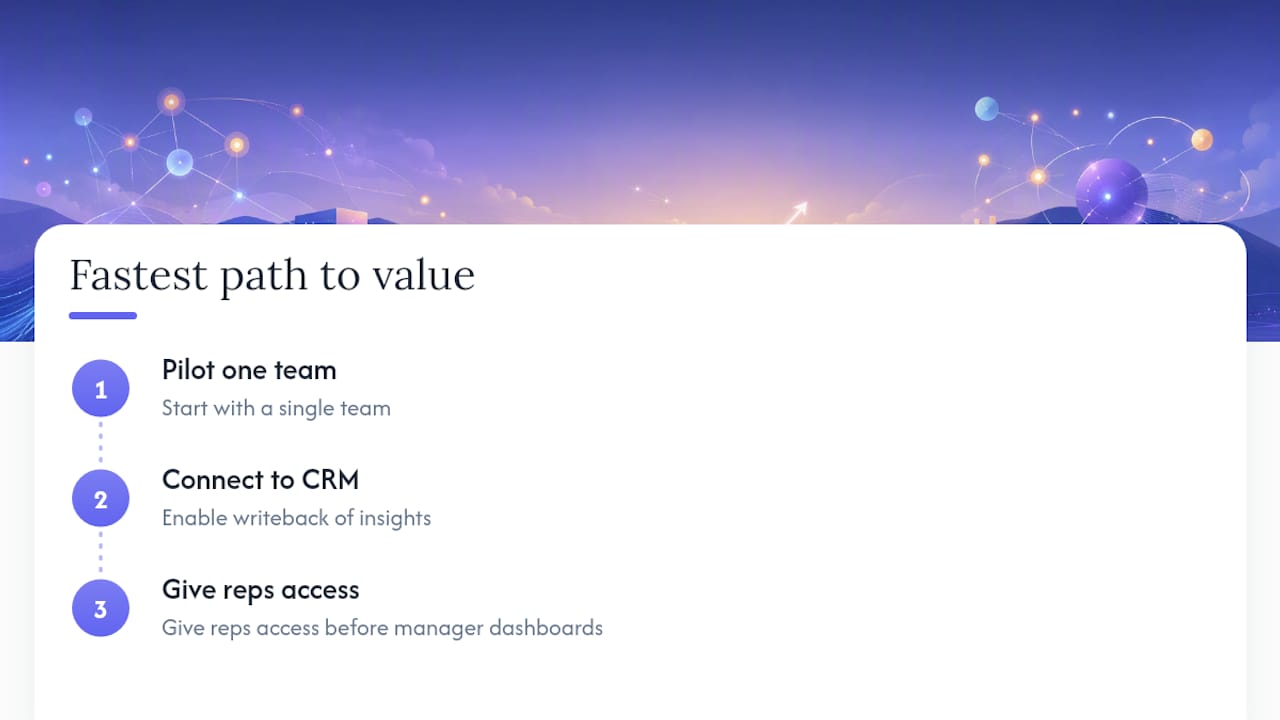
- Pick one team and define objectives. Choose the metrics and keywords you care about (discovery questions, competitor mentions) and set a sample size and duration, typically 30 to 90 days.
- Build your integration checklist. Confirm call capture method (dialer, video conferencing, or browser recording), CRM writeback, identity mapping, and access controls before day one.
- Plan the rollout. Train reps and managers separately, give managers a coaching playbook, and build self-coaching workflows so reps review their own calls, not just the ones a manager flags. Document consent and recording policy up front.
For a deeper look at running CI-enabled calls across a multi-stakeholder deal cycle, see this playbook on AI sales calls for B2B deals. For tactical coaching approaches once the data starts flowing, this guide on coaching with call outcomes is worth reading.
Pro Tip: Give reps access to their own call scores before you roll out manager dashboards. Teams adopt CI faster when it feels like a mirror, not a monitor.
What Does an Integrated CI Platform Look Like in Practice?
Most conversation intelligence tools stop at the transcript and the dashboard. Trailercast was built around a different premise: the call was never the whole problem. The gap between calls, where a champion has to re-explain your demo to a CFO who wasn’t in the room, is where deals actually die.
Trailercast connects conversation intelligence, auto-edited demo trailers, and buyer-facing deal rooms in one workspace instead of five separate tools. A call gets transcribed and summarized, the AI picks the 8 to 15 minutes of a demo that actually mattered, and that clip lands in a tracked follow-up your champion can forward.
- CRM-linked summaries and action items write back automatically
- Auto-edited trailers speed up buyer follow-up without a rep re-explaining anything
- One AI brief follows the whole deal, not just a single call
Pricing is one tier with every feature included: $79 per seat per month, or $59 billed annually, with a free trial and no credit card required.
Pro Tip: If your team currently loses momentum between demo and next meeting, measure how much time reps spend rebuilding recap emails. That number usually justifies the tool by itself.
How Do Conversation Intelligence Tools Compare?
Most conversation intelligence products fall into two camps. The first is call-recording specialists: they capture and transcribe calls, score talk time, and flag keywords well, but their job ends at the call. The second camp is point tools built for a single adjacent task, like video hosting for demos or standalone deal rooms, that don’t touch the call itself.
The gap between those two camps is where most sales orgs bleed time. A rep gets a great transcript from a recording tool, then has to manually cut a highlight clip in a separate video tool, then manually build a follow-up page in a third tool, then manually copy notes into the CRM. Each handoff is a place where deal context gets lost or simply never happens because reps are busy.
Evaluate any conversation intelligence tool, including Trailercast, against a few criteria that matter more than feature-list length:
- Does it separate speakers accurately across accents and call quality? Bad transcription undermines everything downstream.
- Does it write structured data back to your CRM automatically, or does someone still have to copy and paste?
- Does it work across your actual call stack: Zoom, Google Meet, Microsoft Teams?
- Does it stop at the call, or does it carry deal context into demos, follow-up, and handoff to Customer Success?
Trailercast’s approach folds conversation intelligence into a workspace that also handles demo clipping, buyer-facing deal rooms, and post-close handoff, so the insight from a call doesn’t die when the call ends. For teams that just need call analysis and nothing else, a narrower point tool might suffice. For B2B teams managing multi-stakeholder deals across weeks or months, the full deal cycle view tends to matter more than any single feature.
Where Is Conversation Intelligence Headed?
The next wave of conversation intelligence is less about better transcripts and more about connecting what was said to what happens next. Expect three shifts over the coming year.

First, CI is expanding past sales into marketing and product teams, because call transcripts reveal campaign messaging that actually lands and features prospects keep asking for, according to AssemblyAI. A sales call is often the most honest customer research a company has.
Second, deal-level intelligence is replacing call-level intelligence. Instead of scoring one call in isolation, tools increasingly track an entire opportunity: every call, every stakeholder, every promise made across weeks. That shift matters because Gartner’s research found 74% of B2B buyer teams show unhealthy conflict during the decision process. A single call transcript can’t catch that. A system tracking the whole buying committee across every touchpoint has a better shot.
Third, self-coaching is becoming the default entry point rather than a manager-only dashboard. Vendors have historically built CI for sales leadership to review teams, but the bigger behavior change happens when reps use their own data to correct habits before the next call, not after a quarterly review.
Voice cloning and multilingual narration are also starting to show up in demo and follow-up tools, letting a single recorded demo get repackaged for stakeholders who speak different languages or missed the original call entirely.
A Manager’s Take on Coaching at Scale
The biggest shift conversation intelligence brings isn’t better call scores. It’s that one manager can finally coach an entire team’s worth of calls instead of the handful they happened to sit in on. Start your rollout with rep self-coaching playlists, not manager reviews.
Give Every Deal a Home, Not Just Every Call a Transcript
Trailercast is the option built for teams tired of stitching conversation intelligence, video tools, and deal rooms together by hand. Instead of a transcript sitting in one tool, a demo clip in another, and a follow-up page in a third, every call, trailer, and buyer thread lives in one workspace tied to the deal itself.
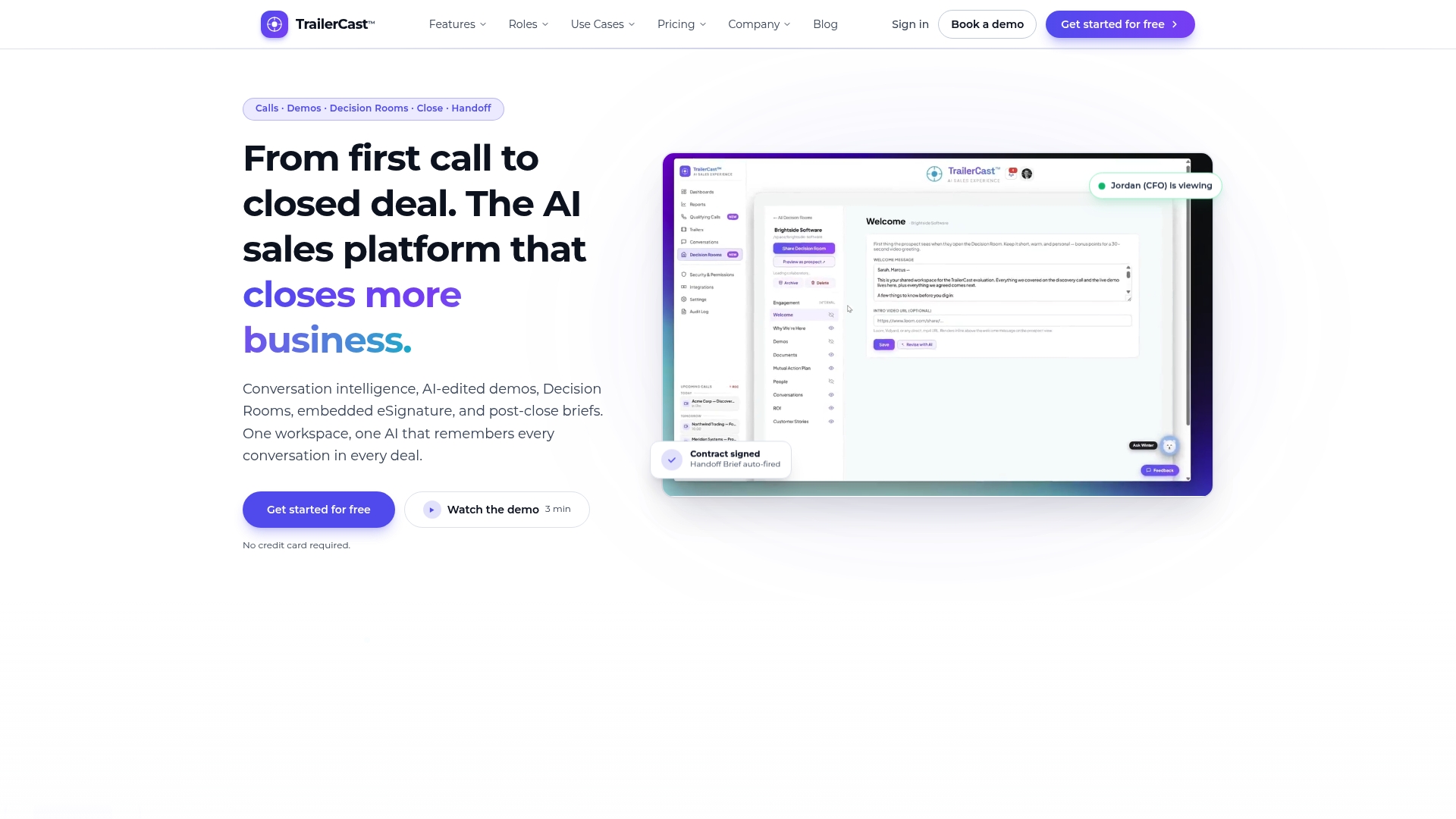
That matters most for B2B teams selling into multi-stakeholder committees, where the champion who loved your demo still has to re-sell it internally without you in the room. Trailercast’s auto-edited demo trailers give that champion something worth forwarding, and the conversation intelligence layer keeps every call’s insight tied to the deal instead of scattered across separate tools.
Pricing is a single tier at $79 per seat per month, or $59 per seat billed annually, with every feature included and no gated tiers. A free trial requires no credit card. Start a trial at Trailercast and connect your first team’s calls before your next pipeline review.
Frequently Asked Questions
What is conversation intelligence in sales? It’s technology that transcribes and analyzes sales calls using ASR, NLP, and machine learning to surface coaching moments, objections, and deal risk automatically.
How is conversation intelligence different from conversational AI? Conversation intelligence analyzes conversations that already happened. Conversational AI conducts or simulates conversations, like a chatbot or voice agent.
What’s the fastest way to see value from conversation intelligence? Pilot it with one team, connect it to your CRM for writeback, and give reps access to their own call data before rolling out manager dashboards.
Does conversation intelligence require recording consent? Yes, in most jurisdictions and under most vendor policies. Confirm your recording and consent notice covers every call channel you plan to capture before rollout.
Can conversation intelligence replace manual note-taking entirely? It replaces most of it. Automated summaries and action items handle the bulk of documentation, though reps should still confirm details before a summary reaches the CRM.
Sources
- Conversation intelligence: The complete guide for 2026
- Gartner sales survey press release (2025)
- How conversation intelligence powers B2B sales (IBM)