Embedded eSignature Benefits: Why In-App Signing Wins

Embedded signing means the person signs a document inside your product, not on a page they get redirected to. That single design choice drives most of the embedded esignature benefits worth caring about: higher completion rates, faster time-to-close, unbroken brand presence, and status updates that fire automation the second a document is signed. Embedding e-signature workflows into your software reduces friction compared to email attachments or fax, which is still how a surprising number of contracts get closed in 2026.
The trade-off is real, and you should know it before you get excited about the upside.
- Higher completion rates because the signer never leaves your app
- Faster deal closure with fewer abandoned sessions
- Consistent brand experience through the entire signing ceremony
- Webhook-driven automation instead of manual follow-up
- Lower per-transaction cost at volume
Here’s the trade-off: embedded signing hands you more control, but it also hands you the operational responsibility that a hosted redirect used to absorb for you. Session security, identity mapping, and webhook reliability become your team’s job, not your provider’s.
Key Takeaways
Embedded signing improves completion rates and deal velocity primarily because it removes the context switch that causes signers to abandon a document mid-process.
| Point | Details |
|---|---|
| Definition matters | Embedded signing happens inside your app; hosted signing redirects the user elsewhere. |
| UX drives completion | Removing the context switch, especially on mobile, is the single biggest lever on completion rate. |
| Webhooks over polling | Event-driven status updates let signature completion trigger provisioning and billing automatically. |
| Responsibility shifts to you | Session security, identity assurance, and audit trails become your team’s job, not the provider’s. |
| Trailercast closes the loop | Trailercast embeds signing in its Decision Room and auto-fires a handoff brief the moment a deal closes. |
Table of Contents
- What Are the Real Embedded Esignature Benefits for Product Teams?
- How Do You Actually Build Embedded Signing Into Your App?
- Is Embedded Signing the Right Choice for Your Workflow?
- What Operational Practices Keep Embedded Signing Reliable?
- How Trailercast Uses Embedded Signing to Close Deals In-App
- What Actually Determines Whether Embedded Signing Pays Off
- A Faster Path From Signed to Closed
- Where to Go Deeper on Implementation
- Sources
What Are the Real Embedded Esignature Benefits for Product Teams?
The clearest benefit is behavioral, not technical: people finish what they start when they don’t have to leave the screen they’re already on. Redirecting a signer to a separate hosted page introduces a context switch. On mobile, that switch often means opening an email client, tapping a link, waiting for a new tab to load, and re-authenticating somewhere unfamiliar. Every one of those steps is a chance for the signer to close the tab and forget.
Embedded signing removes the handoff. The signing ceremony renders inside your existing UI, so a signer already inside their SSO session stays inside it. Moving from email-based signing to embedded, in-app experiences compresses turnaround times from days or weeks down to minutes for many routine agreements, and it tends to reduce drop-off along the way.
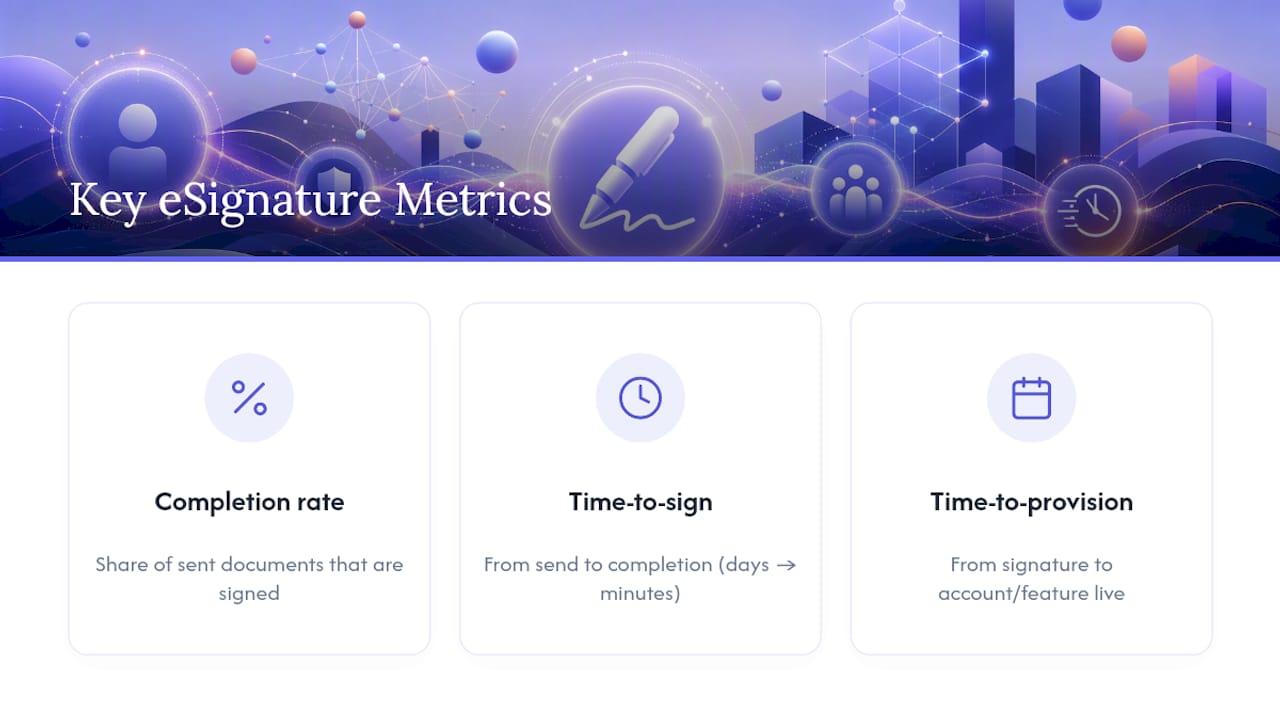
Track three numbers to prove this out for your own product: completion rate (percentage of sent documents actually signed), time-to-sign (from send to completion), and time-to-provision (from signature to the account or feature going live). If those three improve together, you’re seeing the close-rate lift that justifies the engineering investment.
The cost story compounds at volume. A SaaS company onboarding hundreds of new accounts a month, or renewing contracts on a quarterly cadence, saves real operational hours by removing manual document handling and support tickets about “where’s my signing link.” Organizations that make signing event-driven report measurable gains in completion rates and operational efficiency, particularly in high-volume flows where every manual exception has a labor cost attached.

Brand continuity matters more than people assume for high-trust transactions. A financial services buyer or enterprise security reviewer signing inside a white-labeled, on-brand interface reads that consistency as competence. On the security side, embedded signing still delivers tamper-evidence, encryption, and a full audit trail, but be honest with your compliance team: some high-assurance signature requirements (certain regulated industries, certain international standards) still call for identity verification methods beyond what a basic embedded flow provides out of the box.
How Do You Actually Build Embedded Signing Into Your App?
Every developer implementation of embedded signing follows roughly the same five-stage lifecycle, regardless of which API you’re calling.
- Authenticate your application server to the eSignature provider, typically via OAuth 2.0.
- Prepare the document, mapping text tags or a template to the correct fields and signer roles.
- Create an embedded session, generating a short-lived signing URL scoped to one signer.
- Render the signing ceremony inside your app, either through an iframe or a native web component.
- Listen for the webhook (often called something like
folder_executedorcompleted) that confirms the document finalized, then archive the signed artifact.
This five-step pattern shows up consistently across developer documentation from the major eSignature APIs, which suggests it’s less a vendor quirk and more the shape the problem actually takes.
The iframe-versus-web-component decision matters more than teams expect going in. Iframes are simpler to stand up but come with same-origin restrictions that limit how deeply you can theme the signing surface or hook into its events. Web components remove many of those styling and accessibility limitations, giving you native event handling and tighter visual control, which matters if your product has strict design standards or accessibility commitments.
Session tokens deserve their own discipline. Generate one per signer, keep the expiry window short, and build a clean regeneration path for stale sessions rather than letting a signer hit a dead link. And favor webhooks over polling every time. Treating signing as an event-driven state change keeps your internal systems synchronized without hammering an API on a timer, and it’s what lets provisioning or billing fire automatically the moment a contract closes.
Pro Tip: The most common integration bug isn’t the API call. It’s a party sequence mismatch, where signer order in your template doesn’t match the order you pass at session creation, and fields silently drop or land on the wrong signer.
Is Embedded Signing the Right Choice for Your Workflow?
Not every signing workflow needs to live inside your app. Embedded signing earns its complexity when a few conditions line up, and it’s overkill, or even a liability, when they don’t.
Choose embedded signing when your signers are already authenticated through SSO or MFA, the workflow repeats often enough to justify the build, and you’re dealing with mobile-first users where a context switch to an outside page causes real drop-off. It’s also the right call when a signature needs to immediately trigger provisioning, activation, or revenue recognition. Embedded signing performs best in repeatable, authenticated workflows, which is exactly the profile of SaaS onboarding and renewal cycles.
Stay with a hosted or redirect model when you’re dealing with one-off agreements, signers with no existing identity relationship to your product, or a low volume that doesn’t justify engineering time.
- One-off or ad-hoc agreements with no repeat pattern
- Weak or nonexistent identity context for the signer
- Limited engineering bandwidth to own session and webhook infrastructure
- Low document volume where a hosted provider’s simplicity wins
Ask yourself three questions before you commit: Is the signer already authenticated in your app? Will signing in-app materially change the user’s journey? Can your team reliably operate webhooks and recover from expired sessions?
| Signal | Embedded fits? |
|---|---|
| Authenticated, repeat signers | Yes |
| One-off external agreements | No |
| Mobile-first user base | Yes |
| No engineering capacity for webhooks | No |
What Operational Practices Keep Embedded Signing Reliable?
Embedded signing shifts real responsibility onto your team, and the failure modes are predictable enough to plan around.
- Capture identity assurance at the moment of signing. Log the authentication method (SSO token, MFA event) and tie it directly to the signature record, not just to the user’s general account.
- Build a complete audit trail. Every signed document needs a timestamp, IP address, user agent, document hash, signer identifier, and the exact field positions signed, stored as immutable evidence alongside the final PDF.
- Make your APIs idempotent. Verify webhook signatures server-side, retry failed deliveries with backoff, and run a reconciliation job that catches sessions stuck in limbo.
- Plan the failure path. If an embedded session expires or the network drops mid-signature, fall back to an email link rather than leaving the signer stranded, and surface a clear error state to your support team.
- Test like the flow will break. Run smoke tests for multi-signer documents, mobile browsers, and screen readers, and verify webhook delivery end-to-end before you ship.
Common pitfalls in production tend to cluster around three causes: expired session URLs, mismatched signer sequences, and webhook verification gaps that let internal state drift out of sync with reality.
Pro Tip: Run a monthly reconciliation report comparing “sessions created” against “webhooks received.” A growing gap between those two numbers is your earliest warning that something in your webhook pipeline is silently failing.
How Trailercast Uses Embedded Signing to Close Deals In-App
Trailercast built embedded signing directly into its Decision Room, the shared workspace where a buying committee reviews demos, documents, and pricing across the length of a deal. When a buyer is ready to close, they sign inside that same room. No redirect, no separate portal to remember a password for, no new browser tab that a CFO forwards to the wrong inbox.
The moment the signature lands, the platform automates what used to be manual handoff work: it generates an AI handoff brief for Customer Success, updates the running deal record with the final terms, and notifies provisioning so the account can go live without a kickoff call to re-explain context anyone already gave.
What that pattern produces, in practice:
- Shorter time between “signed” and “provisioned”
- Fewer stalled deals waiting on a signing link buried in an inbox
- A Customer Success team that starts a new account already briefed, not starting from zero
What Actually Determines Whether Embedded Signing Pays Off
The engineering conversation around embedded signing tends to focus on the wrong variable. Teams obsess over which API has the cleanest documentation, when the real determinant of success is whether the organization already has authenticated, repeatable relationships with its signers. Embedded signing doesn’t create trust or identity assurance. It amplifies whatever your product already has.
Conventional advice treats this as a checklist of API calls and webhook events, and that’s necessary but insufficient. The teams that get the most value are the ones that treat signing as the final beat of a longer buyer journey, not an isolated document task bolted onto a checkout flow. A signature that fires provisioning, updates a deal record, and briefs the next team automatically is worth more than a signature that just closes a PDF.
If you take one thing from this, prioritize the event-driven architecture before you obsess over UI polish. A beautifully themed iframe that still requires someone to manually check whether a document was signed has solved the wrong problem.
— Daniel
A Faster Path From Signed to Closed
Trailercast is the alternative to bolting a separate eSignature tool onto your sales stack. Instead of sending buyers to a third-party page after the demo is done, signing happens right inside the same Decision Room where the buying committee already reviewed pricing, security answers, and the mutual action plan. The moment a signature lands, Trailercast auto-generates a handoff brief for Customer Success and updates the deal record, so provisioning starts before the buyer’s calendar invite for a kickoff call even goes out.
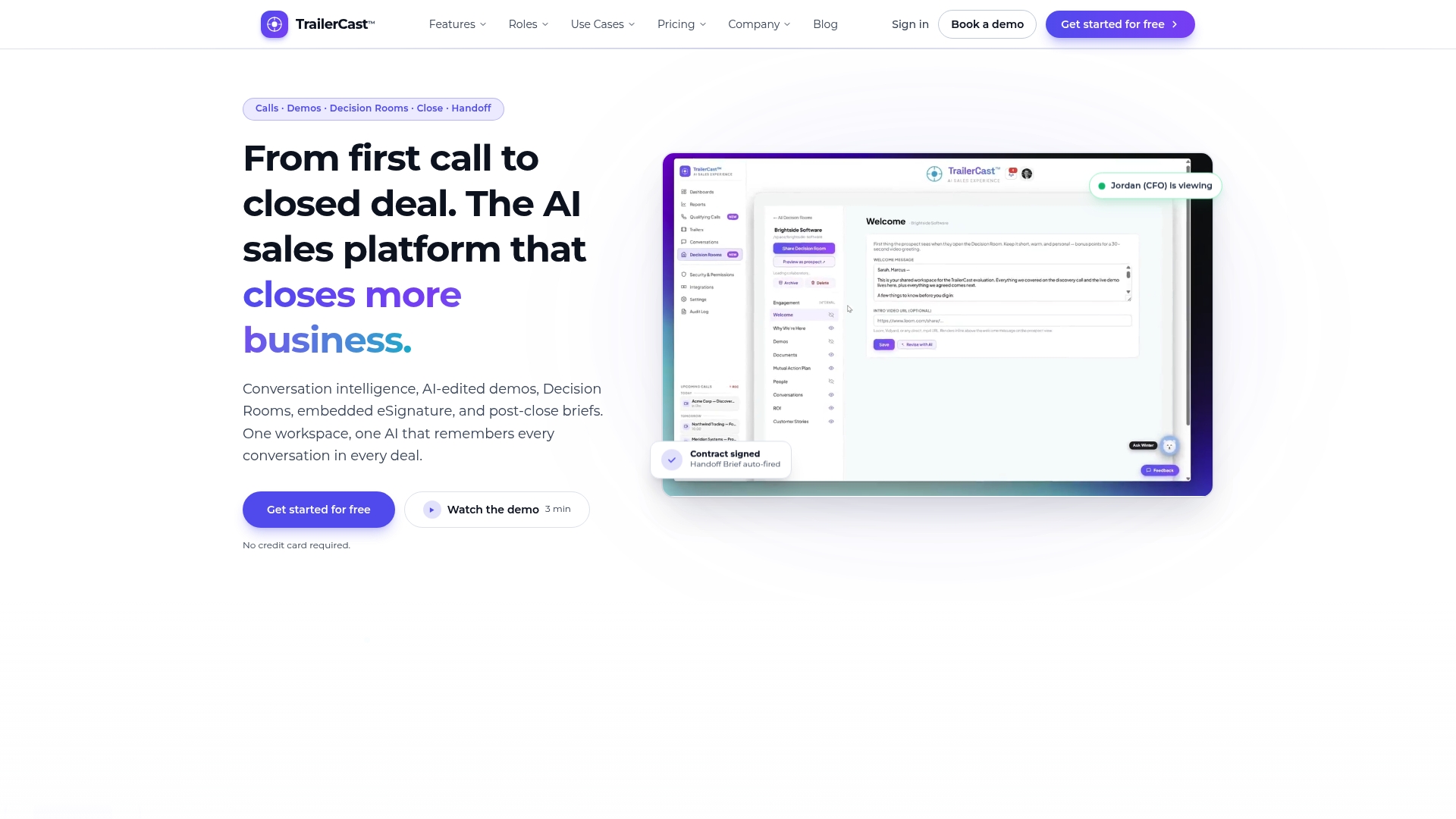
If your team is juggling conversation intelligence, demo videos, buyer portals, and signing across four different tools, that gap between “signed” and “actually closed” is where deals quietly stall. See how the full deal cycle works in one workspace and start a free trial to watch a deal move from signature to handoff without a single manual step.
Where to Go Deeper on Implementation
Start with the Adobe embedded signing guide and Foxit’s API lifecycle documentation for code-level detail, and confirm your baseline legal validity against the US ESIGN Act.
Sources
- 6 reasons to embed e-signature workflows into your software, mobile apps, and websites — Adobe Blog
- How to replace manual email-based signing with in-app experiences — Verdocs
- eSignature API Guide: Add Signing to Your App — Foxit Developer Blog
- Embedded eSignatures for SaaS apps — BoldSign