Free Trial vs. Pilot: How to Choose for B2B SaaS Deals

A free trial lets one buyer try a finished product on their own, with the buyer deciding what success means. A pilot is a structured evaluation with a defined use case, a timeline, named stakeholders and written success criteria, run with your help. Use the trial when one person can reach value alone and fast. Use a pilot when the deal needs a team, real workflows and a decision that more than one person has to defend.
That is the short version. The part that decides whether you win is what happens between the calls: who is checking results, who is telling the CFO what happened, and whether anyone remembers what “success” was supposed to mean. That is where most trials and pilots quietly die.
TL;DR
- Free trial: self-serve, usually 14 days for most SaaS products, success defined by the buyer. Best for simple products with fast time-to-value.
- Pilot: a limited deployment with real workflows, defined metrics, a 30 to 90 day window and your involvement. Best for mid-market and enterprise deals.
- The rule of thumb: choose the lightest offer that produces credible buying signal.
- The failure mode for both: vague success criteria and no plan for what happens on the last day.
- Your job as the seller: keep the deal coherent between conversations, so the people who weren’t in the room still get the answer.
Table of Contents
- What a free trial actually is
- What a pilot actually is
- Free trial vs. pilot, side by side
- When to offer a free trial
- When to run a pilot instead
- Should a pilot be paid?
- Where beta fits (and why it isn’t a pilot)
- How to scope a pilot that converts
- What to measure in each format
- What derails trials and pilots
- Run your next trial or pilot in one workspace
- FAQ
- Sources
What a free trial actually is
A free trial gives the buyer temporary access to the product before they pay. According to Tracsio’s breakdown of B2B offer types, the buyer is expected to find enough value on their own, or with light support, to decide whether to continue. It works best when the product is simple, setup is short and value shows up quickly.
In practice, a trial looks like this:
- The user signs up themselves.
- They get standard access, typically 14 to 30 days, per Rework’s 2026 guide to POCs and pilots.
- Support comes through standard channels.
- Success means the user gets enough value to convert without you.
Trials are common. ChartMogul’s February 2026 SaaS Conversion Report found that 61% of SaaS products use a free trial as the main landing point for new customers, and 14 days is the most common length (62% of products). The same report puts median free-to-paid conversion across all products at 8%.
Note the other finding in that report: 80% of free-trial products have human touchpoints when an enterprise user enters the trial. Even in trial-land, once the buyer is a company and not a person, someone from your side shows up. That is the bridge to the pilot.
What a pilot actually is
A pilot is a limited deployment to a subset of users, such as one team or department, using real workflows rather than test data. Per Rework, it comes with defined success metrics, a 30 to 90 day timeframe and sales and customer-success involvement. The goal is to prove value in a controlled environment before a full rollout.
PartnerStack puts the contrast plainly: with a pilot, results are analyzed against goals before full-scale launch, while with a free trial the customer decides for themselves what success looks like.
That is the real difference. It isn’t the length or the price tag. In a trial the buyer defines success alone. In a pilot you and the buyer define it together, in writing, before you start.
Free trial vs. pilot, side by side
| Free trial | Pilot | |
|---|---|---|
| Who runs it | The buyer, self-serve | You and the buyer together |
| Typical length | 14 to 30 days | 30 to 90 days |
| Users | One person or a small group | A defined team or department |
| Data | Often sample or test data | Real workflows and real data |
| Success criteria | Informal, set by the buyer | Written, agreed before kickoff |
| Cost | Free | Free or paid |
| Best signal | Activation and usage | Results against agreed criteria |
| Main risk | Weak onboarding | Scope drift |
| Best fit | SMB, simple product, product-led motion | Mid-market and enterprise, multi-stakeholder deals |
The signal and risk rows come from Tracsio’s comparison table. The length, data and fit rows follow Rework’s guide.
There is a third format you will hear about: the proof of concept (POC). It is a narrow, time-limited technical test, often managed by a sales engineer. If your deal hinges on a technical question, our breakdown of pilot vs. proof of concept covers where the line falls.
When to offer a free trial
Tracsio’s test is useful because it is concrete. Offer a trial when all of these are true:
- The buyer already understands the problem.
- Setup is fast.
- One user can reach a useful result without coordinating with anyone internally.
- Value shows up inside the trial window.
If you can’t tick all four, the trial will run, nobody will log in on day six, and you will hear “we got busy.”
Timing matters more than most reps assume. A benchmark of 2,000+ B2B SaaS trials, summarized by one analyst, found that if a user doesn’t activate within three days of signup, the odds they ever do drop by 68%. Treat the first 72 hours as the whole trial.
Qualify before you hand out access
Even for sales-assisted trials, access shouldn’t be automatic. PostHog’s sales handbook says to offer a trial only when the deal is qualified for sales-assist (over $20K ARR potential), decision makers and a timeline are identified, the customer wants technical validation and they are ready to invest the time. It skips trials for price shoppers with no technical criteria and for customers already committed to buying.
That qualification is discovery work. If yours is thin, start with our discovery questions for SaaS sales before you decide which evaluation format to offer.
Credit card or no credit card
This choice changes your numbers. ChartMogul found that trials requiring a credit card convert at 30% free-to-paid, more than 5x the rate of trials that don’t, though only 20% of free-trial products ask for a card upfront. If you do collect a card, U.S. rules apply: according to SaaS attorney Andrew Bosin, auto-converting trials trigger the federal ROSCA law and state automatic-renewal laws, which require clear disclosure, affirmative consent and easy cancellation. Have your legal team check the flow before launch.
When to run a pilot instead
Use a pilot when the product needs context, the buyer has to define success and you need to learn how it performs inside a real workflow. Tracsio notes this is common in compliance, security, revenue operations, customer success, finance, data and infrastructure categories.
Signals that you are in pilot territory:
- More than one stakeholder has to validate the result.
- The product touches existing systems or processes.
- Value takes weeks of real usage to show, not minutes.
- The buyer’s champion can’t sell it internally without evidence.
- The deal is big enough to justify your time. PostHog, for example, extends its trials to four weeks when deal value passes $60K ARR, the environment is complex or several stakeholders must sign off.
Jason Lemkin of SaaStr frames it simply: a pilot is a trial with human help and oversight. Free trials only work if customers can deploy successfully on their own very quickly. If your product takes 30 to 60 days to deploy or needs heavy data entry before it shows value, put humans in the loop. He also notes that enterprise customers are used to pilots, and that when a prospect asks for one, finding a way to offer it removes friction from the sale.
Pilots prove adoption, trials don’t
A trial shows whether one person can use the product. A pilot is the only format that tests whether a team keeps using it after the novelty wears off. That is why procurement and finance leaders trust pilot results more than “our champion liked it.”
Should a pilot be paid?
There are two camps, and both have a point.
Paid pilots create commitment. Rework’s playbook argues that even nominal fees of $5K to $10K get customers to pay attention, while free pilots risk being treated as unimportant. It cites an enterprise software company tracked over 18 months: pilots with clear success criteria, defined timelines, paid engagement and pre-negotiated conversion terms converted 68% to full deals. Free pilots with vague metrics and no conversion planning converted 23%.

Free pilots can be right early. Userpilot’s guide says free pilots are fine when you’re still validating whether the problem is painful enough, since speed of learning matters more than revenue. Paid pilots fit later, when you need the signal that someone will pay.
Take the lesson from that 68% vs. 23% gap: the fee is only one ingredient. Criteria, timeline and conversion terms did as much work as the money. If your deal can’t support a fee, you can still copy the other three.
On paperwork, a paid pilot usually carries more than a trial does. Bosin describes a short fee-bearing evaluation, often 30 to 90 days, with success criteria, production-like security terms (a data processing addendum, a security questionnaire, sometimes SOC 2 evidence) and conversion mechanics such as fees credited toward the first-year subscription. Free trials usually run inside your standard terms of service.
Where beta fits (and why it isn’t a pilot)
Reps sometimes use “beta” and “pilot” interchangeably. They aren’t the same. A beta covers an unfinished product, usually free, and the value exchanged is feedback. A pilot evaluates a working product against agreed criteria. Userpilot puts the test this way: if a participant doesn’t know when the engagement ends or what success looks like, you have run a beta and called it a pilot.
If you sell a generally available product, you are choosing between a trial and a pilot. Don’t dress up a free-for-all as a pilot.
How to scope a pilot that converts
Here is the routine, step by step.
1. Define one binary question
Before you agree on scope, agree on what outcome triggers a contract. One practitioner’s framing: if we hit metrics X, Y and Z, does this trigger a contract? If the buyer hesitates to name metrics, that is a signal they may be working from experimental budget with no path to a real purchase order. Teams that want help turning outcomes into numbers can look at setting measurable pilot outcomes and tracking purchase intent as a model for that discipline.
2. Write success criteria in five parts
Dowhatmatter’s guide suggests five categories: business outcome, usage milestone, stakeholder review, timeline and failure criteria. Failure criteria feel awkward to write, but they protect you from a pilot that drifts for months with no verdict.
3. Build a week-by-week plan
A five-week example from the same guide:
- Week 1: setup complete, with a named owner on the buyer side.
- Week 2: the first team completes the target workflow.
- Week 3: the workflow repeats on additional cases.
- Week 4: buyer and users review results.
- Week 5: the customer picks a paid plan, an expansion, an extension or a stop.
4. Name the stakeholders who aren’t in the room
This is the step most pilots skip. Your champion runs the pilot. Their CFO, security lead or VP decides. Each of them needs a version of the result that speaks to their question, not a shared deck they have to translate.
5. Agree the exit in writing
A pilot is close to a purchase: by the end, data and habits have moved in. Agree what happens to the buyer’s data if they say no, and agree what happens on day one after a yes. Pre-negotiated conversion terms are what separated the 68% pilots from the 23% ones.
What to measure in each format
For trials, watch activation and usage. Benchmarks vary widely by product and motion. Lenny’s Newsletter reports 8 to 12% free-to-paid as good and 15 to 25% as great for free-trial products. Compare your own numbers to your segment, not to a headline average.
For pilots, measure against the criteria you wrote in step 2, and nothing else. PartnerStack’s advice is to review pilot data against the goals set for the program. If KPIs weren’t met, the data can tell you why: messaging, product appeal, customer feedback or missed conversion goals. That turns a lost pilot into a better next pitch.
A useful habit is to track four things weekly:
- Usage: are the named users doing the target workflow?
- Outcome: is the agreed business metric moving?
- Stakeholder engagement: have the decision makers seen the evidence?
- Blockers: what is stopping the next milestone?
What derails trials and pilots
SaaStr’s list of trial failures applies to pilots too: deployment that takes weeks, products that need heavy data entry before value appears, onboarding that is too clunky to do alone and vendors who can’t resource support. Add the pilot-specific killers:
- Scope drift. The pilot grows each week. Fix it with a written scope and a change rule.
- No executive sponsor. The champion can’t get the CFO’s time. Fix it with a review meeting booked in week one.
- Forgotten context. Notes live in five tools and nobody remembers what the buyer said in week two.
- Custom work in disguise. You build bespoke features and call it validation.
The third one is the quiet killer. The calls weren’t the problem. The space between them was.
Our view: the pilot is won between the meetings
I built TrailerCast because I kept watching the same scene. A champion leaves a great demo, then walks back to a CFO who wasn’t there, a CISO whose questions are buried in a recording nobody will rewatch, and a PDF they’re expected to re-sell from memory. The deal dies in an internal meeting you weren’t part of.
A trial or pilot doesn’t fix that by itself. It makes it more visible, because now there are weeks of activity, feedback and promises to keep track of. We designed TrailerCast so that every call, demo and message lives in one workspace, and one AI follows the whole opportunity and builds an evolving Deal Brief across every call. When a pilot kickoff, a week-three check-in and a CFO question all feed the same record, the deal stays coherent even when you aren’t in the room.
It’s also why we built demo trailers that can be personalized per stakeholder: a CFO version that talks pricing, a CISO version that talks security. Your champion gets something worth forwarding. And Decision Rooms give buyers one place to see the evidence for the decision, instead of rebuilding it from memory.
Free trial or pilot, my advice is the same: pick the lightest format that produces credible signal, write down what success means, and own the space between conversations.
Daniel
Run your next trial or pilot in one workspace
TrailerCast is one plan with every feature, from $59 per month per seat. It brings conversation intelligence, AI-edited demo trailers, buyer-facing Decision Rooms with a buyer portal, embedded eSignature and an AI handoff brief together, so a pilot’s calls, evidence and contract live in the same place. Every call feeds the Deal Brief, and the room analytics show which stakeholders opened what. See the plan and pricing.
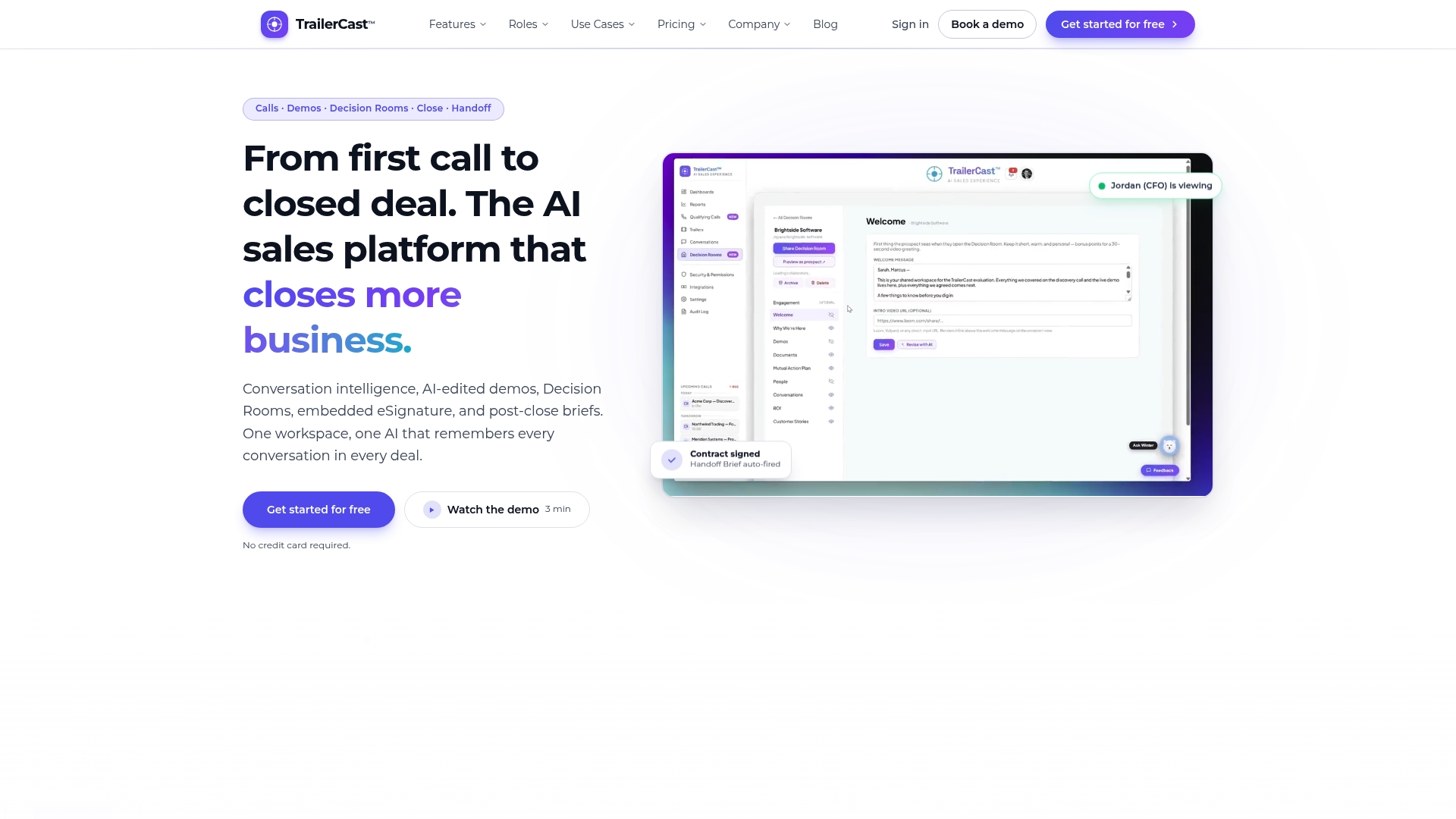
When the pilot converts, the same record carries into the sales-to-CS handoff brief, so the customer success team doesn’t restart the story. For buying groups, deal room analytics show who engaged with the material between your meetings.
FAQ
Is a pilot just a longer free trial?
No. A trial is self-serve and the buyer defines success. A pilot has a defined use case, stakeholders, timeline and written success criteria, with your team involved. Rework’s guide warns against treating pilots as extended free trials, because that is how they lose their purpose.
How long should a free trial or pilot last?
Most SaaS free trials run 14 days, according to ChartMogul’s report, and the typical range is 14 to 30. Pilots usually run 30 to 90 days. PostHog defaults to two weeks for mid-sized deals and four weeks for larger or more complex ones. Pick the shortest window in which the agreed metric can realistically move.
Should I charge for a pilot?
Charge when the buyer needs to treat it as a real commitment and you are past early validation. Rework’s data suggests paid pilots with clear criteria and conversion terms convert far better than free pilots with vague metrics. If a fee isn’t possible, keep the written criteria, timeline and conversion plan anyway.
What is the difference between a pilot and a beta?
A beta tests an unfinished product, usually free, for feedback, with no firm end date. A pilot tests a working product against agreed criteria with a defined end and a path to purchase. If the buyer doesn’t know when it ends or what success is, it is a beta.
What happens if the pilot misses its targets?
Review the data against the goals you set. It will usually show whether the gap came from messaging, fit, usage or the original criteria. Agree the exit options up front, including what happens to the buyer’s data, so a miss ends in a clear decision instead of a stalled deal.
Sources
- Pilot vs Free Trial vs Paid PoC for B2B SaaS, Tracsio
- POC & Pilot Programs: Proving Value Before the Sale, Rework
- Deal Closing Pilot Programs: A Proven Playbook, Rework
- Why Pilot Programs Are a Best Practice for B2B SaaS, PartnerStack
- The SaaS Conversion Report, ChartMogul
- Running trials, PostHog Handbook
- When Not to Offer a Free Trial, SaaStr
- Product Pilot: How I’d Scope, Run, and Measure One, Userpilot
- Beta Test Agreement vs. Pilot Agreement vs. NDA vs. Free Trial
- What is a good free-to-paid conversion, Lenny’s Newsletter
- Pilot Customer Success Criteria for B2B Startups, Dowhatmatter
- Escaping Pilot Purgatory, Ashish Jaiman
- You Have 90 Days Before a New B2B SaaS User Churns