Negotiation Email Templates for SaaS Sellers

The best negotiation email does three things in its first few lines: it affirms the relationship, states exactly what you can do, and names the next step. Below are templates for the situations SaaS sellers hit most: a pricing objection, a counter offer, a scope trade, a stalled thread and a recap after a call. After each one you’ll see why it is built the way it is, so you can adapt it instead of pasting it.
I’ll be blunt about something first. Most deals don’t die because your price was wrong. They die in the space between conversations, when your champion has to re-sell your terms to a CFO from memory. A good negotiation email is the thing your champion can forward.
TL;DR
- Lead with clarity: affirm the relationship, then state your position or request with a figure and a reason in the first two sentences.
- Never give a discount for free. Label every concession, tie it to a reason and link it to something the buyer does in return.
- Offer two or three options of equal value to you rather than one take-it-or-leave-it number.
- End with a specific question and a date, not “let me know your thoughts.”
- Email is risky when emotions run high. Move to a call when the thread turns tense, then send a written recap.
Table of Contents
- How to structure a negotiation email
- Pricing negotiation email templates
- Counter offer email templates
- Negotiation letter to a client: scope and terms
- Following up when the thread goes quiet
- Mistakes that stall negotiations over email
- Our perspective
- Where TrailerCast fits
- FAQ
- Sources
How to structure a negotiation email
Every template below follows the same skeleton. Research from negotiation practitioners points to the same pattern: a strong email leads with clarity in the first two sentences, anchors each ask in a reason, stays warm to people and firm on substance, and names the next step with a date.
Here is that skeleton in plain terms:
- Subject line. Name the company and the topic, for example “Acme + [Your Company]: pricing and term options.” Semi-personalized subject lines that reference the recipient or their company tend to get opened more.
- Opening. One sentence acknowledging their message or the value they’ve said they want.
- Position. Your number, term or boundary, stated plainly.
- Reason. Usage data, scope, a business constraint or the outcome they’re buying. This is the “handle” your contact can defend internally. A price request that pairs a clear figure with a justification gives them something to repeat to their own stakeholders.
- Trade or option. What you can do, and what you need in return.
- Next step. A specific question, with a date.
The tone to aim for is warm but firm: friendly to the person, immovable on the terms that matter.
Keep the writing simple. One idea per sentence and one idea per paragraph is a common recommendation for emails that get read, and it matters even more when the reader is forwarding your message to a finance lead who skims.
Pricing negotiation email templates
Template 1: Responding to “your price is too high”
The instinct is to cut the number. Resist it. First find out what the objection actually is. “Budget” and “I’m not sure the scope is worth it” both produce the same request for a lower number, but they need different answers, as Waco3 points out.
Subject: Acme + [Company]: understanding the pricing concern
Hi [Name],
Thanks for being direct about pricing. I want to make sure I understand what’s driving that: is it the total budget for this quarter, or is it that the scope doesn’t yet feel worth the number?
The answer changes what I can offer. If it’s budget, I can look at how we structure the term and payment. If it’s scope, let’s look at which parts of the workflow matter most for your team and size the package around those.
Could you tell me which it is by Thursday? I’ll come back with options the same day.
[Name]
Why it works: the line about understanding what’s driving the concern is not defensive, it is diagnostic. It slows the thread down and keeps you from solving the wrong problem.
Template 2: Holding your price with a reason
Use this once you know the objection and you don’t want to move the number.
Subject: Acme + [Company]: where I’m landing on price
Hi [Name],
I appreciate the time you and [CFO name] put into this. Where I’m landing is [price] per seat per month for [number] seats. That reflects [specific reason: the three workflows you told us are the priority, the onboarding support included, the usage you described in discovery].
I can flex on structure before I flex on price. For example, an annual term would let us [specific give]. If the budget is fixed, we can adjust scope so the investment matches: fewer seats to start, with the option to add more after the first quarter.
Which of those is closer to what [CFO name] can approve? If it helps, I’m happy to join a 15-minute call with them this week.
[Name]
Two phrases carry this email: “I can flex on structure before I flex on price” and “if we adjust the budget, we should adjust the scope.” Both come from the same set of email phrases that hold price and scope without sounding defensive. That guide also recommends ending with a specific question rather than a soft close, and the template does.
Template 3: Offering options instead of one number
A single offer invites a yes or no. A set of two or three options of equal value to you invites a choice. Watershed Associates recommends exactly this shift.
Subject: Acme + [Company]: three ways to structure this
Hi [Name],
Here are three structures that work on our side. Each is equivalent for us, so pick the one that fits your approval process:
Option A: Annual term, billed annually, [X] seats. Option B: Annual term, billed monthly, [X] seats, with the current rate held for the full term. Option C: Start with [Y] seats now, add the rest at the same rate within 90 days.
Which one should I put in the order form? If none of them fit, tell me what’s blocking and I’ll rework it.
[Name]
Before you send this, make sure you can live with every option. Offering a choice you would regret is not a tactic, it is a mistake.
Counter offer email templates
Template 4: Replying to a buyer’s counter offer
When a buyer counters, you have three moves: accept, decline, or trade. Most of the time you want to trade. Concessions work best when they’re labeled as costly to you, framed around the benefit to the buyer, and paired with a defined reciprocal ask. The same research notes that linking a concession to a specific action from the other side, a contingent concession, protects you in low-trust negotiations.
Subject: Re: Acme + [Company]: your proposal
Hi [Name],
Thank you for the counter. I can see why [their number] makes sense from your side.
I can’t get to that number on a one-year term, since it would put us below what we can sustain on a deal this size. What I can do is [your offer] if we can [reciprocal ask: move to a two-year term, sign by the 30th, agree to a case study after launch].
That’s a real move for us, and I’d like to make it work. Does a two-year term fit your approval process, yes or no?
[Name]
The pattern is straightforward: label the trade, tie it to a reason, link it to movement from their side. Watershed makes the point that written concessions often look accidental and invite nibbling, while a labeled trade turns a give into a decision.
Template 5: Moving a little, without caving
The same Harvard research warns against abandoning your original position too quickly: concessions carry more weight when your starting position looked reasonable and well grounded. So your first reply to a counter should rarely be your best offer.
Hi [Name],
I’ve gone back to my team on your request. We can hold the current rate for the renewal if we can move to a two-year agreement. That’s the most we can do on rate without changing scope.
If a two-year commitment isn’t possible right now, the alternative is to keep the one-year term at the original rate and add [onboarding session, extra seats at the same rate] at no change in price.
Can you let me know which direction works by Friday?
Template 6: When the buyer asks for a discount on renewal
Data is your friend here. Usage reports and specific license activity limit pushback because the request rests on facts, not guesses. If you have adoption numbers, use them.
Hi [Name],
Thanks for flagging the renewal budget. Looking at your account, your team ran [number] calls and sent [number] follow-ups through the platform last quarter, and [specific outcome]. That’s the value I’d want to protect at renewal.
I can’t reduce the per-seat rate, but I can [multi-year rate hold / flexible seat count / added onboarding] in exchange for [a two-year term]. Would that help you make the case internally?
Only include numbers you can pull from the actual account. Never invent usage figures.
Negotiation letter to a client: scope and terms
Scope negotiations are different from price negotiations. The buyer isn’t pushing on the number, they’re pushing on what’s inside it. A letter or email to a client on scope should include:
- What was agreed so far, in two or three bullets.
- The open items, listed individually, so nothing is vague.
- Your proposal for each, with the trade attached.
- A deadline for the decision, with the reason for it.
Template 7: Written recap after a negotiation call
This one is worth sending after every call. Treating email as the official record, with a short factual summary after each conversation, prevents convenient misremembering, puts you in the position of defining reality, and exposes anything left vague.
Subject: Recap: Acme + [Company], [date] call
Hi [Name],
Thanks for the time today. Here is what we agreed:
- Seats: [X] to start
- Term: [12/24] months
- Price: [figure] per seat per month, subject to [condition]
- Open: security questionnaire (you), revised order form (me)
If I’ve missed or misstated anything, tell me by [date] and I’ll correct it. Otherwise I’ll send the order form on [date].
[Name]
A note on legal effect. Under the Uniform Electronic Transactions Act, a contract can’t be denied legal effect just because email was used to form it. That same law firm advises reading your message from the recipient’s point of view before sending, and writing “This is not an offer” when your intent could be unclear. For a recap that is still subject to approval, that line can be worth including. For terms with real legal stakes, have your counsel review your template wording.
Following up when the thread goes quiet
Silence in a negotiation usually means your contact is waiting on someone internal, not that the deal is dead. Vendor negotiation guidance suggests following up within three to five business days if you hear nothing, and staying kind to the person on the other side.
Template 8: The no-pressure nudge
Subject: Acme + [Company]: anything I can clarify?
Hi [Name],
I know approvals take time. To make it easier on your side, I’ve attached a one-page summary of the options we discussed, written so you can forward it to [CFO name] as is.
Is there a question from finance or security I can answer before your next internal review? A short call this week would also work.
[Name]
If the stall came after a missed meeting, keep the tone light. Effective no-show follow-ups avoid guilt, restate the value and make rescheduling one click. If you want to systematize that, email follow-up automation can keep the cadence consistent so a good deal doesn’t slip because you were busy.
For the follow-up that goes out right after a demo, when momentum is highest, see our guide to a demo follow-up email you send within two hours. And if you want a fuller system for staying in touch with buyers, there’s a walkthrough on how to follow up leads and close more deals.

Mistakes that stall negotiations over email
Email has real limits, and knowing them makes you better at it.
Assuming your tone comes across. The Program on Negotiation at Harvard Law School notes that email negotiations see less information exchange, more impasse and less efficient agreements, and that people consistently overestimate how accurately others read their tone. In one study they cite, two trained coders reading the same email transcripts agreed on which emotions were expressed only about 22% of the time. The fix is practical: say how you feel in plain words (“I’d like to find a way to make this work”), check in, and switch channels when things heat up.
Fighting a conflict in writing. A Wharton professor told the New York Times that email can’t convey nuance or emotion, so for real conflict you should pick up the phone. When a thread goes three rounds without movement, propose a 15-minute call, then send the recap in writing.
Giving away information too early. Closing-stage emails often go wrong through giving away too much information, mismatched style and assumptions. Don’t volunteer that your quarter ends Friday.
Bluffing. If you say another buyer is waiting, be ready for them to ask who. Vendor negotiation guidance for buyers specifically warns against bluffing, and sellers get caught the same way.
Ending with “let me know your thoughts.” It asks for nothing. Ask a question they can answer in one line.

Skipping the discovery. Your best negotiation reasons come from what you learned earlier. If you never learned what the CFO cares about, you have nothing to anchor to. Our guide to discovery questions for SaaS sales covers what to ask so your later emails have substance.
Our perspective
Here’s what I’ve seen after years of watching SaaS deals get negotiated: the email you send is rarely read by the person you send it to alone. It gets forwarded to a CFO who wasn’t on the call, a procurement lead who wants a reason, a security reviewer who wants a document. So the real job of a negotiation email is to survive being forwarded.
That’s why I built TrailerCast around the space between conversations. The calls were never the problem. What happens after them is. When your notes, your demo, your terms and your recap all live in one workspace, every email you write starts from the whole deal, not from whatever you remember at 6 p.m.
In practice, we designed the platform so a single AI follows the opportunity from the first call on: the notetaker captures what the buyer said about budget and priorities, the Deal Brief builds across calls, and follow-up emails can be drafted from what was actually said. When you write “you told us the priority was X,” you’re quoting the record, not guessing.
Use the templates in this article. Then make them yours with real details from your own calls.
Daniel
Where TrailerCast fits
If you’re writing these emails from memory, scattered notes and a recording nobody will rewatch, that’s the part we built TrailerCast to fix. It’s an AI sales platform that brings conversation intelligence, AI-edited demo trailers, buyer-facing deal rooms, eSignature and post-close handoff into one workspace, so the reasons behind your price and terms are on hand when you write.
There is one plan with every feature, from $59 per month per seat. You can see the details on the one-plan pricing page, or look at how AI follow-up emails draft a message from your actual call.
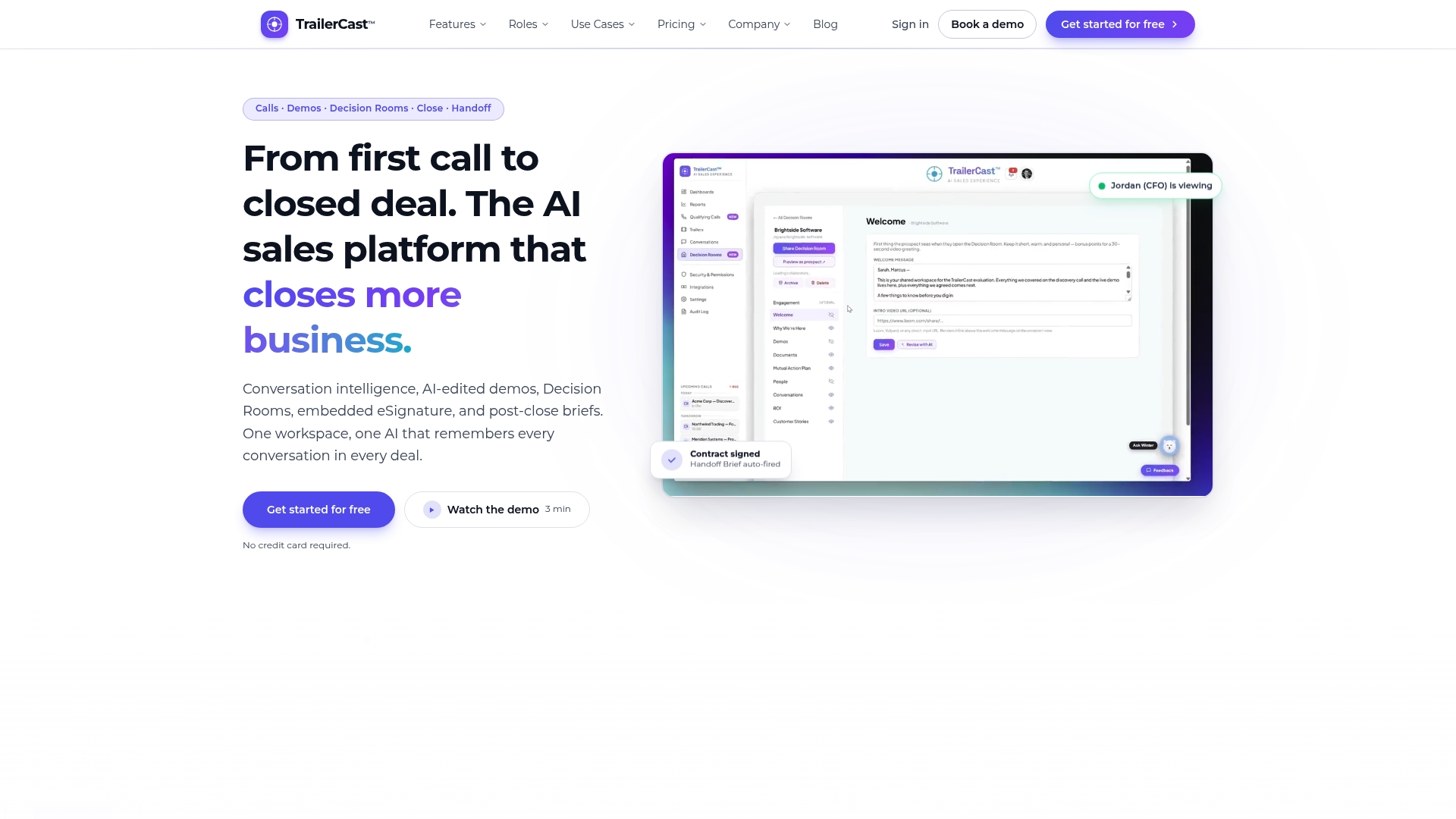
When terms are agreed, a buyer portal for your deal keeps your proposal, trailer and order form in one place your champion can share, and embedded eSignature lets the buyer sign without leaving it.
FAQ
How do I write a pricing negotiation email without sounding defensive?
Affirm the relationship and the value first, then state your figure and the reason for it. Ask what is driving the concern before you respond to it. Close with a specific question and a date instead of a vague invitation to reply.
Should I answer a counter offer by email or call?
Use email for straightforward trades and for the written record. Switch to a call when the thread turns emotional or stalls after a couple of rounds, then send a short recap so both sides have the terms in writing.
How quickly should I follow up if the buyer goes quiet?
Vendor negotiation guidance suggests three to five business days as a reasonable gap. Make the follow-up useful: offer a forwardable summary or answer a likely finance or security question, rather than asking if they’ve seen your last email.
What should a negotiation letter to a client include?
List what’s agreed, what’s open, your proposal for each open item with its trade, and a decision date. Keeping each item separate stops anything from staying vague, and gives your champion a clear document to forward.
Is an email negotiation legally binding?
It can be. Under the Uniform Electronic Transactions Act, a contract can’t be denied effect solely because it was formed by email. If your wording could read as a firm offer when you don’t mean it to be, say so explicitly, and have a lawyer review terms with real legal stakes.
Sources
- Antrophic Negotiations: The Email Cadence of a Strong Buyer
- Forbes: Cold emails that get responses
- AI Emaily: How to Write a Price Negotiation Email
- Negotiation Academy: SaaS Price Negotiation Letter/Email
- GTMnow: Deals Don’t Close in the Inbox
- Waco3: Email Negotiation Tactics, 5 Key Phrases
- Watershed Associates: Threaded Deals, Email Negotiation Tactics
- Program on Negotiation: Four Strategies for Making Concessions
- HSB Law Firm: Email Best Practices for the Remote Negotiator
- Tropic: Vendor Negotiation Email Scripts
- Forbes: 5 ChatGPT Prompts to Turn Rejection Into Revenue
- Program on Negotiation: The Pitfalls of Negotiations Over Email
- Program on Negotiation: Pros and Cons of Email Communication
- New York Times: The E-Mail Handshake
- Autofront: Email Follow-Up Automation