Best Reprise Alternatives for Sales Leaders (2026)

If SE bandwidth is your constraint, a hosted sandbox or live-overlay platform is the first category to test. If demo maintenance is bleeding engineering time, a repo-native or HTML-clone builder solves it faster. And if the real problem is that your deal loses coherence between calls, no single-format demo tool fixes that. That is where Trailercast belongs on your shortlist.
The five categories worth evaluating:
- Hosted sandbox / live-overlay (Walnut, Navattic): best for SE-led enterprise motions where presenter control matters
- HTML-clone builders (Demostack): good for marketing-led product tours with moderate shipping cadence
- Screen-capture / async video (Consensus): fits AE-led SMB motions where SE bandwidth is not the bottleneck at all
- PreSales analytics and forecasting (Vivun): right when the gap is pipeline visibility, not demo format
- Conversation intelligence + full-deal consolidation (Trailercast, Gong, Chorus): for teams that need one platform across calls, demos, deal rooms, close, and handoff
The single most important selection rule: match the tool to your real bottleneck, not to Reprise’s feature list. Reprise’s enterprise pricing sits in a high-cost annual range suitable for enterprise budgets. For AE-led SMB teams, that budget buys a full consolidated stack elsewhere.
Recommended immediate next step: run a 30-day POC scoped to your top bottleneck. If that bottleneck is the full deal lifecycle, start your Trailercast trial with three live deals and measure demo-to-meeting conversion and time-to-close.
Table of Contents
- How do the top Reprise alternatives compare across the full deal lifecycle?
- Which bottleneck should determine which alternative you evaluate first?
- What features should you actually test in a POC?
- What does pricing actually signal about organizational fit?
- How do you run a 30–90 day POC that finance will approve?
- Which Reprise alternative should you actually pick?
- Key Takeaways
- Why consolidation usually wins for SMB and mid-market GTM teams
- Trailercast covers the full deal lifecycle in one trial
- Sources and further reading
How do the top Reprise alternatives compare across the full deal lifecycle?
| Dimension | Hosted sandbox (Walnut, Navattic) | HTML-clone builder (Demostack) | Screen-capture async (Consensus) | PreSales analytics (Vivun) | Full-deal consolidation (Trailercast) |
|---|---|---|---|---|---|
| Best for | SE-led enterprise teams, typically mid-sized or larger sales engineering groups | Marketing-led PLG, frequent shipping | AE-led SMB teams with relatively low sales engineering headcount | PreSales ops, forecasting gap | Multi-stakeholder B2B SaaS, mid-market employees |
| Demo formats | Live overlay, guided tours | HTML clone, product tours | Browser screen-capture, async video | N/A (analytics layer) | Browser record, AI-edited trailers, live overlay |
| Demo editing & trailers | Limited clip editing | Template-based editing | Basic trim | None | AI auto-edits demo trailers, stakeholder-personalized |
| Conversation intelligence | None | None | None | Limited | Full AI notetaker, talk-time analysis, deal briefs |
| Buyer-facing deal room | None or basic | None | None | None | Branded no-login decision rooms, per-stakeholder tracking |
| Embedded eSignature | No | No | No | No | Yes, in-app |
| Post-close handoff | No | No | No | No | AI Handoff Brief auto-fires to CS on contract sign |
| AI sophistication | Single-session | Single-session | Single-session | Pipeline-level | Cross-deal memory, Winter AI assistant reads live transcripts |
| Pricing model | Custom quote | Custom quote | Self-serve + custom | Custom quote | $79/seat/mo or $59/seat/mo annual, free trial |
| Ease of implementation | Moderate | Moderate to high effort | Low | Moderate | Low, no credit card required |
| CRM / SSO integrations | Varies by tier | Varies by tier | Varies by tier | Salesforce-native | Enterprise add-ons: SSO/SAML, native CRM sync |
| Security / compliance | Varies | Varies | Varies | Varies | Custom DPA, SSO/SAML, enterprise contracts |
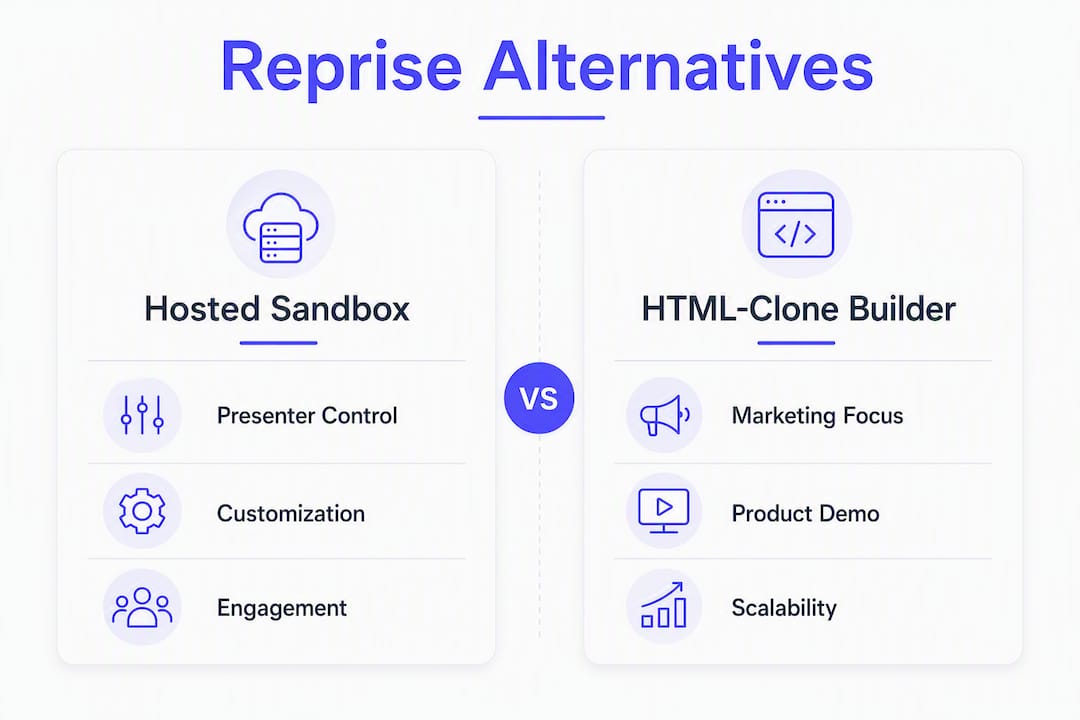
A few practical notes on the trade-offs. Hosted sandbox platforms give SE teams the most presenter control, but they favor enterprise SE teams who need both guided and interactive formats. HTML-clone tools reduce re-capture for text and data edits, but structural UI changes still require a full re-clone. Screen-capture tools have the lowest learning curve and the fastest time-to-first-demo, which is exactly why many SE teams adopt single-format specialists to drive adoption speed over feature breadth.
Budget bands by team size vary from lower spending for small SE teams to higher budgets for larger enterprise teams, reflecting differences in platform scale and complexity.
Which bottleneck should determine which alternative you evaluate first?
The fastest way to shortlist is to name your actual constraint before you open a demo.

| Primary bottleneck | Category to test first | Quick example |
|---|---|---|
| SE bandwidth (volume of demo requests) | Hosted sandbox / live-overlay | SEs declining early-stage demos → Walnut or Navattic |
| Demo drift / stale clones | Repo-native or HTML-clone builder | Demos go stale every sprint → Demostack or repo-native |
| Demo fidelity for complex products | HTML-clone or hosted sandbox | Product has deep workflows → clone-based tools |
| Conversion intelligence gap | Conversation intelligence platform | No call data, no forecast signal → Gong or Chorus |
| Buyer engagement / deal-room need | Full-deal consolidation | Champion can’t re-sell internally → Trailercast decision rooms |
| Post-close handoff failures | Full-deal consolidation | CS runs a discovery kickoff on every deal → Trailercast |
| PreSales forecasting / analytics | PreSales analytics layer | SE utilization invisible to CRO → Vivun |
Sandbox and overlay solutions fit sales-led presenter flows; HTML-clone and repo-native tools fit marketing-led, product-led flows with frequent shipping cadences. If your GTM is AE-led and SE bandwidth is not the gating factor, Reprise is often overkill for that motion.
Pro Tip: Tell every vendor you are running a formal competitive evaluation and name the categories you are considering. Buyers who signal competition early consistently unlock better pricing and more flexible contract terms.
What features should you actually test in a POC?
Most teams over-index on the demo creation experience and under-test the things that break six months in.
Demo format and maintenance
- Can you create a live-overlay demo without engineering help?
- Does an HTML-clone require a full re-capture after a UI change, or just a text edit?
- Repo-native demo builders let coding agents handle updates. Test whether your team has the workflow to use that.
- POC test: make one structural UI change mid-trial and measure re-capture time.
Conversation intelligence and AI notetaker
- Does the platform join Zoom, Meet, and Teams automatically?
- Does it produce structured summaries or just a raw transcript?
- Test: run five discovery calls and check whether summaries are usable without editing. Success metric: less than 5 minutes of cleanup per call.
Buyer-facing deal room and engagement tracking
- Can your champion share the room without creating a login?
- Does the platform show you which stakeholders viewed which content?
- Test with a real multi-stakeholder deal. Track whether the CFO or CISO engaged before the next call.
Embedded eSignature and close
- Does close happen in-app, or does the buyer hop to DocuSign?
- Test: run one contract through the embedded flow and measure friction.
Post-close handoff
- Does a handoff brief auto-generate on contract sign, or does someone write it manually?
- Check whether CS receives a stakeholder map, promised features, and risk flags without asking the AE.
Security and compliance checklist for enterprise buyers
| Requirement | What to ask for |
|---|---|
| SSO / SAML | Confirm supported IdPs and whether it is gated by tier |
| Custom DPA | Request a data processing agreement before procurement |
| Data residency | Confirm US or EU storage options |
| SOC 2 Type II | Request the report, not just a badge |
| Role-based access | Test admin vs. rep vs. viewer permissions |
Trailercast’s security and compliance details are documented for enterprise buyers evaluating SSO/SAML and DPA requirements.
What does pricing actually signal about organizational fit?
Price transparency is itself a signal. Self-serve per-seat pricing means fast onboarding, predictable cost, and no procurement cycle. Custom enterprise quotes mean longer sales cycles, negotiation room, and usually a services layer you will pay for whether you use it or not.
Three pricing archetypes and what they imply:
- Self-serve per-seat ($59/seat/mo annual): you can start a trial today, onboard in days, and cancel without a conversation. Trailercast fits here. No credit card required for the trial.
- Mid-market custom quote ($15K–$60K/yr): expect a 2–4 week sales cycle, a demo environment, and a negotiation window. Most hosted sandbox and HTML-clone tools land here for growth-stage teams.
- Enterprise custom with services ($60K–$200K+/yr): budget for implementation, recurring re-capture cycles, and a dedicated CSM. Enterprise demo platforms sit here.
The hidden cost most teams miss is maintenance. The most common operational failure for enterprise demo platforms is not initial setup but recurring demo drift. Budget a recurring PreSales-engineer cycle into your annual plan if you choose a hosted or HTML-clone tool.
Pro Tip: Consolidation pays off fastest when you are currently paying for three or more point solutions. Add up your current spend on a call recorder, a demo tool, and a deal room. That total is your real comparison point against a consolidated platform’s seat cost.
How do you run a 30–90 day POC that finance will approve?
A POC without defined success metrics is just a free trial. Here is a structure that holds up in a CRO review.
30-day pilot
- Define the bottleneck you are solving (one sentence, agreed by CRO and SE lead).
- Scope to 5–10 active deals in one segment.
- Connect CRM and calendar integrations in week one.
- Run all demos and calls through the platform.
- Capture: demo completion rate, demo-to-meeting conversion, SE time per demo.
60–90 day full POC
- Expand to full team or one full pod.
- Measure: demo drift incidents (how many demos needed re-capture), time-to-close delta vs. control group, buyer engagement rate in deal rooms, CS onboarding time post-close.
- Document integration behavior: does CRM sync correctly? Does SSO work for all users?
- Prepare a one-page summary: cost per seat vs. current stack, time saved per deal, and one concrete deal outcome tied to the platform.
For demo trailer and discovery call test cases, Trailercast’s use-case pages include templates you can adapt for POC scoping.
Which Reprise alternative should you actually pick?
For teams that want one platform across the full deal lifecycle, calls through handoff, Trailercast is the recommended pick. The consolidation case is straightforward: five tools replaced by one, with a single AI that remembers every call, demo, and stakeholder interaction across the deal.
For teams that only need one demo format: choose by workflow. SE-led enterprise teams with high demo volume should evaluate hosted sandbox platforms. Marketing-led teams with frequent product updates should evaluate HTML-clone or repo-native builders. AE-led SMB teams with low SE headcount should start with a screen-capture tool and add conversation intelligence separately.
Exceptions where a specialist tool still makes sense:
- Your product requires a live, fully interactive sandbox that only a hosted environment can replicate.
- Your engineering team already owns a repo-native workflow and wants demos maintained by coding agents.
- You need PreSales forecasting and SE utilization analytics as a standalone layer on top of an existing CRM.
- Your deal cycle is transactional (under 30 days, single stakeholder) and a full deal-room workflow adds friction rather than removing it.
Key Takeaways
Trailercast is the strongest consolidation pick for B2B SaaS teams running multi-stakeholder deals, replacing five point solutions at $59/seat/month billed annually.
| Point | Details |
|---|---|
| Match tool to bottleneck | Identify your real constraint (SE bandwidth, demo drift, conversion gap) before evaluating any vendor. |
| Budget bands by team size | Seed teams with small SE headcount typically spend less annually, while enterprise teams budget significantly more for demo platforms. |
| Maintenance is the hidden cost | Demo drift is the most common failure mode for hosted platforms; budget recurring re-capture cycles. |
| POC needs defined metrics | Measure demo completion rate, demo-to-meeting conversion, and time-to-close delta over 30–90 days. |
| Trailercast for consolidation | At $59/seat/month annual, Trailercast covers calls, demos, deal rooms, eSignature, and post-close handoff in one platform. |
Why consolidation usually wins for SMB and mid-market GTM teams
The argument for specialist tools sounds reasonable until you watch a deal fall apart between calls. The demo went great. The champion loved it. Then they walked back to a CFO who wasn’t in the room, a CISO who needed security answers buried in a recording nobody rewatched, and a PDF they were expected to re-sell from memory. The deal died in an internal meeting you weren’t part of.
That failure mode does not show up in a demo platform’s feature list. It shows up in your close rate.
What I have observed consistently is that teams running three or more point solutions spend more time managing tool handoffs than managing deals. The call recorder does not know what happened in the deal room. The deal room does not know what was promised on the last call. CS starts every onboarding with a discovery call because nobody handed them context.
Consolidation fixes the handoff problem, not just the demo problem. Faster buyer handoff, fewer lost-context moments, and a CS team that starts informed rather than starting over. That is the outcome that shows up in renewal rates and expansion revenue, which is ultimately what a CRO cares about when approving a stack change.
The specialist tool argument holds when your bottleneck is genuinely narrow and your team has the discipline to maintain multiple integrations. Most SMB and mid-market teams do not. One platform that remembers the whole deal is worth more than four best-in-class tools that do not talk to each other.
Trailercast covers the full deal lifecycle in one trial
Five disconnected tools is the default stack for most B2B SaaS sales teams. Trailercast replaces them. One platform covers AI call intelligence, AI-edited demo trailers personalized per stakeholder, branded decision rooms with per-stakeholder engagement tracking, embedded eSignature, and an AI Handoff Brief that fires to CS the moment a contract signs.
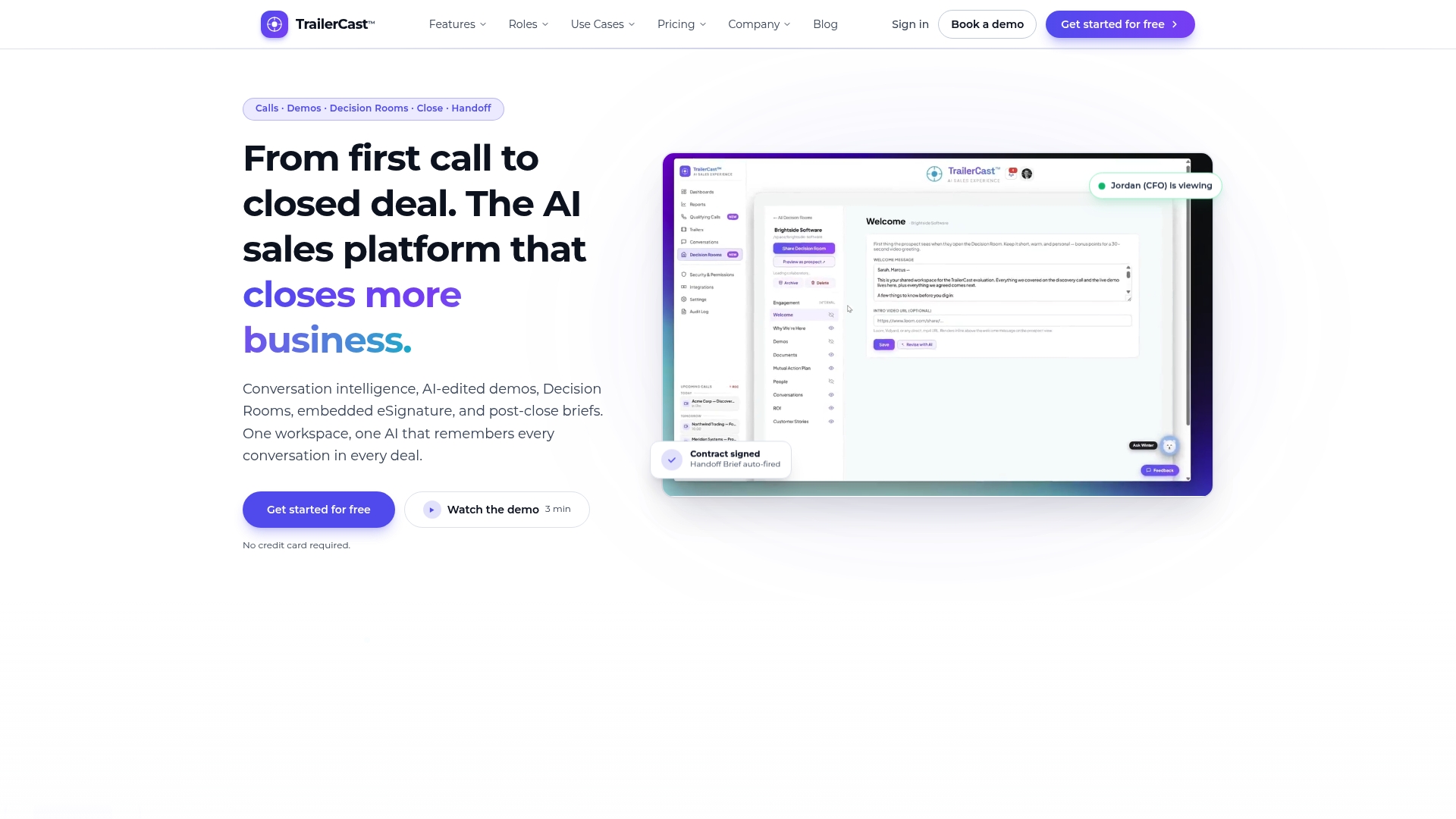
Pricing is $79/seat/month or $59/seat/month billed annually, every feature included, no credit card required for the trial. The first 100 paid teams lock 20% off for life. Enterprise add-ons (SSO/SAML, custom DPA, white-label) are available on custom contracts.
To validate fit in 30 days: connect your calendar, run five live deals through the platform, and measure demo-to-meeting conversion and CS onboarding time against your current baseline. Start your free trial at trailercast.io or review the full feature set before scoping your POC.
Sources and further reading
- GTM Pod: Reprise pricing, features, and alternatives — supports enterprise pricing bands and the overkill claim for AE-led SMB motions
- GTM Pod: demo maintenance failure mode and stale clone risk — supports the maintenance cost argument and bottleneck evaluation framework
- PreSales Pulse: Reprise alternatives and workflow fit — supports category selection by SE workflow and adoption trade-offs
- PreSales Pulse: pricing scenarios by team size — source for the $15K/$60K/$200K budget bands and single-format adoption data
- Inkly: repo-native vs. HTML-clone demo maintenance — supports the re-capture vs. code-agent maintenance argument and GTM motion matching
- Vendr: Reprise pricing and negotiation signals — supports the competitive-evaluation negotiation tactic
- Trailercast use cases: full deal cycle — maps Trailercast capabilities to each comparison dimension
- Trailercast AI sales tool overview — consolidation positioning and AI feature documentation