What Is a Buyer-Facing Workspace, and Why Deals Need One

A buyer-facing workspace is a shared digital space where sellers and buying committees plan, track, and close a deal together, instead of doing it across email threads, PDFs, and someone’s memory of a call. Its main job is simple: turn scattered stakeholder work into one place that moves a decision forward. The fastest way to see if it works for your team isn’t a company-wide rollout. It’s to pick one real, high-value deal or use case and run it there first.
That single pilot tells you almost everything you need to know:
- Whether your champion actually uses it to sell internally
- Whether stalled deals move faster once the CFO and CISO can see what they need without a recap call
- Whether your team’s forecast gets more honest once engagement is visible, not assumed
Key Takeaways
A buyer-facing workspace works because it replaces scattered stakeholder communication with one tracked, shared space that shortens the gap between a great demo and a signed contract.
| Point | Details |
|---|---|
| Define scope early | A workspace sits alongside your CRM as the execution layer, not a content library or a CRM replacement. |
| Prioritize trackable features | AI deal briefs, personalized demo trailers, and tracked sharing matter more than a long feature list. |
| Measure before scaling | Baseline time-to-close and engagement-to-share ratio, then run a pilot before rolling out company-wide. |
| Pilot one deal type first | Choose your highest-value multi-stakeholder motion and prove adoption before expanding. |
| TrailerCast as the implementation model | TrailerCast unifies conversation intelligence, demo trailers, Decision Rooms, eSignature, and handoff briefs in one workspace built for 11 to 200 employee B2B SaaS teams. |
Table of Contents
- What Belongs in a Buyer-Facing Workspace
- What Features Actually Move a Deal Forward
- What Results Should You Expect, and How Do You Measure Them?
- How to Roll Out a Buyer-Facing Workspace Without Breaking Your Process
- How Sales Teams Actually Use These Rooms Day to Day
- How TrailerCast Puts This Into Practice
- The Part of This Everyone Gets Wrong
- Run Your Next Deal Through One Workspace Instead of Five Tools
- Sources
What Belongs in a Buyer-Facing Workspace
A buyer-facing workspace goes by a few names: digital sales room, decision room, buyer portal, deal room. They’re the same idea with different branding. The core definition holds across all of them: a persistent, shared environment tied to one opportunity, where the seller and every stakeholder in the buying committee can see the same information, at the same time, without waiting on a recap email.
Inside that space, real work happens:
- Sharing discovery notes, pricing, security documentation, and case studies in one thread instead of six attachments
- Commenting and asking questions asynchronously, so a stakeholder who missed the call still gets answered
- Building and tracking a mutual action plan that both sides can see and update
- Watching or forwarding a personalized demo recap without scheduling another meeting
- Negotiating terms and signing the contract without leaving the room
What it’s not matters just as much. A buyer-facing workspace doesn’t replace your CRM. It sits on top of the CRM as the layer where the actual conversation with the buyer happens, then feeds signal back into it. It’s also not a static content library. A folder of one-pagers that nobody personalizes or tracks is a file share with a nicer skin, not a workspace.
What Features Actually Move a Deal Forward
Plenty of tools claim to be a workspace. Fewer of them have features that change buyer behavior. Here’s what to check for before you buy or build one:
- AI-driven transcripts and deal briefs. Every call, demo, and follow-up should feed a single evolving summary of the opportunity, not a pile of separate recordings nobody rewatches.
- Shareable demo trailers built per stakeholder. A CFO doesn’t want your full 45-minute demo. A three-minute cut on pricing and ROI, forwarded by your champion, gets watched. Showpad’s approach to buyer engagement makes a similar case for two-way portals where buying committees review materials on their own time.
- A decision room with tracked sharing. You want to know when your champion forwards the room to their CISO, not just that the room exists.
- A visible mutual action plan. Both sides should see the same deadlines and owners, not a plan you keep in a spreadsheet the buyer never sees.
- Engagement analytics tied to CRM. Who opened what, and when, should update your pipeline view automatically.
- Embedded eSignature. Every extra login between “verbally agreed” and “signed” is a chance for a deal to go cold.
Pro Tip: Ask any vendor to show you what a stakeholder sees who was never on a single call. If the workspace can’t answer their questions without a live seller in the room, it’s a content library wearing a workspace’s name.
What Results Should You Expect, and How Do You Measure Them?
The benefits sound obvious on paper: faster decisions, clearer championing, fewer deals that quietly die in an internal meeting you weren’t part of. The harder part is proving it, and that means picking KPIs before you start, not after.
Statistic to watch: vendor positioning across the market now frames these tools as the missing execution layer between CRM and the buyer, which is a useful reframe for measurement. You’re not tracking “did they use the tool.” You’re tracking whether the execution layer closes gaps CRM data never captured.
Track these over a pilot period, against a baseline pulled from your recent closed-won and closed-lost deals in the same segment:
- Time to close, measured from first demo to signature
- Time spent in each pipeline stage, especially the stages after the last live call
- Engagement-to-share ratio: how often a champion forwards the room versus how often it sits unopened
- Demo-watch-to-deal rate: what percentage of viewed trailers turn into a next meeting
- Handoff time to Customer Success after signature
Baseline first. Pilot second. Compare, don’t guess.
How to Roll Out a Buyer-Facing Workspace Without Breaking Your Process
Rolling this out badly looks like handing every rep a new tool and hoping adoption happens. Rolling it out well looks like a controlled pilot with a clear exit criteria before you ever mention “company-wide.”
- Pick a representative pilot cohort. Choose one sales motion, ideally your highest-value multi-stakeholder deal type, and a small group of reps who already run a disciplined process.
- Define success metrics before day one. Use the KPIs above and write down your baseline numbers so the pilot has something real to beat.
- Run the integration checklist. Confirm calendar sync (Google or Microsoft), conferencing (Zoom, Meet, Teams), CRM connection, and SSO if your security team requires it. Market data on buyer engagement platforms consistently shows these three integrations as the baseline expectation, not a nice-to-have.
- Prep your content and playbooks. Build a template mutual action plan, a short library of demo trailer formats, and simple guidance for champions on how to forward the room to stakeholders who weren’t there.
- Set scale criteria in advance. Decide the exact threshold, such as a meaningful drop in time-to-close or a clear jump in engagement-to-share ratio, that triggers expansion beyond the pilot.
Pro Tip: Give your pilot reps a one-page script for the first time they introduce the room to a buyer. “Here’s a link to a room, not a room and forty new instructions” is the difference between adoption and a tool nobody opens twice.
How Sales Teams Actually Use These Rooms Day to Day
The abstraction gets real fast once you watch a deal move through one. Here’s what that usually looks like:
- A rep runs a product demo, and the AI cuts it into an 8 to 15 minute trailer, then builds a second version for the CFO that leads with pricing instead of features.
- The champion forwards both trailers into the room. The seller sees exactly who opened which one, and follows up on the CISO’s version specifically because it sat unopened for three days.
- Inside the room, the mutual action plan lists every internal approver by name, with deadlines both sides can see and edit.
- Negotiation happens async in the room’s thread over a week instead of three scheduled calls, and the contract gets signed inside the room itself.
- The moment it’s signed, a handoff brief fires automatically to Customer Success with the stakeholder map, promised features, and risk flags already attached.
How TrailerCast Puts This Into Practice
Every feature described above maps directly onto how TrailerCast is built, because the product was designed around this exact deal lifecycle rather than bolted onto an existing tool.
- An AI notetaker joins your discovery calls, transcribes them speaker by speaker, and builds an evolving deal brief across every conversation in the opportunity.
- AI-edited demo trailers get cut automatically from real recordings and personalized per stakeholder.
- Decision Rooms hold discovery notes, the mutual action plan, documents, and a tracked attribution tree showing exactly who forwarded what to whom.
- Embedded eSignature closes the deal without a separate DocuSign step.
- A handoff brief fires automatically to Customer Success the moment a contract signs.
The founding bet behind this build was that the calls were never the real problem. The gap between them, where a champion has to re-sell a demo from memory to a CFO who wasn’t there, is where deals actually stall.
TrailerCast fits best for B2B SaaS sales teams selling into multi-stakeholder buying committees of three to seven people, typically at companies with 11 to 200 employees, where one workspace replacing five disconnected tools is the whole point.
The Part of This Everyone Gets Wrong
Most advice on buyer-facing workspaces treats the tooling as the hard part. It isn’t. The features described above are converging across the market, and any serious platform will have most of them within a product cycle or two. The real failure point is treating the workspace as a place you dump content instead of a place a deal actually lives.
I’d push back on the instinct to roll this out broadly before proving it narrowly. Sales leaders love a company-wide launch because it feels decisive. But a workspace nobody’s champion actually opens is worse than no workspace at all. It’s a line item you now have to defend in a budget review.
What I’d prioritize first: pick the one deal type where stakeholder complexity is already killing your cycle time, and prove the engagement-to-share ratio moves before you talk about scale. If your champions won’t forward it, no amount of feature depth fixes that. The tool has to earn a second click, not just a first login.

Run Your Next Deal Through One Workspace Instead of Five Tools
TrailerCast is the alternative to stitching together conversation intelligence, video editing, a separate deal room, and a signature tool: everything above, from AI transcripts to the handoff brief, lives in one workspace priced per seat with no gating between tiers.
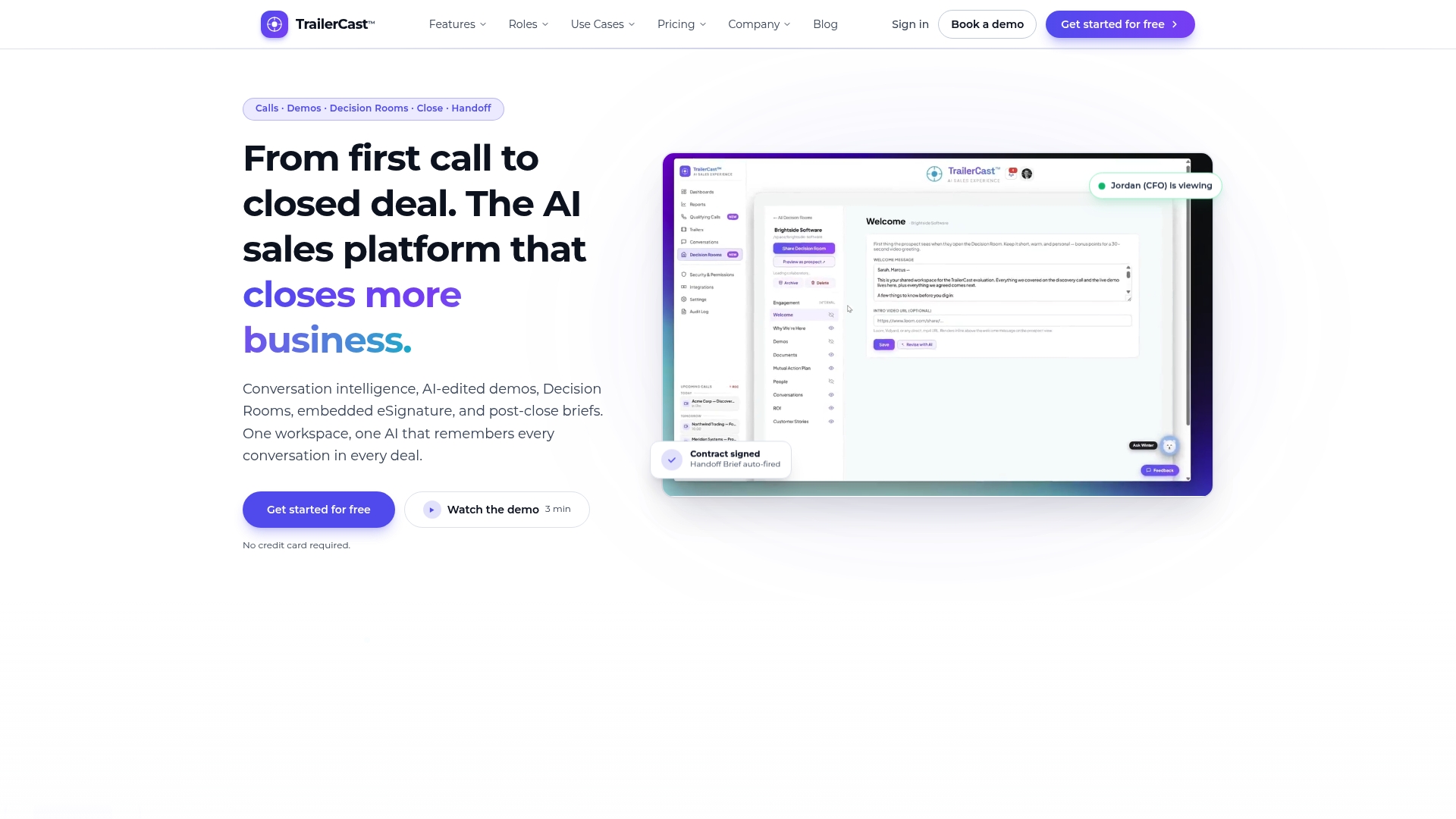
Three pieces of the checklist this article walked through map directly to what you’d be piloting: the AI notetaker builds your deal brief automatically, Decision Rooms track exactly when a champion forwards your trailer to their CFO, and embedded eSignature closes the loop without a separate app. Start a free trial at Trailercast and run it against one real deal this quarter, no credit card required.