Call Recording Consent: What US Businesses Must Know
You can legally record most US phone calls if at least one participant consents. The moment someone in an all-party state joins that call, though, you need everyone’s agreement. The practical rule: default to notice on every recorded call, and you stay safe regardless of where your callers are.
Here’s what to do right now:
- Announce the recording at the start of every call, before any substantive conversation begins.
- Enable your IVR or pre-connect announcement so the notice plays before a live agent picks up.
- Log consent with a timestamp, call ID, and the method of notice for every recorded session.
- Apply all-party notice for any interstate call where you cannot confirm all participants are in one-party states.
- Never record a conversation you are not part of. Secretly recording a call between other people is illegal across all 50 states, regardless of the consent regime.
High-risk scenario: Recording someone who has not consented, or capturing a conversation you could not naturally overhear, exposes you to both criminal prosecution and civil damages. There is no “accidental” defense that holds up well.
Pro Tip: Set your platform’s default to “announce and record” rather than “record silently.” One configuration change eliminates the most common compliance gap before it becomes a lawsuit.
Key Takeaways
The single most important rule in US call recording law: when any participant is in an all-party consent state, every participant must receive notice before recording begins, regardless of where you are located.
| Point | Details |
|---|---|
| Federal baseline is one-party | The Wiretap Act (18 U.S.C. § 2511) permits recording when one participant consents, but states can and do set stricter rules. |
| A smaller group of states require all-party consent, though exact counts shift due to statutory nuances | California, Pennsylvania, Florida, Illinois, Washington, and others require notice to all parties; violating these statutes triggers criminal and civil liability. |
| Interstate calls follow the strictest state | Kearney v. Salomon Smith Barney established that a state can apply its all-party rule to calls into that state, even from a one-party state. |
| Default to all-party notice for every call | Businesses that cannot reliably geolocate participants should announce recording on every call to eliminate cross-jurisdictional risk. |
| Document every consent event | Log the timestamp, call ID, consent method, and participant identifier for every recorded session to demonstrate compliance in audits or litigation. |
Table of Contents
- What call recording consent means under US law
- How US states divide on phone call consent requirements
- Which law governs when callers are in different states?
- Exceptions, penalties, and whether recordings hold up in court
- How businesses should build a compliant recording program
- Your step-by-step checklist for recording calls legally
- The case for making consent the default, not the exception
- Sources
What call recording consent means under US law
Call recording consent, formally governed by wiretapping and electronic surveillance statutes, determines whether a recorded conversation is lawful or a federal crime. Two terms define the landscape.
One-party consent means any single participant in a conversation can record it without telling the others. If you are on the call, you can record it. All-party consent (often called two-party consent, though calls can have more than two people) means every participant must know and agree before recording begins.
The federal baseline lives in 18 U.S. Code § 2511, the Wiretap Act. Under § 2511(2)(d), it is not unlawful for a person to intercept a wire, oral, or electronic communication when that person is a party to the communication and no criminal or tortious purpose is involved. That is the one-party federal floor. States can, and many do, set a stricter standard.
The civil remedy sits in Section 2520: a person whose communication is unlawfully intercepted can sue for the greater of actual damages or statutory damages of $100 per day of violation or $10,000, plus attorney fees. Criminal penalties under § 2511 include fines and potential imprisonment for a first offense.
Three more terms matter for businesses:
- Interception: capturing the content of a communication in real time, not after the fact.
- Electronic communication: covers phone calls, VoIP, email, and most digital messaging.
- Oral communication: in-person spoken words where the speaker has a reasonable expectation of privacy.
The Kearney v. Salomon Smith Barney, Inc., 39 Cal. 4th 95 (2006) case is the clearest illustration of how federal one-party consent does not insulate you from state law. The California Supreme Court held that California’s all-party rule applied to calls into California, even when the recording party was located in Georgia. That ruling is the reason interstate calls deserve special treatment, covered in detail below.
How US states divide on phone call consent requirements
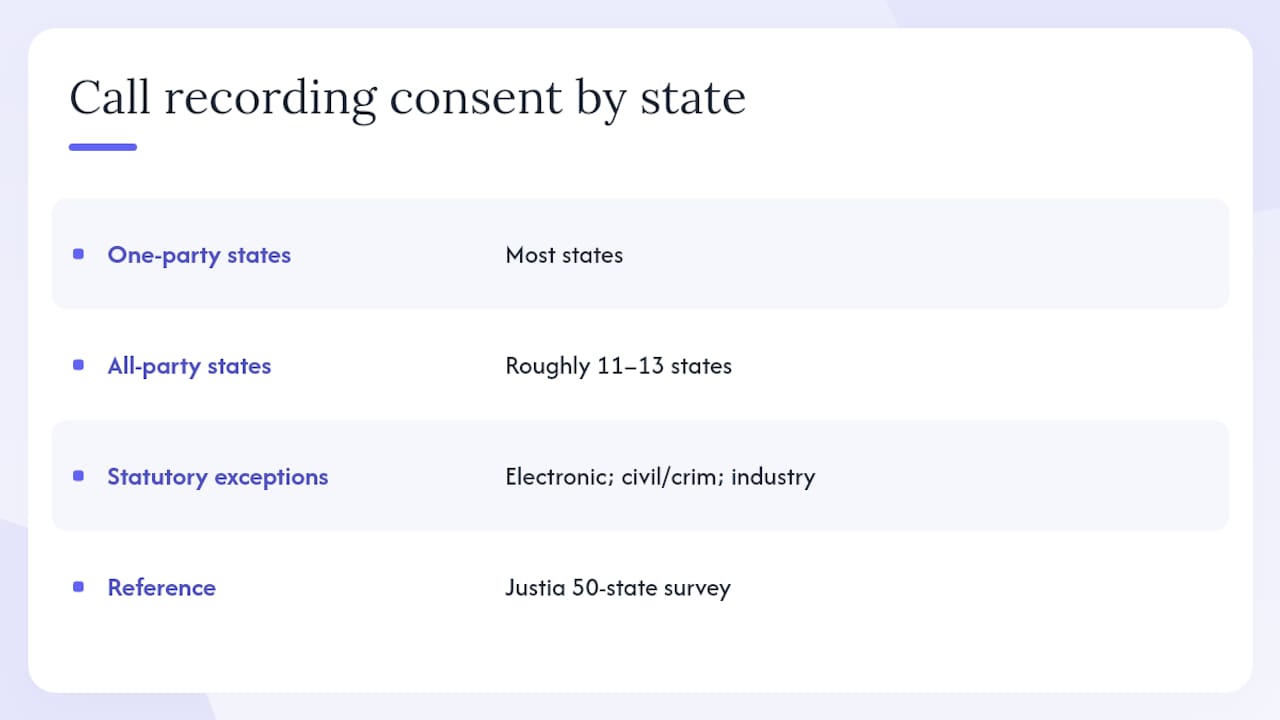
Most states follow the federal one-party model. A smaller group, commonly cited as roughly 11–13 states, require all-party consent, though exact counts shift because statutes include nuanced exceptions for electronic versus in-person communications, civil versus criminal liability, and specific industries. The Justia 50-state survey is the most reliable public reference for statutory citations across all jurisdictions.
The all-party consent states to know
These states require every participant’s consent before a call may be recorded. Some apply the rule only to telephone communications; others extend it to in-person conversations. Statutory nuances mean you should verify the current text before relying on any summary.
All remaining states and the District of Columbia follow a one-party rule, meaning a participant in the call may record without notifying others. The RCFP Reporter’s Recording Guide provides additional jurisdiction-specific detail useful for anyone who records interviews or public-interest conversations.
Implied consent and notice methods
Consent does not always have to be explicit. Most statutes recognize implied consent when a caller is given clear notice and continues the call. Common methods include:
- Verbal IVR announcement: “This call may be recorded for quality and training purposes.” Played before connection.
- Audible beep tone: A periodic tone signals recording is active; accepted in some states as sufficient notice.
- Live agent announcement: “I want to let you know this call is being recorded.” Said at the start of the conversation.
- Written consent: A signed form or a click-through agreement before a scheduled call.
California and Pennsylvania are the strictest in practice. California requires notice that a confidential communication is being recorded; Pennsylvania’s statute has been read to require affirmative consent, not just notice. If you operate in either state, a verbal announcement alone may not be enough without a clear affirmative response from the other party.
Some states also distinguish between telephone calls and in-person conversations. A business that records in-person sales meetings needs to inventory those contexts separately, because a different statute may apply even in a one-party state.
Which law governs when callers are in different states?
No federal statute resolves interstate recording conflicts cleanly. Courts have not set a uniform rule, and state courts sometimes apply their own statute to calls involving their residents. The practical consequence: if you record a call and one participant is in California, Pennsylvania, or Washington, that state’s all-party rule may apply to you even if you are sitting in Texas.
Kearney v. Salomon Smith Barney is the landmark example. A Georgia-based broker recorded calls with California clients without notice. The California Supreme Court applied California Penal Code § 632 to those recordings, holding that the state’s interest in protecting its residents’ privacy extended to calls coming into the state. The broker’s Georgia one-party compliance was irrelevant.
The conservative rule, recommended by most multi-state compliance guides, is simple: if any participant might be in an all-party state, treat the call as all-party. Here is how that plays out in practice:
- Sales rep in Texas calls a prospect in California. Texas is one-party; California is all-party. Apply California’s rule. Announce the recording before any substantive conversation.
- Sales rep in New York calls a prospect whose location is unknown. New York is one-party, but the prospect could be in Washington or Florida. Default to all-party notice. One announcement costs nothing; a violation costs thousands.
- Inbound call center in Nevada receives a call from an unknown state. Nevada is all-party itself, so the announcement is required regardless. But even if Nevada were one-party, the unknown caller location justifies all-party notice.
- Web conference with participants in five states. You cannot reliably confirm all locations. Announce at the start: “This session is being recorded. By continuing, you consent to the recording.”
Mobile numbers make reliable geolocation nearly impossible. A 415 area code does not mean the caller is in California today. Remote work has made this worse. Businesses that try to geolocate participants and apply state-specific rules selectively are taking on operational complexity and legal risk simultaneously.
Pro Tip: Build the announcement into your dialer or conferencing platform as a non-optional step. If a rep can skip it, someone eventually will. Platform enforcement beats policy enforcement every time.
Exceptions, penalties, and whether recordings hold up in court
Statutory exceptions
Recording laws include carve-outs, but they are narrower than most people assume:
- Law enforcement with a warrant or court order: Federal and state wiretap orders permit interception by authorized agencies. This does not apply to private parties.
- Provider monitoring: Telephone and VoIP providers may monitor communications for service quality and fraud detection under limited conditions.
- Public places and no reasonable expectation of privacy: Recording a conversation in a genuinely public setting where participants have no reasonable expectation of privacy may fall outside wiretapping statutes. The line is contested and fact-specific.
- Imminent threat / emergency: Some state statutes include narrow exceptions for recording when necessary to prevent a crime or serious harm. These are rarely applicable to business contexts.
- Consent by conduct: A party who is told recording is occurring and continues the conversation has typically consented, even without saying “yes.”
None of these exceptions cover the scenario most people ask about: “Can I record a call I’m not on?” The answer is no. Active participation is the line most jurisdictions protect, and being a party to the call is what makes one-party consent work at all.
Admissibility versus liability
An illegally obtained recording can sometimes be admitted as evidence in a civil proceeding, depending on the jurisdiction and the judge’s discretion. That does not make the recording legal. The party who made it still faces criminal and civil exposure regardless of whether the recording is admitted or excluded.
Penalties
State wiretapping penalties vary significantly. Under federal law (18 U.S.C. § 2511 / § 2520), civil damages start at $100 per day of violation or $10,000, whichever is greater, plus attorney fees. State statutes can go further. The Kilpatrick Townsend Wiretap Laws Chart documents that several state laws permit statutory damages of $100 per day or $1,000 minimum per violation, with attorney fees and punitive damages available in private actions.
Criminal exposure under state all-party statutes typically runs from misdemeanor fines up to felony charges with multi-year prison terms. California Penal Code § 637.2 allows a private plaintiff to recover $5,000 per violation or three times actual damages, whichever is greater. Pennsylvania’s wiretapping statute carries felony-level criminal penalties. Illinois, post-2014 amendments, still treats unauthorized recording as a Class 4 felony in some circumstances.
Injunctive relief is also available in many states, meaning a court can order you to stop recording and destroy existing recordings.
How businesses should build a compliant recording program
The right default posture for any multi-state business is to treat every recorded call as if all-party consent is required. The friction of a five-second announcement is trivial compared to the exposure of a single California class action. Here is how to build that posture into operations:
1. Set your platform defaults
Configure your telephony or conferencing platform before anything else:
- Enable a pre-connect IVR announcement that plays before the call connects to an agent. The message should state that the call may be recorded and that continuing constitutes consent.
- Add an audible beep tone as a secondary signal where your platform supports it.
- Set retention limits in platform policy. Shorter retention reduces litigation exposure. Recordings rarely need to be kept beyond 90 days for quality purposes; compliance recordings may need longer, but document the reason.
- Configure access controls so only authorized roles can play back recordings. Broad access increases breach risk and complicates data security obligations.
- Enable audit logs that capture who accessed a recording, when, and from which IP or device.
2. Write your IVR and agent scripts
Sample IVR announcement (pre-connect): “Thank you for calling [Company Name]. This call may be recorded or monitored for quality assurance and training purposes. By continuing, you consent to this recording.”
Sample outbound agent announcement: “Hi [Name], before we get started, I want to let you know that this call is being recorded for quality and training purposes. Is that okay with you?”
The outbound script asks for explicit verbal consent. That “yes” is your documented consent event. Log it.
3. Document consent systematically
Every recorded call should generate a consent log entry with:
- Timestamp (date, time, time zone)
- Call ID or session ID from your platform
- Consent method (IVR announcement, agent verbal notice, written pre-call agreement)
- Participant identifiers (phone number or email, not necessarily name)
- Recording file reference
A platform like Trailercast, which captures conversation intelligence across Zoom, Meet, and Teams, can tie transcript records to session metadata, making this log easier to maintain than a manual spreadsheet. The key is that the log exists and is searchable.
4. Train your team
Agents and sales reps need to know three things: when to announce, what to say, and what to do if someone objects. If a prospect says they do not consent to recording, stop the recording. Document that the call was not recorded. Do not pressure the prospect.
5. Secure and limit downstream use
Recordings used to generate AI-edited demo trailers or shared in buyer-facing deal rooms carry additional consent considerations. If you plan to share a recording or a clip with people who were not on the original call, the consent obtained for “quality and training purposes” may not cover that use. Either obtain broader consent upfront or limit sharing to internal use.
Review your platform’s security controls to confirm recordings are encrypted at rest and in transit, access is role-gated, and deletion workflows exist.
Pro Tip: Shorter retention is a compliance feature, not just a cost control. A recording that no longer exists cannot be subpoenaed, breached, or misused. Set a default deletion schedule and enforce it in your platform settings, not just your policy document.
Your step-by-step checklist for recording calls legally
For individuals
- Confirm your state’s rule. Check whether you are in a one-party or all-party state using the Justia 50-state survey.
- Confirm the other party’s state. If they are in an all-party state, you must notify them regardless of your own state’s rule.
- Be a participant. One-party consent only works if you are actually on the call. Recording a conversation between others is illegal everywhere.
- Ask for express consent on any uncertain call. “Do you mind if I record this?” takes three seconds and eliminates ambiguity.
- Document the consent. A note in your CRM or a quick email confirmation (“As discussed, I’ll be recording our call today”) creates a record.
For businesses
- Adopt all-party notice as your default. Do not try to route calls by state. Announce on every call.
- Configure your platform before go-live. IVR announcement, beep tone, retention limits, access controls, and audit logs should all be set before your first recorded call.
- Write and approve your IVR and agent scripts. Have legal review the language. The IVR script above is a starting point, not a final draft.
- Train every agent and sales rep. Include recording consent in onboarding and annual refreshers. Document the training.
- Log consent for every recorded session. Timestamp, call ID, consent method, participant identifier, recording reference.
- Audit your logs quarterly. Spot-check that announcements are playing and that logs are complete.
- Review retention and deletion schedules annually. Regulatory requirements change; so does your business’s actual need for old recordings.
Sample documentation log entry:
Pro Tip: Cross-border and mobile calls are the highest-risk category. A prospect who answers from a California cell phone while traveling is still protected by California law. When in doubt, announce. The announcement costs nothing; the lawsuit costs everything.
Primary legal sources and trusted guidance
The most reliable path to current, jurisdiction-specific rules runs through primary statutes and a small set of authoritative secondary sources.
Federal statute:
- 18 U.S. Code § 2511 (Cornell LII) — the Wiretap Act, including the one-party consent carve-out and criminal penalties.
State statutory sources:
- Each state’s legislature publishes its wiretapping or electronic surveillance statute. Search “[State] wiretapping statute” or “[State] electronic surveillance” on the state legislature’s official site. Justia and Cornell LII both index most state codes.
Authoritative secondary resources:
- Justia 50-state survey — the most comprehensive public survey of state recording laws, with statutory citations.
- Digital Media Law Project (DMLP) — practical legal guide covering federal and state rules, with guidance on surreptitious recording risks.
- RCFP Reporter’s Recording Guide — jurisdiction-specific summaries written for journalists; useful for anyone who records interviews or public-interest calls.
- Kilpatrick Townsend Wiretap Laws Chart (July 2024) — a practitioner-grade chart covering consent requirements, penalties, and statutory damages by state.
- Viirtue call recording consent guide — operational guidance for businesses on multi-state compliance posture.
When to escalate to counsel:
- You operate in California, Pennsylvania, Illinois, or Massachusetts and record customer calls.
- You are building a product that records calls on behalf of third parties (a platform, not just an end user).
- You want to share recordings externally, use them in marketing, or feed them into AI systems.
- You have received a demand letter or litigation threat related to recording practices.
A telecom provider’s own privacy obligations, such as those described in a carrier-level privacy policy, can also inform how consent mechanisms are implemented at the infrastructure layer, particularly for VoIP and hosted telephony deployments.
The case for making consent the default, not the exception
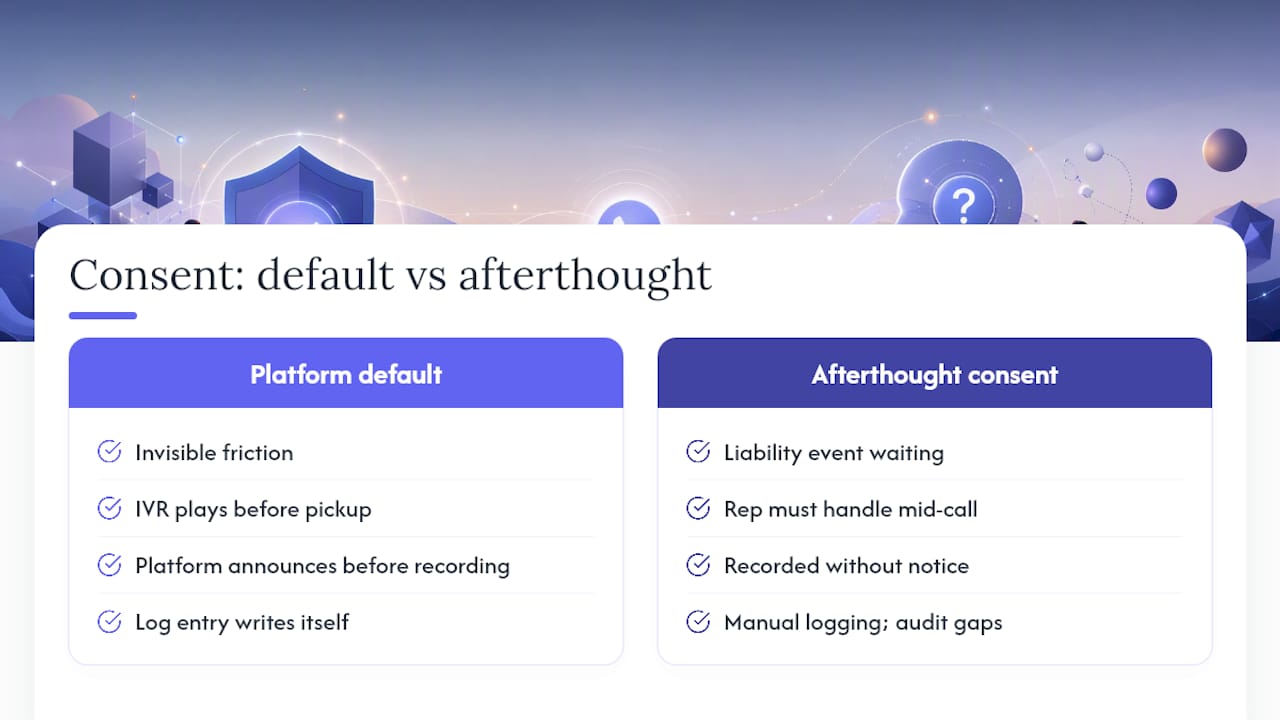
Most compliance conversations about call recording consent focus on avoiding liability. That framing is correct but incomplete. The more useful frame for sales teams is operational: consent built into the workflow is invisible friction. Consent bolted on as an afterthought is a liability event waiting to happen.
Sales reps do not want to think about wiretapping law mid-discovery call. They should not have to. The IVR plays before they pick up. The platform announces before the recording starts. The log entry writes itself. When consent is a platform configuration rather than a rep behavior, compliance becomes the path of least resistance.
The conservative default, treating every call as all-party, also solves a real operational problem: you cannot reliably know where your prospects are. Remote work, mobile numbers, and travel mean a Texas area code might be calling from Washington state. Trying to route consent requirements by detected location is a project that costs more than it saves and still leaves gaps.
There is also a trust dimension that does not show up in legal analysis. Prospects who hear “this call is being recorded” at the start of a sales call are not surprised or put off by it. It is standard. What erodes trust is finding out after the fact that a call was recorded without notice. The announcement protects the rep as much as the prospect.
For teams using AI-assisted recording platforms, the stakes are higher because recordings do not just sit in a folder. They feed transcripts, summaries, deal briefs, and sometimes AI-edited clips shared with buying committees. Each downstream use is a new consent question. Getting the original consent right, and documenting it, is the foundation everything else rests on.
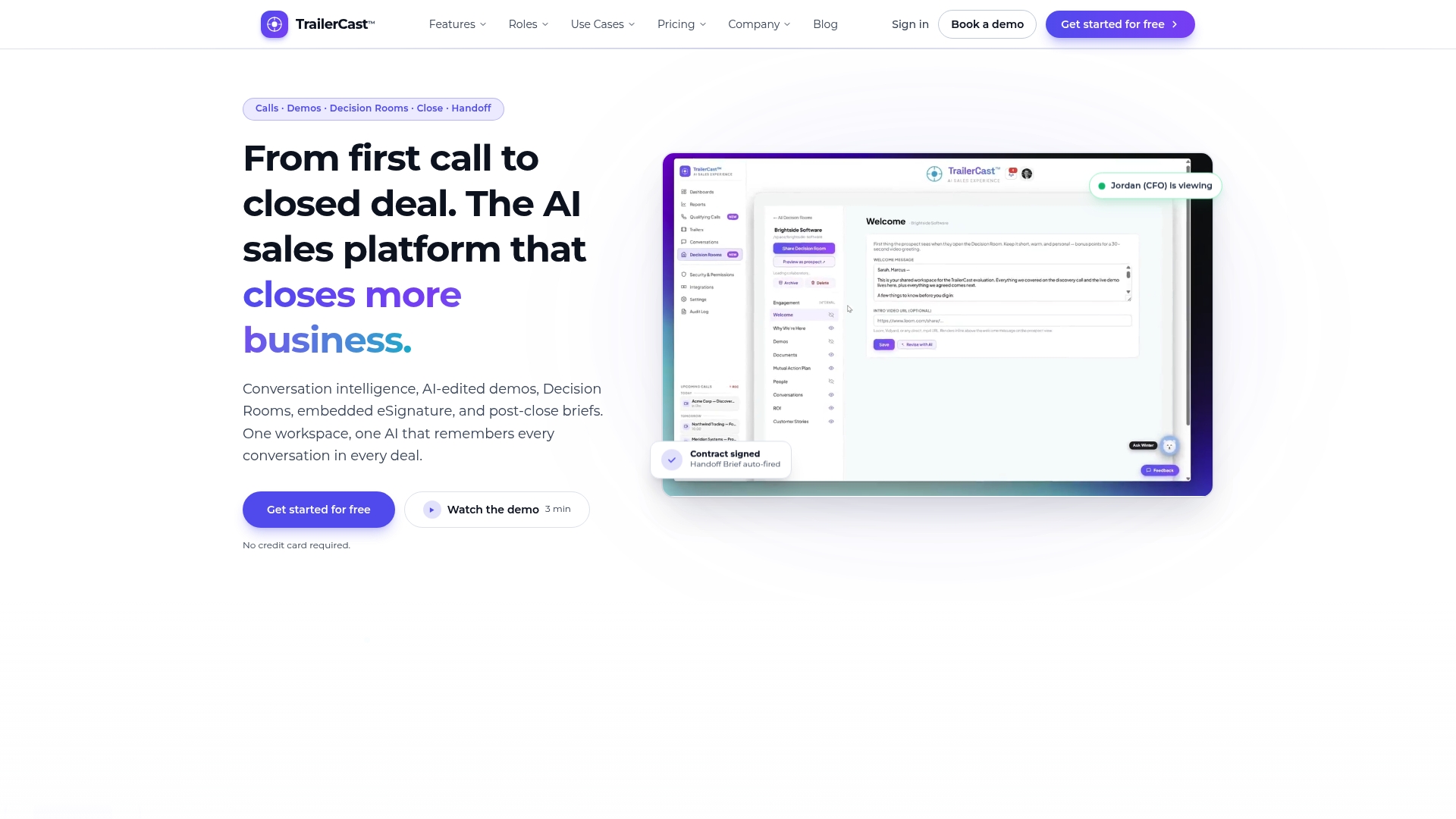
If your sales team records calls across multiple states, the compliance question is not whether to announce. It is whether your platform makes announcing the default. Trailercast’s conversation intelligence layer joins Zoom, Meet, and Teams calls with calendar-based auto-scheduling, transcribes speaker-by-speaker, and produces structured summaries and action items. Every session is logged, searchable, and tied to a deal. The platform is built to support the kind of documented, auditable recording workflow that compliance requires. See how it works.
Sources
- 18 U.S. Code § 2511
- Recording Phone Calls and Conversations Under the Law: 50-State Survey
- Recording Phone Calls and Conversations | Digital Media Law Project
- Call Recording Consent Laws by State (2026 Guide) - Viirtue
- Introduction to the Reporter’s Recording Guide
This article provides general legal information, not legal advice. Call recording laws change and vary by jurisdiction. Confirm current rules with a qualified attorney or the relevant primary statute before implementing a recording program.
This article is general information, not a substitute for advice from a qualified lawyer. Consult a qualified legal professional about your own circumstances before acting on anything here.