How to Capture Customer Quotes From Sales Calls

The best line of a discovery call usually dies in your notes. The buyer says something sharp about what the problem costs them, you scribble a paraphrase, and two weeks later you can’t say who said it, what they meant or whether you’re allowed to repeat it. To capture customer quotes that hold up, you need four things on every one: the exact words, the speaker, the context, and the permission. We built TrailerCast’s AI notetaker for this job: it joins your Zoom, Meet or Teams call, transcribes speaker by speaker, and keeps every transcript searchable.
TL;DR
- A usable quote is verbatim, attributed to a named speaker and role, dated, and tied to the moment in the call where it was said.
- Get recording consent before the call starts. Federal law needs one party’s consent, but a number of states require everyone’s.
- Pull the three to five sentences that carry the deal within a day, while you still remember the room.
- Keep three permissions separate: recording, internal use, and external use under the customer’s name.
- Confirm the quote that matters most in writing, and never reword a quote you plan to publish.
Table of Contents
- What counts as a quote worth capturing
- Step 1: Settle consent before you record
- Step 2: Capture the words during the call
- Step 3: Pull the quotes within a day
- Step 4: Tag and store quotes so you can find them
- Step 5: Confirm the quotes that move the forecast
- Step 6: Use quotes without overstepping permission
- Step 7: Put quotes to work for the people who weren’t on the call
- Try it on your next discovery call
- Our perspective
- FAQ
- Sources
What counts as a quote worth capturing
Not every sentence deserves a record. In a multi-stakeholder B2B deal, a handful of lines do the real work later, when your champion has to re-sell your product to people who weren’t on the call. Those lines tend to fall into four buckets:
- The pain, in their words. “We re-key every renewal by hand and miss about one in ten.”
- The number. A cost, a volume, a deadline, a headcount.
- The consequence. What happens if nothing changes, ideally said by the person who owns the budget.
- The aspiration. What good looks like in their language, not yours.
The reason to keep their phrasing is practical. A proposal or recap that echoes the buyer’s own wording reads as theirs. A recap full of vendor language reads as a pitch, and an executive who spots it in the first paragraph stops reading. A paraphrase also drifts: “they need better reporting” is not the same as “my CFO asked me for pipeline numbers and I had to build them in a spreadsheet at midnight.” Only the second one helps you write a CFO-facing follow-up.
If you want questions that surface these lines in the first place, our guide to discovery questions for SaaS sales covers what to ask and why.
Step 1: Settle consent before you record
A quote you can’t legally have is worse than no quote. Recording rules in the U.S. are a patchwork, so this step comes first.
Under federal law, a participant can record a conversation they are part of with their own consent, which is the one-party baseline in the Wiretap Act at 18 U.S.C. § 2511(2)(d). Many states go further and require every party to agree. Reed Smith’s analysis of AI recording and transcription lists California, Connecticut, Delaware, Florida, Illinois, Maryland, Massachusetts, Michigan (unsettled), Montana, Nevada, New Hampshire, Pennsylvania and Washington as all-party consent states for remote or telephone conversations. Counts differ between guides because a few states, such as Connecticut, Nevada and Oregon, apply the rule only to some conversation types, and Worktime’s 2026 state guide recommends getting consent from everyone before recording.
Because your buyers sit in different states from you and from each other, the safe routine is to treat every call as all-party. The stakes are real: Littler’s 2026 analysis notes that wiretap statutes allow statutory damages of the greater of $10,000 or $100 per day of violation, and that courts’ broad reading of “interception” makes it possible that note-taking and summarization tools will be found to need consent. Littler’s authors suggest a layered approach: configure the tool to request consent automatically, train reps to announce recording at the top of the call, and keep signed consent where your policy calls for it.

In practice, that means a one-line opener (“I’m recording this so I can get your words down accurately. Is that okay?”) and a yes you can hear on the transcript. Our guide to call recording consent for US businesses goes deeper on the rules, and the data privacy playbook for B2B sales calls lays out how to put them into a 30/60/90 day routine. This is general information, not legal advice: for your own policy, talk to your company’s counsel.
Step 2: Capture the words during the call
Typing furiously while you try to run discovery costs you the conversation. You listen worse, the buyer notices, and your notes still miss the exact phrasing. A better split of labor:
- Let the transcript hold the verbatim record. An AI notetaker that transcribes speaker by speaker gives you the words and the attribution in one pass. That is how TrailerCast’s notetaker works on Zoom, Meet and Teams, with calendar auto-scheduling through Google or Microsoft so it shows up without you remembering to start it.
- Use your attention for the moments that matter. When a buyer says something that carries the deal, note a timestamp or a two-word flag. You are marking the spot, not transcribing it.
- Echo the line back live. “Let me make sure I have this right: you said a missed renewal costs you roughly a week of rework.” If they correct it, you have a better quote. If they agree, you have a confirmed one.
- If you can’t record, write the key sentences by hand during the call and confirm them back to the customer afterward. Handwritten quotes are weaker evidence, so label them that way in your records.
The point of the structure is that the call produces more than a summary. TrailerCast also generates structured summaries, talk-time analysis, qualification verdicts and action items from each call, so the quote sits next to the context that explains it. Our guide on how to summarize sales calls shows how to turn that raw material into something you can send.
Step 3: Pull the quotes within a day
Memory decays fast, and so does the shared understanding of what a comment meant. Block fifteen minutes after each discovery call, ideally within 24 hours, and read the transcript for the three to five sentences that carry the deal. For each one, write down:
- The exact words, in quotation marks, trimmed for length but never reworded
- The speaker’s name, title and company
- The date and the call it came from
- A pointer back to the recording or transcript moment
That last item matters more than it looks. A quote with no path back to the source can’t be checked, and the first time someone on your team asks “did they really say that?” you’ll want to play the clip rather than argue about it. Because every transcript in TrailerCast is searchable, you can find the line again by keyword weeks later, instead of rewatching an hour of recording.
Step 4: Tag and store quotes so you can find them
A pile of quotes in a doc is a graveyard. Give each entry a few fields so it can be retrieved by the question you’ll have later:
| Field | Why it earns its place | Example |
|---|---|---|
| Verbatim quote | The raw material; never paraphrased | “If we can’t show payback in two quarters, it won’t get funded.” |
| Speaker and role | Tells you whose voice this is | VP Finance, 80-person SaaS company |
| Date and source | Lets anyone verify it | Discovery call, with timestamp |
| Theme | Lets you group by topic | Budget, security, integration |
| Deal stage | Shows when the concern appears | Discovery, evaluation, procurement |
| Permission status | Says what you may do with it | Internal only; external use not yet approved |
The theme tag pays off over time. One vivid quote is an anecdote. The same phrase from several buyers is a pattern you can build messaging around, so keep a running tally beside each theme.
Inside a single deal, the same logic applies across calls. TrailerCast builds an evolving Deal Brief that spans every call in the opportunity, so a security concern raised in call two is still in view when you prep the CFO conversation in call five. That is the practical difference between capturing quotes and remembering them.
Step 5: Confirm the quotes that move the forecast
Some quotes are not marketing material. They are commitments: “If legal clears it by the 15th, we’ll sign this quarter.” A model-generated summary of that sentence is not good enough to forecast on. DailyRevOps’ playbook on AI write-backs argues that an AI-written sentence should never be the sole authority for a legal date, customer permission or financial value, and that a human reviewer should see the source evidence next to the proposed change.
Follow that rule with your own deals. When the economic buyer states a condition, put it in a recap email in their words and ask for one confirming reply. Now the forecast rests on a sentence they’ve acknowledged, not on your recollection. Our call recap email templates are built for exactly this follow-up, and the sales discovery summary templates keep the recap to four to six lines so the quote stays visible. If those commitments live in a crowded inbox, a tool for tracking high-impact email follow-ups helps you spot an unanswered confirmation before it goes stale.
Step 6: Use quotes without overstepping permission
This is where well-meaning reps get in trouble. Being allowed to record a call is not the same as being allowed to put a buyer’s words on a slide, in a proposal for their colleague, or on your website. Treat these as three separate layers, each with its own record:
- Recording consent. Covered in step 1.
- Quote permission. May you use the words as proof in sales or marketing material?
- Attribution permission. May you name the person or company?
A quote with no permission beyond recording is a research lead. It can inform your messaging, your objection handling and your internal enablement, but it should not appear externally under anyone’s name. Before it does, get consent for that specific use and have the customer approve the final wording. If you are weighing which lines are research and which are publishable, this primer on online reviews and testimonials is a good companion.
When you do publish, keep the words faithful. Per LegalClarity’s testimonial guide, cleaning up grammar, fixing typos and trimming are acceptable, but changing the meaning is not, and quotation marks signal that the words are exact. If the substance shifts, the customer approves the revised language. For testimonials, the FTC’s Endorsement Guides (16 CFR Part 255) also bar presenting an endorsement out of context or rewording it in a way that distorts the endorser’s opinion, as summarized by share.one. If the quote changes meaning, adds a claim or reaches a new audience, pause and ask again.
Sensitive details need a second look before anything is shared more widely. Pricing, security specifics and personal data should be redacted from the version that circulates, with the verbatim original kept under restricted access.
Step 7: Put quotes to work for the people who weren’t on the call
Captured quotes earn their keep in the gap between calls, when your champion walks back to colleagues. Three uses that work:
- Stakeholder-specific follow-up. Open a CFO recap with the cost line the CFO’s own team said, and a security reply with the exact concern the CISO raised.
- Success criteria in the customer’s language. Write the proposal’s goals from their quotes so they defend them as their own.
- Handoff. The customer success manager who inherits the account should hear what the buyer said, not a sanitized summary. Our customer handoff template shows how to carry that forward.
With TrailerCast, the same deal also gets AI-edited demo trailers that can be personalized per stakeholder, such as a pricing-focused one for the CFO and a security-focused one for the CISO, plus buyer-facing Decision Rooms where the material lives in one place. The quotes you captured tell you what each of those people cares about.
Try it on your next discovery call
TrailerCast is one plan with every feature, from $59 per month per seat, and it covers the notetaker, the Deal Brief, trailers, Decision Rooms, eSignature and handoff in one workspace. For quote capture, start with the AI call notetaker for discovery calls: record with consent, get a speaker-by-speaker transcript, and pull your quotes while the call is fresh. Details are on the plan page.
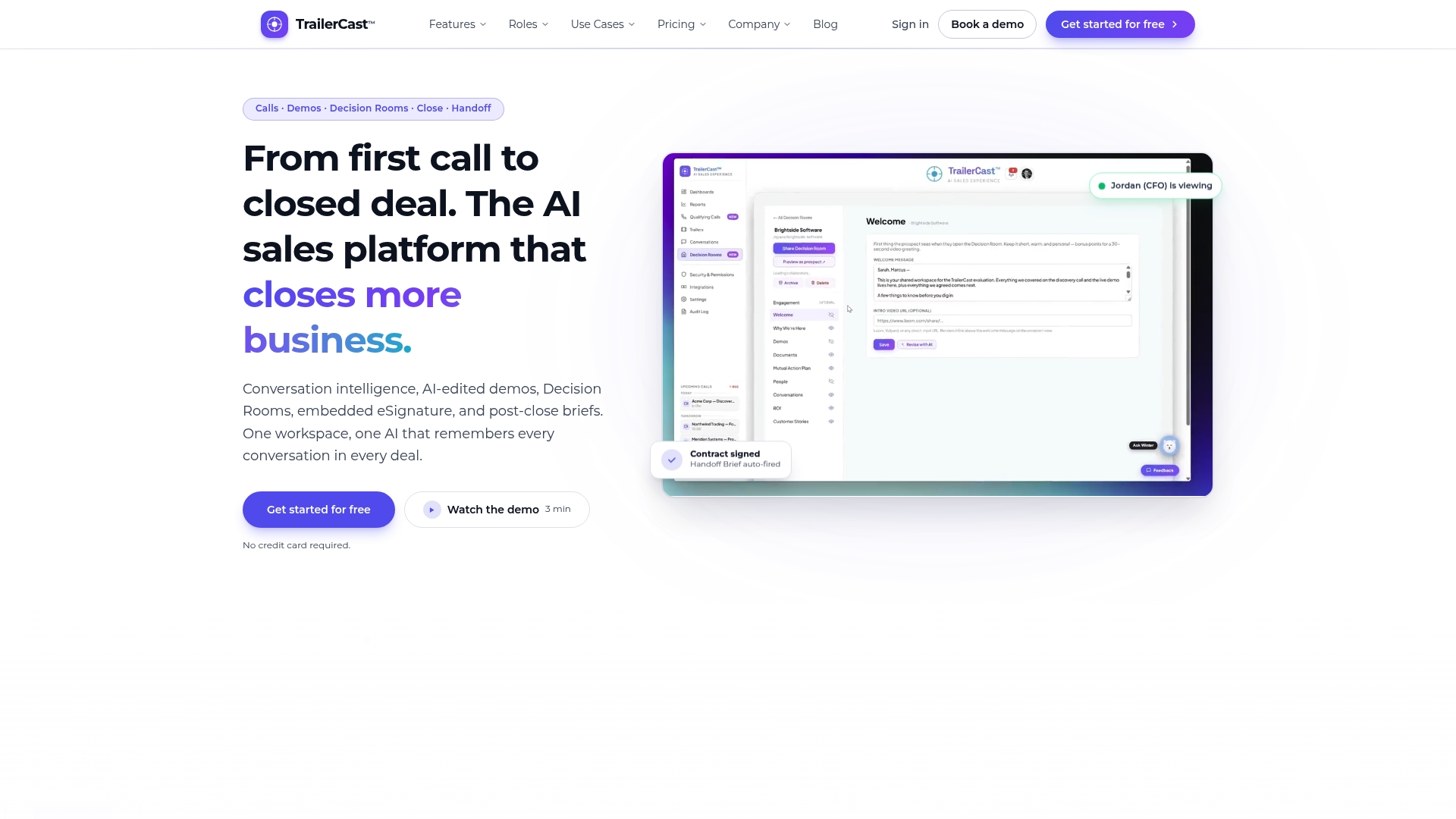
If you’re building this for a whole team, the same workspace lets everyone on a deal work from one record instead of five tools.
Our perspective
I built TrailerCast because the calls were never the problem. The space between them was. A champion leaves a great demo and walks back to a CFO who wasn’t there, with a half-remembered version of what the buyer said.
Quotes are the cheapest fix for that gap, and the most wasted asset in most pipelines. They get typed into a notes field once, never tagged, never tied to a speaker, and never seen again after the next call. A single AI that follows the whole deal changes that: it remembers what each person said, which call it came from, and what it means for the next conversation, even when you’re not in the room.
My advice is simple. Record with consent, keep their exact words, confirm what matters in writing, and ask before you publish anything. Do that and your follow-ups sound like your buyers, not like a vendor.
Daniel
FAQ
Is it legal to record a sales call to capture quotes?
Federal law allows recording when one party to the call consents, but a number of states require everyone’s consent. Because you often don’t know where each participant is, announce recording at the start of every call and get a clear yes. For your own policy, check with your company’s legal counsel.
What should I record alongside each customer quote?
The verbatim words, the speaker’s name and role, the date, the source call with a timestamp, a theme, the deal stage and a permission status. The permission field tells you whether the quote is for internal use only or approved for external use.
Can I clean up a quote before using it in a proposal or on our website?
You can fix grammar, correct typos and trim for length, as long as the meaning stays the same. If the edit changes substance, the customer needs to approve the new wording. For anything under their name or company, get their sign-off on the final text.
How soon after a call should I pull the quotes?
Within 24 hours, while the context is fresh. Read the transcript for the few sentences that carry the deal: the pain, the number, the consequence and the aspiration. Then send the most important one back to the buyer for a written confirmation.
Sources
- US Recording Laws by State (2026)
- The legality of AI-powered recording and transcription, Reed Smith
- Employee monitoring laws by state (2026), Worktime
- AI Transcription and Note-Taking Technologies: Seven Points, Littler
- Where AI CRM write-backs still need a human, DailyRevOps
- Testimonial Form Template: Fields, Consent, and FTC Rules, LegalClarity
- FTC Testimonial Guidelines 2026, share.one