Prevent Duplicate Call Logs: CRM Transcript Sync for RevOps & Eng

Yes, you can automatically sync call transcripts into your CRM. Enable native meeting sync where your CRM supports it, and fall back to a four-stage pipeline (capture, transcription, structuring, write-back) when you need more control. Either path needs webhook-driven writes, idempotent upserts, and a quick human review step before critical fields lock in. Get that right, and you get accurate activity history, searchable transcripts, and next steps that are logged, not lost.
TL;DR:
- Native CRM integrations work well for teams that need basic, standardized transcript syncing and want minimal setup with no custom extraction required.
- Custom pipelines are justified when extracting specific data points, consolidating multiple sources, or tuning AI-controlled fields beyond default transcription capabilities.
- Ensuring reliable sync requires thorough handling of webhook acknowledgment, deduplication using stable external IDs, and explicit field contracts for structured data storage.
- User trust is maintained through review steps and consent handling at call capture, with careful monitoring of correction rates and rejection metrics during rollout.
- A single, unified deal record is more effective than multiple partial integrations for maintaining comprehensive sales context and avoiding silent data breaks.
Table of Contents
- How Does CRM Call Transcript Sync Actually Work?
- Native CRM Integrations vs. Middleware: Which Fits Your Deal Flow?
- Implementation Checklist: Setting Up Transcript Sync Step by Step
- Building for Reliability: Webhooks, Deduplication, and Field Contracts
- Rolling Out Transcript Sync Without Losing Rep Trust
- Why a Single Deal Record Beats a Patchwork of Integrations
- How TrailerCast Handles Transcript Sync for You
- Key Implementation Docs and Guides to Follow
- Sources
How Does CRM Call Transcript Sync Actually Work?
Every reliable transcript sync, whether native or custom, involves several distinct jobs. Understanding where one job ends and the next begins is what lets you debug a broken sync instead of just restarting the whole integration and hoping.
Capture grabs the raw audio from Zoom, Google Meet, Microsoft Teams, or a native CRM notetaker. This stage’s only job is getting clean audio with a stable identifier attached. Transcription runs speech-to-text and diarization (splitting the audio by speaker) so you know your rep said one thing and the prospect said another. Structuring takes that raw transcript and pulls out what matters: a summary, a disposition, action items, and named entities like budget figures or competitor mentions. Write-back pushes that structured output into the right CRM fields on the right record.
A few technical decisions determine whether this pipeline holds up under real call volume:
- Diarization quality varies by audio conditions; cross-talk and poor microphones degrade speaker separation, so validate accuracy on real sales calls, not clean demo audio.
- A stable call identifier (often called a callSid or conference ID) has to persist across the transcription and structuring stages, or you’ll write the right transcript to the wrong deal.
- Named entity recognition tends to drop accuracy when it runs on machine-generated transcripts instead of clean text, according to Deepgram’s engineering guidance, so budget extra review time for fields pulled by AI extraction.
- Faster transcription models trade some accuracy for speed. If your team needs real-time coaching prompts, that trade-off matters more than it does for end-of-day summary sync.
Consent handling belongs in the capture stage, not bolted on later. If your recording tool doesn’t log consent at the moment of capture, you’re retrofitting a compliance gap after the fact.
Native CRM Integrations vs. Middleware: Which Fits Your Deal Flow?
Most teams don’t need custom infrastructure to get transcripts into their CRM. HubSpot, for example, will sync conversation transcripts either through its own notetaker or by connecting Zoom, Google Meet, or Microsoft Teams and turning on meeting sync. Once that’s live, transcripts land on the associated meeting and contact records automatically.
Native sync is the right call when:
- Your reps already live inside standard CRM workflows and don’t need custom fields beyond what the integration maps.
- You want transcripts searchable and associated to records within a short timeframe rather than a lengthy build.
- Your CRM admin, not an engineering team, owns the rollout.
Middleware or a custom pipeline earns its complexity when you need extraction the native tool doesn’t offer, when you’re consolidating call data from multiple sources into one schema, or when your vocabulary (product names, acronyms, competitor names) needs tuning that off-the-shelf transcription doesn’t handle well. Native notetakers reduce friction but often lack that deeper extraction control, a trade-off worth honestly naming before you commit either direction.
The maintenance cost is real either way. Native integrations shift with every CRM API version bump, and custom pipelines carry their own schema drift as fields get renamed or deprecated on your CRM side.
Pro Tip: Before building anything custom, map exactly which fields your reps manually type after every call. If it’s fewer than five fields, native sync probably covers you. If it’s fifteen, you’re already justifying the custom build.
Implementation Checklist: Setting Up Transcript Sync Step by Step
Here’s the order that avoids the most common setup failures:
- Enable recording and transcription in your conferencing tool or CRM settings, and confirm which user seats have permission to see transcripts once they land, since access is often tied to subscription tier.
- Connect your conferencing app (Zoom, Meet, Teams) or activate your CRM’s built-in notetaker, then run one test call to confirm transcripts actually associate with the right record.
- Design your field mapping before writing any code. Decide which CRM field holds the summary, which holds action items, and pick an external ID for idempotent upserts, one that stays stable if the call gets retried or reprocessed.
- Build webhook listeners that validate the signature on incoming events, then queue the heavy processing work in the background instead of doing it inline.
- Add a review card reps see before structured fields finalize; a one-click edit or approve step, not a full re-write.
- Simulate failure, deliberately send duplicate webhook events and force a timeout, and confirm your system doesn’t create duplicate activity records or silently drop the call.
Webhook delivery from most platforms is documented as at-least-once, meaning your endpoint will occasionally receive the same event twice. Deepgram’s integration guide recommends acknowledging receipt fast (a 200 or 202 response) and doing enrichment work asynchronously, which is exactly what step four above is protecting against.
Skipping step six is the single most common reason teams end up with three duplicate call logs on one deal and a rep who stops trusting the sync entirely.
Building for Reliability: Webhooks, Deduplication, and Field Contracts
Reliability isn’t a nice-to-have layer you add later. It’s the difference between a sync reps trust and one they quietly stop checking.
Start with the webhook itself. Acknowledge receipt within a second or two with a 200 or 202 response, then hand the actual processing to a background queue. A Platform Event pattern (or an equivalent lightweight async trigger) lets you confirm receipt without blocking on the slow work of transcription lookup and structuring.
Deduplication depends on treating your external ID as the source of truth. When a webhook fires twice for the same call, an upsert keyed on that ID overwrites instead of duplicating. A short-lived cache of processed event IDs (Redis with a time-to-live is common) catches retries before they even reach your write logic, per Deepgram’s build-the-pipeline framework.
Field contracts matter more than most teams plan for upfront. Decide explicitly: does the raw transcript go into a CRM notes field, or does only the AI-generated summary land there, with the full transcript stored elsewhere? Dumping full transcripts into CRM text fields tends to slow searches and bloat records without adding usable structure. Store the confidence score alongside any AI-extracted field, so reps and managers know when to double-check a number the model pulled from a noisy call.
- Log every retry and failed parse to a visible error queue, not a silent log file nobody checks.
- Alert on repeated mapping misses, since a spike usually means a schema change upstream, not a one-off bad call.
Pro Tip: If your error queue is empty every single day, you’re probably not catching failures, not achieving perfect sync. Build a test webhook that intentionally fails once a week to confirm your alerts still fire.
Rolling Out Transcript Sync Without Losing Rep Trust
Automation that overwrites a rep’s CRM notes without asking wears out trust fast. A lightweight review card, one click to approve or edit before a summary or disposition finalizes, solves most of that friction, and HubSpot’s own guidance on rollout backs the same approach: start with read-only summaries and searchability, then phase in auto-filled fields once accuracy earns confidence.
Handle privacy deliberately, not as an afterthought: capture consent at recording time, set a clear retention window, and store raw transcripts outside the CRM when only the structured summary needs to live on the record.
Pilot with one team first. Track:
| Metric | What it tells you |
|---|---|
| Correction rate | How often reps edit AI-filled fields before approving |
| Time to next action | Whether logged action items actually get worked faster |
| Manual notes reduced | Whether reps stop typing summaries by hand |
| Rep satisfaction | Whether the review card feels helpful or like a chore |
Iterate your transcription vocabulary based on what gets corrected most. That’s your real signal, more useful than any dashboard.
Why a Single Deal Record Beats a Patchwork of Integrations
Sales cycles with multi-stakeholder buying committees don’t fail because a transcript went missing. They fail because the transcript, the summary, and the deal context live in three different tools nobody checks together. Consolidating capture, structuring, and write-back into one workspace means the CFO objection from call three is still visible when you’re drafting the proposal in week six.
Best-of-breed integrations give you more flexibility per component, but they also mean more integration points that can silently break. A unified platform trades some of that flexibility for one system that already understands the whole deal, not just the last call.
— Daniel
How TrailerCast Handles Transcript Sync for You
TrailerCast follows the same pipeline this article just walked through, minus the part where you have to build it. An AI notetaker joins Zoom, Meet, and Teams, transcribes speaker by speaker, and produces structured summaries, qualification verdicts, and action items automatically. That structured output feeds a Deal Brief that follows the opportunity across every call, not just the one you happened to be on.
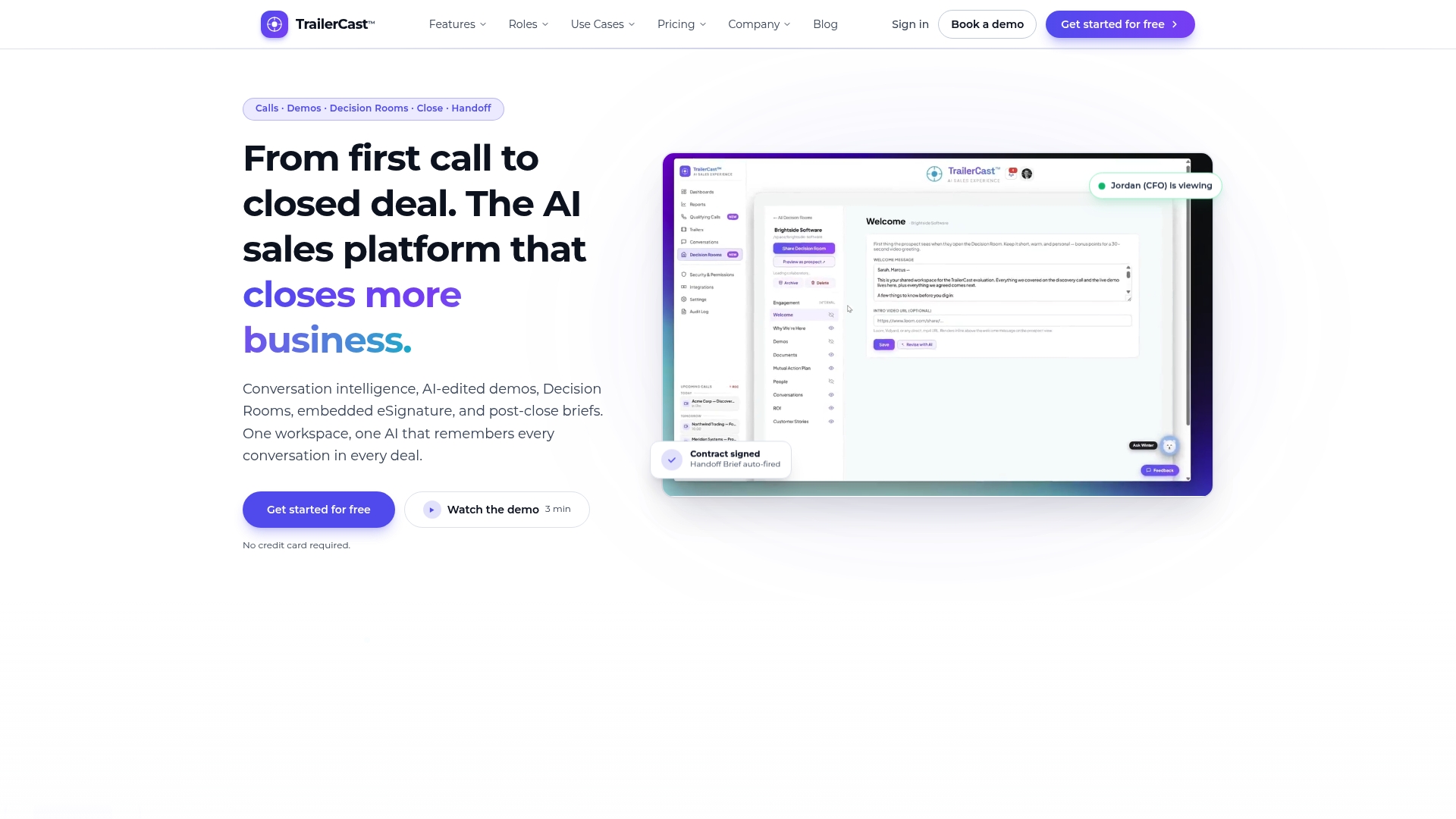
Where a custom pipeline asks you to design field contracts, dedup caches, and review cards from scratch, TrailerCast ships that structure already built, along with AI-edited demo trailers and buyer-facing decision rooms that keep the whole buying committee working from the same context between calls. Every feature sits on one tier: $79 per seat monthly, or $59 billed annually, with a free trial and no credit card required.
If you’re weighing a native sync against a custom build, Trailercast and see how the full deal lifecycle, from first call to closed deal, looks inside one workspace instead of five.
Key Implementation Docs and Guides to Follow
HubSpot’s meeting sync setup, Deepgram’s four-stage pipeline guide, and Microsoft’s real-time transcription tutorial cover setup, architecture, and custom capture in more technical depth. For broader follow-up cadence planning beyond transcript sync itself, this sales follow-up workflow guide is worth a read.
Sources
- Sync conversation transcripts into HubSpot
- Voice AI APIs for CRM integration: Build the pipeline
- Real-time transcription tutorial (Azure Communication Services)