Multi-Threading Sales: Win More B2B Deals in 2026

Multi-threading sales means building active relationships with multiple stakeholders across a buying committee at the same time, not sequentially through a single champion. If you’re still running deals through one contact, you’re not selling to the account. You’re selling to a person and hoping they can carry the whole thing internally. That rarely works.
Here’s what multithreading actually protects you from:
- Single-point-of-failure risk: Your champion leaves, gets promoted, or goes dark. The deal dies in an internal meeting you weren’t part of.
- Late-stage surprises: A CFO, CISO, or procurement lead appears in week eight with objections nobody flagged earlier.
- Stalled consensus: One enthusiastic contact can’t move budget through competing priorities alone.
The buying committee in a typical B2B deal includes multiple decision-makers, each with different priorities, evaluation criteria, and veto power. Economic buyers want ROI. Technical evaluators want integration and security. End users want something that doesn’t wreck their workflow. You need a thread with each of them, not a hope that your champion translates your pitch correctly to all of them.
Multi-threading is the execution layer that makes complex deals survivable. It’s also, frankly, the skill that separates reps who consistently close from those who stall out every time a champion goes quiet.

Why multi-threading sales wins high-value B2B deals
High-performing multi-threaded deals close 10-20% faster and win 3-7 percentage points more often than single-threaded deals. On a significant deal, this level of win-rate improvement can be the difference between hitting quota and explaining your pipeline to your VP.
Here’s why the numbers move that much:
- Parallel consensus: When multiple stakeholders are already aligned, internal approval doesn’t happen sequentially through one gatekeeper. It happens across the org at the same time.
- Fewer late objections: You’ve already addressed the CFO’s budget concern and the IT team’s security question before the final review. Nothing blindsides you.
- Deal protection through personnel changes: Job changes happen constantly. Multi-threading reduces single-point-of-failure risk when a sole champion exits or disengages by building parallel consensus across stakeholders.
- Broader internal advocacy: More people invested means more internal voices pushing the deal forward when it hits friction.
- Deeper account intelligence: Talking to five stakeholders surfaces requirements, objections, and competing priorities that one contact would never share.
“Engaging three or more contacts actively in a deal significantly increases win rates and helps uncover hidden objections early.”
Single-threading feels efficient. It’s not. It’s just comfortable. The rep who builds one strong relationship and hopes for the best is betting the deal on factors entirely outside their control.
How to map and engage multiple stakeholders in a buying committee
Stakeholder mapping is not pulling an org chart and emailing everyone with a VP title. Effective multithreading requires building a detailed buying committee map by influence and open questions before advancing deal stages, not relying on superficial org charts.
The roles you need to identify and engage:
- Economic buyer: Controls budget and final approval. Cares about ROI, strategic alignment, and risk.
- Technical evaluator: Assesses integration, security, and implementation. Cares about whether it actually works with what they already have.
- End user: Lives with the product daily. Cares about workflow disruption and ease of adoption.
- Budget holder: May differ from the economic buyer. Can slow or accelerate spend approval.
- Champion: Your internal advocate. Cares about their own credibility, so arm them well.
- Blocker: The skeptic or political opponent. Ignore them and they’ll surface at the worst moment.
For each contact, you need to know their influence level, their open questions, and what a win looks like for them personally. Titles tell you almost nothing. A director of engineering with strong executive trust carries more weight than a VP who’s been sidelined.
Engage each stakeholder with messaging tied to their specific pain point, not a generic pitch forwarded from your champion. When each person gets language tied to their role, you learn faster which issues matter and where the real objections live.
Pro Tip: Use a shared relationship map (a Google Sheet or a tool like Account Map) that tracks each stakeholder’s name, role, influence level, last engagement date, and open questions. Review it before every internal deal sync. Deals stall when this map lives only in one rep’s head.
Practical steps to implement a multi-threaded sales strategy
The biggest mistake reps make is waiting until after the first meeting to start threading. By then, the buying committee has already formed impressions without you in the room.

Start before the kickoff call. Reach out to adjacent stakeholders ahead of the first meeting to set context and build familiarity. A brief, relevant message to the IT lead or the CFO before discovery signals that you understand their world and aren’t just going through one gatekeeper.
Pair SDRs and AEs deliberately. At ZoomInfo, new sales reps start in inbound roles, then phase into outbound work paired with AEs to help work open pipeline together. That structure matters because it distributes account coverage and keeps everyone updated on contact status and engagement history through regular internal syncs.
Key execution steps:
- Use multi-channel outreach: Email, calls, LinkedIn, and voicemails together. Deals with multi-channel stakeholder engagement close faster than email-only outreach.
- Tailor by persona and seniority: Economic buyers want ROI and strategic impact. Technical evaluators want integration timelines and security compliance. End users want workflow improvements. The higher up the org chart you go, the shorter your message should be.
- Apply the Golden Path framework: A disciplined approach to deciding when and how to ask for introductions to power. Ask by name, not with vague “who else should join?” questions. That specificity cuts friction and gets you into the right rooms faster.
- Maintain weekly value touchpoints: Each active thread needs contact at least once a week. Not a check-in. Something useful: a relevant case study, a benchmark, an answer to a question they raised.
- Track thread health per contact: An active thread means the stakeholder engaged (replied, attended a meeting, clicked a shared resource) in the last 14 days. Anything older than that is a cold thread.
Pro Tip: Write a “forwardable email” for your champion. Draft it yourself, in their voice, addressed to the executive they need to loop in. Your champion forwards it with one click. You get the exec thread without going over anyone’s head, and your champion looks proactive instead of pressured.
Common challenges in multithreading and how to overcome them
Multi-threading is not hard to understand. It’s hard to execute consistently. Here’s where most reps fall apart and what to do about it:
- Inconsistent messaging across threads: If the CFO hears one value story and the IT lead hears another, the buying committee compares notes and the deal loses credibility. Consistent messaging across all threads, tailored by stakeholder role, sustains deal momentum and prevents stalls due to cold contacts. One shared narrative, different proof points per role.
- Spamming multiple contacts simultaneously: Mass threads kill accountability. One-on-one communication creates ownership. Never send a group email to five stakeholders and call it multithreading.
- Asking for introductions too early: If you push your champion to introduce you to the CFO before you’ve earned their trust, you damage the relationship and the deal. Earn the right to expand by delivering value first.
- Losing track of thread health: Without a system, threads go cold and you don’t notice until it’s too late. Use your CRM to track last engagement date per contact, and set alerts when a thread hasn’t had activity in 14 days.
- Overloading your champion: Your champion is not your personal assistant. Give them targeted, easy-to-forward materials. Not a 40-slide deck.
- Starting too late: Threading that begins at negotiation is damage control. Threading that begins at discovery is strategy. Training sales teams on role-specific messaging and multi-threading frameworks directly contributes to higher close rates and deal velocity.
The discipline required here is real. Multi-threading without a cadence and a tracking system is just noise. With both, it’s a repeatable process.
How AI tools make multi-threading manageable at scale
Managing five active threads across a seven-person buying committee, across multiple deals, is genuinely hard without technology. This is where AI earns its place in the sales stack.
AI-powered tools that transcribe calls, generate tailored summaries, and track engagement improve thread management and visibility for sales teams. Here’s what that looks like in practice:
- Real-time transcription and stakeholder mapping: Every call gets transcribed speaker-by-speaker. The AI identifies who said what, surfaces key objections, and flags which stakeholders haven’t been engaged yet.
- Role-specific summaries: Instead of one generic call recap, the AI generates a CFO-facing summary focused on ROI and a technical summary focused on integration. Your champion gets something worth forwarding.
- Engagement analytics per stakeholder: You can see which contacts opened the deal room, watched the demo trailer, and clicked the ROI doc. That tells you where interest is building and where a thread is going cold.
- Thread health alerts: When a stakeholder hasn’t engaged in 14 days, the system flags it. You re-activate before it kills the deal.
- Forwardable email drafts: AI generates draft emails written through your champion’s voice, ready to send to executives. The friction of writing them disappears.
Trailercast is built specifically for this problem. Its AI-edited demo trailers let you create a CFO-specific trailer that talks pricing and a CISO-specific trailer that talks security, both from the same demo recording. Your champion has something concrete to forward to the people who weren’t on the call, and you get attribution tracking that shows exactly who watched what and for how long.
The Decision Rooms feature gives every deal a branded, no-login workspace where the full buying committee can access discovery notes, the mutual action plan, ROI docs, and a live conversation thread. Champion forwarding is tracked as an attribution tree, so you can see who shared with whom inside the account. That’s not just useful. It’s the kind of visibility that changes how you prioritize your next move.
Why understanding decision dynamics changes everything
You can have five active threads and still lose the deal if you don’t understand how decisions actually get made inside the account. Org charts show reporting lines. They don’t show who controls budget timing, who can slow a security review, or whose opinion the CEO actually trusts.
Decision dynamics are the informal power structures that run parallel to the formal hierarchy. The VP of Sales might be your champion, but if the CFO and CTO have a standing Thursday call where they align on major purchases, you need to know that before your deal hits their agenda.
A few things to validate early:
- Who can sponsor spend vs. who can slow review? Ask direct questions about past purchases and internal sign-off paths. Don’t assume the loudest voice carries the most weight.
- Does your champion have real influence? A champion matters only when they can translate interest into internal support and budget attention. Validate that reach early by asking who they can bring in and what authority they carry.
- Where do objections travel? What the IT lead says in your call and what they say to the CFO afterward may be very different. Compare verbal enthusiasm with actual behavior: email replies, meeting attendance, doc sharing.
Recheck your read on decision dynamics every time the account adds a reviewer, revises requirements, or changes the approval order. Buying committees shift. The rep who maps once and never updates gets surprised at the finish line.
Metrics and KPIs to measure multithreading effectiveness
You can’t manage what you don’t measure. Tracking thread health and engagement metrics per stakeholder role enables proactive management and avoids stalled deals. Here are the four metrics that actually matter:
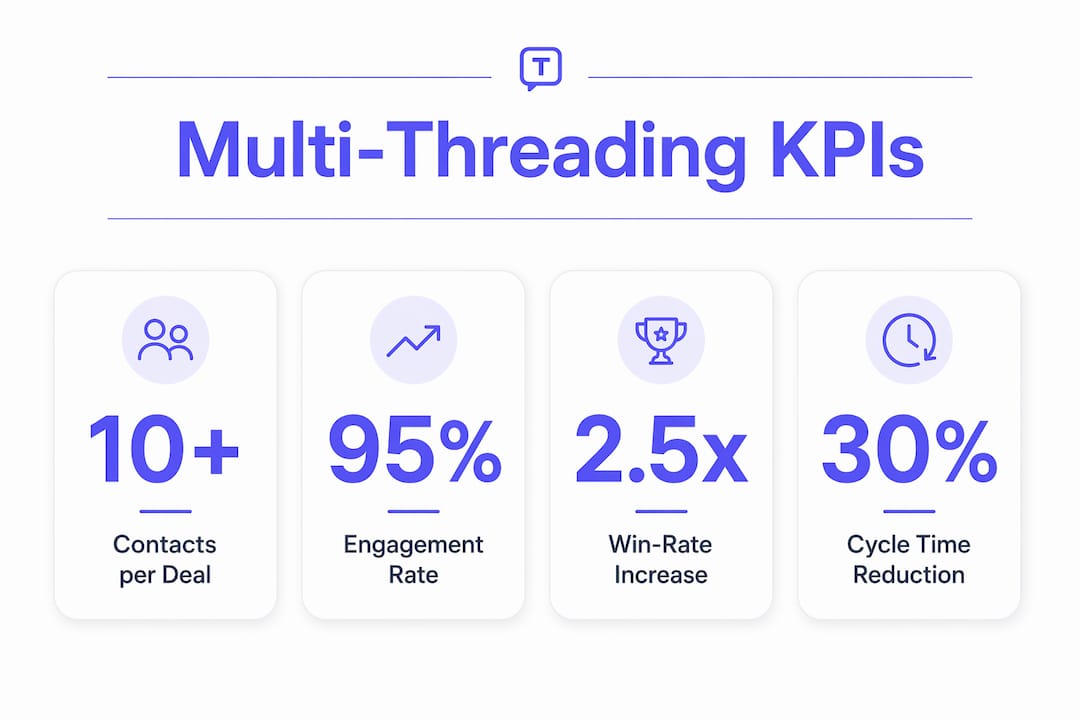
| Metric | What to track | Target |
|---|---|---|
| Contacts per deal | Total stakeholders associated with the opportunity | — |
| Engagement breadth | Contacts with bi-directional activity in the last 14 days | Majority of identified roles |
| Stakeholder coverage ratio | Buying roles with at least one engaged contact | All six core roles covered |
| Channel diversity | Channels used per contact (email, call, meeting) | Multi-channel for each thread |
Review these weekly, not monthly. A thread that’s been cold for three weeks is a deal at risk, not a deal in progress. Top reps treat this data the way a coach reviews game film: looking for patterns, adjusting the approach, and catching problems before they compound.
Win-rate delta and cycle-time delta are your lagging indicators. Maintaining consistent threading with weekly value touchpoints contributes to noticeable win-rate improvements and faster close times within weeks of adopting a disciplined multi-threaded process.
Communication strategies tailored for different stakeholder types
The same pitch sent to five people is not multithreading. It’s spam with a strategy label on it. Every stakeholder type needs a different frame, a different proof point, and a different ask.
Economic buyers (CFO, CEO, VP of Finance): Lead with business impact. ROI, cost savings, strategic alignment with current priorities. Keep messages short. Senior leaders scan. If your point takes more than five seconds to land, you’ve lost them. No-ask executive updates work well here: a brief FYI after each milestone that keeps them informed without requiring a meeting.
Technical evaluators (IT, Security, Engineering): Go deep on integration, compliance, and implementation timeline. They want to know what breaks and what doesn’t. Share technical documentation early. Answer security questions before they ask them.
End users (the people who’ll actually use the product daily): Focus on workflow. What changes for them? What gets easier? What gets harder? Their buy-in matters more than most reps realize because they’re the ones who’ll either champion adoption or quietly undermine it after the contract signs.
Champions: Arm them, don’t burden them. Give them a one-page internal business case, a forwardable email, and clear talking points for the objections they’ll face. Their credibility is on the line when they advocate for you internally.
Blockers: Don’t ignore them. Engage them directly, acknowledge their concerns, and give them a reason to move from skeptic to neutral. You rarely convert a blocker into a champion, but neutralizing them is often enough.
Mirror their internal terminology throughout. If they say “project pipeline,” you say project pipeline. If they call customers “partners,” you do too. That familiarity builds trust faster than any pitch.
Real-world scenarios where multithreading saved the deal
These patterns show up repeatedly in complex B2B sales, and they illustrate why threading early is the only reliable approach.
The champion who went dark. A rep had a strong relationship with a director of operations at a mid-market SaaS company. Three weeks before close, the director left for a new role. Because the rep had already built threads with the VP of Finance and the IT lead, the deal continued moving. The new interim contact was brought up to speed through the existing deal room, and the contract closed two weeks later. A single-threaded rep would have started over.
The late-arriving CFO. A deal was at the negotiation stage when the CFO joined the evaluation for the first time. In a single-threaded deal, that’s a restart. In a multi-threaded deal, the CFO had already received two no-ask executive updates over the prior six weeks. They knew the vendor, understood the business case, and approved the purchase in one meeting.
The technical blocker neutralized early. A security lead raised compliance concerns in week two of a deal. Because the rep had a direct thread with the IT team from discovery, those concerns were addressed with documentation before they reached the economic buyer. The deal never stalled. In a single-threaded deal, that same objection would have surfaced at the final review, after the champion had already told the CFO it was a done deal.
These aren’t edge cases. They’re what happens when you build coverage across the buying committee instead of betting everything on one relationship.
How to train your sales team on multithreading techniques
Multithreading doesn’t happen because you tell your team to do it. It happens because you build it into your process, your training, and your deal reviews.
Start with the framework, not the tactics. Reps need to understand why multithreading works before they’ll commit to the discipline it requires. Walk through the single-point-of-failure risk, the consensus-building math, and the win-rate data. Make the case before you hand them the playbook.
Build role-specific talk tracks. Every rep should have a ready script for the economic buyer, the technical evaluator, and the end user. Not a rigid script. A framework that covers the key pain points, the right proof points, and the natural ask for each persona. Training sales teams on role-specific messaging and multi-threading frameworks directly contributes to higher close rates and deal velocity.
Make threading visible in deal reviews. When you review pipeline, ask: how many active threads does this deal have? When did each stakeholder last engage? Who haven’t we talked to yet? If threading isn’t part of the deal review conversation, it won’t be part of the rep’s process.
Use call recordings as coaching material. Pull transcripts from deals where threading worked and deals where it didn’t. Show reps the specific moments where a second thread would have changed the outcome. Concrete examples land harder than abstract advice.
Pair experienced reps with newer ones on multi-threaded accounts. The SDR/AE pairing model works because it distributes coverage and forces internal communication about contact status. That structure teaches threading through practice, not just instruction.
For teams that want to go deeper, Trailercast’s AI call notetaker automatically surfaces which stakeholders were mentioned on each call, which roles haven’t been engaged, and what each contact’s key concerns were. That gives managers real coaching material without requiring manual note review. You can also check sales close rate tips that complement a multithreading approach for additional tactical depth.
How Trailercast supports your multi-threaded sales process
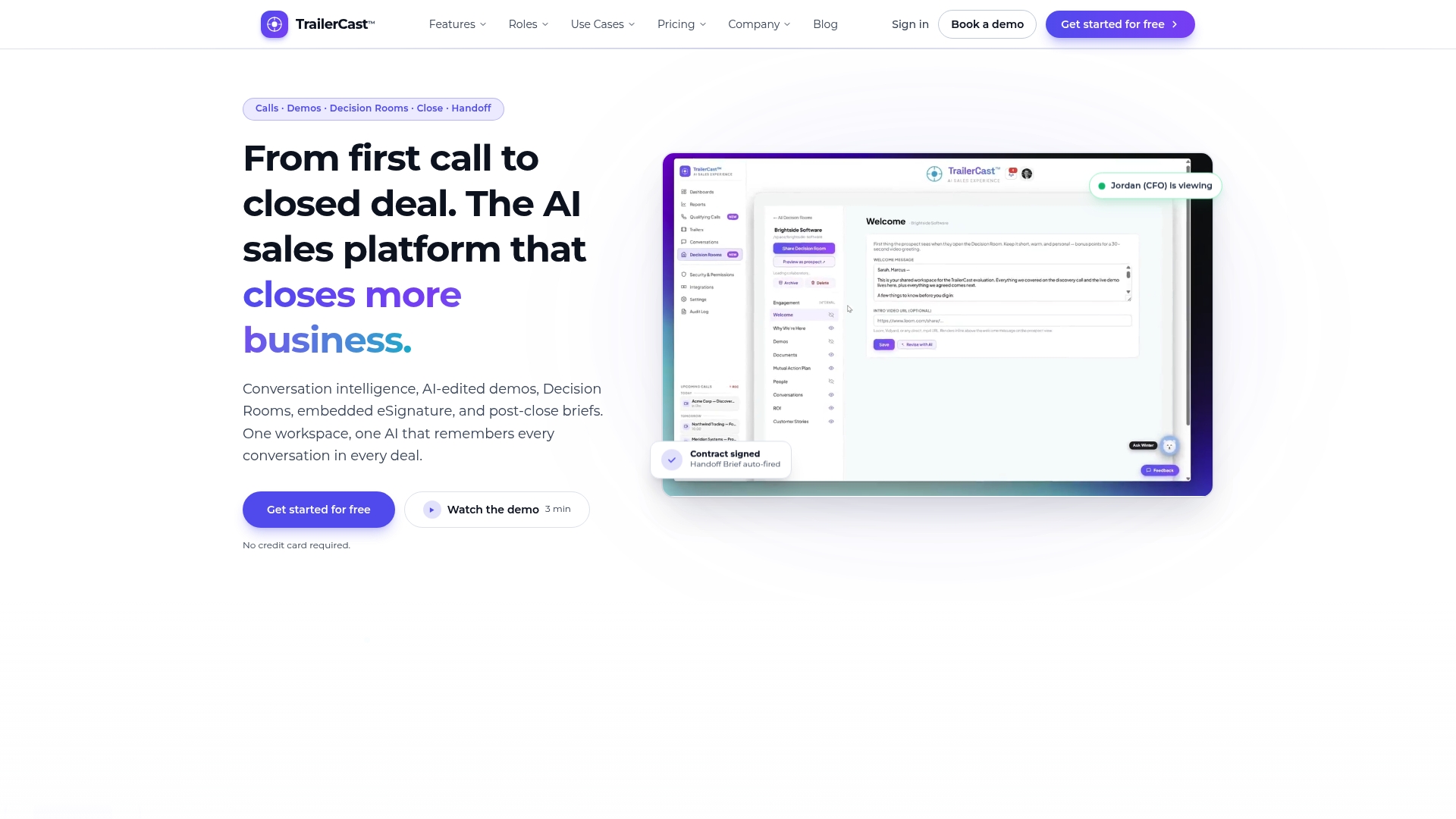
The hardest part of multithreading isn’t knowing what to do. It’s doing it consistently across every deal, every week, without dropping threads or losing context between conversations. That’s the problem Trailercast is built to solve.
Trailercast’s AI sales platform follows the entire deal lifecycle, not just the calls. Every transcript, demo, stakeholder interaction, and message lives in one workspace. The AI builds an evolving Deal Brief that spans every conversation in the opportunity, so you always know where each thread stands without piecing it together from inboxes and call notes.
The per-stakeholder demo trailers let your champion forward a CFO-specific video that talks pricing and a CISO-specific video that talks security, both cut automatically from the same demo recording. The Decision Room tracks exactly who watched what, who forwarded it, and who hasn’t engaged yet. That attribution tree is your thread health dashboard, live and updated after every interaction.
At $59/seat/month billed annually (free trial, no credit card required), it’s the consolidation play that replaces five disconnected tools with one workspace where every deal lives. Explore the full feature set and see how it fits your multi-threaded sales motion.
Key Takeaways
Multi-threading sales is the single most reliable way to protect high-value B2B deals from the personnel changes, late objections, and internal politics that kill single-threaded opportunities.
| Point | Details |
|---|---|
| Thread early, not late | Start stakeholder engagement before the first meeting; threading at negotiation is damage control. |
| — | Aim for at least three engaged contacts per deal, spanning different buying roles by mid-cycle. |
| Measure win-rate delta | High-performing multi-threaded deals close 10-20% faster and win 3-7 percentage points more often than single-threaded deals. |
| Tailor every message by role | Economic buyers need ROI framing; technical evaluators need integration details; end users need workflow clarity. |
| Track thread health weekly | A thread with no bi-directional activity in 14 days is a cold thread and a deal at risk. |